
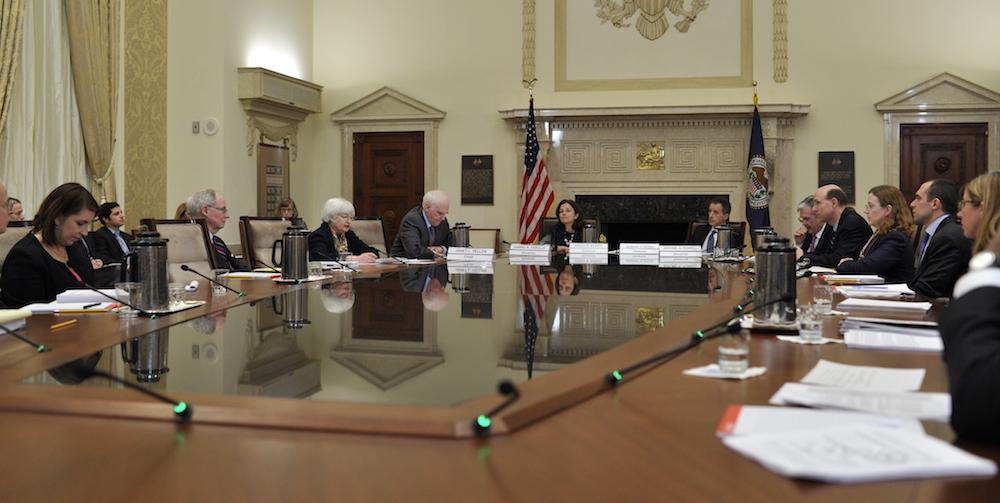
The Federal Reserve left interest rates unchanged on Wednesday, and the market barely cared about the decision. What it cared about was the vote: 9-3, with all three dissenters pushing to raise rates, not cut them, the most divided hawkish split the central bank has produced since 2016.
The bond market read it as a warning. The 30-year Treasury yield climbed to its highest level since 2007, the Dow fell more than 2%, and the rate-cut positioning that built through the spring began to unwind. For a decision that changed nothing on paper, it repriced a great deal.
The 9-3 Fed Hold and Why the Split Is the Story
The Federal Open Market Committee voted 9-3 to keep the federal funds rate in a target range of 3.50% to 3.75%, a fifth consecutive pause. The statement, in keeping with Chair Kevin Warsh’s stripped-down communication style, was brief and offered no forward guidance on the next move, as FinanceFeeds flagged it would ahead of the meeting. It described economic activity as expanding at a solid pace and inflation as still elevated relative to the 2% goal, citing energy-driven supply shocks and Middle East uncertainty.
The dissents are what make it unusual. Three officials formally voting to hike at the same meeting has not happened since September 2016. This was not a committee split between hawks and doves over whether to ease; it was a unanimous majority to hold, opposed by a bloc that wanted to tighten immediately. In a cycle where markets spent the spring pricing cuts, a three-way dissent in the hawkish direction is a signal in itself, regardless of the rate staying put.
Who Dissented, and Why
The three “no” votes came from regional Fed presidents who had been the most vocal about persistent inflation: Beth Hammack of Cleveland, Neel Kashkari of Minneapolis, and Lorie Logan of Dallas. Each preferred to raise the target range by a quarter point at this meeting.
The statement recorded their shared rationale: inflation has run above the Fed’s 2% target for more than five years, and they judged that record as requiring action now rather than later. Logan had been the most explicit in the run-up, arguing rates should be “modestly” higher. Warsh, for his part, made no attempt to paper over the divide.
“I asked for a good family fight, and I got one. That’s the purpose. That’s the design feature,” he told reporters, a reference to the deliberately contested decision-making he has said he wants. He added that the committee has “no soft or implicit inflation target” and remains focused on 2%.
The Bond Market Took the Dissents as the Signal
The clearest read on what the meeting meant came from Treasuries. The 30-year yield rose to around 5.21% to 5.23%, its highest since 2007, a level that says investors now expect rates to stay elevated well beyond this meeting. Long-dated yields move on the expected path of policy, not the current rate, so a 19-year high on a day the Fed did nothing is the market pricing the dissents as a preview.
Equities fell in step. The Dow dropped 2.19%, the S&P 500 lost 1.52%, and the Nasdaq fell 1.74%, as higher-for-longer repricing hit the rate-sensitive, long-duration names hardest. The September meeting is now live: CME FedWatch priced the odds of a hike by September at 63.4% as of 30 July, up from roughly 57% in the immediate aftermath of the decision, meaning the repricing extended overnight rather than fading.
CME FedWatch priced a 63.4% chance of higher rates by the September 16 meeting, up from about 57% immediately after the July decision, as of 30 July. Source: CME FedWatchInvestor Takeaway
The 30-year at a 19-year high is the signal that matters, since it prices the policy path rather than the unchanged Fed rate, and it says the market expects tightening to continue
Crypto Diverged, and What to Watch Into September
Crypto did not follow equities down. As of press time the day after the decision, Bitcoin traded around $64,912, up 1.59% on the day, with Ether and the broader market also higher and total crypto market cap up 1.29% to $2.19 trillion, per TradingView data.
On a session that sent long-dated yields to a 2007 high and knocked more than 2% off the Dow, crypto held and rose, a notable divergence from the risk-off move in equities and one worth watching for whether it persists or reverses as the September repricing continues. FinanceFeeds’ Bitcoin outlook tracks how the rate path feeds into that picture over a longer horizon.
That divergence is the open question rather than a settled trend. If the market keeps pricing a September hike, the higher-for-longer backdrop that pressured stocks is the same headwind that has weighed on crypto through much of 2026, and a decoupling on a single session may not hold.
The variables into September are clear: the July and August CPI reports, which the committee explicitly said it wants to see before moving, and whether the hawkish bloc grows from three to a majority. Warsh has made clear he will give markets no advance signal, which means the data and the next dissent count will have to speak for themselves.
Investor Takeaway
Crypto’s one-day divergence from equities is the thing to watch, since a sustained higher-for-longer path has historically pressured it alongside rate-sensitive stocks.