Author

admin

Browsing

President Donald Trump said he will call the final shots on a peace deal to end the conflict between Russia and Ukraine, with Ukrainian President Volodymyr Zelenskyy preparing to unveil a new peace plan when the two meet Sunday. 

‘He doesn’t have anything until I approve it,’ Trump told Politico Friday. ‘So we’ll see what he’s got.’

Zelenskyy told reporters Friday he will meet with Trump Sunday in Florida and will share a 20-point peace proposal for the president to review. 

Additionally, Zelenskyy said the meeting will likely focus on security guarantees for Ukraine, adding it was unclear if ‘territorial issues will be discussed.’

‘The 20-point plan that we worked on is 90% ready. Our task (is) to make sure that everything is 100% ready. It is not easy, and no one says that it will be 100% right away, but nevertheless we must bring the desired result closer with each such meeting, each such conversation,’ Zelenskyy told reporters Friday.

The White House did not respond to a request for comment from Fox News Digital to confirm the meeting. 

Trump voiced optimism about the meeting with Zelenskyy and future conversations with Putin. 

‘I think it’s going to go good with him. I think it’s going to go good with [Vladimir] Putin,’ Trump told Politico. Trump also said that he expects to speak with Putin ‘soon.’

Trump said in November he would not meet with Zelenskyy again — or Putin — unless a deal to end the war was in its final stages. 

Zelenskyy has indicated progress is being made and touted that he had a ‘a very good conversation’ with Jared Kushner and U.S. special envoy Steve Witkoff Thursday. Specifically, Zelenskyy said, talks focused on ending the war and efforts to ensure lasting peace in the region.

Trump has met with Zelenskyy multiple times since taking office in January, including in February when Zelenskyy sparred openly with Trump and Vance in the Oval Office over engaging in diplomacy with Russia to end the conflict. Additionally, Trump met with Putin in Alaska in August. 

Fox News’ Rachel Wolf contributed to this report. 

This post appeared first on FOX NEWS

(TheNewswire)

Vancouver, British Columbia TheNewswire – January 9th, 2025 Prismo Metals Inc. (‘Prismo’ or the ‘Company’) (CSE: PRIZ,OTC:PMOMF) (OTCQB: PMOMF) is pleased to announce that it has entered into an agreement with Infinitum Copper Corp. (TSXV: INFI) (‘Infinitum’) whereby Prismo will increase its interest in the Hot Breccia copper project, located in the heart of Arizona’s prolific copper belt, from 75% to 95%. In addition, Prismo has obtained an irrevocable option to acquire Infinitum’s remaining 5% interest, providing a clear path to 100% interest in the project.

Alain Lambert, CEO of Prismo commented: ‘The absence of a clear mechanism to secure full ownership at Hot Breccia had previously limited our ability to fund drilling and pursue potential third-party partnerships. The transaction announced today totally removes that constraint and materially improves the strategic flexibility of the project.’

He added: ‘Prismo remains firmly committed to advancing Hot Breccia. The recent extension of certain milestone obligations under the option agreement with Walnut Mines LLC (the ‘Option Agreement‘), the owner of the Hot Breccia claims, together with the deal announced today, provides the Company with additional flexibility as we evaluate a range of strategic alternatives. Each of these pathways is intended to position Prismo to commence drilling on what we consider to be one of the most compelling copper exploration opportunities in Arizona and the broader United States.

Dr. Linus Keating, manager of Walnut Mines LLC, enthusiastically commented: ‘Walnut Mines is solidly in favor of any action that moves Hot Breccia closer to a serious drill program. We are hopeful that this transaction will accomplish that goal in 2026. In our opinion, this property remains one of the best copper exploration opportunities in North America.’

Under the terms of the transaction, Prismo will pay Infinitum CA $185,000 to acquire a 20% additional interest in the Hot Breccia project and assume all of Infinitum’s remaining obligations under the Option Agreement to issue shares to Walnut, which is currently evaluated at approximately CA $54,000 through the issuance of Prismo common shares at a deemed issue price of $0.11 per share, subject to adjustments at closing. Prismo has also agreed to pay 5% of any consideration received in connection with a transaction in which Prismo assigns its interest in Hot Breccia to a third-party. The cash payment will be funded through a third party as an advance to the Company and will not utilize its working capital which is earmarked for the advancement of the Silver King project. Closing of the transaction is expected to take place on or around January 16th.

Prismos Hot Breccia project lies at the heart of the Arizona Copper Belt, which hosts several globally significant porphyry copper deposits.  Examples of these significant deposits are Freeport McMoRan’s Miami-Inspiration mining complex, BHP’s San Manuel mine, Rio Tinto and BHP’s Resolution deposit and others (see Figure 1).  

Figure 1. Location of the Hot Breccia Project in the Arizona Copper Belt.

Historical drilling carried out in the mid to late 1970s by a Rio Tinto subsidiary intersected high-grade copper mineralization at depths ranging from 640 to 830 meters below surface. Several holes targeted an area with a coincident magnetic high, believed to be caused by magnetite skarn that was cut in the drill holes and that occurs in xenoliths in cross cutting dikes exposed at the surface. Prismo believes those intercepts may represent the periphery of the upper portion of a large mineralized system.  

Support for the Companys mineralization model at the project comes from several sources, including the results of historical drilling, geophysical surveys, distribution of dikes with xenoliths of Cu-bearing skarn, the 2023 ZTEM survey as well as the results of an AI study. The anomalous target area identified in Prismos modelling measures 1,100 meters by 1,150 meters.  

Dr. Craig Gibson, Chief Exploration Officer of Prismo stated: The copper exploration target at Hot Breccia has geophysical, geochemical and geological features characteristic of many porphyry copper deposits. The project area has a regional setting similar to BHP-Rio Tinto’s Resolution copper deposit located 40 kilometers to the northwest of Hot Breccia and which is considered to be one of the greatest copper discoveries in the history of North American mining.‘  He added: The drill program is intended to drill through the entire prospective Paleozoic carbonate stratigraphy into the postulated porphyry body/breccia zone. The exploration team will take advantage of geological information provided by each hole during drilling to refine targeting of subsequent holes.

Historical drill holes cut high grade skarn mineralization including 23 meters with 0.54% Cu at 640 meters depth (hole OC-1), 18 m with 1.4% Cu and 4.65% Zn at 830 meters depth (hole OCC-7), and 7.6 m with 1.73% Cu and 0.11% Zn at 703 meters and 4.6 meters with 1.4% Cu and 0.88% Zn at 716 meters (OCC-8).  Mineralization occurs within a several hundred-meter-thick altered zone hosted in favorable Paleozoic carbonate rocks that underly a sequence of Cretaceous andesitic volcanic rocks.  These carbonates are the same rocks that host the high-grade copper mineralization at Freeports nearby Christmas mine.  The historical drilling intersected a blind mineralized intrusion associated with the skarn mineralization, providing an immediate drill target that is believed to be the source of the mineralization at Hot Breccia (Figure 2). Several magnetic highs in the region surrounding the proposed intrusion may also indicated buried skarn mineralization and provide additional exploration targets.


Click Image To View Full Size


Figure 2. Schematic cross section at Hot Breccia showing updated interpretation after Barrett (1974).

Notes:

  1. (1)Barrett, Larry Frank (1972): Igneous Intrusions and Associated Mineralization in the Saddle Mountain Mining District Pinal County, Arizona. Unpublished Master’s Thesis, University of Utah. 

  2. (2)Barrett, Larry Frank (1974): Diamond drill hole OC-1, O’Carroll Canyon, Pinal County, Arizona, unpublished internal report, Bear Creek Mining. 

About Hot Breccia

The Hot Breccia property consists of 1,420 hectares in 227 contiguous mining claims located in the world class Arizona Copper Belt between several very well understood world-class copper mines including Morenci, Ray and Resolution (Figure 1). Hot Breccia shows many features in common with these neighboring systems, most prominently a swarm of porphyry dikes and series of breccia pipes containing numerous fragments of well copper-mineralized rocks mixed with fragments of volcanic and sedimentary derived from considerable depth. Prismo performed a ZTEM survey last year that identified a very large conductive anomaly directly beneath the breccia outcrops.  

Sampling at the project has shown the presence of copper mineralization associated with dacite dikes that transported fragments of strongly mineralized carbonate rocks to the surface from depths believed to be 400-1,000 meters. Drilling deep holes is necessary to tap into the source of these mineralized fragments found at surface.

Assay results from historical drill holes are unverified as the core has been destroyed, but information has been gathered from memos, photos and drill logs that contain some, but not all, of the assay results and descriptions.  Technical information from adjacent or nearby properties does not mean nor does it imply that Prismo will obtain similar results from its own properties.

Data on previous drilling and geophysics is historical in nature and has not been verified, is not compliant with NI 43-101 standards and should not be relied upon; the Company is using the information only as a guide to aid in exploration planning.

Qualified Person

Dr. Craig Gibson, PhD., CPG., a Qualified Person as defined by NI 43-01 and Chief Exploration Officer and a director of the Company, has reviewed and approved the technical disclosure in this news release.

About Prismo Metals Inc.

Prismo (CSE: PRIZ,OTC:PMOMF) is a mining exploration company focused on advancing its Hot Breccia copper project in Arizona and its Palos Verdes silver project in Mexico.

Please follow @PrismoMetals on , , , Instagram, and

Prismo Metals Inc.

1100 – 1111 Melville St., Vancouver, British Columbia V6E 3V6  Phone: (416) 361-0737

Contact:

Alain Lambert, Chief Executive Officer alain.lambert@prismometals.com

Gordon Aldcorn, President gordon.aldcorn@prismometals.com

Cautionary Note Regarding Forward-Looking Information

This release includes certain statements and information that may constitute forward-looking information within the meaning of applicable Canadian securities laws. Forward-looking statements relate to future events or future performance and reflect the expectations or beliefs of management of the Company regarding future events. Generally, forward-looking statements and information can be identified by the use of forward-looking terminology such as intends‘ or anticipates, or variations of such words and phrases or statements that certain actions, events or results may’, could‘, should‘, would‘ or occur. This information and these statements, referred to herein as ‘forwardlooking statements’, are not historical facts, are made as of the date of this news release and include without limitation, statements regarding discussions of future plans, estimates and forecasts and statements as to management’s expectations and intentions with respect to, among other things: the timing, costs and anticipated results of drilling at Hot Breccia; the ability of Prismo to fund drilling and pursue potential third-party partnerships; the Company’s strategic flexibility with respect to the Hot Breccia project going forward; the number of shares issuable by Prismo to Walnut pursuant to the transaction described in this news release; and the Company’s expectations regarding mineralization and other qualities of the Hot Breccia project.

These forwardlooking statements involve numerous risks and uncertainties, and actual results might differ materially from results suggested in any forward-looking statements. These risks and uncertainties include, among other things: delays in obtaining or failure to obtain appropriate funding to finance the exploration program at Hot Breccia; the risk that the Company will not enter into a third-party partnership with respect to the Hot Breccia project; the risk that mineralization will not be as anticipated at the project; the risk that the Company will not be able to take advantage of geological information to refine drill targeting; metal prices; market uncertainty; and other risks and uncertainties application to exploration activities and the Company’s business as set forth in the Company’s disclosure documents available for viewing under the Company’s profile on SEDAR+ at www.sedarplus.ca.

In making the forward-looking statements in this news release, the Company has applied several material assumptions, including without limitation, that: the ability to raise capital to fund the drilling campaign at Hot Breccia and the timing of such drilling campaign; the ability of the Company to enter into a third-party partnership on the project; that the project will have the anticipated mineralization and other qualities; and the  Company will be able to take advantage of geological information to refine drill targeting.

Although management of the Company has attempted to identify important factors that could cause actual results to differ materially from those contained in forward-looking statements or forward-looking information, there may be other factors that cause results not to be as anticipated, estimated or intended. There can be no assurance that such statements will prove to be accurate, as actual results and future events could differ materially from those anticipated in such statements. Accordingly, readers should not place undue reliance on forward-looking statements and forward-looking information. Readers are cautioned that reliance on such information may not be appropriate for other purposes. The Company does not undertake to update any forward-looking statement, forward-looking information or financial out-look that are incorporated by reference herein, except in accordance with applicable securities laws. We seek safe harbor.

Copyright (c) 2026 TheNewswire – All rights reserved.

News Provided by TheNewsWire via QuoteMedia

This post appeared first on investingnews.com

President Donald Trump is taking his pressure campaign to the next level against Venezuelan President Nicolás Maduro and making it clear he doesn’t believe the strongman should be leading the country — all while China and Russia are speaking out on the escalating conflict involving their ally.

The Trump administration has launched a series of strikes targeting alleged drug boats off the coast of Latin America in recent months and announced this month a ‘complete blockade of all sanctioned oil tankers going into and out of Venezuela’ as his administration has significantly beefed up its naval assets in the region. 

While the Trump administration has said that these efforts align with the administration’s effort to curb the influx of drugs into the U.S., the campaign also appears geared toward removing Maduro from power. This isn’t the first attempt by Trump to squeeze out Maduro. He previously imposed sanctions on Venezuela and backed opposition leader Juan Guaidó during his first term. 

As a result, Trump said Monday that Washington’s pressure campaign against Venezuela would ‘probably’ be sufficient to coerce Maduro to step down and made it clear he believes that’s something Maduro should be doing.

‘That’s up to him, what he wants to do,’ Trump said Monday. ‘I think it would be smart for him to do that. But, again, we’re going to find out.’

The White House has historically refused to comment on whether it is pursuing regime change in Venezuela even though it does not recognize Maduro as a legitimate head of state and insists he is the leader of a drug cartel. 

China and Russia are speaking out about U.S. actions in the region, accusing the U.S. of breaking international law after the U.S. seized multiple oil tankers off the coast of Venezuela. The first seizure occurred Dec. 10, and Trump confirmed Monday that the U.S. is still pursuing another oil tanker that a U.S. official told Fox News Digital is a ‘sanctioned dark fleet vessel that is part of Venezuela’s illegal sanctions evasion.’

‘The U.S. practice of arbitrarily seizing other countries’ vessels grossly violates international law,’ Chinese Foreign Ministry spokesman Lin Jian told reporters Monday. Jian said Beijing opposes anything that ‘infringes upon other countries’ sovereignty and security, and all acts of unilateralism or bullying.’

Meanwhile, Russia’s Foreign Ministry said Foreign Minister Sergey Lavrov and Venezuela’s Minister of Foreign Affairs Yván Gil spoke over the phone Monday, and the ‘Russian side reaffirmed its all-out support and solidarity with the leaders and people of Venezuela in the current context.’ 

‘The ministers expressed grave concern in connection with Washington stepping up its escalation actions in the Caribbean, actions fraught with far-reaching consequences for the region and creating a threat for international shipping,’ the statement said.

Katherine Thompson, a senior fellow in defense and foreign policy studies at the libertarian think tank the Cato Institute, previously told Fox News Digital that adversaries like Russia and China are likely perplexed as to why the Trump administration has zeroed in on the Maduro regime. That’s because Caracas doesn’t jeopardize U.S. interests as much as other actors, in addition to the Trump administration’s ‘American First’ mantra, Thompson said. 

‘I imagine, for them, it’s probably a bit puzzling if they’re looking at it through a real, brass tacks, realist lens why this administration would be prioritizing ousting the Maduro regime as opposed to conflicts in other theaters,’ Thompson said earlier in December. 

The Trump administration has conducted nearly 30 strikes in Latin American waters since September as part of its hard-line approach to crack down on the influx of drugs into the U.S. 

For example, the Trump administration designated drug cartel groups like Tren de Aragua, Sinaloa and others as foreign terrorist organizations and bolstered its naval assets in the region in recent months, including signing off on the unprecedented step of sending the aircraft carrier USS Gerald R. Ford to the region.

In addition to the strikes against alleged drug vessels, Trump has suggested for months that strikes on land could be the next step.

‘We’re knocking out drug boats right now at a level that we haven’t seen,’ Trump said Dec. 3. ‘Very soon we’re going to start doing it on land too.’

Although the Trump administration has said it has the authority to conduct these attacks against alleged drug boats, Democrats and some Republicans have questioned the legality of the strikes.

Senate Minority Leader Chuck Schumer, D-N.Y., and senators Tim Kaine, D-Va., Adam Schiff, D-Calif., and Rand Paul, R-Ky., introduced a war powers resolution this month to bar Trump from using U.S. armed forces to engage in hostilities within or against Venezuela.

Fox News’ Lucas Tomlinson contributed to this report. 

This post appeared first on FOX NEWS

This week’s market action reflected renewed caution amid evolving signals from the US Federal Reserve, with tech stocks facing pressure from shifting interest rate expectations and renewed overvaluation concerns.

Artificial intelligence (AI) heavyweight NVIDIA (NASDAQ:NVDA) announced a US$100 billion investment partnership with OpenAI on Monday (September 22), deploying at least 10 gigawatts of NVIDIA-powered data centers.

The initial US$10 billion investment will occur once the first gigawatt is operational in late 2026. OpenAI will purchase chips from NVIDIA with this investment, and NVIDIA will receive non-controlling equity in OpenAI.

The news was initially met with optimistic market sentiment, buoying NVIDIA shares and related AI-focused tech stocks.

Similarly, data center developers experienced a surge in their stock prices due to the increasing need for AI infrastructure. This was further fueled by announcements of significant expansion projects, such as the Stargate initiative. This rally hasn’t translated to ongoing price momentum at this point.

Global markets gained ahead of Fed Chair Jerome Powell’s Tuesday (September 23) remarks, in Providence, Rhode Island, during which he offered cautious guidance and dimmed hopes for near-term rate cuts.

Meanwhile, Canada’s S&P/TSX Composite Index (INDEXTSI:OSPTX) marked a milestone, breaking 30,000.

The milestone came as Bank of Canada Governor Tiff Macklem stressed the urgent need for economic reforms to counteract risks from US trade protectionism and the US dollar’s declining safe-haven status.

A more cautious tone emerged midweek, with analysts and investors weighing potential risks around the scale of the deal, including concerns about circular financing and renewed questions about market concentration.

Oracle’s (NYSE:ORCL) issuance of US$18 billion in public debt to expand its AI data center operations fueled concerns about escalating leverage risks. Meanwhile, at the macro leve, factors such as stronger-than-expected US unemployment numbers, and geopolitical tension after US President Donald Trump’s contentious remarks at the UN General Assembly, contributed to a market pause. Major US indexes marked their third straight day of losses on Thursday (September 25), with the tech sector bearing much of the brunt.

Nasdaq-100 performance, September 19 to 26, 2025.

Chart via Nasdaq.

The market rebounded slightly on Friday (September 26) as the latest US personal consumption expenditures index data aligned with expectations, giving investors relief and a sense of continued stability.

The Nasdaq-100 (INDEXNASDAQ:NDX) and S&P 500 (INDEXSP:.INX) posted modest losses for the week, reflecting a wait-and-see mood heading into the fourth quarter.

3 stocks that moved markets this week

Apple (NASDAQ:AAPL)

  • Share price performance: Shares of Apple have risen 11.45 percent since September 12 pre-orders, positively impacted by strong iPhone 17 sales exceeding expectations.

    Intel (NASDAQ:INTC)

    • Share price performance: Shares of Intel rose 19.65 percent this week as the legacy tech company continued to strengthen its market position.

      GlobalFoundries (NASDAQ:GFS)

        • News highlights: The US said it is planning to implement a 1:1 chip production rule to reduce reliance on overseas semiconductor supply. Under this proposal, chip manufacturers would be required to produce domestically as many semiconductors as their customers import from foreign suppliers. Companies failing to maintain this 1:1 domestic-to-import production ratio over time may face tariffs.

        Apple, Global Foundries and Intel performance, September 23 to 26, 2025.

        Chart via Google Finance.

        ETF performance

        Gains across AI-focused exchange-traded funds (ETFs) this week reflected ongoing investor optimism for AI innovation and infrastructure buildup. The VanEck Semiconductor ETF (NASDAQ:SMH) led the pack with a 1.74 percent increase, followed by the Invesco PHLX Semiconductor ETF (NASDAQ:SOXQ), which gained 0.85 percent, and the iShares Semiconductor ETF (NASDAQ:SOXX), which advanced by 0.82 percent.

        Other market news

                      Tech news to watch next week

                      • TikTok deal developments: Watch for updates on ongoing TikTok negotiations, as regulatory and geopolitical scrutiny persists. Any breakthroughs or setbacks could have significant implications for global tech and social media landscapes.
                        • Fermi America IPO: Fermi America, the data center developer founded by former Energy Secretary Rick Perry, prepares for a Nasdaq IPO targeting a valuation near US$13 billion on October 1. The outcome and investor reception to this IPO will serve as a bellwether for the AI infrastructure sector and data center buildout investment appetite.

                        Securities Disclosure: I, Meagen Seatter, hold no direct investment interest in any company mentioned in this article.

                        This post appeared first on investingnews.com

                        (TheNewswire)

                        GRANDE PRAIRIE, ALBERTA (September 26, 2025) TheNewswire – Angkor Resources Corp. (TSXV: ANK,OTC:ANKOF) (‘ANGKOR’ OR ‘THE COMPANY’) The Board of Directors, in recognition of exceptional performance and dedication, announces that they has chosen to   grant a total of 4,775,000 stock options to acquire the same number of common shares of the Company to Directors, Officers and consultants at a price of $0.255 per share, Certain options issued to Consultants are subject to vesting requirements. The options were granted pursuant to the Company’s Stock Option Plan as approved by the Shareholders at the meeting in 2025 and are subject to the terms of the applicable grant agreements and the requirements of the TSX Venture Exchange. 2,600,000 of the options issued to Directors and officers expire 3 years from the date of the grant, with the remaining 2,175,000 options having a term of either 2 or 1 years subject to the optionees continuing to act as consultants of the Company.

                        Options are issued in accordance with the policies of the Company and are subject to approval of the TSX-V Exchange.

                        The Company also announces it has contracted King Tide Media LLC  to assist in an awareness campaign.  The agreement is for a one-month period for US $35,000, commencing on September 22, 2025.  King Tide, services includes digital marketing and content creation. The Company and King Tide maintain an arm’s-length relationship, and no securities will be issued as compensation for marketing services.

                        ABOUT Angkor Resources CORPORATION:

                        Angkor Resources Corp. is a public company, listed on the TSX-Venture Exchange, and is a leading resource optimizer in Cambodia working towards mineral and energy solutions across Canada and Cambodia.  The company’s mineral subsidiary, Angkor Gold Corp. in Cambodia holds two mineral exploration licenses in Cambodia and its Cambodian energy subsidiary, EnerCam Resources, is actively exploring Cambodia’s onshore Block VIII of 4200 square kilometers in the southwest quadrant of Cambodia.   Since 2022, Angkor’s Canadian subsidiary, EnerCam Exploration Ltd., has been involved in gas/carbon capture and oil and gas production in Saskatchewan, Canada.

                        CONTACT: Delayne Weeks – CEO

                        Email: info@angkorresources.com Website: angkor resources.com Telephone: +1 (780) 831-8722

                        Please follow @AngkorResources on , , , Instagram and .

                        Neither TSX Venture Exchange nor its Regulation Services Provider (as that term is defined in the policies of the TSX Venture Exchange) accepts responsibility for the adequacy or accuracy of this release.

                        Certain information set forth in this news release may contain forward-looking statements that involve substantial known and unknown risks and uncertainties. These forward-looking statements are subject to numerous risks and uncertainties, certain of which are beyond the control of the Company, including, but not limited to the potential for gold and/or other minerals at any of the Company’s properties, the prospective nature of any claims comprising the Company’s property interests, the impact of general economic conditions, industry conditions, dependence upon regulatory approvals, uncertainty of sample results, timing and results o f future exploration, and the availability of financing.  Readers are cautioned that the assumptions used in the preparation of such information, although considered reasonable at the time of preparation, may prove to be imprecise and, as such, undue reliance should not be placed on forward-looking statements.

                        Copyright (c) 2025 TheNewswire – All rights reserved.

                        News Provided by TheNewsWire via QuoteMedia

                        This post appeared first on investingnews.com

                        Precious metals are wrapping up a record-setting week once again.

                        Silver was in the spotlight, pushing past US$46 per ounce, a price not seen since 2011. At that level, it’s up about 55 percent year-to-date, a better performance than gold.

                        Still, gold’s price activity is nothing to sneeze at. The yellow metal had another record-setting week, this time getting close to US$3,800 per ounce. It continues to see support from a variety of underlying factors, but turning heads this week was the news that China is looking to boost its position in the global gold market by becoming a custodian of foreign sovereign gold reserves.

                        People familiar with the matter said that in recent months the Asian nation has been approaching central banks in ‘friendly’ countries with the aim of encouraging them to buy gold and store it in China. Experts see the move as yet another part of the de-dollarization trend.

                        If China is successful, foreign gold reserves would be held in custodian warehouses linked to the international board of the Shanghai Gold Exchange. The board was set up by the People’s Bank of China in 2014, and is where foreign entities trade gold with Chinese counterparts.

                        Also relevant for gold this week were comments from US Federal Reserve Chair Jerome Powell. During a Providence, Rhode Island, speech on Tuesday (September 23), he indicated that the central bank will take a cautious approach to interest rates after last week’s 25 basis point cut.

                        The Fed has faced ongoing calls from US President Donald Trump to make bigger cuts more quickly, and while Powell continues to resist pressure, CME Group’s (NASDAQ:CME) Fedwatch tool still shows that a reduction is highly likely at the Fed’s October meeting.

                        With gold trading at or near all-time highs, a key question for investors is whether the price has more room to run. I’ve been speaking with a variety experts about that topic, and I encourage you to go check out the interviews on our YouTube channel to hear their full thoughts.

                        For now I’ll sum up the view points I’ve been hearing most often.

                        First and foremost, the message I’ve been getting is that gold’s run is not over — US$4,000, which once sounded like a fairly distant number, is now only US$200 to US$300 away, and many market watchers see it getting there by the end of the year, if not sooner.

                        Prices beyond US$4,000 are also being talked about as attainable.

                        There is of course a caveat, and that is that nothing can go straight up, including gold. Especially now after its rapid upward momentum, the broad consensus is that a correction is all but guaranteed, and perhaps soon. Here’s how Steve Barton of In It To Win It explained it:

                        ‘I would be pretty shocked if we got up to US$4,000 and didn’t have some type of corrective move. I suppose anything’s possible — we blew through US$3,750, I didn’t expect that. So maybe it’ll go on up. But we’re getting pretty stretched here.’

                        Bullet briefing — Freeport drops, Lithium Americas spikes

                        Copper up on Freeport force majeure

                        Copper prices were on the rise this week after major miner Freeport-McMoRan (NYSE:FCX) declared force majeure at its Indonesia-based Grasberg copper-gold mine.

                        Grasberg has been offline since September 8, when around 800,000 metric tons of mud flowed into underground levels at the operation. Seven employees went missing during the incident, with two now confirmed to have died; search efforts continue for the other five.

                        Freeport has cut its copper and gold sales guidance for the third quarter of the year, and expects to defer ‘significant’ production in Q4 as well as 2026. Preliminary assessments suggest that Grasberg may not return to pre-incident operating rates until 2027.

                        The company’s share price took a dive on the back of the news.

                        Putting the impact into context, Bloomberg notes that prior to the disruption, Grasberg accounted for about 3.2 percent of copper mine supply this year, as well as 30 percent of Freeport’s copper output and 70 percent of its gold production.

                        Lithium Americas shares spike

                        On the opposite end of the spectrum, Nevada-focused Lithium Americas (TSX:LAC,NYSE:LAC) saw its share price spike over 100 percent this week after Reuters reported that the Trump administration may be gearing up to take a 10 percent equity stake in the company.

                        Lithium Americas finalized a US$2.26 billion loan from the US Department of Energy last year, but the government has been looking to renegotiate terms due to concerns about low lithium prices.

                        Lithium Americas reportedly proposed a change in the loan’s amortization schedule, with the request for an equity stake in the company coming during those discussions.

                        Reuters states that to secure its funding, Lithium Americas offered the government no-cost warrants that would equate to 5 to 10 percent of its common shares.

                        The loan is tied to the company’s Thacker Pass lithium project, which is set to open in 2028.

                        ‘President Trump supports this project. He wants it to succeed and also be fair to taxpayers. But there’s no such thing as free money,’ an anonymous White House official told the news outlet.

                        Securities Disclosure: I, Charlotte McLeod, hold no direct investment interest in any company mentioned in this article.

                        This post appeared first on investingnews.com

                        Here’s a quick recap of the crypto landscape for Friday (September 26) as of 9:00 a.m. UTC.

                        Get the latest insights on Bitcoin, Ether and altcoins, along with a round-up of key cryptocurrency market news.

                        Bitcoin and Ether price update

                        Bitcoin (BTC) was priced at US$109,743, trading 1.2 percent lower over the past 24 hours. Its lowest valuation of the day was US$108,776, while its highest was US$111,694.

                        Bitcoin price performance, September 26, 2025.

                        Chart via TradingView.

                        Bitcoin is hovering just under the US$110,000 mark, and traders on prediction platforms now see a 61 percent chance it will dip below US$100,000 before 2026, up sharply from last week’s 41 percent.

                        Position trader Bob Loukas noted that the asset is nearing its weekly cycle low five weeks after peaking, with bears retaining short-term control after Bitcoin failed to break all-time highs in mid-August. CoinDesk’s James Van Straten compared today’s setup to September 2024, when Bitcoin corrected 11 percent before rebounding into October.

                        Bitcoin dominance in the crypto market is 56.83 percent, a 1.37 percent slight rise over the week.

                        For its part, Ether (ETH) was priced at US$4,019.71, trading 1.1 percent lower over the past 24 hours and near its lowest valuation of the day, which was US$3,833.75. Its price peaked at US$4,019.71.

                        Ether is struggling with critical support levels after slipping under US$4,000, down nearly 20 percent in the last two weeks. Analysts warn that failure to reclaim momentum could send Ether tumbling toward US$2,750, with Ali Martinez highlighting US$4,841 as the key level needed to break the downtrend.

                        Pressure on Ether intensified after co-founder Jeffrey Wilcke transferred 1,500 ETH worth US$6 million to Kraken on Thursday (September 25), following previous multimillion-dollar deposits to the exchange.

                        Altcoin price update

                        • Solana (SOL) was priced at US$196.27, a decrease of 2.7 percent over the last 24 hours. Its lowest valuation of the day was US$191.28, while its highest value was US$203.50.
                        • XRP was trading for US$2.74, down by 3.6 percent over the last 24 hourse. Its highest valuation of the day was US$2.86, while its lowest was US$2.70.

                        ETF data and derivatives trends

                        Spot Bitcoin exchange-traded funds (ETFs) continued to see institutional demand this week.

                        Inflows were led by BlackRock’s iShares Bitcoin Trust (NASDAQ:IBIT), which saw net purchases of US$128.9 million and taking its total assets under management to about US$87.2 billion.

                        Other US spot BTC ETFs also saw significant inflows. The Fidelity Advantage Bitcoin ETF (TSX:FBTC) added US$29.7 million, and the ARK 21Shares Bitcoin ETF (BATS:ARKB) added US$37.7 million on the same day.

                        In total, US Bitcoin ETFs now hold roughly US$150 billion in Bitcoin, equivalent to about 1.33 million to 1.35 million coins and roughly 6 to 7 percent of Bitcoin’s total market cap.

                        Altcoin ETF momentum is also building. In mid-September, the first spot altcoin ETFs hit US markets, including the REX Osprey XRP ETF (CBOE:XRPR) and the REX Osprey DOGE ETF (CBOE:DOJE).

                        Several firms are now racing to list others, including Solana and Stellar.

                        On the derivatives side, leverage remains near record levels. CryptoQuant data shows Bitcoin futures open interest above US$220 billion in September — a historic high — suggesting heavy speculative positioning. Analysts warn that clustered stops around the current price could trigger massive liquidations if breached.

                        Ether also saw significant liquidations in this pullback, reflecting similar crowd behavior in derivatives. Perpetual funding rates for both Bitcoin and Ether remain near zero, indicating a balanced market bias between bulls and bears.

                        Next week’s crypto news to watch

                        Several major events are on the horizon.

                        Korea Blockchain Week continues in Seoul through September 28, with major exchange executives and policymakers expected to announce partnerships and regulatory updates. In Europe, the Token2049 conference in London kicks off on October 2, drawing institutional investors who may reveal ETF and custody initiatives.

                        Finally, regulatory headlines remain a wild card. The US Securities and Exchange Commission is expected to issue updates on pending applications for altcoin ETFs.

                        Today’s crypto news to know

                        Crypto’s institutional support falters as treasury buying slumps

                        Corporate crypto treasuries, once seen as a stabilizing force for Bitcoin, are sharply cutting back their purchases.

                        Data from CryptoQuant shows acquisitions plunged from 64,000 BTC in July to just 12,600 BTC in August, with September barely reaching 15,500 BTC, a 76 percent decline from early summer highs.

                        The pullback has weighed on Bitcoin, which slid nearly 6 percent in the past week amid broader liquidations across digital assets. Some treasury firms, which had previously traded at premiums to the value of their Bitcoin reserves, are now priced nearly in line with their holdings, which reflect weaker investor confidence.

                        Regulators are also probing irregular trading patterns in these stocks, raising questions about transparency in PIPE deals and the disclosure of acquisition prices.

                        BlackRock pitches covered-call Bitcoin ETF for yield hunters

                        BlackRock has filed plans for a new Bitcoin Premium Income ETF, a product designed to generate steady payouts through covered-call strategies on Bitcoin. The move follows the runaway success of the firm’s iShares Bitcoin Trust, which launched in early 2024 and has already amassed more than US$87 billion in assets.

                        Unlike the iShares Bitcoin Trust, which offers straightforward exposure, the new fund aims to appeal to investors seeking Bitcoin-linked returns without the full brunt of price swings. Analysts say the filing underscores BlackRock’s strategy to focus on Bitcoin and Ethereum while leaving smaller tokens to other issuers.

                        The iShares Bitcoin Trust alone commands roughly 60 percent of the US Bitcoin ETF market and has produced over US$218 million in annual revenue, surpassing even some of BlackRock’s flagship equity funds.

                        Curve founder targets introduces new Bitcoin yield platform

                        Curve Finance founder Michael Egorov has introduced Yield Basis, a decentralized protocol aimed at giving Bitcoin holders meaningful on-chain returns without exposure to impermanent loss.

                        Traditional lending markets offer minimal yields on Bitcoin, while automated market maker (AMM) pools have historically left users vulnerable to losing value when asset prices diverge. Yield Basis reworks the AMM model to remove this risk, debuting with three capped pools of US$1 million each to control early adoption. The project raised US$5 million earlier this year and is the first to launch on the joint Legion and Kraken community platform.

                        Egorov says the framework could eventually expand beyond Bitcoin to assets like Ethereum, commodities or even tokenized equities, potentially broadening DeFi’s appeal to more risk-averse investors.

                        Securities Disclosure: I, Giann Liguid, hold no direct investment interest in any company mentioned in this article.

                        Securities Disclosure: I, Meagen Seatter, hold no direct investment interest in any company mentioned in this article.

                        This post appeared first on investingnews.com

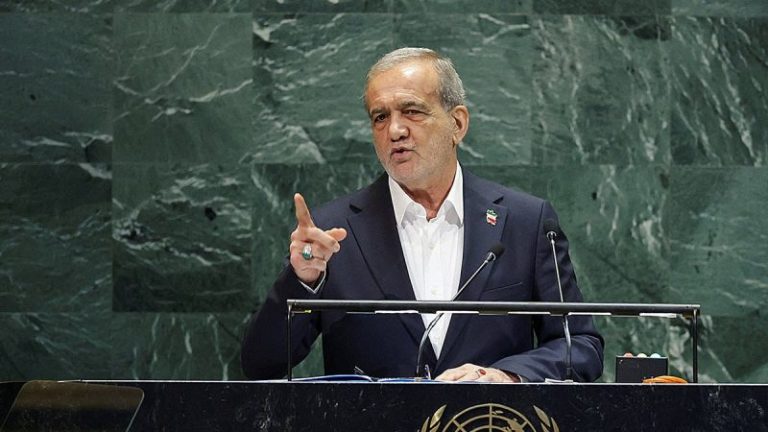
                        As Iranian President Masoud Pezeshkian delivered his first address to the United Nations General Assembly on Wednesday, accusing the United States and Israel of ‘savage aggression,’ thousands of Iranian Americans and dissidents massed outside the building to denounce what they called the hypocrisy of the UN for giving Tehran’s rulers a platform.

                        Inside the hall, Pezeshkian claimed June’s U.S. airstrikes on Iran’s nuclear facilities amounted to a ‘grave betrayal of diplomacy’ and a violation of international law. He said the attacks killed civilians, scientists and intellectuals, while insisting Iran ‘never sought weapons of mass destruction.’

                        Outside the U.N., however, the message was very different. Protesters waving Iranian flags and holding placards declared that Pezeshkian did not represent the Iranian people.

                        Mitra Samani, a former political prisoner held for four years in Tehran’s notorious Evin Prison in the early 1980s, traveled from Los Angeles to attend. ‘We are here to say that the seat in the U.N. doesn’t belong to those murderous regime agents. It belongs to the people of Iran and their representatives, and we believe that is the National Council of Resistance of Iran,’ she told Fox News Digital.

                        Samani said she has attended the rally every year for three decades. ‘I promised myself when I was released from that dungeon that I would be the voice of my friends that I lost. That’s why I’m here every year.’

                        Nasser Sharif, chair of the Iranian American Community of California, said thousands came from 40 states to participate in the protest. ‘We’re here to support the Iranian Resistance, the National Council of Resistance of Iran, and to condemn the regime for its crimes against humanity,’ Sharif told Fox News Digital.

                        He added that the movement backs the plan for a free, secular, democratic republic in Iran: ‘We are asking the U.S. administration to put more pressure on the regime and side with the Iranian people and their desire for democratic change.’

                        Alireza Jafarzadeh, deputy director of the U.S. office of the National Council of Resistance of Iran, called the rally ‘an impressive show of force.’

                        ‘Thousands of protesters supported the overthrow of the Iranian regime by the Iranian people, with no need for foreign boots on the ground or providing money and arms,’ he said.

                        Jafarzadeh also criticized the UN for giving Tehran a platform despite repeated condemnations of its human rights record. ‘It is appalling to see the world’s leading executioner play any role in any U.N. body dealing with human rights. It is like appointing a serial killer as a judge to rule on his own murders.’

                        Richard Goldberg, senior advisor at the Foundation for Defense of Democracies (FDD), said the UN’s willingness to elevate Iran reflects ‘an alternative reality.’

                        ‘The U.N. is a lot like the Netflix show ‘Stranger Things.’ You walk through the door, the characters are the same, but it’s a horrifying alternative reality where a tyrannical, women-oppressing, nuclear-weapons-pursuing regime can serve as a leader of human rights, women’s rights and nuclear nonproliferation organizations,’ Goldberg said.

                        He added that Pezeshkian arrived in New York ‘with nothing — no popular support at home and no nuclear weapons program to scare the rest of the world,’ while facing looming U.N. sanctions that could destabilize Iran’s economy.

                        Behnam Ben Taleblu, senior director of FDD’s Iran program, said the speech was ‘short but not sweet.’

                        ‘Sadly, these things have come to be expected from the U.N. when it comes to Iran. While the fact-finding mission on Iran languishes due to lack of funding and staff, the regime continues to be offered a platform to spew its invective and propaganda,’ he told Fox News Digital.

                        Taleblu highlighted the irony of Iran’s leadership roles in international organizations: ‘Can there be something more ironic than the Islamic Republic of Iran, which has long been a proliferator and seeking a nuclear weapon, being a vice president of the IAEA?’

                        He added that Pezeshkian’s remarks were overshadowed by recent comments from Supreme Leader Ayatollah Ali Khamenei. ‘While Pezeshkian and [Iranian negotiator Abbas] Araghchi were in NYC trying to stall and prevent SnapBack, Khamenei did not mince words when it came to no negotiations with America. ‘Supreme Leader’ is a title meant to be taken rather literally after all.’

                        U.S. President Donald Trump’s Middle East envoy Steve Witkoff said Wednesday that Washington was talking to Iran and that the U.S. had a ‘desire’ to realize a permanent solution to the dispute. But Iran’s Foreign Ministry told Reuters Thursday that the U.S. saying it wanted a diplomatic solution to Iran’s nuclear program was a ‘deception.’

                        ‘America’s claim of a desire for diplomacy is nothing but deception and blatant contradiction; one cannot simultaneously bomb a country while engaging in diplomatic negotiations and speak of diplomacy,’ ministry spokesperson Esmaeil Baghaei said.

                        This post appeared first on FOX NEWS

                        Statistics Canada released its natural resource indicators report for the second quarter of 2025 on Thursday (September 25), which includes real gross domestic product (GDP), export and import data for Canadian resources.

                        According to the announcement, the real GDP for the sector decreased by 2.4 percent during the quarter, following a 1.8 percent rise in the first quarter, and outpaced the 0.4 percent decline in the broader Canadian economy.

                        Forestry saw the most significant decline, with real GDP falling by 4.9 percent; however, declines were felt throughout the sector. Real GDP of the energy sector dropped 2.5 percent, led by refined petroleum products decreasing 7.4 percent and electricity decreasing 3.5 percent. Minerals and mining decreased 1.2 percent, with primary metallic mineral products dropping the most in the category at 3.7 percent.

                        Exports declined by 6.6 percent, with forestry again registering the largest decrease at 15.5 percent, followed by energy decreasing 5.9 percent and minerals and mining dropping 4 percent. The reporting agency noted that declines coincided with increased tariffs on goods, especially steel and aluminum, entering the United States.

                        Meanwhile, imports increased by 6.6 percent during the quarter, following a 2.9 percent rise in the first quarter, and were mainly attributable to a 17.3 percent increase in mineral and mining imports, which included a 35.4 percent rise in metallic mineral products.

                        In major mining news this week, Freeport-McMoRan (NYSE:FCX) announced on Wednesday (September 24) that the closure of its Grasberg operations in Indonesia would be extended. The closure came after 800,000 metric tons of liquid materials entered its main Grasberg block cave on September 8, trapping seven workers. So far, the bodies of two workers have been recovered, and the remaining five workers are still missing.

                        Operations at two underground mines that were unaffected by the accident should restart mid-way through the fourth quarter, according to the company, but operations at the Grasberg block cave will not return to full production until at least 2027.

                        Grasberg is among the largest copper and gold mines in the world, contributing 1.7 billion pounds of copper and 1.4 million ounces of gold annually.

                        The announcement caused copper prices to surge by 5 percent in trading on Wednesday to US$4.84 per pound on the COMEX. Meanwhile, shares in Freeport tumbled by 16.95 percent to US$37.67 that day, and fell another 6 percent to US$35.46 on Thursday.

                        For more on what’s moving markets this week, check out our top market news round-up.

                        Markets and commodities react

                        Canadian equity markets were in positive territory this week by the end of trading Thursday.

                        The S&P/TSX Composite Index (INDEXTSI:OSPTX) set another new record high this week, climbing above the 30,000 mark for the first time on Tuesday before retreating to close Thursday at 29,731.98. The S&P/TSX Venture Composite Index (INDEXTSI:JX) performed even better, peaking at 929.64 Tuesday and ending the week at 920.18. For its part, the CSE Composite Index (CSE:CSECOMP) peaked on Wednesday at 168.38, but retreated to end Thursday at 163.31.

                        The gold price continued to climb this week, setting another new record, as it achieved an intraday high of US$3,788 per ounce on Tuesday. While the price retreated slightly, it was still up 1.7 percent on the week at US$3,749.21 by Thursday’s close.

                        The silver price saw more significant gains, rising 8.14 percent to set a year-to-date high of US$45.19 per ounce at 4 p.m. EST Thursday. The silver price is trading at 14 year highs and has been closing in on its record US$47.91 set in March 2011.

                        Copper had sizable gains this week on the news of the closure of Freeport’s Grasberg mine discussed above. The copper price was up 5 percent on Wednesday, but shed some gains Thursday to end the day with a weekly gain of 4.12 percent to US$4.80 per pound. The S&P Goldman Sachs Commodities Index (INDEXSP:SPGSCI) gained 1.54 percent gain to end Thursday at 558.11.

                        Top Canadian mining stocks this week

                        How did mining stocks perform against this backdrop?

                        Take a look at this week’s five best-performing Canadian mining stocks below.

                        Stocks data for this article was retrieved at 4:00 p.m. EDT on Thursday using TradingView’s stock screener. Only companies trading on the TSX, TSXV and CSE with market caps greater than C$10 million are included. Mineral companies within the non-energy minerals, energy minerals, process industry and producer manufacturing sectors were considered.

                        1. Lithium Americas (TSX:LAC)

                        Weekly gain: 126.93 percent
                        Market cap: C$2.02 billion
                        Share price: C$9.94

                        Lithium Americas is a lithium development company focused on advancing its flagship Thacker Pass project in Nevada, US, which is considered a critical component of the US’s domestic lithium supply chain.

                        The project is a 62/38 joint venture between Lithium America and General Motors (NYSE:GM), with the latter investing US$625 million in the project last year for its stake. The companies are currently working to advance Phase 1 of the project into production, targeting a capacity of 40,000 metric tons per year of battery-quality lithium carbonate. First production is expected in Q4 2027, and GM has the right to buy all Phase 1 lithium production.

                        Shares in the company surged this week following news reports on the status of a US$2.26 billion loan from the US Department of Energy (DOE). On Tuesday, Reuters reported that the White House is seeking an equity stake of up to 10 percent in Lithium Americas as it renegotiates the terms of the loan. The company had planned to make its first draw from the loan this month, according to Reuters’ sources.

                        On Wednesday, Lithium Americas noted its rising share price in a press release about the situation. The company stated it was continuing to work with the DOE and General Motors to reach a mutually agreeable resolution regarding the first draw of the loan and potential amendments, noting discussions also included the topic of ‘corresponding consideration,’ or fair compensation, for the lithium company.

                        2. Scandium Canada (TSXV:SCD)

                        Weekly gain: 75 percent
                        Market cap: C$20.09 million
                        Share price: C$0.07

                        Scandium Canada is a scandium exploration company working to advance its Crater Lake scandium project in Northern Québec, Canada. The property consists of 96 contiguous claims covering an area of 47 square kilometers. To date, the company has identified five primary zones of interest at Crater Lake.

                        An updated mineral resource estimate released on May 12 demonstrated an indicated resource of 16.3 million metric tons of ore at an average grade of 277.9 grams per metric ton (g/t) scandium oxide, plus an inferred resource of 20.9 million metric tons at 271.7 g/t. The MRE also included grades of other rare earths at the project.

                        Gains in Scandium Canada’s share price began when trading opened Tuesday, the day after Reuters reported on White House plans to source scandium oxide from Rio Tinto (ASX:RIO,NYSE:RIO,LSE:RIO), which produces scandium oxide from its facility in Québec.

                        The company’s shares continued rising throughout the week. On Wednesday, Reuters reported that the Group of Seven nations is discussing instituting rare earth price floors as a means to increase rare earth production in their countries to counter China’s dominance. The considerations follow the G7 leaders’ announcement of a critical minerals action plan in June, which aims to strengthen the Western supply of critical minerals.

                        In company news, on Thursday Scandium Canada announced an update on advancements for its proprietary aluminum-scandium alloys, which it is aiming to commercialize.

                        3. Sendero Resources (TSXV:SEND)

                        Weekly gain: 64.58 percent
                        Market cap: C$14.74 million
                        Share price: C$0.79

                        Sendero Resources is a copper and gold exploration company focused on its Peñas Negras copper-gold project located along the border between Chile and Argentina in the Vicuña mining district.

                        Vicuña is home to several significant operations, including the Josemaria and Filo del Sol copper-gold mines, which are 50/50 joint ventures between Lundin Mining (TSX:LUN) and BHP Group (ASX:BHP,NYSE:BHP,LSE:BHP).

                        Peñas Negras covers an area of 211 square kilometers in Argentina’s portion of the district and bears geological similarities to the aforementioned deposits, according to Sendero.

                        Shares in the company were up this week, but the company has not released news since July 21, when it reported granting stock options to company employees and consultants.

                        4. Tincorp Metals (TSXV:TIN)

                        Weekly gain: 58.82 percent
                        Market cap: C$14.65 million
                        Share price: C$0.27

                        Tincorp Metals is a mineral exploration company with a pair of tin assets in Bolivia, and also owns a gold project in the Yukon, Canada.

                        Its SF Tin project covers a 2 square kilometer area in the Potosí Department of West-central Bolivia. The site hosts a historical open-pit mine and was previously explored by Rio Tinto in the 1990s. Tincorp’s 2022 exploration program encountered a highlighted intercept of 0.20 percent tin, 0.94 percent zinc, 0.17 percent lead and 24.01 g/t silver over 182.6 meters.

                        The company’s Porvenir project is an 11.25 square kilometer property in Western Bolivia that hosts historical open-pit and underground mining operations. Its exploration of the site in 2023 encountered a highlighted intercept with 0.65 percent tin, 1.97 percent zinc, 4 g/t silver and 0.10 percent copper over 21.2 meters.

                        The most recent news from Tincorp came on September 17 when it announced it had closed on a non-brokered private placement for 3 million common shares for gross proceeds of C$375,000. The company said it intends to use the net proceeds for working capital requirements and corporate purposes.

                        5. Wealth Minerals (TSXV:WML)

                        Weekly gain: 58.33 percent
                        Market cap: C$56.41 million
                        Share price: C$0.19

                        Wealth Minerals is a lithium exploration and development company with several Chilean lithium brine assets. Much of its news in Q2 and Q3 has been about advancing its Kuska project in the Salar de Ollagüe. The Kuska project covers 10,500 hectares in the Antofagasta region near the Bolivian border.

                        In May, the company created the Kuska Minerals 95/5 joint venture with the Quechua Indigenous Community of Ollagüe for the Kuska project.

                        A February 2024 preliminary economic assessment (PEA) for Kuska demonstrated an indicated resource of 139,000 metric tons of contained lithium from 8 million cubic meters of brine with an average grade of 175 milligrams per liter lithium. The report also demonstrated a post-tax net present value of US$1.15 billion, with an internal rate of return of 28 percent and a payback period of 6.9 years.

                        In September 2024, the Chilean government selected the Salar de Ollagüe to be among the first group of six salars considered for production licenses. Wealth applied for a special lithium operation contract (CEOL) for Kuska, but was denied due to not meeting the criteria of 80 percent ownership of the area designated by Chile, referred to as a polygon, that contained its concessions.

                        On Tuesday, the company reported that the Chilean government has reopened applications after simplifying the process for assigning a CEOL with revised requirements. During consultation with the local Indigenous communities, the ministry agreed to exclude ‘the areas of greatest cultural interest to Indigenous communities and the populated areas that were part of the polygon.’ Wealth Minerals is now verifying it meets all conditions before reapplying.

                        The following day, Wealth announced that it had entered into a letter agreement to acquire the past-producing Andacollo Oro Gold project in Chile. The project has historic measured and indicated resources of 2.02 million ounces of gold from 130 million metric tons with a grade of 0.48 g/t.

                        According to the company, it believes the acquisition is the right choice for shareholders as it expects the drivers of the current investment interest in gold, namely worry about monetary and fiscal policies, to remain unchanged.

                        Additionally, in connection with the transaction, the company announced it was opening a non-brokered private placement for a minimum of 41.67 million shares with the intention of raising gross proceeds of C$5 million.

                        FAQs for Canadian mining stocks

                        What is the difference between the TSX and TSXV?

                        The TSX, or Toronto Stock Exchange, is used by senior companies with larger market caps, and the TSXV, or TSX Venture Exchange, is used by smaller-cap companies. Companies listed on the TSXV can graduate to the senior exchange.

                        How many mining companies are listed on the TSX and TSXV?

                        As of May 2025, there were 1,565 companies listed on the TSXV, 910 of which were mining companies. Comparatively, the TSX was home to 1,899 companies, with 181 of those being mining companies.

                        Together, the TSX and TSXV host around 40 percent of the world’s public mining companies.

                        How much does it cost to list on the TSXV?

                        There are a variety of different fees that companies must pay to list on the TSXV, and according to the exchange, they can vary based on the transaction’s nature and complexity. The listing fee alone will most likely cost between C$10,000 to C$70,000. Accounting and auditing fees could rack up between C$25,000 and C$100,000, while legal fees are expected to be over C$75,000 and an underwriters’ commission may hit up to 12 percent.

                        The exchange lists a handful of other fees and expenses companies can expect, including but not limited to security commission and transfer agency fees, investor relations costs and director and officer liability insurance.

                        These are all just for the initial listing, of course. There are ongoing expenses once companies are trading, such as sustaining fees and additional listing fees, plus the costs associated with filing regular reports.

                        How do you trade on the TSXV?

                        Investors can trade on the TSXV the way they would trade stocks on any exchange. This means they can use a stock broker or an individual investment account to buy and sell shares of TSXV-listed companies during the exchange’s trading hours.

                        Article by Dean Belder; FAQs by Lauren Kelly.

                        Securities Disclosure: I, Dean Belder, hold no direct investment interest in any company mentioned in this article.

                        Securities Disclosure: I, Lauren Kelly, hold no direct investment interest in any company mentioned in this article.

                        This post appeared first on investingnews.com

                        An appellate court is poised to decide a case that supporters and opponents of abortion access are closely watching because the decision could put Planned Parenthood, a prolific abortion vendor, on the hook for up to $1.8 billion.

                        A full panel of judges on the U.S. Court of Appeals for the 5th Circuit heard oral arguments Thursday in the years-long case, which centers on Planned Parenthood’s use of Medicaid funds in Texas and Louisiana.

                        Jennie Bradley Lichter, president of March for Life, told Fox News Digital the ‘stakes couldn’t be higher’ and that the lawsuit could bankrupt Planned Parenthood, a nonprofit with hundreds of clinics across the country.

                        ‘Planned Parenthood is facing a repayment obligation of close to $2 billion because it continued to fill its coffers with taxpayers’ money even after two states had already disqualified it,’ Lichter said. ‘If that obligation stands, it will strike a serious — even existential — blow to Planned Parenthood’s national operations and potentially change the abortion landscape in this country forever.’

                        The case comes after Texas and Louisiana stripped Planned Parenthood affiliates of their Medicaid qualifications in response to activist David Daleiden releasing video footage showing Planned Parenthood staff discussing selling aborted fetal tissue.

                        Daleiden faced a lawsuit and prosecution for illegally recording the staff, but his footage set off a firestorm in the pro-life movement and caused it to ramp up its efforts to weaken the nonprofit.

                        Planned Parenthood, however, sued Texas and Louisiana and initially won an injunction that allowed it to keep receiving the Medicaid reimbursements. But the decision was reversed on appeal years later.

                        An anonymous litigant then brought a new lawsuit on behalf of the two states seeking to claw back the millions of dollars Planned Parenthood had collected while the injunction had been in place.

                        Court papers indicate that the potential money Planned Parenthood could now owe — reimbursement of the Medicaid dollars it collected plus various multipliers — could add up to $1.8 billion. The exact dollar amount would be determined by a jury in the lower court.

                        But Planned Parenthood and the anonymous litigant, named in court papers as ‘Alex Doe,’ are now waiting to see where the conservative 5th Circuit will land.

                        The issue before the 5th Circuit’s en banc panel is about whether Planned Parenthood had immunity when it collected the four years’ worth of Medicaid dollars. Planned Parenthood has argued it has immunity because its counsel advised it to collect the payments during the injunction period.

                        Thursday’s oral arguments came after a three-judge panel for the 5th Circuit comprising two Republican-appointed judges and one Democrat-appointed judge sided with Planned Parenthood.

                        Susan Manning, general counsel for Planned Parenthood Federation of America, blasted the Texas and Louisiana lawsuit as a ‘politically-motivated’ attempt to put the nonprofit out of business.

                        ‘This baseless case has only one goal: to shut down Planned Parenthood and deny patients access to sexual and reproductive health care,’ Manning said in a statement this year. ‘Planned Parenthood health centers are nonprofits that provide essential, high-quality health care to more than 2 million people nationwide every year.’

                        Separately, pro-life activists made progress in their mission to defund Planned Parenthood this year when Congress voted to strip the nonprofit of Medicaid funding at the federal level for a one-year period.

                        The U.S. Court of Appeals for the 1st Circuit sided against Planned Parenthood in a lawsuit over the measure.

                        This post appeared first on FOX NEWS