American Uranium (AMU:AU) has announced Lo Herma Resource Drilling Timing Confirmed
Download the PDF here.
This post appeared first on investingnews.com

American Uranium (AMU:AU) has announced Lo Herma Resource Drilling Timing Confirmed
Download the PDF here.

American Rare Earths Limited (ARR:AU) has announced COB: Repayment of Promissory Note
Download the PDF here.

YouTube said Monday it would settle a lawsuit brought by President Donald Trump for more than $24 million, adding to a growing list of settlements with tech and media companies that have amassed millions of dollars for Trump’s projects.
Trump sued after his YouTube account was banned in 2021. After the Jan. 6 riot, YouTube said content posted to Trump’s channel raised “concerns about the ongoing potential for violence.” His account was reinstated in 2023.
Monday’s settlement makes YouTube the last major tech platform to settle a lawsuit with Trump, who similarly sued Meta and Twitter for banning his accounts in the aftermath of Jan. 6. Meta, the owner of Facebook and Instagram, settled for $25 million, while Twitter, since renamed X, settled for about $10 million.
A notice of settlement for Trump’s lawsuit against YouTube details that $22 million of it will go toward building a new White House ballroom. Trump has touted that the addition will have room for 900 people, and the White House has said it could cost $200 million to build.
Other plaintiffs that joined Trump’s suit, such as the American Conservative Union and a number of other people, will get $2.5 million of the settlement.
In addition to tech companies, many major media outlets have settled lawsuits with Trump over the past year.
In July, Paramount Global settled with him for $16 million after he took issue with a “60 Minutes” interview with Kamala Harris that aired on CBS.
In December, Disney settled with Trump over a lawsuit in which he accused ABC and anchor George Stephanopoulos of defamation in an interview with Rep. Nancy Mace, R-S.C. Disney paid Trump’s future presidential library $15 million as part of the settlement.
Disney came under pressure from the administration again when it recently suspended “Jimmy Kimmel Live!” for nearly a week after two major station owners threatened to stop airing the show. One of the station owners, Nexstar, is seeking clearance from Trump’s Federal Communications Commission chairman for a $6.2 billion merger.
The other station owner, Sinclair, is reportedly considering a merger, which the FCC would also need to approve.
Trump is also suing The Wall Street Journal over its reporting about his friendship with Jeffrey Epstein, and he recently sued The New York Times for $15 billion. A judge struck down that lawsuit, though Trump could refile it.

Rejecting reports of a split with the brass, the Department of War says the National Defense Strategy was ‘seamlessly coordinated’ with senior civilian and uniform leaders — and that ‘any narrative to the contrary is false.’
On Monday, The Washington Post reported that multiple senior officers had raised concerns about the forthcoming strategy, pointing to a divide between political leadership.
Deputy Secretary of War Steve Feinberg pushed back on Wednesday, in an on-the-record statement to Fox News Digital.
‘The Department’s National Defense Strategy has been seamlessly coordinated with all senior civilian and military leadership with total collaboration — any narrative to the contrary is false,’ Feinberg said.
A senior War Department official said the strategy was the product of ‘extensive and intensive’ collaboration across the department.
The drafting team included a policy lead, a Joint Staff deputy and representatives from the military services who consulted widely with civilian and uniformed offices.
Under Secretary of War for Policy Elbridge Colby and the acting deputy under-secretary for policy, Austin Dahmer, met with leaders from every group. The official called that level of policy-shop engagement ‘unprecedented.’
Air Force Gen. Dan Caine, who chairs the Joint Chiefs of Staff, provided feedback directly to Secretary of War Pete Hegseth and Colby, the official said, and both assured him his input would be reflected in the final draft.
The Post report said political appointees in the Pentagon policy office led the drafting and described unusually sharp pushback from some commanders over priorities and tone.
The War Department disputes that characterization and says the document was coordinated at the principal level and aligned closely with the National Security Strategy.
The pushback comes a day after Hegseth addressed hundreds of commanders at Marine Corps Base Quantico.
In a 45-minute speech, he argued the force needs tougher standards and a tighter focus on warfighting. He has recalled one-star and above officers from around the world to brief in person and has removed several senior general officers as part of a broader overhaul.
Hegseth says new directives will restore rigorous physical, grooming and leadership standards and require combat roles to meet one set of physical benchmarks.
The Washington Post did not immediately respond to Fox News Digital’s request for comment.
Fox News Digital’s Jasmine Baehr and Morgan Phillips contributed to this report.
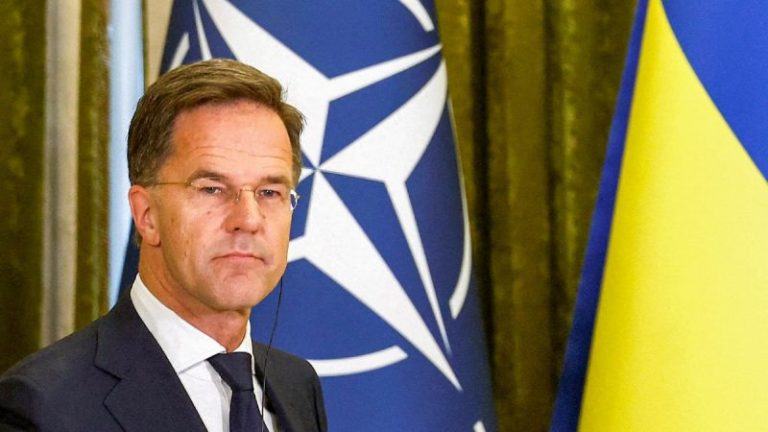
Recent Russian incursions into NATO airspace have sharpened divisions inside the alliance over how to respond, exposing both the strength and the limits of collective defense.
Secretary General Mark Rutte clashed with Estonian Prime Minister Kristen Michal last week after Estonia invoked NATO’s Article 4 clause, which triggers consultations when a member feels its security is threatened.
According to three European officials granted anonymity to speak freely, Rutte argued that repeated invocations risked diluting the treaty’s force. One source said he even raised his voice at Michal, warning that NATO must be cautious about how often it signals alarm.
Rutte argued that if Article 4 were invoked every time Russia violated sovereignty — through drone incursions, fighter jets, cyberattacks and more — it would quickly lose impact, according to the officials.
A NATO spokesperson confirmed Rutte and Michal spoke Friday and said the secretary general ‘has supported Estonia throughout the process.’
Rasmus Ruuda, director of the Government Communication Office of Estonia, told Fox News Digital Rutte ‘expressed support for Estonia and the Prime Minister thanked NATO for its actions.’
‘Article 4 is just a signal that we’re taking note of what happened,’ said Giedrimas Jeglinskas, a Lithuanian member of parliament and former NATO assistant secretary general. ‘We can be invoking Article 4 every week, and I think that only weakens us, because we’re unable to truly respond to that aggression that Russia is sort of throwing at us.’
The tension comes after a series of provocative moves by Moscow. Last month, missile-carrying Russian MiG-29s flew into Estonian territory, following an earlier breach of Polish airspace by 19 drones and repeated incursions over Romania. In Poland, jets scrambled to intercept the drones, shooting some of them down. It marked the first time since World War II that Polish armed forces mobilized to engage an airborne threat over their homeland.
The Russian jets in Estonia were eventually escorted out of its territory by Italian F-35s. Estonia’s Article 4 request followed Poland’s own invocation days earlier, prompting another round of consultations in Brussels.
Since its creation in 1949, Article 4 has been triggered only nine times. NATO’s warning to Russia after the Estonian request was blunt: any further breaches would be met with ‘all means’ of defense. Estonia’s defense minister said his nation was prepared to shoot down Russian planes violating airspace ‘if there is a need.’
But Jeglinskas said signaling without consequence risks leaving the alliance trapped.
‘We’re happy to do Article 4 every other day, but so what? What’s next?’ he said. ‘The real question is what happens when the jets actually enter our airspace.’
The debate cuts to a deeper question: what constitutes a ‘need’ to shoot down Russian jets? How can Russia be deterred without stumbling into direct war?
‘The last thing we want is to have NATO get drawn into a war with Russia,’ a senior State Department official told Fox News Digital. ‘God knows how that ends.’
‘Almost all wars … they don’t necessarily start with a big bang,’ the official went on. ‘They start with an escalation, and then somebody feels they need to respond to this, and then you just get in a toxic spiral.’
The United States has promised to defend ‘every inch’ of NATO while pressing Europe to bear more of its own defense burden. Washington’s mixed signals have only complicated matters.
Trump administration officials long favored reducing the U.S. troop presence in Europe. But President Donald Trump recently delivered one of the starkest warnings to Moscow, declaring that NATO states should shoot Russian aircraft down if they incur on their territory.
Jeglinskas said the statement resonated across the Baltic States. ‘What was really helpful was that President Trump was very clear,’ he said. ‘That gives us confidence we’re on the right track, and we really appreciate the support.’
Still, allies remain divided on whether to escalate. Some warn that Eastern Europe cannot credibly threaten retaliation without an American security guarantee. Others argue that deterrence depends on showing Russia its incursions carry a cost.
‘If we really want to send a proper message of deterrence to Russia, we need to be prepared to use kinetic force,’ Jeglinskas said. ‘That means neutralizing those jets — shooting them down or finding other ways to impose consequences — so Russia actually feels the cost of its incursions. That hasn’t happened yet, and it leaves us vulnerable.’
The airspace disputes now extend beyond fighter jets. European Union members are meeting in Copenhagen this week to discuss shoring up air defenses after a wave of drone sightings. Denmark briefly shut down its airspace following mysterious drone activity, while Lithuania’s Vilnius airport and Norway’s Oslo airport also reported disruptions. Drones have even been spotted over Germany’s northern state of Schleswig-Holstein.
‘We are not at war, but we are no longer at peace either. We must do much more for our own security,’ German Chancellor Friedrich Merz said in Düsseldorf.
NATO jets scrambled to intercept drones over Poland, but the response underscored a growing mismatch: deploying multi-million dollar fighters to counter small, unmanned aircraft is neither efficient nor sustainable.
‘NATO remains the most crucial element of our security equation,’ Jeglinskas said. ‘It’s the backbone through which our security is viewed. There’s really no doubt about NATO’s political will and its capability to defend its territory, but warfare is changing — and the question now is, has NATO adapted to the new way of war that is seeping through the borders of Ukraine?’
Jeglinskas warned that neither NATO nor the Baltic States have done enough. ‘The Polish incursion signified that NATO is not fully ready to counter these threats,’ he said. ‘Scrambling jets is a tremendous economic mismatch. If these kinds of attacks become swarms, it’s not sustainable.’
To address mounting threats, NATO last month launched Operation Eastern Sentry, reinforcing its presence on Europe’s eastern flank. Jeglinskas welcomed the move but said gaps remain.
‘Jets are very important, but more jets don’t mean we’re more secure from low-altitude drones,’ he said. ‘The question is: do we have sensors that can detect what’s happening from the ground up to a kilometer into our airspace? We don’t see that. It’s like a dead space.’
Jeglinskas called for stronger short- and medium-range radar, as well as layered defenses akin to Israel’s Iron Dome, capable of intercepting drones with both kinetic and electronic means.
‘NATO’s response is commendable,’ he said, ‘but it’s not enough. You need technical know-how, the right capabilities, and systems that are truly integrated if you want to make this work.’
For now, NATO remains caught between signaling resolve and acting on it. As Russia continues to test the alliance’s borders, Jeglinskas and other Eastern European officials warn that credibility is at stake. The next incursion, they argue, may demand more than words.
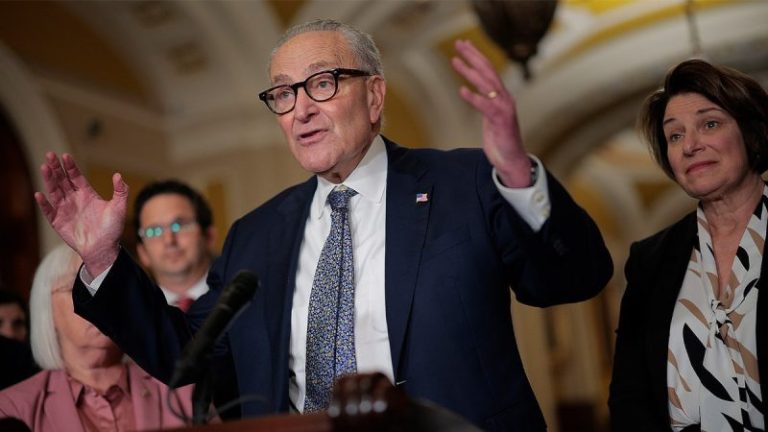
Bipartisan talks on reopening the government began to materialize less than a day into the shutdown, with Republicans and Democrats trying to find a middle ground on expiring Obamacare tax credits.
The federal government entered its first full day of a shutdown on Wednesday, and so far neither side of the aisle is willing to buckle as the hours ticked by.
Still, in the middle of Senate Republicans’ third attempt to pass the House GOP’s short-term funding extension, a group of nearly a dozen senators huddled on the floor in the first public display of negotiations so far.
‘There are glimmers of hope, and I think they’re bipartisan,’ said Sen. Richard Blumenthal, D-Conn., who was in the huddle.
The conversations on the floor came as Republicans demanded that Democrats yield and provide the votes to reopen the government, while Senate Minority Leader Chuck Schumer, D-N.Y., doubled down on his position that Democrats wouldn’t budge without ‘serious’ movement on Obamacare premium subsidies.
‘Donald Trump and Republicans have barreled us into a shutdown because they refuse to protect Americans’ healthcare,’ Schumer said. ‘It’s clear that the way out of this shutdown is to sit down and negotiate with Democrats to address the looming healthcare crisis that faces tens of millions of American families.’
Senate Majority Leader John Thune, R-S.D., appears willing to slowly chip away at Senate Democrats through a de facto war of attrition and plans to bring House Republicans’ bill to the floor for a vote again and again.
The Senate will be out on Thursday to observe Yom Kippur but is expected to return Friday and possibly vote into the weekend on the continuing resolution (CR) that would reopen the government until Nov. 21 to give lawmakers more time to finish work on the dozen spending bills needed to fund the government.
Thune told Fox News Digital that he expected to talk to Schumer ‘in the next day or two.’
‘He’s indicated that he’s interested in doing that,’ Thune said. ‘I’m not sure what we’ll achieve by that, but I think there are, I mean, things seem to be moving on their side. We just keep telling them to ‘give us — open up the government, and we’ll get on with regular business.’’
Thune and Senate Republicans have argued that Senate Democrats’ rejection of the GOP’s CR is hypocritical, given that when former President Joe Biden was in office, Schumer and his caucus routinely voted for ‘clean’ extensions — like the GOP’s current proposal.
But the issue for Democrats was multifaceted.
Sen. Tim Kaine, D-Va., was among the many lawmakers holding a confab on the Senate floor, and while he didn’t divulge full details of the private talks, he said a major issue for him was about ensuring that a ‘deal is a deal.’
‘Anything we agree to, because it’s not a clean CR if the president will tear it up tomorrow,’ he said. ‘In the past, we voted for clean CRs, but the president has shown that he’ll take the money back.’
Among the options tossed around in the huddle were a 10-day funding extension once floated by Schumer, which he quickly shot down earlier this week, or passing the Republican plan to actually give lawmakers time to negotiate a solution to the expiring tax credits.
Sen. Peter Welch, D-Vt., said there were no high-level discussions quite yet, but that any path forward had to be ‘enforceable.’
‘The bottom line here is that I sense real concern among my Republican colleagues about what happens to the people they represent if we go off the cliff on the Affordable Care Act,’ he said, referring to Obamacare.
And Sen. Mike Rounds, R-S.D., who helped facilitate the conversation, said it’d be ‘great’ if lawmakers were able to get something figured out before the Nov. 21 deadline in the GOP’s bill, but that he and other Republicans were still pushing Democrats to support their legislation.
‘It’s not like there’s anything that they should be objecting to with regard to what’s in the existing bill,’ he said. ‘This is their hostage, and we’re just telling them, ‘Look, we’ve got support on the other side to fix the issues that you have a concern about, but it’s going to take time to negotiate those through.”
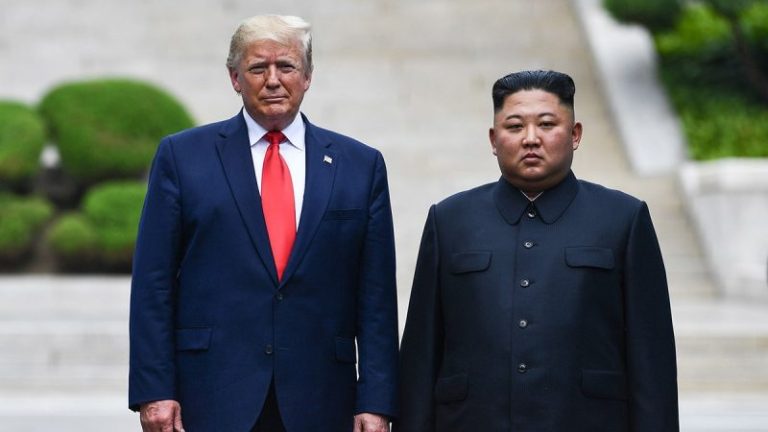
President Donald Trump is open to talks with North Korean leader Kim Jong Un ‘without any preconditions,’ a White House official said, as South Korea’s unification minister warned Pyongyang’s missiles could reach the U.S. mainland.
‘President Trump in his first term held three historic summits with North Korean Leader Kim Jong Un that stabilized the Korean Peninsula. U.S. policy on North Korea has not changed,’ a White House official told Fox News Digital. ‘President Trump remains open to talking with Kim Jong Un, without any preconditions.’
South Korean Unification Minister Chung Dong-young used blunt language in Berlin this week, telling reporters, ‘North Korea has become one of the three countries capable of attacking the U.S. mainland,’ according to the Yonhap News Agency. ‘What needs to be acknowledged should be acknowledged rationally.’
The White House did not respond to Fox News Digital’s request for comment on Chung’s claim.
Yonhap also reported that Chung said Pyongyang’s ‘strategic position is different’ than in 2018, when Trump and Kim held their first summit in Singapore.
‘Acknowledging this reality should be the starting point’ in dealing with the regime, Chung told reporters.
But experts say North Korea has long held the capability to reach the U.S. mainland with intercontinental ballistic missiles.
‘They’ve tested ICBMs for a long time,’ said Bob Peters, senior research fellow for strategic deterrence at the Heritage Foundation.
‘The question, then, for a long time, is, do they have a warhead that can go underneath a nose cone on an ICBM that goes by definition, exo atmospheric, comes down and then hits a target with some semblance of accuracy and then detonate and produce a nuclear yield,’ Peters added. ‘That’s been the real question — do they have that capability? That’s not what it sounded like the South Korean minister said.’
Meanwhile, Kim has said dialogue with the U.S. is possible, but on his terms.
‘If the United States drops the absurd obsession with denuclearizing us and accepts reality, and wants genuine peaceful coexistence, there is no reason for us not to sit down with the United States,’ state media quoted Kim as saying.
A meeting with Kim would make Trump’s fourth sit-down with the dictator, at a time when his nation has once again grown increasingly hostile to U.S. interests.
In July, the White House said Trump ‘remains open to engaging with Leader Kim to achieve a fully denuclearized North Korea.’ But North Korea asserted it would not meet the U.S. president if he was going to demand denuclearization.
On Monday, North Korean Vice Foreign Minister Kim Son Gyong told the United Nations General Assembly that his country will never give up its nuclear program, Reuters reported.
Trump is scheduled to travel to Asia later this month for an economic leaders’ summit with South Korean President Lee Jae-myung. A senior U.S. official said no Demilitarized Zone meeting with Kim is currently on the agenda.
Reports have suggested Trump may meet Chinese President Xi Jinping on the sidelines of the Asia-Pacific Economic Cooperation summit, Oct. 30-Nov. 1, though plans are still being finalized.
In a call last month, Xi invited Trump and first lady Melania Trump to visit China. Trump returned the invitation.
The same official said progress on nuclear talks depends on China.
‘The first thing that would need to happen is for the Chinese to acknowledge and be more transparent about its own programs,’ the official said.
U.S. estimates put China’s nuclear arsenal at about 600 warheads in 2024, with projections of 1,000 by 2030. North Korea is believed to possess roughly 50 warheads, with enough fissile material for up to 90.
Pyongyang last year declared an ‘irreversible hegemonic position’ after test-firing its Hwasong-19 intercontinental ballistic missile, which North Korea has claimed can strike the American mainland.
Trump is strengthening deterrence even as he keeps the option of ‘talks without preconditions’ open.

Highlights
– Given increased industry interest in DeepSolv(TM), the Company has requested the expansion & acceleration of the Rice technology program
– The expansion would include the following components:
o Testing of multiple antimony feedstocks at different processing stages, direct ore, post DMS and high-grade concentrates
o Testing of antimony feedstock from multiple sources including the Mojave Project, EV Resources and additional other 3rd party samples
– Meetings held with Professor Pulickel Ajayan, Rice Executive Vice President for Research, and Technology Transfer Office
– Dedicated project workshop with the Ajayan research team to discuss technical programs
– Locksley in discussions with an additional mining group regarding the opportunity of evaluation the DeepSolv(TM) technology
– Locksley is focused upon providing Antimony processing independence to the USA and the opportunity presented by the $1.5bn+ domestic market
During the visit, the Locksley team met with Professor Pulickel Ajayan and members of his laboratory, senior Rice administrators including the Executive Vice President for Research and the Office of Technology Transfer and representatives from Rice Public Affairs. These discussions were followed by a dedicated project workshop with the Ajayan group, providing the foundation for the joint technical program under the collaboration.
The work program, formally launched through this visit, will focus on two parallel thrusts:
1. The development of DeepSolv(TM) product, for the extraction and refining of antimony feedstocks
2. The evaluation of antimony-based materials for advanced energy storage applications
As previously announced, Locksley has secured an agreement with EV Resources for the supply of external antimony ore, which will be incorporated alongside feedstock from the Mojave Project to support the development of DeepSolv(TM). In addition, DeepSolv(TM) continues to gain industry momentum, with discussions now underway with an additional potential user for the treatment of antimony ore. Given the growing industry interest in DeepSolv(TM) the Company is actively evaluating options to expand and accelerate the Rice technology program.
Locksley views the Rice partnership as a cornerstone of its U.S. strategy, providing access to world class expertise and positioning the Company to advance both upstream and downstream opportunities in antimony and rare earths.
Locksley’s Chairman Patrick Burke, commented:
‘This visit marks an important milestone in Locksley’s mine-to-market strategy to onshore the supply of antimony and rare earths into the United States. By formally commencing our collaboration with Rice University and incorporating additional ore supply secured through our agreement with EV Resources, we have laid the foundation for a practical and accelerated testwork program. These initiatives position Locksley at the centre of developing a secure domestic supply chain, aligned with U.S. government priorities. We look forward to working closely with Professor Ajayan and his team as we move rapidly toward delivering tangible results.’
*To view images and figures, please visit:
https://abnnewswire.net/lnk/U3C84R75
About Locksley Resources Limited:
Locksley Resources Limited (ASX:LKY,OTC:LKYRF) (FRA:X5L) (OTCMKTS:LKYRF) is an ASX listed explorer focused on critical minerals in the United States of America. The Company is actively advancing exploration across two key assets: the Mojave Project in California, targeting rare earth elements (REEs) and antimony. Locksley Resources aims to generate shareholder value through strategic exploration, discovery and development in this highly prospective mineral region.
Mojave Project
Located in the Mojave Desert, California, the Mojave Project comprises over 250 claims across two contiguous prospect areas, namely, the North Block/Northeast Block and the El Campo Prospect. The North Block directly abuts claims held by MP Materials, while El Campo lies along strike of the Mountain Pass Mine and is enveloped by MP Materials’ claims, highlighting the strong geological continuity and exploration potential of the project area.
In addition to rare earths, the Mojave Project hosts the historic ‘Desert Antimony Mine’, which last operated in 1937. Despite the United States currently having no domestic antimony production, demand for the metal remains high due to its essential role in defense systems, semiconductors, and metal alloys. With significant surface sample results, the Desert Mine prospect represents one of the highest-grade known antimony occurrences in the U.S.
Locksley’s North American position is further strengthened by rising geopolitical urgency to diversify supply chains away from China, the global leader in both REE & antimony production. With its maiden drilling program planned, the Mojave Project is uniquely positioned to align with U.S. strategic objectives around critical mineral independence and economic security.
Tottenham Project
Locksley’s Australian portfolio comprises the advanced Tottenham Copper-Gold Project in New South Wales, focused on VMS-style mineralisation
Source:
Locksley Resources Limited
Contact:
Locksley Resources Limited
T: +61 8 9481 0389
E: info@locksleyresources.com.au
News Provided by ABN Newswire via QuoteMedia

Here’s a quick recap of the crypto landscape for Monday (September 29) as of 9:00 p.m. UTC.
Get the latest insights on Bitcoin, Ether and altcoins, along with a round-up of key cryptocurrency market news.
After opening on Monday at its lowest valuation of the day, US$112,168, Bitcoin (BTC) reached a high of US$114,336, a 3.6 percent increase in 24 hours. The cryptocurrency dipped below US$110,000 last week, but its Sunday (September 28) night rebound liquidated roughly US$250 million in short positions.
Bitcoin price performance, September 29, 2025.
Chart via TradingView.
Despite the rally, some market participants aren’t convinced the bull market is back in full force. Crypto investor and entrepreneur Ted Pillows noted that Bitcoin’s pump is “mostly due to short positions getting closed.”
Meanwhile, bulls argue that Bitcoin usually follows gold’s price moves with a three to four month delay, suggesting a strong rally could come in October or November.
Targets mentioned range from US$150,000 to as high as US$300,000 over the next few months.
Ether (ETH) is also performing well, up 3.8 percent over 24 hours to US$4,190.47. Like Bitcoin, Ether opened at its lowest daily valuation, US$4,112.40, before peaking at US$4,202.65.
Supply reduction, increased DEX activity and seasonal bullish trends could set the stage for an Ether price pump in October, with predictions pointing toward US$4,300 or higher.
A looming US government shutdown could increase short-term volatility in the cryptocurrency market this week due to delayed economic data and regulatory uncertainties.
Decisions on 16 crypto exchange-traded funds (ETFs) — including those tied to Solana, XRP, Litecoin and Dogecoin — are expected from the US Securities and Exchange Commission throughout October.
The Fear & Greed Index currently reads 39, indicating fear amongst market participants.
Bitcoin dominance in the crypto market is at 56.66 percent, showing a slight fall week-over-week.
Last week, the cumulative net flow for spot Bitcoin ETFs was predominantly negative, with several days of outflows. According to data from the week of September 22 to September 26, spot Bitcoin ETFs had outflows on four days, with September 24 being the only day of inflows at US$241 million. The inflows were led by BlackRock’s iShares Bitcoin Trust (NASDAQ:IBIT) and the ARK 21Shares Bitcoin ETF (BATS:ARKB).
Overall, the weekly trend showed significant withdrawal pressures despite the one day inflow exception. Cumulative total inflows for spot Bitcoin ETFs stood at US$56.78 billion as of September 26.
On the derivatives side, CoinGlass data shows Bitcoin futures open interest at US$82.89 billion, an increase of 6.73 percent over 24 hours and a rise of 0.32 percent over four hours. Open interest for Ether futures is at US$56.04 billion, up 2.71 percent over 24 hours and a 0.06 percent boost over four hours.
Bitcoin leveraged positions have resulted in liquidations totaling US$5.61 million in four hours. Ether saw significantly greater liquidations, amounting to US$9.53 million. Bitcoin’s max pain price is US$114,000.
The Ether funding rate is positive, signaling bullish sentiment and more demand for long positions, while the Bitcoin funding rate is in the red, signaling bearish sentiment.
According to a Monday announcement, the Society for Worldwide Interbank Financial Telecommunication (SWIFT) is developing a blockchain in collaboration with over 30 financial institutions and Consensys.
The initial focus is on developing infrastructure for “real-time 24/7 cross-border payments.” SWIFT CEO Javier Pérez-Tass made the announcement at SWIFT’s annual Sibos conference, held in Frankfurt, Germany, on Monday:
“We provide powerful and effective rails today and are moving at a rapid pace with our community to create the infrastructure stack of the future. Through this initial ledger concept we are paving the way for financial institutions to take the payments experience to the next level with Swift’s proven and trusted platform at the centre of the industry’s digital transformation.’
SWIFT will consider feedback on its design from financial institutions from 16 countries.
Bryan Chen, co-founder of Polkadot and chief technology officer of its Acala blockchain, introduced a proposal on Sunday to develop a native stablecoin for the Polkadot network.
The stablecoin (pUSD) would be algorithmic and backed by Polkadot tokens, and would use the pUSD ticker. It would also include an optional savings module, allowing holders to lock their stablecoins and earn interest from stability fees. It will utilize the Honzon protocol on the Acala network. The aim is to reduce reliance on USDt and USDC.
The proposal is gathering support among users. The ballot will close in 24 days.
One of the largest financial institutions in the Middle East, Qatar’s QNB Group, has switched to JPMorgan Chase’s (NYSE:JPM) blockchain platform for US dollar corporate payments processing.
By adopting JPMorgan’s Kinexys Digital Payments system, QNB can now process US dollar-based payments for its business clients in Qatar in minutes and 24/7, the companies said in a statement.
Kazakhstan, in partnership with Binance, has launched a state-backed crypto reserve called the Alem Crypto Fund, according to an announcement on the country’s government website.
The fund, established by the Ministry of Artificial Intelligence and Digital Development and managed by Qazaqstan Venture Group, aims for long-term digital asset investments and strategic reserves. Its initial asset is BNB, Binance’s utility token. The announcement does not specify the amount of BNB purchased or future investments.
Securities Disclosure: I, Meagen Seatter, hold no direct investment interest in any company mentioned in this article.

International Graphite (IG6:AU) has announced Institutional Investment
Download the PDF here.