
Author

admin

Browsing

There are many factors to consider when investing in silver-focused stocks, including the silver price outlook, the company’s management team and whether its assets are in one of the top silver-producing countries.

Location can be key, and knowing the top silver-producing countries can help investors made sound decisions. For example, high silver production in a particular nation might indicate mining-friendly laws or high-grade deposits.

So which country produces the most silver? In 2024, Mexico was once again the world’s leading silver-producing country, followed by China and Peru.

Increasing silver demand in recent years hasn’t been met by increases in mine production; global silver production totaled 25,000 metric tons in 2024, pulling back slightly during the period. As the majority of the world’s silver production comes as a byproduct from the mining of gold, copper, lead and zinc, silver production has largely been tied to fortunes in those other markets rather than its own fundamentals.

With prices of the metal rising to their highest level in more than a decade, the top silver countries could benefit.

Below is an overview of the countries that are already driving the mining output in 2024. Statistics are based on the latest report from the US Geological Survey, along with supporting data from Mining Data Online (MDO) and the UN Comtrade database.

The USGS reports silver production in metric tons while most companies report in ounces. As a point of reference, 1 metric ton of silver is equivalent to 35,274 ounces of the metal.

1. Mexico

Silver production: 6,300 metric tons

Mexico is the world’s largest silver producer with production of 6,300 metric tons of the precious metal in 2024, nearly double second-place China.

Silver has been an important commodity for the country for hundreds of years, with evidence of trade dating back to the 1500s. In 2024, the mining sector in Mexico contributed $312.46 billion pesos to the Mexican economy, and silver alone made up $68.24 billion pesos of that total.

The states of Zacatecas, Durango and Chihuahua account for 80 percent of the country’s total output of the metal. The country’s largest silver mine is Newmont’s (TSX:NGT,NYSE:NEM) Penasquito mine in Zacatecas. In 2024, the mine produced 33 million ounces (935.5 metric tons) of silver and is expected to deliver more than 28 million ounces in 2025.

Mexico is also home to Fresnillo (LSE:FRES), the world’s largest silver producer. In 2024, the company produced 56.3 million ounces (1,496 metric tons) of silver between its mines, which are all located in the country.

2. China

Silver production: 3,300 metric tons

China produced 3,300 metric tons of silver in 2024, a decline from the 3,400 metric tons it produced in 2023. According to Shanghai Metal Market (SMM), the drop off is part of a longer trend that is owed to lower silver grades as older mines begin to deplete reserves of the metal.

Most silver is produced as a byproduct metal from the mining of lead, copper, zinc and gold. Of the few silver primary operations in the country, Silvercorp Metals’ (TSX:SVM,NYSEAMERICAN:SVM) Ying mining district is the largest, hosting seven underground mines and two processing plants.

In its fiscal year ended March 31, 2025, the Ying mining district produced 6.95 million ounces (197 metric tons) of silver, up 17 percent year-over-year. The increase was supported in part by an extension to the number two mill in November 2024.

3. Peru

Silver production: 3,100 metric tons

Peru produced 3,100 metric tons of silver in 2024, making it the world’s third largest silver country. Its 2024 production was down from 3,200 metric tons in 2023, in part due to declining grades and social unrest.

Overall, the mining industry plays a significant role in the Peruvian economy, accounting for 9.5 percent of its GDP. In 2024, total mineral exports from the country were tallied at US$49 billion, with copper making up more than half of the value of trade and silver accounting for approximately US$1.3 billion.

Silver production in Peru is primarily a byproduct of copper mining. The largest operation in the country is the Antamina mine, a joint venture between BHP (ASX:BHP,NYSE:BHP,LSE:BHP), Glencore (LSE:GLEN,OTC Pink:GLCNF), Teck (TSX:TECK.B,TSX:TECK.A,NYSE:TECK) and Mitsubishi (TSE:8058). In 2024, the mine produced 11.36 million ounces of silver.

4. Bolivia

Silver production: 1,300 metric tons

Bolivia’s silver production totaled 1,300 metric tons in 2024, a slight decline from 2023’s 1,350 metric tons, tying it with Poland for the fourth highest silver producing country. The resource industry makes up a substantial portion of Bolivia’s exports. Silver exports alone generated US$1.2 billion for Bolivia’s economy in 2024.

Bolivia’s largest mine is the San Cristóbal silver-lead-zinc mine in Potosí, which produced 16.8 million ounces of silver in 2024, up 33 percent year-over-year. Private company San Cristobal Mining acquired the mine from Sumitomo (TSE:8053) in early 2023.

Another significant silver operation in Bolivia is Andean Precious Metals’ (TSXV:APM,OTCQX:ANPMF) San Bartolomé silver-gold operation. San Bartolomé’s production has steadily decreased from 5.47 million ounces in 2020 to 4.32 million ounces in 2024, during which time it transitioned from mining to processing material from its fines disposal facility and third parties.

4. Poland

Silver production: 1,300 metric tons

Silver production in Poland was 1,300 metric tons in 2024, just below the 1,320 metric tons it registered the previous year. While its output comes in significantly below the top three silver countries, Poland holds the world’s third highest silver reserves at 61,100 metric tons.

In total, the mining sector accounts for 7 percent of Poland’s GDP. In 2024, silver exports rose to 1,328.27 metric tons from 1,256.25 metric tons in 2023 and represented a value of US$1.2 billion.

KGHM Polska Miedz (FWB:KGHA) is Poland’s top silver company and one of the world’s top silver producers, producing the metal as a by-product at its Polish copper mines, including the Polkowice-Sieroszowice mine. According to the World Silver Survey, KGHM produced 1,341 metric tons of silver in 2024 between its Polish and international operations.

6. Chile

Silver production: 1,200 metric tons

Chile produced 1,200 metric tons of silver in 2024, down from the 1,260 metric tons in 2023.

Mining is a significant contributor to the Chilean economy. In 2024, the sector accounted for 14 percent of the nation’s GDP and was a driving force behind the country’s overall 5.6 percent growth rate.

With 85 percent of Chilean silver output coming as a byproduct of copper mining, declines in recent years have been owed to production issues and low prices in the copper sector. According to Reuters, copper output from state-run mining company Codelco fell to a 25 year low in 2023 and struggled to recover.

At Chuquicamata, one of the company’s largest operations, silver production gradually declined from its peak of 10.91 million ounces in 2019 to 8.14 million ounces in 2023, before plunging to 5.7 million ounces in 2024.

6. Russia

Silver production: 1,200 metric tons

Russia produced 1,200 metric tons of silver in 2024, a slight decrease from the 1,240 metric tons it produced the previous year.

Mangazeya Plus is the country’s largest silver producer from its portfolio of mines in the country, including its largest silver operation, the Dukat mine, which produced an estimated 7.7 million ounces of silver in 2023.

Prior to 2024, the owner of these assets was Kazakhstan-based Polymetal International, now named Solidcore Resources. However, due to operational challenges associated with sanctions against Russian metals exports, the company sold all of its Russian mining assets to Mangazeya Plus.

8. United States

Silver production: 1,100 metric tons

The United States produced 1,100 metric tons of silver in 2024, an increase from the 1,020 metric tons mined the previous year. Silver is mined in 12 states, with Alaska and Idaho topping the list of regional producers.

Production of silver came from four silver-primary mines, with additional amounts produced as a byproduct of gold and base metals at 31 other operations.

The largest silver operation in the United States is Hecla Mining’s (NYSE:HL) Greens Creek silver mine in Southern Alaska. In 2024, the mine produced 8.48 million ounces (240 metric tons) of silver, as well as several other metals as by-products of its silver operations.

In terms of economic contribution, silver contributed US$960 million to the US economy in 2024, with the majority of the metal destined for domestic markets, with just 140 metric tons being exported.

9. Australia

Silver production: 1,000 metric tons

Australia produced 1,000 metric tons in 2024, just 30 metric tons fewer than registered in 2023.

According to the Reserve Bank of Australia, mining holds the largest share of the nation’s GDP with 12.2 percent, and resources make up 59.2 percent of the country’s total exports. However, like the United States, the majority of silver is used domestically for manufacturing and investment.

Australian silver production also comes as a byproduct of mining other metals like gold, copper and other base metals. South32’s (ASX:S32,OTC Pink:SHTLF) Cannington lead-silver-zinc mine is by far the largest silver operation in Australia, producing 12.67 million ounces of silver in 2024.

9. Kazakhstan

Silver production: 1,000 metric tons

Kazakhstan produced 1,000 metric tons of silver in 2024, up from 985 metric tons in 2023. Output in the country has risen significantly since 2020, when it produced just 435 metric tons of the precious metal.

The largest silver mining operation in the country is the Kazzinc Complex, a 70/30 joint venture between Glencore and the state-run Tau-Ken Samruk. In 2024, the mine produced 3.34 million ounces of silver, a sizable increase from the 2.73 million ounces produced in 2023.

Overall, the mining sector’s contribution to the Kazakh economy has exploded in recent years. According to the USGS Kazakhstan 2022 Mineral Yearbook released in March 2025, mineral exports were pegged at US$84.6 billion in 2022, a 40.2 percent increase compared to 2021 and 68 percent of the country’s total exports.

Securities Disclosure: I, Dean Belder, hold no direct investment interest in any company mentioned in this article.


This post appeared first on investingnews.com

Homerun Resources (TSXV:HMR,OTC:HMRFF,FSE:5ZE) is advancing a three-phase strategy to establish itself as a leading global supplier and processor of high-purity silica, transforming this critical material into high-value products for the renewable energy and advanced materials sectors.

  • Phase 1: Secured the Belmonte Silica District and established a logistics pathway.
  • Phase 2: Advancing construction of processing facilities and solar glass production capacity.
  • Phase 3: Expanding into downstream verticals, including energy storage, perovskite solar technology, and AI-driven energy solutions.

Homerun is positioning itself across multiple high-growth industries where demand is accelerating, supply remains constrained, and pricing is strong. Brazil currently imports all of its solar glass and advanced silica components, creating a significant domestic supply gap.

Global solar glass demand is projected to grow from US$13 billion in 2024 to nearly US$197 billion by 2034 (31 percent CAGR), while high-purity quartz (HPQ) is critical to achieving the efficiency and purity standards required for advanced applications.

Supported by industrial tariffs and tax incentives in Brazil, Homerun’s **full-stack model — from silica sand through to finished solutions into downstream verticals such as energy storage, perovskite solar technology, and AI-driven energy solutions.

Company Highlights

  • Vertically Integrated Growth Model: Multiple profit centers across HPQ silica, advanced materials, solar glass and perovskite PV on glass, energy storage and AI-driven energy management solutions.
  • Flagship Resource Advantage: Exclusive 40-year leases with the government of the State of Bahia over the Santa Maria Eterna silica sand deposit in Brazil with over 63.9 Mt combined measured and inferred at >99.6 percent silicon dioxide (SiO₂) and low iron impurities, enabling direct feed into solar glass.
  • Latin America’s First Solar Glass Facility: Planned 365,000 tpa plant adjacent to the resource, supported by LOIs with Brazil’s largest solar module manufacturers and a large competitive COGS and subsequent pricing advantage over Chinese imports.
  • HPQ Processing Plant Near-Term: 120,000 tpa initial capacity for ultra-pure (>99.99 percent SiO₂) silica, with rapid scalability and low relative capex and projected ROI.
  • Breakthrough Energy Storage Partnership: Collaborating with the US Department of Energy’s NREL on a thermal energy storage system using Homerun’s silica with ancillary revenue from purified product output.
  • Government-backed Execution: MOU with Bahia State Government and Municipality of Belmonte includes a 64.5-hectare land grant, tax incentives, expedited permitting, infrastructure upgrades and workforce training.
  • Strong Financing Pipeline: Advancing funding discussions with Brazil’s development bank, innovation agency, institutional investors and announced plan for a UK main board listing.

This Homerun Resources profile is part of a paid investor education campaign.*

Click here to connect with Homerun Resources (TSXV:HMR) to receive an Investor Presentation

This post appeared first on investingnews.com

Matt Geiger, managing partner at MJG Capital Fund, shares his thoughts on the resource sector, honing in on the health of the junior miners.

In his view, after a decade of hit-or-miss performances, the best is yet to come.

Securities Disclosure: I, Charlotte McLeod, hold no direct investment interest in any company mentioned in this article.

This post appeared first on investingnews.com

Here’s a quick recap of the crypto landscape for Friday (November 21) as of 9:00 a.m. UTC.

Get the latest insights on Bitcoin, Ether and altcoins, along with a round-up of key cryptocurrency market news.

Bitcoin and Ether price update

Bitcoin (BTC) was priced at US$83,590.70, down by 10.4 percent over 24 hours. Its lowest price of the day was US$81,868.75 and its highest was US$91,971.75.

Bitcoin price performance, November 21, 2025.

Chart via TradingView.

Bitcoin’s slide continues as it heads for its worst month since the 2022 crypto crash.

The largest cryptocurrency fell and touched US$81,000 on Friday before recovering to around US$84,166, extending a monthly decline of about 23 percent that marks its heaviest drop since June 2022.

Despite pro-crypto messaging from the Trump administration and a year of strong institutional adoption, Bitcoin has now fallen more than 30 percent from its early-October record high.

The downturn accelerated following the massive October 10 liquidation event that erased US$19 billion in leveraged positions and wiped roughly US$1.5 trillion from the combined value of all cryptocurrencies.

Institutional flows reflect the same caution. US-listed Bitcoin ETFs have recorded a record US$3.79 billion in outflows this month, surpassing February’s previous high, with BlackRock’s IBIT alone seeing more than US$2 billion in redemptions.

In total, about US$1.2 trillion has been wiped from crypto markets over the past six weeks, according to CoinGecko data.

Ether (ETH) was at US$2,736.63, down 11.2 percent over 24 hours. Its lowest price on Friday was US$2,675.70 and its highest was US$3,033.20.

Altcoin price update

  • XRP (XRP) was priced at US$1.94, down by 12.2 percent over 24 hours. Its lowest price of the period was US$1.86 and its highest was US$2.13.
  • Solana (SOL) was trading at US$128, down by 13 percent over 24 hours. Its lowest price of the day was US$123.30 and its highest was US$141.97.

Fear and Greed Index snapshot

As of Friday, CMC’s Crypto Fear & Greed Index has plunged to 11, firmly in “extreme fear” and its lowest level since late 2022.

Reports of large-scale whale liquidations have added to the uncertainty, amplifying pressure across an already fragile market. Further, traders brace for potential Federal Reserve inaction on rate cuts. CME’s FedWatch now shows only 37.6 percent expecting a 25-basis-point cut in December, while more than 62 percent anticipate no change, a reversal from near-even odds just a week ago.

Prediction market Polymarket reflects the same trend, pricing a 63 percent chance of no move after sentiment flipped late Tuesday.

CMC Crypto Fear and Greed Index, Bitcoin price and Bitcoin volume.

Chart via CoinMarketCap.

Today’s crypto news to know

Bitcoin logs weakest month since 2022

Bitcoin is heading for its steepest monthly decline since the wave of corporate failures that hit the crypto sector in 2022, with the token sliding below US$82,000 on Friday.

Its November losses have now reached roughly 25 percent, reversing much of the momentum that carried prices to record highs in early October.

Overall, data from CoinGecko shows the total crypto market value dipping back under US$3 trillion as Ether and mid-cap tokens recorded similar double-digit declines.

Analysts link the downturn to cascading liquidations that began on October 10, when nearly US$19 billion in leveraged bets were wiped out in a single session. Selling pressure intensified again this week with a two-day liquidation tally topping US$2 billion, according to CoinGlass.

Long-dormant whale activity has added to uncertainty after a wallet holding Bitcoin since 2011 unloaded more than US$1.3 billion in late October.

S&P stocks shed US$2.7 trillion

A sharp pullback across US equities sparked another wave of risk-off trading in crypto, sending Bitcoin to its weakest level in seven months.

The S&P 500’s nearly 4 percent decline on Thursday erased more than US$2.7 trillion in market value, according to Bloomberg calculations, overshadowing an earlier bounce driven by enthusiasm around AI-linked earnings.

Crypto assets fell in tandem, with Bitcoin briefly revisiting the US$85,000 range and total liquidations surpassing US$800 million for the day.

Coinbase rolls out Ether-backed loans

Coinbase has launched a new lending feature that allows eligible US users to borrow up to US$1 million in USDC by using Ether as collateral.

The product is integrated with the Morpho protocol on Base, though users interact with it entirely through Coinbase’s interface. Borrowers keep exposure to ETH’s price movements while accessing liquidity without having to sell their holdings.

The company says the service is available across most US states, with the exception of New York due to regulatory requirements.

Securities Disclosure: I, Giann Liguid, hold no direct investment interest in any company mentioned in this article.

Securities Disclosure: I, Meagen Seatter, hold no direct investment interest in any company mentioned in this article.

This post appeared first on investingnews.com

Focused on unlocking West Africa’s untapped mineral potential, Kobo Resources (TSXV:KRI) is advancing its flagship Kossou Gold Project in Côte d’Ivoire. Strategically located next to Perseus Mining’s (TSX:PRU) producing Yaouré Gold Mine, Kossou benefits from access to infrastructure, skilled local labor, and strong logistical advantages.

Kobo’s value proposition rests on a seasoned leadership team and backing from strategic partner Luso Global Mining, part of engineering giant Mota-Engil. Beyond capital, this partnership provides access to world-class mining expertise. With a phased exploration strategy, Kobo is advancing near-term catalysts—including updated technical reports, metallurgical studies, and a 2025 drill campaign aimed at delivering a maiden resource in 2026.

Aerial view of the Kossou gold project in proximity to nearby infrastructure and operators

The Kossou Gold Project (KGP) is Kobo Resources’ flagship asset in Côte d’Ivoire, located 40 km from Yamoussoukro and adjacent to Perseus Mining’s producing Yaouré Gold Mine. Covering 110 sq. km within the prolific Birimian greenstone belt, Kossou benefits from excellent infrastructure, logistical advantages, and strong exploration potential in one of West Africa’s fastest-growing mining jurisdictions.

Company Highlights

  • Mining-friendly and Underexplored Location – Côte d’Ivoire’s gold production has grown significantly but still trails neighboring countries.
  • Prime Location with Infrastructure Advantage – The Kossou Gold Project (KGP) is 40 km from Yamoussoukro and 9.5 km from a major operating gold mine.
  • Proven Gold Discoveries with Strike Continuity – 24,471 m drilled at KGP with multiple mineralized zones that remain open along strike and depth.
  • Promising Secondary Project – Kotobi gold project offers early-stage exploration upside in a highly prospective greenstone belt.
  • Aggressive Growth and Near-term Milestones – +/- 20,000 m 2025 drill program targeting priority zones and advancing toward a potential MRE in 2026 with a strong project pipeline.
  • Strong Team and Strategic Backing – Decades of exploration success combined with a strategic partnership with Luso Global Mining (Mota-Engil).

This Kobo Resources profile is part of a paid investor education campaign.*

Click here to connect with Kobo Resources (TSXV:KRI) to receive an Investor Presentation

This post appeared first on investingnews.com

Questcorp Mining Inc. (CSE: QQQ,OTC:QQCMF) (OTCQB: QQCMF) (FSE: D910) (the ‘Company’ or ‘Questcorp’) is pleased to announce they have completed 25% of the planned drilling program on its La Union Project in northwest Sonora, Mexico. This work is being carried out by property vendor and operator Riverside Resources Inc. (TSXV: RRI).

Highlights

  • The Company has completed 300 metres of the planned drill program of 1200 to 1500m.
  • Drilling to test the carbonate-hosted replacement deposit (CRD) style of mineralization, with gold associated with mantos, chimneys, and along structural zones.
  • Angled drill holes are aimed at cutting perpendicular to stratigraphic targets and some structural targets which is typical in CRD systems
  • Structural features may have served as mineralizing conduits and are key targets in the current drill program.

Questcorp is capitalizing on the recent exploration work over the past three months by Riverside that improved the understanding of the structural geology and stratigraphy that is guiding current exploration efforts at La Union. The exploration target focus is for a large potential gold discovery that expands from previous smaller scale mine operations on the property. The drill program will begin to test the new concepts and expand past previous mining.

Saf Dhillon, President & CEO states, ‘Questcorp is pleased with the progress being made at this first ever drill program at La Union. The Riverside team has been able to work throughout these hot summers months to enable the successful completion of this Maiden drill.

Earlier this year, Questcorp entered into a definitive option agreement with Riverside’s wholly owned subsidiary, RRM Exploracion, S.A.P.I. DE C.V. to acquire a 100% interest in the La Union Project. As part of the agreement, Questcorp issued shares to Riverside, making Riverside a shareholder and aligning both parties’ interests in the Project’s success. With funding provided by Questcorp, an initial C$1,000,000 exploration program is now underway. This marks the first phase of a larger, C$5,500,000 work commitment, contingent on exploration results and Questcorp’s continued participation.

The Drill Program Targets include more than four different areas, beginning with this early-stage stratigraphic and orientation phase of drilling exploration aimed at evaluating the scale of alteration and indications of a mineralized system. This will be the first drilling ever conducted on most of the targets, despite past mining having occurred in the majority of these areas. The initial program will consist of one to three holes per area, primarily for orientation purposes. Follow-up drilling is planned and can be expanded based on initial results, which will help verify the stratigraphy, lithologies, and structural features allowing for improved modeling and next-stage discovery targeting. The four areas are listed below:

  • Union Main Mine Area – The program will use angled drill holes to test limestone and other carbonate stratigraphic hosts within the Clemente Formation, with the potential to reach the underlying Caborca Formation. These units are considered the primary hosts for replacement-style mineralization.
  • North Union Mine Area – The initial focus of the program will be on testing structural interpretations. Additional drilling is anticipated following this first phase, as results will help guide future drill testing of areas with past mining activity and various structural orientations.
  • Cobre Mine Area – The Clemente Formation is the primary host unit, and structural features combined with areas of past mining provide multiple target zones. Drilling will begin with an initial stratigraphic test hole to help orient around the thickness of the host unit and extend into the lower Caborca Formation, which is also a favorable host for CRD-style mineralization.
  • Central Union Area – Structural targets, as possible mineralization feeder zones, are a key focus in this past mining manto area. There are extensive additional target zones in the area, and this initial orientation drilling will provide vectoring for the next stage of drilling and further study of the Clemente Formation, and possibly into the Caborca Formation as currently interpreted.

General Overview of La Union Project

The Project is summarized in a recently published NI 43-101 Technical Report available under Questcorp’s SEDAR+ profile (www.sedarplus.ca). Riverside initially acquired the Project and subsequently consolidated additional inlier mineral claims, building a strong land position. Riverside then advanced the Project through surface access agreements and drill permitting, making it a turn-key exploration opportunity for Questcorp.

The Project was originally identified through Riverside’s exploration work in the western Sonora Gold Belt, conducted in collaboration with AngloGold Ashanti Limited, Centerra Gold Inc., and Hochschild Mining Plc. Earlier research by Riverside Founder John-Mark Staude also contributed to recognizing the district’s potential. Initial work by members of the Riverside team, drawing on more than two decades of geological compilation and analysis, further confirmed the region as highly prospective.

At the Project, historical mining by the Penoles Mining Company targeted chimney and manto-style replacement bodies within the upper oxide zones. As a result, the underlying sulfide zones represent immediate and compelling drill targets for further exploration.

At the La Union Project, immediate drill targets offer the potential for significant-scale discoveries. La Union is well positioned for near-term exploration success, with targets that include both oxide and deeper sulfide mineralization.

The La Union Project

The La Union Project is a carbonate replacement deposit (‘CRD’) project hosted by Neoproterozoic sedimentary rocks (limestones, dolomites, and siliciclastic sediments) overlying crystalline Paleoproterozoic rocks of the Caborca Terrane. The structural setting features high-angle normal faults and low-to-medium-angle thrust faults that sometimes served as mineralization conduits. Mineralization occurs as polymetallic veins, replacement zones (mantos, chimneys), and shear zones with high-grade metal content, as shown in highlight grades of 59.4 grams per metric tonne (g/t) gold, 833 g/t silver, 11% zinc, 5.5% lead, 2.2% copper, along with significant hematite and manganese oxides, consistent with a CRD model (see the technical report entitled ‘NI 43-101 Technical Report on the Union Project, State of Sonora, Mexico’ dated effective May 6, 2025 available under Questcorp’s SEDAR+ profile). These targets also demonstrate intriguing potential for large gold discoveries potentially above an even larger porphyry Cu district potential as the Company’s target concept at this time.

Questcorp cautions investors that grab samples are selective by nature and not necessarily indicative of similar mineralization on the property.

The technical and scientific information in this news release has been reviewed and approved by R. Tim Henneberry, P. Geo (BC), a director of the Company and a ‘qualified person’ under National Instrument 43-101 – Standards of Disclosure for Mineral Projects.

About Questcorp Mining Inc.

Questcorp Mining Inc. is engaged in the business of the acquisition and exploration of mineral properties in North America, with the objective of locating and developing economic precious and base metals properties of merit. The Company holds an option to acquire an undivided 100% interest in and to mineral claims totaling 1,168.09 hectares comprising the North Island Copper Property, on Vancouver Island, British Columbia, subject to a royalty obligation. The Company also holds an option to acquire an undivided 100% interest in and to mineral claims totaling 2,520.2 hectares comprising the La Union Project located in Sonora, Mexico, subject to a royalty obligation.

Contact Information

Questcorp Mining Corp.

Saf Dhillon, President & CEO

Email: saf@questcorpmining.ca
Telephone: (604) 484-3031

This news release includes certain ‘forward-looking statements’ under applicable Canadian securities legislation. Forward-looking statements include, but are not limited to, statements with respect to Riverside’s arrangements with geophysical contractors to undertake orientation surveys and follow up detailed survey to confirm and enhance the drill targets. Forward-looking statements are necessarily based upon a number of estimates and assumptions that, while considered reasonable, are subject to known and unknown risks, uncertainties, and other factors which may cause the actual results and future events to differ materially from those expressed or implied by such forward-looking statements. Such factors include but are not limited to: the ability of Riverside to secure geophysical contractors to undertake orientation surveys and follow up detailed survey to confirm and enhance the drill targets as contemplated or at all, general business, economic, competitive, political and social uncertainties, uncertain capital markets; and delay or failure to receive board or regulatory approvals. There can be no assurance that the geophysical surveys will be completed as contemplated or at all and that such statements will prove to be accurate, as actual results and future events could differ materially from those anticipated in such statements. Accordingly, readers should not place undue reliance on forward-looking statements. The Company disclaims any intention or obligation to update or revise any forward-looking statements, whether as a result of new information, future events or otherwise, except as required by law.

To view the source version of this press release, please visit https://www.newsfilecorp.com/release/262984

News Provided by Newsfile via QuoteMedia

This post appeared first on investingnews.com

Is the market’s next surge already underway? Find out with Tom Bowley’s breakdown of where the money is flowing now and how you can get in front of it.

In this video, Tom covers key moves in the major indexes, revealing strength in transports, small caps, and home construction. He identifies industry rotation signals, which are pointing to aluminum, recreational products, and furnishings. Tom then demonstrates how to use StockCharts’ tools to scan for momentum stocks in emerging leadership groups — see why SGI tops Tom’s list. He ends with a discussion of post-earnings reactions from major names like GOOGL, TSLA, IBM, and LVS. 

And, of course, Tom wraps every idea with clear chart setups you can act on today. 

This video premiered on July 24, 2025. Click this link to watch on Tom’s dedicated page.

Missed a session? Archived videos from Tom are available at this link.

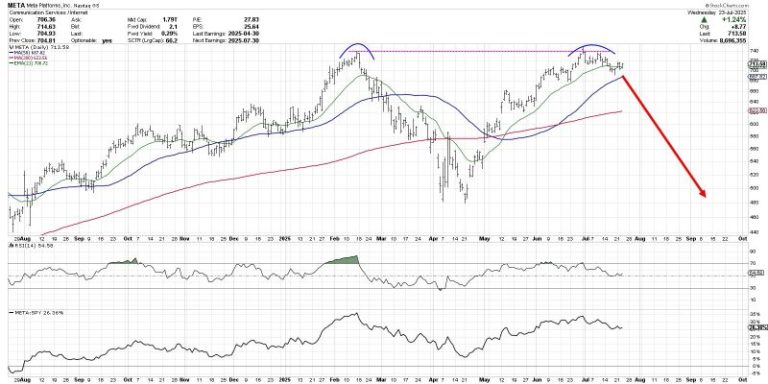
The chart of Meta Platforms, Inc. (META) has completed a roundtrip from the February high around $740 to the April low at $480 and all the way back again.  Over the last couple weeks, META has now pulled back from its retest of all-time highs, leaving investors to wonder what may come next.

Is this the beginning of a new downtrend phase for META?  Or just a brief pullback before a new uptrend phase propels META to new all-time highs?

Today we’ll look at two potential scenarios, including the double top pattern and the cup and handle pattern, and share which technical indicators and approaches could help us determine which path plays out into August.

The double top scenario basically means that the late July retest of the previous all-time high was the end of the recent uptrend phase.  The double top pattern is literally when a major resistance level is set and then retested.  The implication is that a lack of willing buyers means the uptrend is exhausted, and there is nowhere to go but down.

While the 21-day exponential moving average is currently in play for META, I would say that a break below the 50-day moving average could confirm this as the correct scenario.  If that smoothing mechanism does not hold, then the price action would imply less of a pullback and more like the beginning of a real distribution phase.

What is META pulls back but then resumes an uptrend phase, leading META to another new all-time high?  That would result in a confirmed cup and handle pattern, created by a large rounded bottoming pattern followed by a brief pullback.  The key to this pattern is the “rim” of the cup, which sits right at $740 for META.

Given the pullback META has demonstrated so far in July, I would say that a break above the $740 level would basically confirm a bullish cup and handle pattern.  That would suggest much more upside potential for META, as the stock would literally go into previously uncharted territory.

So how can we determine which scenario is more likely to play out?  This is where we need to incorporate more technical indicators into the discussion, as a way to further validate and confirm our investment thesis.

Just to review, I think a break above $740 would confirm a bullish cup and handle pattern.  I would also say that a break below the $680 level, which would represent a move below the 50-day moving average as well as the June swing lows, would basically confirm a bearish double top pattern.

We can also use the Relative Strength Index (RSI) to help determine whether META remains in a bullish trend phase.  During bull phases, the RSI rarely gets below 40, because buyers usually step in to “buy the dips” and keep the momentum fairly constructive.  So if the price would break down, and the RSI would not hold that crucial 40 level, that could mean a bearish outlook is warranted.

Finally, we can use volume-based indicators to assess whether moves in the price are supported by stronger volume readings.  Here I’ve included the Accumulation/Distribution Line, which tracks the trend in daily volume readings over time.  We can see that the high in July resulted in a divergence, as the A/D line was trending lower.  If the A/D line would break below its June and July lows, marked by a dashed red line, that would represent a bearish volume reading for META.

Technical analysis is less about predicting the future, and more about determining the most probable scenarios based on our analysis of trend, momentum, and volume.  I hope this discussion shows how the outlook for META can be easily determined and tracked using the best practices of technical analysis!

RR#6,

Dave

PS- Ready to upgrade your investment process?  Check out my free behavioral investing course!

David Keller, CMT

President and Chief Strategist

Sierra Alpha Research LLC

marketmisbehavior.com

https://www.youtube.com/c/MarketMisbehavior

Disclaimer: This blog is for educational purposes only and should not be construed as financial advice.  The ideas and strategies should never be used without first assessing your own personal and financial situation, or without consulting a financial professional.  

The author does not have a position in mentioned securities at the time of publication.    Any opinions expressed herein are solely those of the author and do not in any way represent the views or opinions of any other person or entity.

Markets don’t usually hit record highs, risk falling into bearish territory, and spring back to new highs within six months. But that’s what happened in 2025.

In this special mid-year recap, Grayson Roze sits down with David Keller, CMT, to show how disciplined routines, price-based signals, and a calm process helped them ride the whipsaw instead of getting tossed by it. You’ll see what really happened under the surface, how investor psychology drove the swings, and the exact StockCharts tools they leaned on to stay objective. 

If you’re focused on protecting capital, generating income, and sleeping well at night while still capturing the upside, this is a must-watch. Discover which charts deserve your attention now, what to ignore, and how to prep for the back half of 2025. 

This video premiered on July 23, 2025. Click on the above image to watch on our dedicated Grayson Roze page on StockCharts TV.

You can view previously recorded videos from Grayson at this link.