Author

admin

Browsing

The silver price kept surging on Friday (October 3), breaking US$48 per ounce.

The white metal last reached this level in 2011, the same year it nearly hit US$50 for only the second time in history. Silver’s first run to the US$50 level came in 1980, when the Hunt brothers attempted to corner the market.

Silver price chart, December 31, 2024, to October 3, 2025.

Known for lagging behind gold before outperforming, silver is now ahead of its sister metal in terms of percentage gains — it’s up close to 60 percent year-to-date, while gold has risen around 47 percent.

Still, silver remains below its all-time high, while gold continues to set new records — it’s been closing in on US$3,900 per ounce this week, buoyed by the US government shutdown.

Gold is also seeing underlying support from strong central bank buying, global geopolitical uncertainty, concerns about the US dollar and other fiat currencies and expectations of lower interest rates.

Silver acts as both a precious and industrial metal, meaning that it’s driven by many of the same factors as gold, but also has additional sources of demand. According to the Silver Institute, industrial demand for silver reached a record 680.5 million ounces in 2024, driven by usage in grid infrastructure, vehicle electrification and photovoltaics.

Total silver demand was down 3 percent year-on-year in 2024, but still exceeded supply for the fourth year in a row, resulting in a deficit of 148.9 million ounces for the year.

Watch five experts share their thoughts on the outlook for silver.

As silver gets closer to surpassing its all-time high, investors are wondering about its long-term prospects.

While many experts have lofty expectations for silver, including triple-digit price predictions, there’s a broad consensus that the white metal may correct before continuing on upward.

However, there’s also recognition that silver’s situation today is different than it was previously.

‘If you have something happen with the supply, and then on top of that at some point you’re running into issues with debt loads and currencies, that would certainly leave us probably into a much different environment for silver than either 1980 or 2011,’ said Chris Marcus, founder of Arcadia Economics.

Securities Disclosure: I, Charlotte McLeod, hold no direct investment interest in any company mentioned in this article.

This post appeared first on investingnews.com

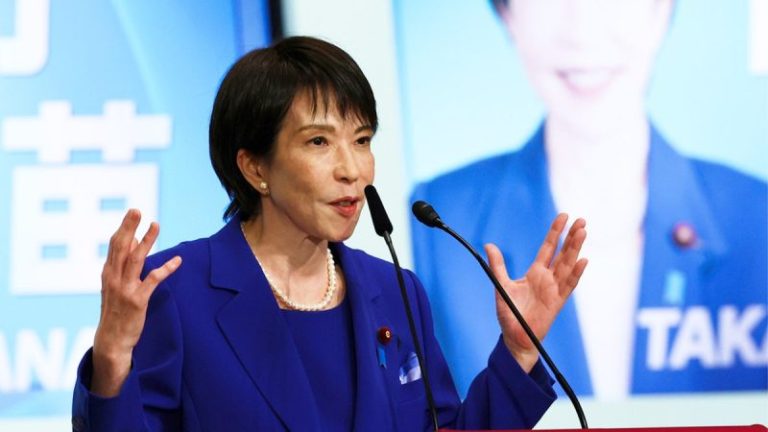
Japan is on track to get its first female prime minister after the leading conservative party elected Sanae Takaichi as its new leader. 

Takaichi, the former economic security minister of Japan, beat Agriculture Minister Shinjiro Koizumi, the son of popular former Prime Minister Junichiro Koizumi, in a runoff in an intraparty vote on Saturday by the ruling Liberal Democratic Party.

Takaichi is replacing Prime Minister Shigeru Ishiba as the party looks to regain public support and stay in power. 

Despite suffering major election losses, the Liberal Democratic Party remains by far the largest in the lower house and determines Japan’s leader because opposition groups are highly splintered.

In the first round of voting, Takaichi finished first with 183 votes and Agriculture Minister Shinjiro Koizumi placed second with 164. Because neither candidate reached a majority in the first round, the winner was determined in an immediate two-way runoff. 

The LDP, whose consecutive losses in parliamentary elections in the past year have left it in the minority in both houses, sought a leader who can quickly address challenges both domestic and international, while seeking cooperation from key opposition groups to implement its policies.

Takaichi, a hard-line conservative who’s cited former British Prime Minister Margaret Thatcher as her hero, has called for strengthening Japan’s military, and taking a tougher stance against China and North Korea. She also opposes same-sex marriage and retains ties to nationalist groups. 

Takaichi also faces a possible summit with President Donald Trump, who could demand that Japan increase its defense spending. A meeting is reportedly being planned for late October. Trump will travel to the Asia-Pacific Economic Cooperation summit in South Korea starting Oct. 31.

The LDP also needs help from the opposition, which it has long neglected. The party will likely look to expand its coalition with the moderate centrist Komeito with at least one of the key opposition parties, which are more centrist.

A parliamentary vote is expected in mid-October.  

The Associated Press contributed to this report.

This post appeared first on FOX NEWS

Senate Democrats blocked Republicans’ attempt to reopen the government again, all but guaranteeing that the government shutdown rolls through the weekend.

After a day off to observe Yom Kippur, lawmakers made little progress in finding an off-ramp to end the shutdown, which entered its third day on Friday. And as the government remains closed, both sides appear to be digging further into their positions.

Senate Republicans’ attempt to reopen the government failed on a largely party-line 54-44 vote for a fourth time, with the same trio of Senate Democratic caucus members — Sens. John Fetterman, D-Pa.; Catherine Cortez Masto, D-Nev.; and Angus King, I-Maine — joining most Republicans in backing the bill.

Senate Majority Leader John Thune, R-S.D., plans to bring the bill to the floor again and again in a bid to chip away at Democrats’ largely unified front. He lamented the work that could be happening, like advancing spending bills and negotiating other bipartisan priorities, on the Senate floor rather than repeating the same exercise of trying to reopen the government. 

‘They have taken hostage the federal government and, by extension, the American people, who are the only losers in this,’ Thune said. ‘Everybody’s talking about who wins and who loses and who gets the blame. That’s not what this is about. This is about doing what’s in the best interest of the American people. And what’s in the best interest of the American people is keeping the government open and operating so it can continue to work on their behalf.’ 

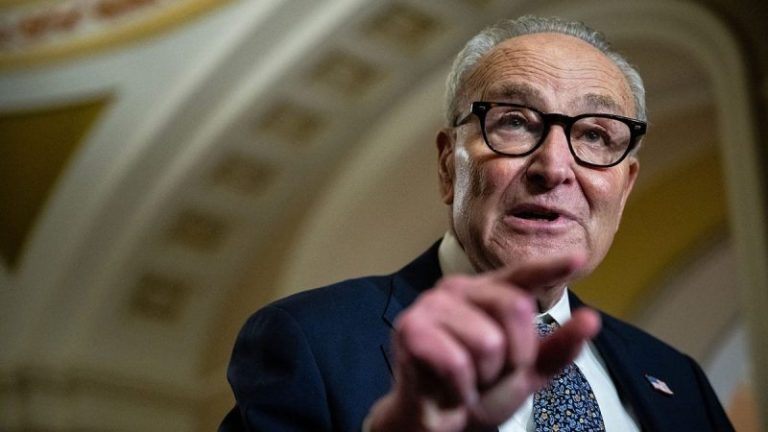
Senate Democrats, led by Senate Minority Leader Chuck Schumer, D-N.Y., demand that they get a seat at the table to negotiate a bipartisan continuing resolution (CR).

Their main rallying cry has been pushing for an extension to expiring Obamacare tax credits, which Senate Republicans have said they would consider only after the government is reopened. While the credits don’t expire until the end of the year, Democrats argue that if Congress doesn’t act now, people who use Obamacare will see their healthcare premiums skyrocket.

‘We know Americans want this, and we know many of my Republican colleagues want this as well,’ Schumer said. ‘But failure to act would be devastating. And Republicans know it. Even Donald Trump knows it. He talked about it a little bit with us in the White House.’

When asked if the pressure would mount to a point where Democrats cave, Sen. Gary Peters, D-Mich., told Fox News Digital, ‘We’re on the right side of history right now.’

Republicans largely agree it is an issue that should be dealt with, but they also want reforms in the program rather than the blanket, permanent extension that Democrats suggested in their counter-proposal.

Some Democrats also view the shutdown as a way to stand up to President Donald Trump.

‘The truth is, we shut down the government because Republicans wouldn’t negotiate, because Donald Trump wants to shut down,’ Sen. Chris Murphy, D-Conn., said. ‘He’s just bragging in the Oval Office about how good a shutdown will be for him. And we’re going to talk about the consequences of Republicans continuing to push these giant healthcare increases on people and the consequences of a lawless president.’

The administration is not resting on its laurels either and has targeted funding in blue cities and states, along with threats of mass firings beyond the typical furloughs of nonessential federal employees to get congressional Democrats to blink.

Office of Management and Budget Director Russ Vought announced Friday that $2.8 billion in Chicago infrastructure project funding would be put on hold to prevent ‘race-based contracting,’ a move that came on the heels of $18 billion in infrastructure money in New York City and $8 billion in ‘Green New Scam’ funding from going to 16 blue states being withheld earlier this week.

Thune argued that the administration is what Democrats ‘have wrought’ by continuing to withhold their votes. 

‘They are allowing the administration to do the very thing that, back in March, they said they didn’t want to give them the authority to do,’ he said. ‘And that’s to make decisions just like that. But that’s what’s going to happen.’ 

Meanwhile, bipartisan talks are brewing in the background, though no real deal nor compromise has materialized.

There have been suggestions of extending the credits for another year after the government is reopened or doing a shorter CR to match up with the beginning of open enrollment on Nov. 1. But Republicans engaged in talks are more keen to keep the government open until at least Nov. 21 to allow appropriators to finish their work on spending bills.

‘Nobody’s married to any of this, but we’ve got to get the 45 days in effect first,’ Sen. Mike Rounds, R-S.D., said. 

This post appeared first on FOX NEWS

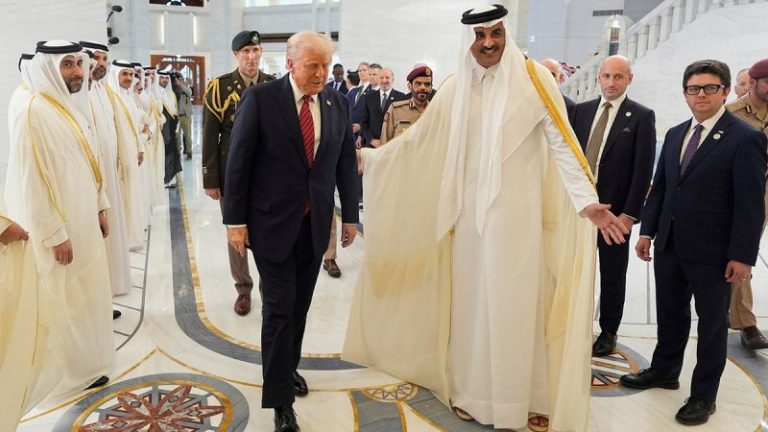
President Donald Trump signed an order Monday offering a U.S. guarantee for Qatar’s security, a significant commitment for the rising non-NATO Arab ally.

‘The United States shall regard any armed attack on the territory, sovereignty, or critical infrastructure of the State of Qatar as a threat to the peace and security of the United States,’ the order, made public Wednesday, read in no uncertain terms.

‘In the event of such an attack, the United States shall take all lawful and appropriate measures — including diplomatic, economic, and, if necessary, military — to defend the interests of the United States and of the State of Qatar and to restore peace and stability.’

The guarantee represented a level of support typically offered to Washington’s closest allies. It came after Prime Minister Benjamin Netanyahu apologized to Qatari Emir Tamim bin Hamad Al Thani for a Sept. 9 Israeli strike on his territory. 

The strike was targeted at Hamas but killed one Qatari security official in the process.

Qatar also was attacked by Iran in June in a strike targeted at its U.S. base.

The order falls short of a NATO-style defense pact — it hasn’t been ratified by the Senate, so it isn’t binding.

It came as Netanyahu and Trump, during a visit to the White House Monday, announced a 20-point plan to end the war in Gaza, brokered with Qatari mediation. Hamas has not yet accepted the plan.

U.S. relations with Doha have come a long way since 2017, when Trump accused Qatar of harboring terrorism: ‘The nation of Qatar, unfortunately, has historically been a funder of terrorism at a very high level,’ Trump said at the time.

From there, Qatar became a major non-NATO ally to the U.S. in 2022 under President Biden and is home to Al Udeid Air Base, one of the U.S.’ largest Middle East bases and a key hub for U.S. Central Command operations.

The nation is now gifting the U.S. with a new plane to serve as Air Force One.

Qatar welcomed the president’s executive order in a statement saying it reflects ‘the strong and longstanding ties between Doha and Washington.’

‘Qatar remains committed to working with the United States and international partners as a trusted mediator to address shared challenges, advance conflict resolution through diplomatic means, and support sustainable peace in the region,’ the statement said.

A security guarantee has long been a goal for Qatar and other Gulf allies like Saudi Arabia and the United Arab Emirates.

The nation has hosted a Hamas political office since 2012, but local officials say they were asked to do so by the U.S. to establish a line of communication for negotiations.

Before Qatar was involved in mediating the Gaza ceasefire, it was a bridge for U.S. and Taliban talks before the withdrawal in 2021 and has worked on prisoner exchanges between Russia and Ukraine. This year it’s been involved with the U.S. in working out a peace agreement between Rwanda and the Democratic Republic of Congo, signed at the White House in June.

This post appeared first on FOX NEWS

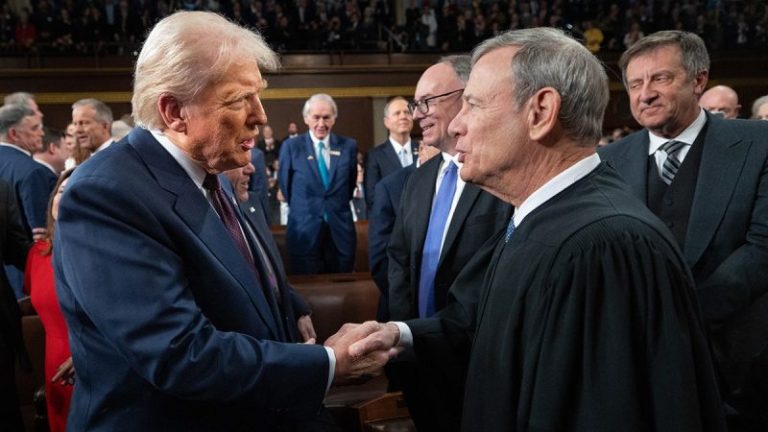
President Donald Trump has an almost flawless record on the Supreme Court’s emergency docket this year, a streak that has delivered crucial moments of relief to the government as it fights hundreds of lawsuits challenging the president’s agenda.

The Supreme Court has ruled in Trump’s favor on government cuts, nationwide injunctions, immigration policies and more, leading the White House to tout what it recently counted as 21 victories before the high court.

Those victories are, however, temporary. The upcoming term, which begins Monday, will allow the justices to begin weighing the full merits of some of these court disputes and ultimately cement or undo key parts of the Trump agenda.

Jonathan Adler, a William & Mary Law School professor, attributed the interim wins to the Supreme Court’s desire to narrow the judicial branch’s role in policymaking.

Speaking during a Federalist Society panel this week, Adler said the high court’s thinking might be that ‘lower courts are doing too much. We’re going to scale that back because it’s not our place, and it’s for the executive branch and the legislative branch to figure that out.’

The Trump administration has only challenged about one-fifth of the adverse rulings it has received from the lower courts. Adler said Solicitor General John Sauer, who represents the government, is strategically selecting which cases to bring to the high court. 

‘If you go through them, setting Humphrey’s Executor stuff slightly to the side, what they all have in common is that there’s a kind of clear argument that … district courts were a little too aggressive here,’ Adler said.

He acknowledged that some might have a different view, that the Trump administration has been ‘too muscular’ and that court intervention is a necessary check.

The emergency docket, sometimes known as the shadow or interim docket, allows the Trump administration or plaintiffs to ask the Supreme Court to quickly intervene in lawsuits and temporarily pause lower court rulings. The process can take a couple of days, weeks or months, and is viewed as a much speedier, albeit temporary, way to secure court relief than if the high court were to fully consider the merits of a case, which can include a long briefing schedule and oral arguments.

The Supreme Court’s emergency docket this year has been extraordinarily active. Attorney Kannon Shanmugam, who has argued dozens of cases before the high court, said Trump’s high volume of executive actions is partly the reason for that.

‘[An increase in emergency motions] coincides with the rise of executive orders and other forms of unilateral executive action really as the primary form of lawmaking in our country with the disappearance of Congress, and that has posed enormous challenges for the court,’ Shanmugam said.

Through the emergency docket, the Supreme Court has greenlit Trump’s mass firings of career employees and high-profile terminations of Democratic appointees. It has curtailed nationwide injunctions and cleared the way for controversial deportations and immigration stops. The high court has said the government can, for now, withhold billions of dollars in foreign aid and discharge transgender service members from the military.

In other instances, parties on both sides in a court fight have construed Supreme Court outcomes as wins.

In one such order, the Supreme Court said the Trump administration must attempt to return Salvadoran migrant Kilmar Abrego Garcia, whom the government admitted in court to improperly deporting to a Salvadoran prison. But at the same time, the high court noted that district court judges must also be deferential to the executive branch’s authority over foreign policy.

Similarly, the high court said the administration must allow deportees under the Alien Enemies Act a reasonable chance to fight their removal through habeas corpus petitions. The justices have not yet weighed in on the merits of Trump’s invocation of the Alien Enemies Act, one of his most aggressive deportation tactics, which the president employed to swiftly remove alleged Tren de Aragua members.

Conservative lawyer Carrie Severino, president of the legal watchdog JCN, said one criterion the Supreme Court considers when making fast decisions is whether parties are at risk of irreparable harm.

As an example, Severino pointed to the Supreme Court recently allowing Trump to fire Biden-appointed FTC Commissioner Rebecca Slaughter, a case that the high court is now using as a vehicle to revisit in the coming months the 90-year precedent set by Humphrey’s Executor v. United States.

Severino said, ‘If one assumes, ‘Okay, if Trump’s right,’ then this is a serious burden on the government to have a good chunk of their four years being taken up with not being able to actually staff the government as they want to. If Trump’s wrong, then Commissioner Slaughter should have been in that position, and they can remedy that by providing her back pay.’

‘When you’re balancing those types of harms, this is the kind of case where the government’s going to have a leg up,’ Severino said.

In a small defeat for Trump on Wednesday, the Supreme Court declined to allow the president to fire Federal Reserve Governor Lisa Cook and instead said it would hear her case in January. The move was a deviation from the court’s typical posture and underscored its unique view on the Federal Reserve compared with other agencies.

The Supreme Court’s majority has often split along ideological lines and offered little reason for its emergency decisions. This differs from final orders from the court, which can be lengthy and include numerous concurring opinions and dissents.

Attorney Benjamin Mizer, who served as a top DOJ official during the Biden administration, cautioned during the panel that the Supreme Court could reverse its shadow docket positions down the road.

‘As cases reach the court on the merits, we shouldn’t presume that the administration will win them all,’ Mizer said.

This post appeared first on FOX NEWS

Iran reportedly executed six prisoners Saturday who the regime claimed carried out deadly attacks in the country’s oil-rich southwest on behalf of Israel, marking the latest surge in executions that rights groups say have reached levels unseen in decades.

The six executions were reported by The Associated Press, as well as Iranian news agency Mizan. 

A seventh prisoner, accused of killing a Sunni cleric in 2009, along with other crimes, was executed in Kurdistan province. 

Saturday’s executions follow the 12-day Iran-Israel war in June, which ended with Tehran vowing it would target its enemies at home and abroad.

According to Amnesty International, Iranian authorities have executed more than 1,000 people so far in 2025, the highest annual figure recorded by the group in at least 15 years.

Iran said the six men linked to Israel killed police officers and security forces, as well as orchestrated bombings targeting sites around Khorramshahr in Iran’s restive Khuzestan province. Iranian state television aired footage of one of the men talking about the attacks, saying it was the first time the details were being made public.

A Kurdish group called the Hengaw Organization for Human Rights said the six were actually Arab political prisoners who had been arrested during the 2019 protests. Hengaw said Iran accused them of having links to the Arab Struggle Movement for the Liberation of Ahvaz, a separatist group blamed for pipeline bombings and other attacks in the region.

The group insisted the men were tortured and forced into giving televised confessions under duress.

The seventh prisoner, Saman Mohammadi Khiyareh, a Kurd, was convicted over the 2009 assassination of Mamousta Sheikh al-Islam, a pro-government Sunni cleric in the Kurdish city of Sanandaj.

Activists have questioned Khiyareh’s case, noting he was only 15 or 16 at the time of the assassination, was arrested at 19 and was held for more than a decade before his execution. His conviction, they said, relied on confessions extracted under torture — a practice activists accuse Iranian courts of using regularly.

The number of state executions has drastically escalated since President Massoud Pezeshkian took office in July 2024. At least 975 people were executed in 2024, according to figures from the United Nations. Pezeshkian answers to Supreme Leader Ayatollah Ali Khamenei, who holds ultimate authority in the country.

Iran has been putting prisoners to death at a pace unseen since 1988, when it executed thousands at the end of the Iran-Iraq war.

Independent U.N. human rights experts have sounded the alarm about the sheer number of executions, calling it ‘a dramatic escalation that violates international human rights law,’ according to a recent press release from the Office of the High Commissioner for Human Rights.

‘With an average of more than nine hangings per day in recent weeks, Iran appears to be conducting executions at an industrial scale that defies all accepted standards of human rights protection,’ the body said.

The Associated Press and Reuters contributed to this report

This post appeared first on FOX NEWS

Here’s a quick recap of the crypto landscape for Wednesday (December 3) as of 9:00 a.m. UTC.

Get the latest insights on Bitcoin, Ether and altcoins, along with a round-up of key cryptocurrency market news.

Bitcoin and Ether price update

Bitcoin (BTC) was priced at US$92,758.95, up by 4.1 percent over 24 hours.

Bitcoin price performance, December 3, 2025.

Chart via TradingView.

After Bitcoin stared the week with its largest single-day decline in a month, it rallied about 6.6 percent in 24 hours to reclaim US$93,000. This now marks Bitcoin’s highest intraday level in more than two weeks.

Despite the cryptocurrency’s rebound, analysts are still urging caution and advising investors to await clearer macro signals before fully re-entering higher-risk assets.

Ether (ETH) also regained ground and is currently priced at US$3,051.34, up 7.1 percent over 24 hours.

Altcoin price update

  • XRP (XRP) was priced at US$2.19, an increase of 4.6 percent over 24 hours.
  • Solana (SOL) was trading at US$142.17, up by 6.6 percent over 24 hours.

Today’s crypto news to know

Strategy faces possible removal from MSCI indexes

Michael Saylor’s Strategy (NASDAQ:MSTR) is in discussions with index provider MSCI as the company thinks about removing Strategy from major stock indexes, according to Reuters.

MSCI is considering cutting companies whose business model is to buy crypto. Strategy currently holds about 650,000 BTC and has relied on new debt and equity issuance to add to its holdings.

JPMorgan Chase (NYSE:JPM) estimates a removal could trigger up to US$8.8 billion in outflows if other index providers follow suit. Saylor said the company is participating in MSCI’s review process, but questioned the scale of possible selling projected by JPMorgan. A verdict is expected by January 15 of next year.

Sony partner launches stablecoin for Soneium

Startale Group has launched USDSC, a stablecoin pegged to the US dollar that is designed to serve as the default settlement currency on Sony Group’s (NYSE:SONY,TSE:6758) Soneium blockchain.

According to a Decrypt report, the launch includes a new rewards program called STAR Points that is geared at encouraging user activity across payments, liquidity supply and app interaction. Soneium went live earlier this year following a test phase that drew 14 million users and processed 50 million transactions.

Startale CEO Sota Watanabe said USDSC aims to support payments and yield generation across the network’s creator-focused ecosystem. Stablecoin infrastructure firm M0 is providing backend support for issuance and liquidity.

A waitlist for the Startale app is open to users seeking early access to USDSC features and rewards.

SEC blocks rollout of high-leverage ETFs

The US Securities and Exchange Commission (SEC) has halted the approval process for multiple ultra-leveraged exchange-traded funds (ETFs), citing concerns about investor risk.

Warning letters were sent to nine issuers, including Direxion, ProShares and Tidal, affecting products designed to offer more than 2x exposure to equities, commodities and cryptocurrencies.

The SEC said the proposals exceed regulatory limits on allowable leverage and rely on benchmark definitions that may fail to reflect true market volatility. Some of the planned funds target exposure to highly volatile assets. No 3x or 5x single-stock ETFs currently exist in the US due to existing restrictions.

Leveraged ETF trading has surged since 2020, with total assets rising to around US$162 billion.

Securities Disclosure: I, Giann Liguid, hold no direct investment interest in any company mentioned in this article.

This post appeared first on investingnews.com

Sankamap Metals Inc. (CSE: SCU) (‘Sankamap’ or the ‘Company’) further to the Company’s news releases dated October 21, 2025, November 4, 2025, and November 18, 2025, the Company continues to work towards the filing of its annual audited financial statements and management’s discussion and analysis for the fiscal year ended June 30, 2025 (the ‘Required Filings’). The Company has obtained approval from the Alberta Securities Commission to extend the Management Cease Trade Order (‘MCTO’) under National Policy 12-203 Management Cease Trade Orders (‘NP 12-203’) until December 28, 2025.

While the audit of Sankamap’s private subsidiary has now been completed, timing adjustments in the subsidiary’s audit resulted in a brief postponement of fieldwork and the review of Sankamap’s audit file. The upcoming holiday period is also expected to affect scheduling. To support timely completion of the audit, the Company intends to appoint the subsidiary’s auditor as its auditor, as their familiarity with the Company’s mineral property and the Solomon Islands jurisdiction is expected to facilitate an expedited process. A change of auditor is underway, and the Company expects to file the required change of auditor documentation shortly.

The Required Filings were due to be filed by October 28, 2025. In connection with the anticipated delays in making the Required Filings, the Company made an application for a Management Cease Trade Order (‘MCTO‘) under National Policy 12-203 Management Cease Trade Orders (‘NP 12-203‘) to the Alberta Securities Commission, as principal regulator for the Company, and the MCTO was issued on October 29, 2025. The MCTO restricts all trading by the Company’s CEO and CFO in securities of the Company, whether direct or indirect. The issuance of the MCTO will not affect the ability of persons who are not directors, officers or insiders of the Company to trade their securities. The MCTO will remain in effect until the Required Filings are filed or until it is revoked or varied.

The Company expects to proceed with the filing of its interim first-quarter financial statements shortly after the Required Filings have been completed and submitted.

The Company confirms that it intends to satisfy the provisions of the alternative information guidelines described in NP 12-203 by issuing bi-weekly default status reports in the form of a news release until it meets the Required Filings requirement. The Company has not taken any steps towards any insolvency proceeding and the Company has no material information relating to its affairs that has not been generally disclosed.

About Sankamap Metals Inc.

Sankamap Metals Inc. (CSE: SCU) is a Canadian mineral exploration company dedicated to the discovery and development of high-grade copper and gold deposits through its flagship Oceania Project, located in the South Pacific. The Company’s fully permitted assets are strategically positioned in the Solomon Islands, along a prolific geological trend that hosts major copper-gold deposits; including Newcrest’s Lihir Mine, with a resource of 71.9 million ounces of gold¹ (310 Mt containing 23 Moz Au at 2.3 g/t P+P, 520 Mt containing 39 Moz Au at 2.3 g/t indicated, 81 Mt containing 5 Moz Au at 1.9 g/t measured, 61 Mt containing 4.9 Moz Au at 2.3 g/t Inferred).

Exploration is actively advancing at both the Kuma and Fauro properties, part of Sankamap’s Oceania Project in the Solomon Islands. Historical work has already highlighted the mineral potential of both sites, which lie along a highly prospective copper and gold-bearing trend, suggesting the possibility of further, yet-to-be-discovered deposits.

At Kuma, the property is believed to host an underexplored and largely untested porphyry copper-gold (Cu-Au) system. Historical rock chip sampling has returned consistently elevated gold values above 0.5 g/t Au, including a standout sample assaying 11.7% Cu and 13.5 g/t Au2; underscoring the area’s significant potential.

At Fauro, particularly at the Meriguna Target, historical trenching has returned highly encouraging results, including 8.0 meters at 27.95 g/t Au and 14.0 meters at 8.94 g/t Au3. Complementing these results are exceptional grab sample assays, including historical values of up to 173 g/t Au3, along with recent sampling by Sankamap at the Kiovakase Target, which returned numerous high-grade copper values, reaching up to 4.09% Cu. In addition, limited historical shallow drilling intersected 35.0 meters at 2.08 g/t Au3, further underscoring the property’s strong mineral potential and the merit for continued exploration. With a commitment to systematic exploration and a team of experienced professionals, Sankamap aims to unlock the untapped potential of underexplored regions and create substantial value for its shareholders. For more information, please refer to SEDAR+ (www.sedarplus.ca), under Sankamap’s profile.

1.Newcrest Technical Report, 2020 (Lihir: 310 Mt containing 23 Moz Au at 2.3 g/t P+P, 520 Mt containing 39 Moz Au at 2.3 g/t indicated, 81 Mt containing 5 Moz Au at 1.9 g/t measured, 61 Mt containing 4.9 Moz Au at 2.3 g/t Inferred)

2. Historical grab, soil and BLEG samples from SolGold Kuma Review June 2015, and SolGold plc Annual Report 2013/2012

3. September 2010-June 2012 press releases from Solomon Gold Ltd. and SolGold Fauro Island Summary Technical Info 2012

QP Disclosure

The technical content for the Oceania Project in this news release has been reviewed and approved by John Florek, M.Sc., P.Geol., a Qualified Person in accordance with CIM guidelines. Mr. John Florek is in good standing with the Professional Geoscientists of Ontario (Member ID:1228) and a director and officer of the Company.

ON BEHALF OF THE BOARD OF DIRECTORS

s/ ‘John Florek’
John Florek, M.Sc., P.Geol
Chief Executive Officer
Sankamap Metals Inc.

Contact:
John Florek, CEO
T: (807) 228-3531
E: johnf@sankamap.com

The Canadian Securities Exchange has not approved nor disapproved this press release.

Forward-Looking Statements

Certain statements made and information contained herein may constitute ‘forward-looking information’ and ‘forward-looking statements’ within the meaning of applicable Canadian and United States securities legislation. These statements and information are based on facts currently available to Sankamap and there is no assurance that the actual results will meet management’s expectations. Forward-looking statements and information may be identified by such terms as ‘anticipates,’ ‘believes,’ ‘targets,’ ‘estimates,’ ‘plans,’ ‘expects,’ ‘may,’ ‘will,’ ‘could’ or ‘would.’

This press release contains forward-looking statements, including, but not limited to, statements regarding management’s expectations about obtaining the MCTO and completing the Required Filings within the anticipated timeline. Forward-looking statements are subject to various risks, uncertainties, and other factors that could cause actual results or events to differ materially from those expressed or implied by such statements. Sankamap does not undertake any obligation to update forward-looking statements or information, except as required by applicable securities laws. For more information on the Company, investors should review the Company’s continuous disclosure filings that are available at www.sedarplus.ca.

To view the source version of this press release, please visit https://www.newsfilecorp.com/release/276869

News Provided by Newsfile via QuoteMedia

This post appeared first on investingnews.com

This year has had no shortage of alarming Chinese espionage efforts targeting the United States that were uncovered by government officials.

2025 saw the conviction of a former active-duty military member accused of selling Navy secrets to Chinese intelligence, the arrests of Chinese nationals accused of trying to recruit active-duty service members as intelligence assets and smuggle dangerous toxins into the United States, the disruption of a Chinese ‘Hacker-for-Hire’ ecosystem, and more.

‘President Trump is not afraid of the Chinese,’ Gatestone Institute senior Fellow Gordon Chang said on Fox Business’ ‘Mornings with Maria’ following a new arms sale to Taiwan. However, Chang lamented that Trump was ambivalent to the ‘information war’ with China, noting that ‘the Chinese are able to tar him and tell the rest of the world that Trump is afraid of the Chinese … but when you look at the reality, President Trump is going after China across the board,’ Chang argued.

One of the alarming Chinese espionage headlines to hit the news this year was an effort by several Chinese nationals to smuggle a pathogen described by the government as a ‘potential agroterrorism weapon’ into the United States in 2024. A complaint against the suspects was unsealed by federal officials this year, leading the case to make headlines nationwide. 

One of those individuals complicit in the case, Yunqing Jian, 33, a citizen of the People’s Republic of China and a researcher employed at the University of Michigan, was allegedly receiving money from the Chinese government for her work on the pathogen the suspects were trying to smuggle. Meanwhile, her boyfriend, who worked at a Chinese university conducting research on that same pathogen, initially lied but then admitted to smuggling it through the Detroit airport so it could be taken to the University of Michigan laboratory where his girlfriend worked.

Jian eventually pleaded guilty. She was later sentenced to time served and then deported back to China. Her boyfriend was immediately deported to China when he was caught at the Detroit airport trying to bring the toxin into the United States.  

Just this month, a separate Chinese researcher from Indiana University was also accused by the Federal Bureau of Investigation (FBI) of trying to smuggle a dangerous toxin into the country, this time Escherichia coli (E. coli). The FBI identified the smuggling suspect as post-doctoral researcher Youhuang Xiang, who also allegedly made false statements to law enforcement.

Federal officials have disrupted Chinese intelligence efforts to recruit assets in the United States this year as well, according to Justice Department communications.

In July, federal officials disrupted a ‘Clandestine PRC Ministry of State Security Intelligence Network’ that was operating in the United States and was attempting to bribe active-duty soldiers with thousands in cash to work for them as assets. 

The following month, in a separate case, a federal jury convicted former Navy sailor, Jinchao Wei, also known as Patrick Wei, who was caught trying to sell military secrets to a Chinese intelligence officer for $12,000.

Hacking was a big part of Chinese espionage efforts in 2025 too. 

A major Chinese-linked hacking threat referred to as ‘Salt Typhoon’ was reported this year to have launched an attack compromising at least 200 American companies as part of its broader efforts that have included gaining access to law enforcement wiretapping mechanisms and information on members of Congress, according to the top cyber chief at the FBI. Critical infrastructure manufacturers like AT&T, Verizon, Charter Communications, and others have reportedly been exposed by the group, which was first uncovered publicly in 2024 but whose efforts have dated back several years.

Earlier this year, in March, the Department of Justice also announced that federal officials had disrupted a ‘Hacker-for-Hire Ecosystem’ operating out of China at the direction of Chinese intelligence officers as well. These malicious actors worked for private companies and as contractors in China, which was intended to hack and steal information in a way that would obscure the Chinese government’s involvement, the DOJ said.

China’s increasing acquisition of farmland in the United States has been of growing concern during 2025 as well, with Chinese-linked entities buying up land near military bases, including a trailer park near Missouri’s Whiteman Air Force Base. 

‘From smuggling crop-killing pathogens and E. Coli into the United States, to conspicuously purchasing a trailer park that shares a fence with America’s entire B-2 bomber fleet and selling ‘green’ tech devices that spread kill switches across our electrical grid, Communist China seeks to harm the American homeland,’ Michael Lucci, a China-hawk and the founder of State Armor Action, a conservative group with a mission to develop and enact state-level solutions to global security threats such as those emanating from China.

‘Furthermore, these events are just the tip of the iceberg,’ Lucci continued. ‘Lawmakers across the country must accelerate action to shield Americans from CCP influence, espionage, and sabotage. Communist China treats the United States as an enemy, and it is past time we recognize the CCP party-state always and everywhere chooses conflict with the United States.’

Fox News Digital’s Rachel Wolf contributed to this report.

This post appeared first on FOX NEWS

Ukrainian President Volodymyr Zelenskyy declared Saturday that his country ‘is willing to do whatever it takes’ to end its war with Russia ahead of a meeting Sunday in Florida with President Donald Trump.

In a series of posts on X, the Ukrainian leader said, ‘If the whole world – Europe and America – is on our side, together we will stop Putin,’ but, ‘if anyone – whether the U.S. or Europe – is on Russia’s side, this means the war will continue.’

‘There are no other options here. And this is a risk for all countries in the world. Because Russia will not stop, regardless of any agreements, any eloquent messages from them. They will not stop at Ukraine,’ Zelenskyy warned. He is set to meet with Trump in Florida on Sunday, where Zelenskyy said he will share a 20-point peace proposal to end the conflict with Russia. 

The posts came after Russia launched a fresh overnight attack against Kyiv involving hundreds of drones and dozens of missiles. Zelenskyy said the attack put the ‘true attitude’ of Russian President Vladimir Putin and his inner circle on display.

The overnight blitz in Ukraine’s capital left at least one person dead and 27 injured, local authorities told the Associated Press. 

‘Another Russian attack is still ongoing: since last night, there have been almost 500 drones – a large number of ‘shaheds’ – as well as 40 missiles, including Kinzhals. The primary target is Kyiv – energy facilities and civilian infrastructure,’ Zelenskyy wrote on X on Saturday morning. ‘Regrettably, there have been hits, and ordinary residential buildings have been damaged. Rescuers are searching for a person trapped under the rubble of one of them.’ 

‘There have been many questions over the past few days – so where is Russia’s response to the proposals to end the war offered by the United States and the world? Russian representatives engage in lengthy talks, but in reality, Kinzhals and ‘shaheds’ speak for them. This is the true attitude of Putin and his inner circle,’ Zelenskyy added. ‘They do not want to end the war and seek to use every opportunity to cause Ukraine even greater suffering and increase their pressure on others around the world.’

Zelenskyy also said Saturday that, ‘If Russia turns even the Christmas and New Year period into a time of destroyed homes and burned apartments, of ruined power plants, then this sick activity can only be responded to with truly strong steps.’ 

‘The United States has this capability. Europe has this capability. Many of our partners have this capability. The key is to use it,’ he declared. 

Zelenskyy added in another X post later Saturday morning that, ‘Ukraine did not start this war. Russia started it.’

‘Ukraine supported President Trump’s proposal for a ceasefire. Ukraine has agreed to many different compromises, and this is documented in our draft agreements, in our 20-point plan. Ukraine is willing to do whatever it takes to stop this war. For us, priority number one – or the only priority – is ending the war,’ Zelenskyy continued.

‘For us, the priority is peace. We need to be strong at the negotiating table. To be strong, we need the support of the world: Europe and the United States. And this includes air defenses – which are currently insufficient, weaponry – which is currently insufficient, and money – thankfully, there is now a European decision, but, frankly, there is a constant shortage of funds, in particular for the production of weapons and, most importantly, drones,’ he said.

Trump, ahead of the meeting with Zelenskyy, has said he will call the final shots on a peace deal to end the conflict.

‘He doesn’t have anything until I approve it,’ Trump told Politico Friday. ‘So we’ll see what he’s got.’ 

The Russian Defense Ministry said Saturday that it carried out a ‘massive strike’ overnight, using ‘long-range precision-guided weapons from land, air, and sea, including Kinzhal hypersonic aeroballistic missiles’ and drones, on energy infrastructure facilities ‘used by the Ukrainian Armed Forces,’ as well as ‘Ukrainian military-industrial complex enterprises.’ 

The ministry said the strike came in response to Ukraine’s attacks on ‘civilian objects’ in Russia.

Earlier on Saturday, the ministry said its air defenses shot down seven Ukrainian drones over the Russian regions of Krasnodar and Adygeya overnight. 

Fox News Digital’s Diana Stancey and The Associated Press contributed to this report. 

This post appeared first on FOX NEWS