Author

admin

Browsing

African Discovery Group (OTC:AFDG) (“AFDG” or the “Company”) has entered into a term sheet to acquire the Butembo Copper exploration license in the Democratic Republic of Congo (DRC) by acquiring 100% of the shares of SOCIETE GRABIN MINING SAS (the “Transaction”). The Butembo Copper project is a greenfield exploration project located in the North Kivu province of the Democratic Republic of Congo. 40km south of the provincial capital of Beni. The project is located 33km west of the Ugandan border with verified road and rail access to the port of Mombasa.

The area is generally underexplored relative to the well-known copper belts of the Katanga copper belt to the south – however the Mesoproterozoic Kibalian greenstone belt is known for its tungsten-tin-gold occurrences, and it hosts the well-known Kilembe Mine nearby which has produced substantial quantities of both copper and cobalt

According to Rio Tinto, African deposits make up eight out of the 10 highest grade deposits discovered since 1990. The recent discovery of the Butembo copper deposit has underscored the need for further exploration work in areas peripheral to the Katanga Copper Belt.It is important to note that the artisanal pits initially targeted and extracted alluvial gold in the surficial gravels that overly the schists hosting the copper mineralization.The implication is that Butembo is prospective for both gold and copper.

The Butembo discovery is a near surface high-grade copper oxidized ore with measured grades of up to 18% with depth and lateral extension potential of over 5km along strike. The project is located at the base of the Ruwenzori mountains and borders Virunga National Park. There is extensive artisanal activity for both copper and gold and by extension a thriving small scale minerals industry exists in Butembo going back years. Regolith clay samples to the north have tested positively for copper – this is interpreted as a positive indicator of a northern extension to Butembo.

The artisanal and first phase exploration pits around the flood plain of the Talehya River, which runs through the concession, have been tested over an initial 500m of strike length – and the results have been positive with one of these analyses reporting the 18% Cu mentioned above as well as 16.3% in another exploration pit.

The deposit is in the vicinity of the historic Kilembe copper mine (4 million tons) across the border in Uganda whose sulphide mineralization occurs within biotite schists thought to have formed by hydrothermal fluids during early tectonic cycles that were trapped in structurally favorable impermeable locations. This offers a unique insight into the potential geological controls of the Butembo deposit. Mineralization is structurally controlled, occurring along northeast-trending shear zones and folds that facilitated hydrothermal fluid flow. The primary ore minerals include chalcopyrite, pyrite, and linnaeite, forming massive sulfide lenses and disseminated zones.

The Butembo deposit holds a strategically advantageous location, benefiting from proximity to regional infrastructure, which includes electrical power being available within reach of the project boundary. The site is located close to the Ugandan border, offering access to the East African transport corridor. This includes road and rail connections through Uganda to the port of Mombasa, Kenya—providing a viable export route for future development.

The combination of surface high-grade mineralization, artisanal activity, infrastructure access, and strategic location positions the Butembo Copper Project as a high-potential target for early-stage exploration and resource delineation.

Source

This post appeared first on investingnews.com

House Republicans’ campaign arm is going after Democrats hours after the federal government entered a shutdown at midnight on Wednesday.

A new National Republican Congressional Committee (NRCC) ad being rolled out in 42 battleground districts is aimed at putting pressure on Democratic lawmakers to accept the GOP’s plan and end the shutdown.

‘Democrats refused to fund the government. So now military troops, police and Border Patrol lose their paychecks. Because of Democrats, veterans, farmers, small businesses lose critical funding. Disaster relief — cut off,’ a voiceover states.

‘Democrats are grinding America to a halt in order to give illegal immigrants free healthcare. Tell Democrats: Stop the shutdown.’

The ad buy came at a four-figure price tag, according to an NRCC spokesperson.

It’s being rolled out in 25 districts represented by Democrats and 17 held by Republicans.

The federal government shut down overnight after Democrats and Republicans in the Senate failed to reach a spending agreement in time for the end of fiscal year (FY) 2025 on Sept. 30.

A short-term extension of FY 2025 funding, aimed at giving Congress more time to reach a longer-term deal, failed to advance in the Senate on Tuesday evening.

The measure, aimed at keeping the government open through Nov. 21, passed the House mainly along party lines earlier this month.

Democrats were angered at being sidelined in the spending negotiations, and by the GOP bill’s exclusion of enhanced COVID-19-era Obamacare subsidies. Those subsidies, passed in 2021 under President Joe Biden, are set to expire by the end of 2025 without congressional action.

Republicans have signaled that they will not budge from their measure, citing Democrats’ past support for similar bills aimed at averting shutdowns.

‘Out of touch Democrats shut down the government to bankroll handouts for illegal immigrants and appease their radical base. Voters won’t forget who betrayed them, and the NRCC will make sure Democrats pay the price,’ NRCC spokesman Mike Marinella told Fox News Digital.

President Donald Trump and his administration have wide discretion over what changes occur during a shutdown.

However, it’s likely that thousands of government employees get furloughed, while others are made to work without paychecks until funding is reinstituted. A host of federal agencies and services could also be shuttered.

Some federal workers could lose their jobs permanently as well, with Office of Management and Budget Director Russ Vought issuing guidance earlier this month warning offices to consider plans for mass layoffs in the event of a shutdown.

This post appeared first on FOX NEWS

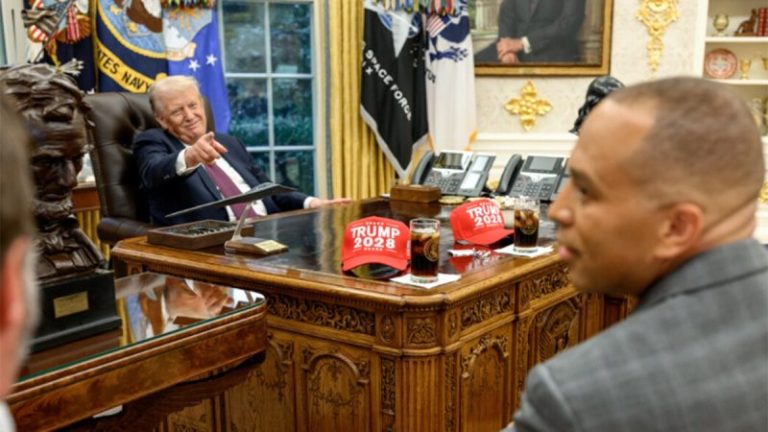
President Donald Trump shared photos on Truth Social on Tuesday showing red ‘Trump 2028’ hats strategically displayed on the Resolute Desk during an Oval Office meeting with Democrat leaders Monday in hopes of fending off a government shutdown.

Trump’s post came late Tuesday, hours before Washington grappled with its first shutdown since 2018-19. 

‘The Trump administration wants a straightforward and clean CR [continuing resolution] to continue funding the government – the exact same proposal that Democrats supported just 6 months ago, 13 times under the Biden Administration,’ White House spokeswoman Abigail Jackson told Fox News Digital. 

‘But radical Democrats are shutting the government down because they want a nearly $1.5 trillion wish list of demands, including free health care for illegal aliens. The Democrat’s radical agenda was rejected by the American people less than a year ago at the ballot box, now they’re shutting down the government and hold the American people hostage over it.’

Vice President JD Vance warned, ‘I think we’re headed to a shutdown’ after Monday’s meeting. 

Senate Minority Leader Chuck Schumer, D-N.Y., said at the time the sides ‘have very large differences.’ 

Late Tuesday, the Senate failed a last-ditch vote on extending funding and barreled toward a shutdown as the clock struck midnight on Oct. 1.

Trump posted the photos late Tuesday, a few hours before the shutdown was slated to begin. 

His campaign has sold ‘Trump 2028’ hats since earlier this year.

Democrat leaders downplayed the stunt. 

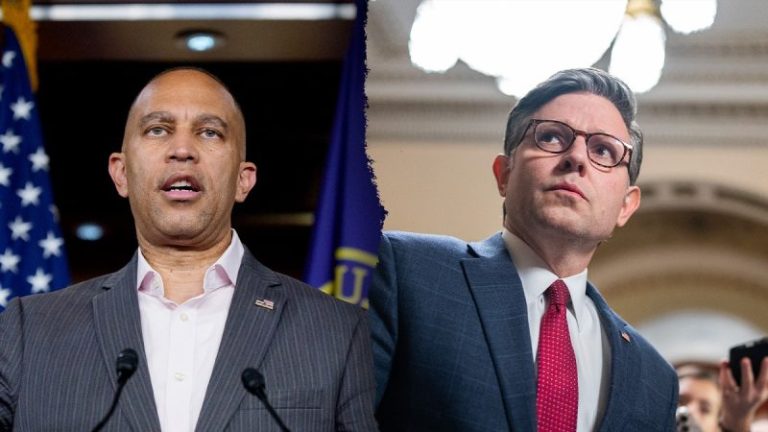
Schumer said Trump ‘can avoid a shutdown if he chooses to,’ while House Minority Leader Hakeem Jeffries, D-N.Y., added, ‘we will not back down’ in defending healthcare and spending priorities.’

Trump presided over a 35-day government shutdown in 2018–19, the longest in American history, during his first term in office.

This post appeared first on FOX NEWS

Senate Democrats again blocked Republicans’ short-term funding extension Tuesday afternoon, further increasing the odds of a partial government shutdown and thousands of federal workers going without paychecks.

Democratic lawmakers in the upper chamber, led by Senate Minority Leader Chuck Schumer, D-N.Y., banded together to vote against the GOP’s continuing resolution (CR), a move that marked the second time Democrats impeded the legislation’s progress this month.

Congress has until midnight Wednesday to pass a CR or else the government will shut down. However, the possibility of that happening became increasingly unlikely throughout the day as Republicans and Democrats huddled behind closed doors in separate meetings hours before the vote. 

The bill, which was passed by the House GOP earlier this month, failed on a largely party-line vote, 55-45. Sen. Rand Paul, R-Ky., was the lone Republican to vote against the bill, while Sens. John Fetterman, D-Pa., Catherine Cortez Masto, D-Nev., and Angus King, I-Maine, crossed the aisle to vote for the funding extension.

Democrats also tried to advance their own counter-proposal, but that bill was similarly blocked by Senate Republicans.

There is still time to avert a partial shutdown, but the window is closing fast. If Schumer and Thune are unable to find a path forward, it would mark the third shutdown under President Donald Trump.

When asked if he believed a shutdown was inevitable, Trump said, ‘Nothing is inevitable.’ 

‘But I would say it’s probably likely, because they want to give healthcare to illegal immigrants, which will destroy healthcare for everybody else in our country,’ he told reporters in the Oval Office. ‘And I didn’t see them bend even a little bit when I said we can’t do that.’ 

Shortly after the vote, however, the Office of Management and Budget released a memo that the appropriations for Fiscal Year 2025 would run out at 11:59 p.m. on Tuesday, making a shutdown official. 

‘It is unclear how long Democrats will maintain their untenable posture, making the duration of the shutdown difficult to predict,’ the memo read. 

Republicans want to pass a ‘clean’ short-term extension until Nov. 21 that would give appropriators time to finish spending bills, while Democrats want to extend expiring Obamacare premium subsidies, among multiple other demands.

But the chances of a deal materializing, particularly one that meets Democrats’ demands, are slim. Both Senate leaders traded barbs throughout the day, first on the Senate floor and then in back-to-back press conferences. 

Thune panned Democrats’ push for an extension to the expiring tax credits, which aren’t set to sunset until the end of this year, as well as their other demands to repeal the healthcare portion of Trump’s ‘big, beautiful bill’ and clawback canceled funding for NPR and PBS. 

Republicans argue that reversing the cuts from Trump’s megabill and undoing the public broadcasting rescission would amount to $1.5 trillion in spending tacked onto their short-term funding extension. 

‘These are things that they’re demanding as part of their so-called negotiation,’ Thune said. ‘Ladies and gentlemen, there isn’t anything here to negotiate.’

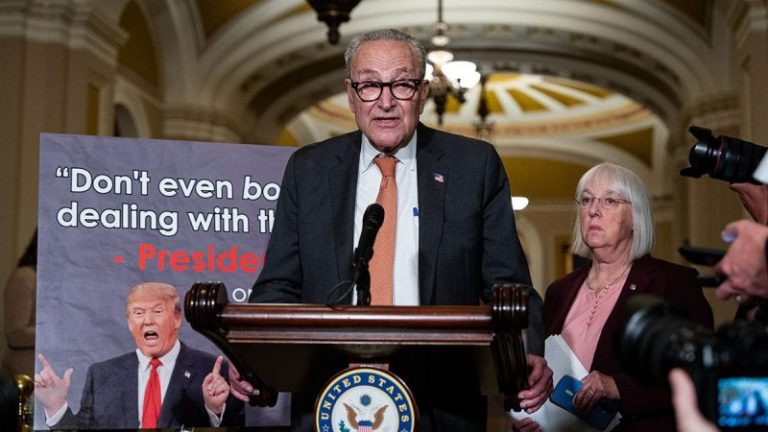
Schumer, however, countered that the decision to shut the government down was ‘in their court’ and charged that Democrats were working to solve the GOP’s ‘healthcare crisis.’

Still, despite scoring a meeting in the Oval Office with Trump and congressional Republican leaders, in addition to public guarantees from Thune and Republicans that Obamacare tax credits could be discussed after a shutdown was averted, Schumer demanded that Democrats be cut in on negotiations to craft a bipartisan bill. 

Earlier in the day, the top Senate Democrat commandeered a floor chart from Thune that showed how many times Democrats supported CRs under former President Joe Biden. He said that each time, Republicans were involved in the process. 

‘As leader, I sat down with the Republicans every one of those years and created a bipartisan bill. Their bill is partisan. They call it clean. We call it partisan. It has no Democratic input,’ Schumer said. ‘Thune never talked to me.’ 

This post appeared first on FOX NEWS

The Interior Department announced Tuesday it is testing autonomous lawnmowers on the National Mall in Washington, D.C., in an effort by the Trump administration to use artificial intelligence to ‘boost operational efficiency.’

In an order obtained by Fox News Digital, Interior Secretary Doug Burgum said AI will ‘drive smarter decision-making, boost operational efficiency, and better deliver on our core mission of advancing American energy dominance, protecting our natural resources, partnering with Tribal Nations, and enhancing internal services.’ 

The Interior Department is working with a private company, the name of which was not shared, to develop its AI technologies for use by the agency. 

Video shared with Fox News Digital shows a demonstration of the AI-controlled lawnmowers on the National Mall, each carrying an American flag. Visitors scanned a QR code on the technology to view a map tracking their progress.

In the video, Jeff Gowen, division manager of the National Park Service’s Technical Services Division, said the new machines will ‘allow us to get more work done with the same amount of people.’

Gowen added that six AI-controlled lawnmowers are being tested at six national parks with a grant provided by the National Park Foundation. 

‘Wild time to be alive,’ he said.

In his order, Burgum said AI will strengthen relationships with state and tribal lands while pushing federal agencies to adopt AI faster and more responsibly.

‘To fully unlock the potential of AI, we must scale intelligently, govern responsibly, and enable our workforce to lead with confidence and clarity,’ he said. ‘As AI becomes more accessible to the DOI workforce, it offers real opportunities to modernize how we serve, strengthening coordination with stakeholders, including State and Tribal partners, across the Nation’s lands.’

In addition to the lawnmowers, Burgum said the Interior Department is already using AI for wildfire response and environmental reviews.

‘AI is reshaping how industries operate and government must not be left behind, and must adapt to private sector standards,’ he said in the order.

‘AI offers a strategic advantage across all facets of the Department’s mission, enabling an advanced workforce with well-trained employees to strengthen domestic resource development and operational efficiency, allowing for the best management of public lands,’ he added. ‘AI adoption shall be pursued in ways that strengthen Interior’s ability to serve the American people through safe, responsible, and outcome-oriented innovation.’

The lawnmowers come after the Trump administration released its ‘America’s AI Action Plan’ in July, a plan aimed at securing U.S. dominance in AI. The plan highlights AI’s role in economic competitiveness and national security.

‘Winning the AI race will usher in a new golden age of human flourishing, economic competitiveness, and national security for the American people,’ the White House said.

This post appeared first on FOX NEWS

A judicial consensus is forming against climate lawfare, but the U.S. Supreme Court must still end environmental extortion of American energy. In two landmark cases, the court will soon have the opportunity to reassert the federal government’s authority over questions of national energy and environmental policy. 

Environmental groups believe that energy use increases global temperatures, causes sea levels to rise and creates more destructive weather. Their campaign to curtail energy has taken many forms — including asking the Environmental Protection Agency (EPA) to block pipelines and the Interior Department to deny oil and gas leases — but it met a roadblock with the 2024 election and the Trump administration’s subsequent blizzard of executive orders lifting overregulation.  

Rather than pursue their interests in Congress or before the electorate, environmental extremists have now allied with bankrupt cities and trial lawyers to use the courts to shake down the energy industry. Blue cities and states have filed tort suits in state courts to extract money for allegedly causing weather-related costs in their jurisdictions. 

The Supreme Court will soon decide whether to take up one of those cases, Boulder County v. Suncor Energy, following a ruling this year from the Colorado Supreme Court that allowed the county’s case to move forward in state court. Borrowing theories of liability from tobacco and opioid litigation, Boulder alleges that energy companies sold their products without disclosing climate risks. Such claims plainly intrude on federal authority over interstate pollution. 

Other climate cases are still progressing in lower state courts. In Hawaii, summary judgment motions are pending in a case seeking damages for rising sea levels. Hawaii’s highest court allowed this litigation to move forward in 2023 with Justice Todd Eddins issuing a remarkable concurrence, declaring that litigation would proceed under the ‘Aloha Spirit,’ regardless of federal precedent.  

In Rhode Island, the state judge presiding over a similar lawsuit against the energy industry compared it to developing nations devastated by natural disasters, citing Kenya, Tanzania and the Seychelles. The suggestion that Rhode Island has suffered comparable ‘severe destruction’ is telling: judges are inflating rhetoric to justify climate claims, not grounding them in law.  

Meanwhile, other states are effectively trying to replace federal authority over environmental policy. In Louisiana, plaintiffs obtained a $750 million judgment (potentially over $1 billion with interest) against Chevron for coastal erosion that they claimed was caused by oil extraction during World War II. Those companies had been under federal contracts to supply aviation fuel for the war effort. Yet eight decades later, Louisiana claims it can punish those practices retroactively. 

The energy firms sought to move the case to federal court because of its genesis in work for the federal government. But a divided 5th U.S. Circuit Court of Appeals panel refused to allow it. As Judge Andrew Oldham rightly noted in dissent, crude oil extraction plainly ‘relates to’ war production. If states can sue private businesses for their wartime work generations later, future cooperation with the federal government will be chilled, raising the costs of national defense. This coming term, the Supreme Court will review the Fifth Circuit’s decision. 

Despite some disappointing rulings from activist judges, a growing number of state courts are beginning to resist such frivolous claims. A Maryland judge rejected Baltimore’s lawsuit that alleged fossil fuels caused sea rises that have harmed the city; the Maryland Supreme Court will hear the appeal later in October. A South Carolina court dismissed Charleston’s similar claims, which blue city officials will almost certainly appeal as well. Likewise, nearly identical state and municipal lawsuits have been similarly dismissed in Pennsylvania, New York, Delaware and New Jersey. 

Notwithstanding some recent wins, climate lawfare is like Hydra — new cases are constantly being brought. Even if higher courts ultimately overturn them, simply forcing the industry to defend against these suits imposes enormous litigation costs. That alone is a victory for environmental radicals. At this stage, the Supreme Court must act to reaffirm federal authority over national energy and environmental policy.  

If climate change is producing harmful effects nationwide, then the nation should decide how to address it. As the U.S. Court of Appeals ruled in a 2021 case rejecting New York City’s lawsuit against Chevron, ‘the question before us is whether a nuisance suit seeking to recover damages for the harms caused by global greenhouse gas emissions may proceed under New York law. Our answer is simple: no.’ However, they frame their aims, blue cities and states are trying to set nationwide climate policy through litigation — violating federal law and tort principles. 

As the country decides how to respond to climate change, those choices — including the possibility of not acting — must have nationwide legitimacy. Courts cannot allow a handful of blue jurisdictions, aided by trial lawyers and environmental activists, to dictate those decisions for the rest of America. 

This post appeared first on FOX NEWS

Elon Musk’s Neuralink has captured the public’s attention and imagination with its futuristic vision of connecting the human brain to computers.

Neuralink has drawn interest to the brain computer interface (BCI) sector with its N1 implant, which is undergoing human trials in patients with spinal cord injuries (SCIs) and ALS.

Musk’s company is far from the only one developing BCI tech to assist users with conditions such as SCIs, ALS and neurological disorders.

‘The number of new firms entering the space and the amount of venture funding being distributed to startups surpasses any other product category we have seen in the 25 years we have been covering the neurotechnology industry,’ Neurotech Reports stated in June 2025.

As Neuralink continues to make strides, investors are wondering how to get a piece of the action by investing in the neurotechnology venture.

Because it is privately held, Neuralink stock isn’t accessible to the average person — but that doesn’t mean it’s impossible to get exposure to this future-looking medical research company. Read on to learn how to participate in the growth of this exciting business, and other BCI firms you can invest in.

In this article

    What is Neuralink?

    Neuralink is a neurotechnology startup that was founded in 2016 by Tesla (NASDAQ:TSLA) CEO Musk and a team of eight scientists and engineers in 2016.

    It was first reported on in 2017, and two years later, in June 2019, the company held and streamed its public launch event to showcase the technology it is developing: an innovative brain-computer interface.

    Instead of using traditional electrodes, which, according to a company whitepaper, can be bulky and damaging to brain tissue, Neuralink’s BCI uses “ultra-thin threads” that are implanted into the brain using a robotic device that resembles a sewing machine. Once implanted, the electrodes develop a BCI, stimulating the brain and monitoring activity, and the threads connect to a custom-designed chip that can read data from groups of neurons.

    Musk announced the coin-sized Telepathy chip, with over 1,000 electrodes 20 times finer than hair, in January 2024.

    Potential uses of BCI technology include helping paralyzed individuals regain control of their limbs and restoring vision. Musk told his audience during Neuralink’s 2019 launch event that this technology could have a wide range of applications in medicine, such as restoring sensory and motor function in people with spinal cord injuries or neurological disorders. Additionally, an early goal of development is translating neuron signals into computer commands, which would allow humans to control devices like computers and smartphones with their brainwaves.

    Musk has claimed that BCI could even facilitate direct communication between humans and machines, although some members of the neuroscientific community are skeptical.

    Other experts have suggested that Neuralink’s work is not necessarily novel, as Dr. Jason Shepherd, an associate professor of neurobiology at the University of Utah, told Business Insider in 2020. “All the technology that he showed has been already developed in some way or form,’ he said. ‘Essentially, what they’ve done is just package it into a nice little form that then sends data wirelessly.”

    Other experts in the field have ethical concerns about how Neuralink is conducting its clinical trials and the broader implications of disregarding established standards.

    “If you decide to play with fire in a house, you increase the risk threshold not only of yourself but of the whole house,” Marcello Ienca, a professor of ethics of AI and neuroscience at Technical University of Munich, told Forbes in 2024. “My fear is that Neuralink’s disregard for the ethical aspects of their technology may cause a backfire effect for the entire neurotechnology community.”

    How much is Neuralink worth?

    Neuralink was valued at around US$9.7 billion as of June 2025, but as a privately held business, much of its financial information is kept under wraps. That said, US Securities and Exchange Commission (SEC) documents containing information about its funding rounds provide some insight.

    The earliest came in 2017, when the company raised US$27 million out of a planned US$100 million in a Series A funding round. In April 2019, SEC filings show the company acquired US$39 million out of a planned US$51 million in a Series B funding round. A limited amount of information has been made available to the public, and the identities of the investors have not been publicly disclosed. However, some news outlets have speculated that funding could have come from a combination of venture capitalists, or from Musk himself and the Neuralink team.

    In 2021, Neuralink received what was then its largest amount of money to date, raising US$205 million in a funding round led by tech investment firm Vy Capital. Other participants included Google Ventures, the venture capital arm of Alphabet (NASDAQ:GOOGL); OpenAI CEO Sam Altman; Fred Ehrsam, co-founder of Paradigm and Coinbase Global (NASDAQ:COIN); and Ken Howery, co-founder of PayPal Holdings (NASDAQ:PYPL) and Founders Fund.

    In May 2023, as Neuralink faced public backlash over accusations of animal mistreatment, it received clearance from the US Food and Drug Administration (FDA) to run the first human trial of its brain implant. Just months later, in August, Neuralink closed a US$280 million funding round led by Founders Fund. The filing was amended in November 2023 to reflect an additional US$43 million, bringing the total to US$323 million.

    Most recently, the company announced the closure of a US$650 million Series E funding round in June 2025.

    Is Neuralink approved for human trials?

    In May 2023, Neuralink received clearance from the US Food and Drug Administration (FDA) to run the first human trials of its brain implant. The company opened a patient registry in early 2023 that allowed people who had at least one of a qualifying list of conditions to volunteer for upcoming clinical trials. It is also approved for human trials in Canada, Great Britain and the UAE.

    The first US study, dubbed PRIME — Precise Robotically Implanted Brain-Computer Interface — is specifically focused on patients with cervical spinal cord injuries or amyotrophic lateral sclerosis (ALS). It has an estimated primary completion date of January 2026 and is estimated to be fully completed by January 2031.

    The study’s first participant, a patient with quadriplegia, received the implant on January 28, 2024; Musk reported a quick recovery and ‘promising neuron spike detection’ the following day.

    A month later, Musk said the patient, who is named Noland Arbaugh, could control a cursor mentally. Arbaugh shared 100-day positives in May 2024, calling it a success over prior tech. One of the largest benefits is that it allows him to operate his computer and other devices lying down, while he needed assistance for setup and repositioning with prior devices. He explained that the change gives him more freedom to live on his own time.

    The study’s next two participants were a patient who became paralyzed following a spinal cord injury from a diving accident and another who lost use of his limbs to ALS. The company issued an update on their progress in February 2025, with all three patients touting positive changes following the procedure.

    As of January 2026, Neuralink has now implanted devices in 21 trial participants across the US, Canada, the UK and the UAE.

    The UAE-PRIME trial began recruiting in May 2025 via the Cleveland Clinic Abu Dhabi, while the GB-PRIME study launched in Great Britain two months later.

    Neuralink is also conducting the CONVOY study in the US, announced in November 2024, testing the use of the implant to control an investigational assistive robotic arm. It is open to participants of the PRIME study.

    Meanwhile, the company received FDA breakthrough device designation for Blindsight, a capability being developed to generate visual perception by activating brain areas responsible for visual function, as well as for its speech restoration technology, in 2024 and 2025, respectively. Blindsight trials aimed at restoring vision for the blind are reportedly planned to begin soon in the UAE.

    Looking ahead, Musk says the company will begin high-volume chip production in 2026. In a January update, Neuralink shared plans to improve the implant, including raising electrodes from 1,000 to 3,000. It is also investigating a change to the surgical procedure that would reduce invasiveness by inserting the implant’s threads through the dura mater, the brain’s tough outer membrane.

    How to invest in Neuralink?

    With Neuralink continuing to move forward, how can investors get a piece of this up-and-coming technology?

    The firm has yet to go public, so purchasing Neuralink stock is not an option for many investors. However, there are still ways for investors to potentially profit from Neuralink’s growth before it goes public.

    The vast majority of Neuralink’s funding has come from venture capitalists and a handful of billion-dollar companies. Investors can gain indirect exposure to Neuralink before its IPO by buying publicly traded companies that have invested in the company. This includes Alphabet (NASDAQ:GOOGL), which has funded Neuralink via its subsidiary Google Ventures. This strategy captures potential upside from Neuralink’s growth.

    Those who qualify as accredited investors could also potentially invest in a Neuralink funding round. According to the SEC, an accredited investor must have a net worth of at least US$1 million, not including the value of their primary residence, or an annual income of at least US$200,000 for individuals and US$300,000 for married couples. There must also be a reasonable expectation of the same level of income in the year of filing.

    Individuals can also qualify as accredited investors if they are investment professionals in good standing. In that case, the SEC’s guidelines indicate that they need to hold either a general securities representative license, an investment advisor representative license or a private securities offerings representative license.

    Entities like banks, insurance companies or investment firms with total assets of at least US$5 million may also qualify as accredited investors. Certain types of entities, such as private business companies and small business investment companies, may be exempt from the standard asset value requirements for accredited investor status.

    It’s also worth noting that Neuralink is just one of several companies currently working on developing BCI technology:

      The potential for BCI to impact various industries such as robotics, medicine and biotech has generated a growing amount of interest and excitement. Additionally, heightened interest in the artificial intelligence (AI) sector has led to more research and exploration in related fields, and has attracted increased investment in fields benefiting from AI advancements, including robotics and medicine.

      AI is also being used as a tool to help discover new insights and make moves that might not have been possible without its use. Scientists in California have even developed a brain implant capable of decoding and vocalizing inner speech.

      Finally, one of the simplest ways to gain exposure to Neuralink would be through an exchange-traded fund (ETF) that invests in companies related to BCI technology. While there isn’t an ETF that exclusively focuses on BCIs, there are funds that offer exposure to related themes.

      In the health sector, some options covering similar themes include medical device ETFs and the iShares Healthcare Innovation ETF (LSE:HEAL,OTCPK:BLKIF), a fund that consists of companies that are developing new and innovative healthcare technologies.

      Two other options are the Global X Robotics & Artificial Intelligence ETF (NASDAQ:BOTZ), which includes companies that are involved in the development of robotics and AI, and the ARK Innovation ETF (ARCA:ARKK), which focuses on disruptive technologies across multiple industries, including healthcare and robotics.

      As with any investment decision, it’s important to perform due diligence on available options, including comparing ETFs, to ensure they align with one’s investment goals.

      Securities Disclosure: I, Meagen Seatter, hold no direct investment interest in any company mentioned in this article.

      This post appeared first on investingnews.com

      Iranian President Masoud Pezeshkian said his country is engaged in what he described as a ‘total war’ with the U.S., Israel and Europe.

      In an interview published Saturday by Iranian state media, Pezeshkian said that he believes the Western powers want to bring Iran ‘to its knees,’ The Times of Israel reported.

      ‘In my opinion, we are at total war with the United States, Israel and Europe,’ Pezeshkian said. ‘They want to bring our country to its knees.’

      Pezeshkian argued that the current conflict is more complex than the Iran-Iraq war of the 1980s, saying his country is now under pressure ‘from every angle,’ according to The Times of Israel.

      ‘If one understands it well, this war is far more complex and difficult than that war. In the war with Iraq, the situation was clear, they fired missiles, and we knew where to hit,’ Pezeshkian said, according to The Jerusalem Post. 

      ‘Here, they are besieging us from every aspect, they are creating problems for us in terms of livelihood, culturally, politically, and security-wise.’

      Despite the strain, Pezeshkian claimed Iran’s military emerged stronger following its June conflict with Israel, according to The Times of Israel.

      ‘Our beloved military forces are doing their jobs with strength and now, in terms of equipment and manpower, despite all the problems we have, they are stronger than when they attacked. So if they want to attack, they will naturally face a more decisive response,’ he said.

      The interview with Pezeshkian was released ahead of a planned meeting this coming week at Mar-a-Lago between Israeli Prime Minister Benjamin Netanyahu and President Donald Trump, according to The Jerusalem Post.

      Tensions remain high following a brief but intense air conflict in June that was kicked off by Israel. 

      The fighting resulted in roughly 1,100 deaths in Iran, including senior military commanders and nuclear scientists, while Iranian missile attacks killed 28 people in the Jewish State.

      On June 22, President Donald Trump announced U.S. forces had launched attacks on Iranian nuclear sites, including Fordow, Natanz and Isfahan.

      ‘Our objective was the destruction of Iran’s nuclear enrichment capacity and a stop to the nuclear threat posed by the world’s number one state sponsor of terror,’ the president said. ‘Tonight, I can report to the world that the strikes were a spectacular military success. Iran’s key nuclear enrichment facilities have been completely and totally obliterated.’

      A US-brokered ceasefire between Iran and Israel took effect on June 24.

      Fox News Digital’s Landon Mion contributed to this report.

      This post appeared first on FOX NEWS

      Amid the ongoing conflict with Iran, analysts say the Trump administration should pressure Lebanon to fulfill its commitments to disarm the Iran-backed terrorist group as it drags the country into another war with Israel.  

      David Schenker, a former U.S. Assistant Secretary of State for Near Eastern Affairs who oversaw Lebanon’s policy during the first Trump administration and now directs the Program on Arab Politics at the Washington Institute for Near East Policy, said: ‘The U.S. should make clear to Lebanon that it is time for the state to honor its ceasefire commitment to disarm Hezbollah,’ he told Fox News Digital. Schenker warned if Beirut ‘doesn’t pursue disarmament, it will remain a failed state.’

      The warning comes as the IDF attacked multiple Hezbollah targets Friday in response to the terror group’s launching of rockets and drones toward Israel on March 2, its first attack since a November 2024 ceasefire ended the previous round of fighting. 

      Since the first day of the renewed fighting, the IDF has carried out over 200 strikes across Lebanon targeting Hezbollah’s military, media and financial infrastructure, as well as operatives from the group and affiliated networks, according to a March 5 analysis by the Foundation for Defense of Democracies’Long War Journal. Israeli Defense Minister Israel Katz also threatened Hezbollah Secretary-General Naim Qassem.

      The renewed fighting has exposed deep tensions inside Lebanon’s government, which in recent days called on Hezbollah to disarm and ordered security agencies to prevent attacks on Israel from Lebanese territory. 

      Schenker says the move reflects frustration in Beirut rather than a fundamental policy shift. ‘The Government of Lebanon’s latest cabinet vote on Hezbollah disarmament is nothing new,’ Schenker said. ‘It is a reiteration of the cabinet decision last August mandating the disarmament of Hezbollah. The language is perhaps more strident, but the message is the same.’

      ‘It is a reflection of the Government’s frustration and desperation over Hezbollah dragging Lebanon into yet another war with Israel,’ he added. ‘It also reflects the Lebanese Armed Forces’ failure to date to take its mission of disarmament seriously.’

      Hezbollah’s latest attacks appear to have caught Lebanese officials off guard. Reports suggest the group had previously assured officials it would not intervene in a broader regional conflict tied to Iran.

      Schenker said the episode underscores a longstanding reality in Lebanon’s political system. ‘The government of Lebanon has never tried to control Hezbollah,’ he said. ‘The few months that the LAF devoted to disarmament in south Lebanon was performed with Hezbollah’s consent and coordinated with the militia.’

      Still, public frustration inside Lebanon may be shifting the political environment. ‘Given the population’s growing anger toward Hezbollah now, the political environment should be more conducive for the LAF to confront Hezbollah,’ Schenker said.

      ‘The fear of ‘civil war’—i.e., Hezbollah perpetrating violence against the Government—remains,’ he added. ‘But increasingly, Lebanese prefer taking that risk and possibly gaining sovereignty than being in a state of perpetual war with Israel.’

      In a clip posted on X by the Center for Peace Communications, Lebanese people angrily responded to Hezbollah’s actions with one man telling Jusoor News: ‘If Hezbollah leader Naim Qassem wants to commit suicide, let him go do it in Tehran, not Lebanon.’

      According to David Daoud, senior fellow at the Foundation for Defense of Democracies, Hezbollah’s decision to attack Israel despite the ceasefire reflects the group’s willingness to escalate the conflict even as Lebanon’s government seeks to avoid another war.

      The crisis has also drawn international attention. French President Emmanuel Macron called for urgent steps to prevent Lebanon from sliding deeper into war.

      ‘Everything must be done to prevent this country, so close to France, from once again being drawn into war,’ Macron wrote in a statement posted on X on March 5 after speaking with Donald Trump, Benjamin Netanyahu and Lebanese leaders.

      Macron said Hezbollah ‘must immediately cease its fire toward Israel,’ while urging Israel to avoid expanding military operations inside Lebanon.

      For now, analysts say the outcome may depend on whether Lebanon’s government is willing to confront Hezbollah directly or continue to tolerate Iran’s terror proxy that has long operated outside the control of the government’s control.

      Related Article

      Iran smuggled $1B to Hezbollah this year despite US sanctions, Treasury official says
      This post appeared first on FOX NEWS

      Here’s a quick recap of the crypto landscape for Monday (December 1) as of 9:00 p.m. UTC.

      Get the latest insights on Bitcoin, Ether and altcoins, along with a round-up of key cryptocurrency market news.

      Bitcoin and Ether price update

      Bitcoin (BTC) was priced at US$85,482.46, down by 6.4 percent over 24 hours.

      Bitcoin price performance, December 1, 2025.

      Chart via TradingView.

      Bitcoin marked its largest single-day decline in a month, continuing a sell-off that started in November.

      This sharp downturn was influenced largely by rising expectations of a Bank of Japan rate hike at its December meeting, which triggered a surge in Japanese bond yields, strengthening the yen and prompting global investors to pull capital from risk assets like Bitcoin. This caused liquidations of speculative long positions and created downward price pressure.

      However, significant technical support levels lie around US$86,000 to US$79,600, with further downside possible to US$67,700 and major support between US$45,000 and US$70,000 if bearish momentum persists. Holding above roughly US$85,200 is critical to avoid deeper bearish territory.

      Farzam Ehsani, CEO of cryptocurrency exchange VALR, added that concerns about MSCI potentially excluding major crypto-holding companies such as Strategy from global indices are adding pressure through expected forced sell-offs, further weakening market structure and liquidity.

      “The recovery of the cryptocurrency market, and Bitcoin in particular, after the decline of the last month and a half, will take some time. The main questions at the moment are how the market will close out this year and whether Bitcoin will recover above $100,000 in December.”

      Ether (ETH) also experienced a steep decline, priced at US$2,757.79, down by 8.9 percent over 24 hours.

      Derivatives data

      Derivatives data showed US$10.93 million liquidated in BTC shorts positions over the final four hours of trading, indicating short sellers getting squeezed out as price stabilized rather than accelerating lower.

      Open interest edged up 0.50 percent to US$57.63 billion, showing fresh positions entering despite the dip, which often signals sustained trader interest and potential stabilization or rebound setup.

      A funding rate of -0.001 percent reflects mild bearish sentiment, common in corrections but not extreme enough to indicate panic selling. BTC’s RSI at 32.58 marks deeply oversold territory, suggesting selling may be nearing a climax and creating conditions for a short-term bounce if support holds.

      Altcoin price update

      • XRP (XRP) was priced at US$2.02, down by eight percent over 24 hours.
      • Solana (SOL) was trading at US$124.54, down by 9.3 percent over 24 hours.

      Today’s crypto news to know

      Bitcoin’s weekend slide wipes out US$637 million in leveraged positions

      Bitcoin’s latest downturn over the weekend triggered a wave of liquidations that erased roughly US$637 million across futures markets.

      The selloff pushed Bitcoin to an intraday low near US$85,700, extending its monthly decline past 21 percent and dragging Ethereum, XRP, and other majors sharply lower. The slump began as momentum-driven selling forced heavily leveraged longs to unwind, turning a routine correction into a fast, disorderly slide.

      Comments from Strategy CEO Phong Le about potentially selling part of the company’s sizable Bitcoin holdings added to jitters, even though prediction markets continue to see a low probability of actual disposals this year.

      “We can sell Bitcoin, and we would sell Bitcoin if needed to fund our dividend payments below 1x mNAV,” Le said in a podcast.

      The company currently controls 649,870 BTC, which valued at about US$56.26 billion at current prices.

      Further, China’s central bank reiterating its hard line against crypto activity further weighed on sentiment heading into the final month of the year.

      Goldman Sachs boosts ETF offerings with Innovator Capital acquisition

      Goldman Sachs (NYSE:GS) has agreed to buy Innovator Capital Management, a company specializing in defined outcome ETFs, in a deal worth about US$2 billion in cash and stock, according to a Monday announcement.

      Defined outcome ETFs are special funds that limit losses or cap gains for investors using options contracts.

      Innovator’s US$28 billion in assets and 159 ETFs will significantly enhance Goldman Sachs Asset Management’s ETF portfolio, increasing that bank’s total ETF lineup from US$51 billion to US$79 billion.

      The acquisition payment partly depends on Innovator meeting certain performance targets after the deal closes, which were not publicly disclosed. The deal is expected to close in Q2 2026, subject to regulatory approval and other usual conditions.

      Goldman Sachs will fully own the Innovator business, integrating its 60-plus employees into Goldman’s teams. However, Innovator’s investment managers and services will remain unchanged.

      Tether blasts S&P after fresh downgrade

      Tether pushed back forcefully this week after S&P Global cut its assessment of USDT’s peg stability, assigning the stablecoin the lowest score on the agency’s scale.

      S&P pointed to weaker reserve quality, shrinking cash-equivalent holdings, and rising exposure to secured loans and Bitcoin as reasons for the downgrade.

      The report noted that Tether’s Bitcoin holdings now exceed the cushion meant to absorb volatility, increasing the risk that a sharp price drop could leave the token undercollateralized.

      Tether’s leadership dismissed the rating as biased and politically motivated.

      ‘Some influencers are either bad at math or have the incentive to push our competitors,’ Tether CEO Paolo Ardoino said in a recent post on X.

      After the downgrade last week, Ardoino also maintained that ‘the traditional finance propaganda machine is growing worried when any company tries to defy the force of gravity of the broken financial system.’

      The downgrade also comes as Tether’s mining affiliate winds down operations in Uruguay after months of unpaid power bills and stalled expansion plans.

      Japan prepares 20 percent flat tax on crypto gains

      Japan is moving toward a flat 20 percent tax on cryptocurrency gains, a change that would replace the current progressive regime that can push rates above 50 percent for active traders.

      Nikkei Asia reported that under the proposal, crypto income would be placed into a separate category similar to equities, with the goal of reducing distortions that discourage trading or push users offshore.

      Lawmakers backing the plan say aligning digital assets with other investment products could draw liquidity back to domestic exchanges and boost overall tax receipts.

      The reform is expected to be finalized as part of the country’s 2026 tax framework, with revenue split between the national and local governments.

      Securities Disclosure: I, Giann Liguid, hold no direct investment interest in any company mentioned in this article.

      Securities Disclosure: I, Meagen Seatter, hold no direct investment interest in any company mentioned in this article.

      This post appeared first on investingnews.com