
Author

admin

Browsing

The global lithium market enters 2026 after a punishing 2025 marked by oversupply, weaker-than-expected EV demand and sustained price pressure, although things began turning around for lithium stocks in Q4.

Lithium carbonate prices in North Asia fell to four-year lows early in the year, triggering production cuts and project delays, before rebounding sharply in the second half. By late December, prices had jumped 56 percent from their January levels, signaling the start of a potential market rebalancing.

Analysts point to tightening inventories and high-cost supply under strain as early signs of a recovery, while long-term demand from electrification, energy storage and the energy transition remains intact.

Battery energy storage systems are emerging as a major growth driver, expected to account for roughly a quarter of global battery demand in 2025. In the US, storage could make up 35 to 40 percent of battery demand in the coming years, according to Benchmark Mineral Intelligence’s Iola Hughes.

“LFP is the story right now,” Hughes said, highlighting falling costs and technological innovation as key enablers for large-scale deployment. Global storage remains concentrated in China and the US, but new markets like Saudi Arabia are scaling rapidly.

As storage expands in scale, geography and strategic importance, it is set to become a central pillar of lithium demand heading into 2026.

1. Lithium Argentina (NYSE:LAR)

Year-to-date gain: 106.39 percent
Market cap: US$891.03 million
Share price: US$5.49

Lithium Argentina produces lithium carbonate from its Caucharí-Olaroz brine project in Argentina, developed with Ganfeng Lithium (OTC Pink:GNENF,HKEX:1772). The company was spun out from Lithium Americas in October 2023 and changed its name from Lithium Americas (Argentina) in January 2025.

In mid-April, Lithium Argentina executed a letter of intent with Ganfeng Lithium to jointly advance development across the Pozuelos-Pastos Grandes basins.

In August, Lithium Argentina agreed to form a new joint venture with Ganfeng Lithium that will combine the companies’ projects in the Pozuelos and Pastos Grandes basins of Salta, Argentina.

The joint venture will bring together Ganfeng’s wholly owned Pozuelos-Pastos Grandes (PPG) project and Lithium America’s Pastos Grandes and Sal de la Puna projects, in which Ganfeng currently holds a 15 percent and 35 percent stake respectively.

Once completed, Ganfeng will hold a 67 percent stake in the consolidated PPG project, and Lithium Argentina will hold a 33 percent interest.

In Q4, Lithium Argentina released a positive scoping study for the PPG project, confirming its scale and strong economics. The consolidated project hosts a measured and indicated resource of 15.1 million metric tons of lithium carbonate equivalent (LCE) and is designed for staged production of up to 150,000 metric tons per year over a 30 year mine life.

In the same announcement, the company confirmed receipt of an environmental approval for Stage 1 from the Secretariat of Mining and Energy of the Province of Salta.

Lithium Argentina released its Q3 results in November, noting approximately 8,300 metric tons of lithium carbonate production at its Caucharí-Olaroz operation during the quarter, with 24,000 metric tons produced between January and September.

Company shares rose to a year-to-date high of US$5.58 on December 31, in line with rising lithium carbonate prices.

2. Sociedad Química y Minera (NYSE:SQM)

Year-to-date gain: 87.39 percent
Market cap: US$19.66 billion
Share price: US$68.98

SQM is a major global lithium producer, with operations centered in Chile’s Salar de Atacama. The company extracts lithium from brine and produces lithium carbonate and hydroxide for use in batteries.

SQM is expanding production and holds interests in projects in Australia and China, including a 50/50 joint venture for the Mt Holland lithium operation in Western Australia. In July, the company produced its first battery-grade lithium hydroxide production at its Kwinana refinery in the state.

In late April, Chile’s competition watchdog approved the partnership agreement between SQM and state-owned copper giant Codelco aimed at boosting output at the Atacama salt flat. The deal, first announced in 2024, reached another milestone when it secured approval for an additional lithium quota from Chile’s nuclear energy regulator CChEN.

SQM ended the year finalizing the agreement. The partnership was formalized through SQM’s subsidiary SQM Salar absorbing Codelco’s Minera Tarar and being renamed Nova Andino Litio.

SQM reported a net income of US$404.4 million for the first nine months of 2025, rebounding from a US$524.5 million loss in the same period of 2024. Revenue totaled US$3.25 billion, down 5.9 percent year-over-year, while gross profit reached US$904.1 million.

The company’s third-quarter performance highlighted the turnaround, as SQM achieved record lithium sales volumes. It reported net income of US$178.4 million, up 36 percent from Q3 2024, and revenue of US$1.17 billion, up 8.9 percent. Gross profit for the quarter climbed 23 percent to US$345.8 million.

SQM attributed the rebound to higher realized lithium prices and improved operational efficiency, signaling a strong recovery trajectory for the remainder of 2025.

Shares of SQM reached a year-to-date high of US$71.63 on December 26.

3. Albemarle (NYSE:ALB)

Year-to-date gain: 64.29 percent
Market cap: US$16.71 billion
Share price: US$142.01

North Carolina-based Albemarle is dividing into two primary business units, one of which — the Albemarle Energy Storage unit — is focused wholly on the lithium-ion battery and energy transition markets. It includes the firm’s lithium carbonate, hydroxide and metal production.

Albemarle has a broad portfolio of lithium mines and facilities, with extraction in Chile, Australia and the US. Looking first at Chile, Albemarle produces lithium carbonate at its La Negra lithium conversion plants, which process brine from the Salar de Atacama, the country’s largest salt flat. Albemarle is aiming to implement direct lithium extraction technology at the salt flat to reduce water usage.

Albemarle’s Australian assets Wodgina hard-rock lithium mine in Western Australia, which is owned and operated by the 50/50 MARBL joint venture with Mineral Resources (ASX:MIN,OTC Pink:MALRF). Albemarle wholly owns the on-site Kemerton lithium hydroxide facility. The company’s other Australian joint venture is the Greenbushes hard-rock mine, in which it holds a 49 percent interest.

In late October, Albemarle signed an agreement to sell its 51 percent stake in its refining catalyst business, Ketjen, leaving it with 49 percent ownership, part of a broader portfolio reshaping that also includes the sale of Ketjen’s 50 percent stake in the Eurecat joint venture to partner Axens.

The combined deals are expected to generate approximately US$660 million in pre-tax cash proceeds and strengthen Albemarle’s financial flexibility. Both transactions are anticipated to close in the first half of 2026, subject to regulatory approvals.

In November, Albemarle reported third‑quarter results that reflected improved operations amid continued lithium market headwinds. The company logged net sales of roughly US$1.31 billion, a slight year‑over‑year decline driven by lower energy storage pricing.

Albemarle generated US$356 million in quarterly cash from operations, noting the company remained on track to reduce full‑year capital expenditures to around US$600 million while targeting positive free cash flow of US$300 million to US$400 million in 2025.

Shares of Albemarle marked a year-to-date high of US$150.01 on December 26, amid strengthening lithium prices.

4. Lithium Americas (NYSE:LAC)

Year-to-date gain: 47 percent
Market cap: US$1.24 billion
Share price: US$4.41

US-focused Lithium Americas is developing its flagship Thacker lithium Pass project located in Humboldt County in northern Nevada. The project is a joint venture between Lithium Americas at 62 percent and General Motors (NYSE:GM) at 38 percent.

According to the company, Thacker Pass holds the “largest measured lithium reserve and resource in the world.”

In March, Lithium Americas secured a US$250 million investment from Orion Resource Partners to advance Phase 1 construction of the project, which is expected to fully cover development costs through the construction phase. On April 1, the joint venture partners made a final investment decision for the project, with completion targeted for late 2027.

Shares of Lithium Americas surged in late September, rising from US$3.07 to US$7.37 in three days. Its share price reached a 2025 high of US$10.05 on October 13.

Lithium Americas’ share price rose on news of renegotiation talks over its US$2.26 billion Department of Energy loan tied to the Thacker Pass project. According to media reports, the Trump administration was seeking up to a 10 percent equity stake as part of amendments to the loan’s repayment structure.

In response, Lithium Americas offered no-cost warrants for 5 to 10 percent of its shares and agreed to cover related administrative costs, while requesting changes to the amortization schedule without altering the loan’s term or interest.

An agreement was reached on October 1 and Lithium Americas received the first US$435 million installment of the loan on October 20.

The company ended the year by announcing it was being added to the S&P/TSX Composite Index (INDEXTSI:OSPTX).

5. Sigma Lithium (NASDAQ:SGML)

Year-to-date gain: 20.23 percent
Market cap: US$1.5 billion
Share price: US$13.49

Sigma Lithium is a Brazil-focused lithium producer supplying chemical-grade lithium concentrate to the global battery market. The company operates the Grota do Cirilo project in Minas Gerais, one of the world’s largest hard-rock lithium operations.

Sigma’s Greentech industrial lithium plant currently produces about 270,000 metric tons per year of lithium concentrate, equivalent to roughly 38,000 to 40,000 metric tons of LCE. The company is building a second processing plant that is expected to lift total capacity to approximately 520,000 metric tons of concentrate annually.

In September, Sigma Lithium’s flagship Grota do Cirilo operation in Brazil faced both regulatory scrutiny and operational disruption.

That month, Brazilian prosecutors requested a pause in operations after a technical review flagged shortcomings in the project’s Environmental Impact Assessment, citing potential water-management risks to the Piauí stream from planned open pits, a key water source for nearby communities, particularly during droughts.

While it denied issues with its EIA, Sigma paused mining to upgrade equipment and improve efficiency. The company phased down operations in September and shut the mine throughout October, leading to a sharp drop in output.

In mid-November, Sigma reported a strong Q3 2025, with net revenue rising 69 percent quarter-over-quarter and 36 percent year-over-year. The company generated US$24 million from final price settlements on sales completed by the end of Q3, with a further US$4 million in cash expected from additional settlements.

Sigma also expects to receive approximately US$33 million from the sale of 950,000 metric tons of lithium-bearing material that can be reprocessed by its customers, providing an additional near-term cash inflow.

Operationally, it said mining activities would restart by the end of November, with full ramp-up targeted for the first quarter of 2026. Because the company took over mining operations from its equipment contractor earlier in 2025, the restart is supported by upgraded equipment leased directly from manufacturers and operated in-house.

Sigma Lithium shares rose to a year-to-date high of US$14.50 on December 26.

Securities Disclosure: I, Georgia Williams, currently hold no direct investment interest in any company mentioned in this article.


This post appeared first on investingnews.com

In today’s political environment, it is hard to envision important issues where Republicans and Democrats can find common ground. Protecting the safety and security of citizens from the Chinese Communist Party (CCP) is hopefully still that issue. 

In recent years, we have seen growing agreement among lawmakers that the CCP is actively working against the security of the U.S. Whether through coercive trade practices, espionage, military aggression or technology theft, the CCP is intent on undermining American strength. 

President Donald Trump has rightly identified our nation’s increased dependence on Chinese companies as a clear threat to national security. In response, he has taken action to rebuild our domestic industrial manufacturing bases. This is especially true in critical security industries like defense, nuclear development, pharmaceutical manufacturing and data center infrastructure. 

The Trump administration should now look at medical devices. This lesser-known threat to American privacy and security lurks within our hospitals, health care facilities and even in the homes of everyday Americans. Used to treat patients, monitor patient health and inform medical decisions made by health care professionals, medical devices are critical tools used in the everyday care of our most vulnerable members of society. 

It is no wonder, then, that medical devices made by Chinese companies not only have the potential to take advantage of that intimate access, but have already been shown to exploit those vulnerabilities to gain access to the personal, private data of American patients.

Just this month, it was reported that medical hardware from Shanghai-based United Imaging has been installed in some of the country’s top research labs. In some instances, these labs were even funded by the National Institutes of Health (NIH). Not only has United Imaging worked alongside the Chinese military and the state-run Chinese Academy of Sciences, according to the FBI, the company has also bribed employees working at an NIH-funded lab to backchannel non-public information about their research to United Imaging and the Chinese Academy of Sciences. 

Earlier this year, the Food and Drug Administration (FDA) issued a warning about a patient monitor made by Chinese-based company Contec, specifically calling attention to a software backdoor on the device that once connected to the internet ‘begins gathering patient data, including personally identifiable information (PII) and protected health information (PHI), and exfiltrating (withdrawing) the data outside of the health care delivery environment.’ 

The Department of Homeland Security’s Cybersecurity and Infrastructure Security Agency (CISA) followed up with its own report, saying that the backdoor enabled remote actors to engage in ‘remote code execution and device modification with the ability to alter its configuration.’

Far from being an idle threat, CISA explained that this vulnerability in a machine that monitors and displays critical information like electrocardiograms and blood pressure could result in life-or-death consequences: ‘This introduces risk to patient safety as a malfunctioning monitor could lead to improper responses to vital signs displayed by the device.’

Medical devices made by Chinese companies have quietly made their way into many hospitals and clinics in the United States, bringing with them hidden risks that are waiting to be abused by the CCP. 

First, patient privacy is compromised when unknown actors can access and siphon the most sensitive and confidential data from every patient in America, undermining the very foundation of trust in our health care system. 

Compounded with the fact that Chinese law compels Chinese companies to cooperate and share information with the CCP and that China prizes big data and is gathering information on individuals around the world, we can be assured that whatever private information is gathered on American patients is not in our national interest.

Second, we cannot trust that information siphoning will not escalate to more serious tactics that put patient lives at risk. Remote access to medical devices could result in real-world harm to patients if those devices were reconfigured to display false information that then led to unnecessary and harmful medical interventions. 

Third, the U.S. healthcare system is becoming too dependent on Chinese companies to run our hospitals. It does not take much of a leap to think about what would happen if the CCP decided to cut off the supply of medical devices. Just like critical minerals, energy or military equipment, depending on Chinese companies for medical devices is a clear threat to American security.

What these threats amount to is that the U.S. can no longer blindly outsource medical devices – some of our most vital and sensitive equipment – to companies that operate at the behest of foreign adversarial governments like the CCP. It is critical that America has a domestic supply chain of medical devices. 

Now is the time that lawmakers, both at the federal and state level, take this threat seriously and take meaningful steps to reduce the risks posed by these medical devices. 

Protecting Americans from threats to their health and security should be an easy, bipartisan win.

This post appeared first on FOX NEWS

Front-runners for New York City mayor, Zohran Mamdani and Andrew Cuomo, wasted little time attacking each other on alleged personal scandals they have been involved in during a Wednesday night debate between the pair and GOP candidate Curtis Sliwa.  

Mamdani and Sliwa took the opportunity during Wednesday’s debate to drill down on past sexual harassment allegations against Cuomo, the former governor of New York, ahead of an impeachment inquiry that preceded Cuomo’s 2021 resignation. Cuomo was also hit by Mamdani over accusations he has – while in public office – failed to meet with Muslim constituents and only began doing so amid pressure from his mayoral campaign, and over his alleged poor handling of the COVID-19 virus in New York after Cuomo was party to issuing guidance forcing nursing homes and long-term care facilities to admit COVID-19 positive patients.

Meanwhile, Cuomo did not hold back on targeting Mamdani over alleged controversies that have embattled his campaign. Cuomo blasted the self-proclaimed socialist over his lack of experience, ties to radical politics, and past radical comments about law enforcement, Israel and the situation in Gaza.

‘My main opponent has no new ideas. He has no new plan. … He’s never run anything, managed anything. He’s never had a real job,’ Cuomo said of Mamdani during the debate. Cuomo also branded Mamdani as someone who has proven to be ‘a divisive force in New York,’ pointing to past incidents that have garnered Mamdani heat from critics. 

One of those incidents included a picture he took with a hard-lined Ugandan lawmaker who has pushed policies of imprisoning people for being gay, which Mamdani took while taking a break from the campaign trail to visit his home country of Uganda for a wedding. Cuomo also hit the controversy over whether Mamdani supports Jewish New Yorkers, as his critics have claimed he is anti-Israel pointing to statements he has made, like ‘globalize the intifada.’ 

Cuomo also accused Mamdani of disrespecting Italian-Americans after a video of him surfaced giving the middle finger to a statue of Christopher Columbus, while also pointing to criticism the self-proclaimed socialist candidate has garnered from 9/11 first-responders after posting a photo with a Muslim cleric who served as a character witness for the mastermind behind the September 11, 2001 attacks. 

‘You have been a divisive force in New York, and I believe that’s toxic energy for New York. It’s with the Jewish community. It’s with the Italian-American community – when you give the Columbus statue the finger. It’s with the Sunni Muslims when you say decriminalize prostitution, which is Haram. It’s the Hindus,’ Cuomo continued. ‘Then, you take a picture with Rebecca Kadaga, deputy Prime Minister of Uganda. … She’s known as Rebecca ‘Gay Killer.’ … You’re a citizen of Uganda. You took the picture. You said you didn’t know who she was. It turns out you did. How do you not renounce your citizenship or demand BDS against Uganda for imprisoning people who are gay just by their sexual orientation? Isn’t that a basic violation of human rights?’

Mamdani shot back that his politics have remained ‘consistent’ and that they are built on a belief in human rights for all people, including LGBTQ+ folks. Had he known Kadga’s role in drafting legislation to imprison gay folks, Mamdani said, he never would have taken the picture. 

‘This constant attempt to smear and slander me is an attempt to also distract from the fact that, unlike myself, you do not actually have a platform or a set of policies,’ Mamdani shot back at Cuomo before introducing his own claims about the former governor regarding past accusations of sexual harassment.

‘Mr. Cuomo. In 2021, 13 different women who worked in your administration credibly accused you of sexual harassment. Since then, you have spent more than $20 million in taxpayer funds to defend yourself, all while describing these allegations as entirely political,’ Mamdani said while attacking Cuomo Wednesday night. 

‘You have even gone so far as to legally go after these women. One of those women, Charlotte Bennett, is here in the audience this evening. You sought to access her private gynecological records. She cannot speak up for herself because you lodged a defamation case against her. I, however, can speak. What do you say to the 13 women that you sexually harassed?’ 

Cuomo, in 2021, was accused of multiple incidents of sexual harassment that preceded his resignation as governor that year. A subsequent report from New York Attorney General Letitia James confirmed Cuomo ‘sexually harassed multiple women from 2013 through 2020,’ while in January 2024, the U.S. Department of Justice announced it had reached a nearly $500,000 settlement with Cuomo’s executive office over one of the claims. However, no criminal charges were ever filed against Cuomo, with some district attorneys citing insufficient evidence.

Cuomo defended himself against Mamdani’s accusations, noting the cases were eventually dropped, before returning to questions about Mamdani’s alleged past. 

Meanwhile, Sliwa didn’t skip an opportunity to slam Cuomo over the sexual assault allegations either, saying early in the debate during a discussion about homelessness that Cuomo ‘fled’ the governor’s office amid an impeachment inquiry that was investigating him.

‘Andrew, you didn’t ‘leave.’ You fled from being impeached by the Democrats in the state legislature,’ Sliwa began before getting into the homelessness issue, earning him a round-of-applause from the audience. 

”Leave?’ You fled!’ Sliwa continued to applause. ‘But let’s get back on topic.’ 

This post appeared first on FOX NEWS

Here’s a quick recap of the crypto landscape for Wednesday (September 17) as of 9:00 p.m. UTC.

Get the latest insights on Bitcoin, Ethereum and altcoins, along with a round-up of key cryptocurrency market news.

Bitcoin and Ethereum price update

Bitcoin (BTC) was priced at US$115,680, a one percent decrease in 24 hours. Its lowest valuation of the day was US$114,940, and its highest was US$116,225.

Bitcoin price performance, September 17, 2025.

Chart via TradingView.

The crypto markets showed immediate volatility following today’s US Federal Reserve interest rate decision, which was a widely anticipated 25 basis points, lowering the target range to 4 to 4.25 percent.

Bitcoin initially rose slightly above US$116,000, but then dropped below US$115,000 as traders digested Fed Chair Jerome Powell’s remarks. He noted that inflation risks are currently tilted to the upside, while employment risks are to the downside, posing a challenging situation for policy balance.

Ether (ETH) hovered near US$4,500, showing some cautious optimism against the macro backdrop. It was priced at US$4,519.07 at the closing bell, its highest valuation of the day and an increase of 0.6 percent over the past 24 hours. Its lowest valuation on Wednesday was US$4440.

Crypto derivatives analytics and market indicators

Total BTC Futures Open Interest was at 727.55K BTC, equivalent to US$84.19 billion, up by 1.15 percent over four hours and 0.04 percent over 24 hours. The perpetual funding rate for BTC was at 0.0057 percent, while the ETH funding rate stood at 0.0041 percent, indicating bullish market sentiment.

Liquidations reached US$143.67 million over the past four hours, with long positions representing the majority, signaling strong selling pressure that could push prices down.

BTC dominance stands at 55.8 percent.

ETF data

Institutional Bitcoin demand is now outpacing new issuance. Bitwise data shows that US spot Bitcoin exchange-traded fund (ETF) inflows far exceed new Bitcoin supply. Monday’s (September 15) Bitcoin ETF inflows were about US$260 million versus ETH’s US$360 million, followed by an uptick to US$292 million on Tuesday (September 16).

This seven day inflow streak (US$2.9 billion) is the largest since July, pushing total Bitcoin ETF assets to US$151.7 billion, or around 6.6 percent of Bitcoin’s market cap. Data shows that 97 percent of this surge came from US spot funds, pushing their combined holdings to a record 1.32 million BTC.

Fear and Greed Index snapshot

Sentiment gauges have cooled from recent highs.

CMC’s Crypto Fear & Greed Index currently stands around 51 (neutral), down from “greed” levels last week.

The neutral reading, which is up only slightly from 49 last week, shows that while neither bullish nor bearish sentiments are dominant, investors are still cautiously optimistic buoyed by ETF inflows and Fed hopes of favorable interest rates.

CMC Crypto Fear and Greed Index, Bitcoin price and Bitcoin volume.

Chart via CoinMarketCap.

Altcoin price update

Altcoins continued to show strength midweek, with many outperforming Bitcoin.
  • Solana (SOL) was priced at US$238.66, an increase of 0.4 percent over the last 24 hours and its highest valuation of the day. Its lowest valuation on Wednesday was US$232.78.
  • XRP was trading for US$3.04, down by 0.4 percent in the past 24 hours. Its lowest valuation of the day was US$2.99, and its highest value was US$3.06.
  • SUI (Sui) was valued at US$3.68, trading at its highest valuation of the day and up by 1.3 percent over the past 24 hours. Its lowest price point today was US$3.54.
  • Cardano (ADA) was priced at US$0.8832, up by 1.3 percent over 24 hours to its highest value of the day. Its lowest valuation was US$0.8634.

Today’s crypto news to know

Bitcoin ETF inflows surge to highest level since July

Bitcoin exchange-traded products drew their largest weekly inflows since late July, according to K33 Research, as institutional investors piled back into the market.

Net inflows totaled 20,685 BTC, pushing US spot ETFs’ combined holdings to a record 1.32 million BTC.

Analysts say the fresh demand is outpacing new supply nearly nine times over, creating strong upward pressure on prices. Bitwise notes that this reallocation is coming at the expense of Ethereum, with capital flowing back into Bitcoin after months of mixed positioning. ETF inflows have become a critical driver of performance, with Bitwise data showing an unprecedented correlation between flows and price action.

With more than 22,000 BTC accumulated via funds in the last month, compared with just 14,000 newly mined, analysts see this as a bullish signal for the final quarter of the year.

Forward Industries files for US$4 billion ATM equity offering

Forward Industries (NASDAQ:FORD), a prominent Solana treasury company, has filed with the US Securities and Exchange Commission (SEC) to establish an at-the-market (ATM) equity offering program.

This initiative, announced on Wednesday, will be facilitated by Cantor Fitzgerald and will enable the company to incrementally sell up to US$4 billion of its common stock on the open market.

The company said it plans to use the net proceeds for general corporate purposes, including working capital, its Solana token strategy and acquiring income-generating assets.

Chairman of the Board, Kyle Samani, stated this offering provides a flexible mechanism to deploy capital for its Solana treasury strategy, scale its position, which already has over 6.8 million SOL purchased, strengthen its balance sheet and pursue growth initiatives.

Google, Coinbase partner for stablecoin payments in AI protocol

Google (NASDAQ:GOOGL) and Coinbase Global (NASDAQ:COIN) have joined forces to integrate stablecoin payments into AP2, a new open-source artificial intelligence (AI) payments protocol.

Developed in close collaboration with Coinbase, Google’s AP2 enables AI applications and agents to autonomously send and receive payments using both traditional methods and stablecoins. The AP2 system aims to establish a universal, secure, compliant, and flexible payment language for both legacy financial rails and emerging digital assets.

Ultimately, this will enable AI agents to conduct financial transactions in applications like personal shopping or financial advising, without human intervention, a significant step toward an AI economy powered by digital payments.

The initiative extends beyond Google and Coinbase, including the Ethereum Foundation and over 60 other companies from both the crypto and traditional finance sectors, such as Salesforce (NYSE:CRM), American Express (NYSE:AXP) and Etsy.

This partnership ensures the payment infrastructure supports stablecoins and integrates with Coinbase’s existing AI-driven crypto payment system, positioning Coinbase centrally in Google’s efforts to merge AI with digital money, capitalizing on the growing adoption and interest in stablecoins.

Bullish secures New York BitLicense

Bullish has secured a BitLicense from the New York State Department of Financial Services, a key regulatory approval allowing the company’s US entity to legally provide cryptocurrency spot trading and custody services to institutional clients and advanced traders in New York State. This regulatory milestone in New York, a major financial hub, is critical for Bullish’s full-scale launch and expansion in the US market. The company is one of a handful of crypto firms licensed under this rigorous state framework, joining firms like Gemini and Paxos.

The BitLicense will enable Bullish to offer regulated, institutional-grade digital asset services in New York, increasing access for hedge funds, asset managers, banks, and other institutional players.

CEO Tom Farley emphasized the company’s commitment to regulatory compliance and building trusted infrastructure. President Chris Tyrer highlighted that clear regulation drives responsible market evolution and institutional engagement.

Metaplanet expands to US with new Bitcoin income unit

Metaplanet (TSE:3350,OTCQX:MTPLF) has established a Miami-based subsidiary to oversee its Bitcoin income generation business, following the close of a US$1.44 billion global equity sale earlier this month.

The new arm, Metaplanet Income, received an initial US$15 million capital injection and will focus on derivatives trading and related yield strategies separate from the company’s core treasury holdings.

Upsized from an original plan of 180 million shares to 385 million due to strong demand, the offering raised ¥212.9 billion in gross proceeds. Funds are earmarked for further Bitcoin purchases through October as well as expansion of income products that have generated steady revenue since late 2024. Management says the new US subsidiary will not materially affect 2025 earnings but strengthens its long-term operational footprint.

Saudi Arabia doubles down on digital payments with Google and Ant

Saudi Arabia is accelerating its financial technology ambitions through new partnerships with Google Pay and Ant International, its central bank confirmed at the Money20/20 conference in Riyadh. Google Pay will now integrate with the country’s mada network, allowing cardholders to manage payments through Google Wallet.

Meanwhile, a collaboration with Ant International aims to enable cross-border QR code payments linking mada with Alipay+ by 2026. The push is expected to benefit small and mid-sized merchants.

Securities Disclosure: I, Giann Liguid, hold no direct investment interest in any company mentioned in this article.

Securities Disclosure: I, Meagen Seatter, hold no direct investment interest in any company mentioned in this article.
This post appeared first on investingnews.com

Over a decade ago, Sen. Ted Cruz, R-Texas, predicted that healthcare premiums would skyrocket, even in the face of subsidies put into effect under Obamacare that were meant to bring them down. 

Today, the ballooning of those premiums and their accompanying subsidies are at the center of the 22-day shutdown that looks poised to get longer still.

‘Despite Obamacare subsidies, many Americans will still be paying higher premiums in 2014 as a result of Obamacare,’ Cruz said in 2013, referring to the Affordable Care Act (ACA).

In his 2013 floor speech, Cruz pointed to research from Avik Roy, a healthcare researcher who, at the time, was a senior fellow at the Manhattan Institute. Roy’s research made the case that subsidies passed by the Obama administration would do little to stop government-backed healthcare plans from growing more expensive over time or competing effectively with non-government-backed plans. 

But even those forecasts have paled in comparison to the costs of the government’s emergency response to the COVID-19 pandemic.

The subsidies under Obamacare have vastly expanded in recent years. An emergency provision included in President Joe Biden’s 2021 American Rescue Plan widened the range of eligible applicants as a response to the global pandemic. 

Now that those COVID-era provisions are set to sunset at the end of 2025, an expiration date set by Democrats themselves, Democrats are voicing alarm that Obamacare policyholders will have to shoulder the costs of health insurance without the enhanced supplemental aid. 

According to the Committee for a Responsible Federal Budget, a nonpartisan think tank that focuses on fiscal policy, continuing the expanded credits could cost upwards of $30 billion annually. Findings by KFF, a healthcare policy group, say that over 90% of the 24 million Obamacare enrollees make use of the enhanced credits.

KFF analysis indicates that the enhanced premium tax credits saved subsidized enrollees an average of $705 last year. 

Democrats in Congress, led by House Minority Leader Hakeem Jeffries, D-N.Y., and Senate Minority Leader Chuck Schumer, D-N.Y., have demanded some sort of extension to the already expanded COVID-era subsidies as a condition for passing spending legislation to end the current government shutdown, which is now the longest full shutdown in history.

Republicans, who maintain that the subsidies are completely unrelated to government funding considerations, have said lawmakers will address the subsidies when the government is open again.

The most conservative members in Congress have said cutting back on the subsidies is key to returning the government to pre-COVID levels of funding.

Lawmakers in the Senate have voted 11 times on a short-term spending extension meant to keep the government open through Nov. 21 but have so far failed to move past the gridlock over the enhanced premium tax credits.

Cruz did not immediately respond to Fox News Digital’s request for comment.

This post appeared first on FOX NEWS

Silver Hammer Mining Corp. (CSE: HAMR) (the ‘Company‘ or ‘Silver Hammer‘) is pleased to announce that, further to its news releases dated June 17, 2025 and August 5, 2025, it has closed the second and final tranche (the ‘Second Tranche‘) of its previously announced non-brokered private placement (the ‘Offering‘), issuing 26,864,491 units (the ‘Units‘) at a price of CDN$0.055 per Unit for gross proceeds of CDN$1,477,547.01. Together with the first tranche of the Offering, the Company has issued an aggregate of 32,890,909 Units and raised total gross proceeds of CDN$1,809,000 under the Offering.

‘The Company is pleased to be fully subscribed and close over CDN$1.8 million, and I am excited to continue to be a large shareholder in the Company by subscribing once again alongside our existing and new shareholders. We have had significant interest in the private placement, well above the funds raised, and truly appreciate the support in the market,’ commented Peter A. Ball, President & CEO. ‘It will be an exciting period going forward for the Company in this robust silver market, which is approaching $43 per ounce, and showing potential for additional upside in the sector for 2026 and beyond. The Company is positioned extremely well with the ability to explore its seven historical high-grade drill-ready silver mines in Idaho and Nevada within our three 100% owned silver projects, with no royalties, or cumbersome earn-in exploration agreements, or future payments required. It was a tough past twelve months, but the market is back and so is Silver Hammer!’

Each Unit consists of one common share in the capital of the Company (a ‘Share‘) and one transferable common share purchase warrant (a ‘Warrant‘). Each Warrant entitles the holder to acquire one additional Share at an exercise price of CDN$0.07 for a period of five years from the date of issuance.

The Second Tranche was completed in reliance on prospectus exemptions under National Instrument 45-106 – Prospectus Exemptions (‘NI 45-106‘), and, for greater certainty, did not include any portion completed under the listed issuer financing exemption set out in Part 5A of NI 45-106. All securities issued in connection with the Second Tranche are subject to a statutory hold period of four months, expiring on January 19, 2026, in accordance with applicable securities laws.

In connection with the Second Tranche, the Company paid finder’s fees consisting of CDN$44,679.40 in cash and issued 1,012,353 finder’s warrants (the ‘Finder’s Warrants‘) to eligible finders. Each Finder’s Warrant is exercisable to acquire one Share at an exercise price of CDN$0.07 for a period of 60 months from the date of issuance.

Certain directors and officers of the Company have purchased an aggregate of 2,952,310 Units under the Second Tranche. Their participation constituted a ‘related party transaction’ within the meaning of Multilateral Instrument 61-101 – Protection of Minority Security Holders in Special Transactions (‘MI 61-101‘). The Company relied on exemptions from the formal valuation and minority shareholder approval requirements of MI 61-101, as neither the fair market value of the securities issued to insiders nor the consideration paid exceeded 25% of the Company’s market capitalization.

The Company intends to use the proceeds from the Offering for exploration of its Silver Strand project in Idaho and its Eliza and Silverton projects in Nevada (see below), as well as for general working capital and corporate purposes.

Projects Overview:

Silverton Project, Nevada

Silver Hammer has identified several targets at its 100% owned Silverton Project in Nevada and currently has 13 drill targets identified. The Company’s technical team is currently ranking and prioritizing targets at Silverton with a view towards completing a Phase I drill program in the fall of 2025. Previous exploration work, including rock and soil sampling, geologic mapping and satellite imagery, provided evidence of two separate mineralized systems: silver rich and gold rich. The volcanic-hosted gold system highlighted grades ranging from 0.06 grams per tonne (‘g/t’) to 6.1 g/t gold (‘Au’). The silver dominated mineral system is hosted by silicified limestone with grades ranging from 0.32 g/t silver (‘Ag’) to 692 g/t Ag.

Silver Strand Project, Idaho

The Company plans to follow up on previous exploration results at its 100% owned Silver Strand Project in Idaho by executing an eight (8) hole exploration drill program via its Plan of Operations Permit, which was previously approved. The majority of surface samples collected across the property have returned gold and silver mineralization, and historical and recent drilling completed by Silver Hammer in 2021 and 2022, and by previous operators in 2002, highlight high-grade silver and gold mineralization below the lowest level (90 metres) of the mine. In addition, the Company has recently been approached by a local operator to review the project and to potentially mine the Silver Strand Mine for feed for their milling operation through a small miner exemption previously granted.

Highlighted historical drill results and drill results completed by Silver Hammer (2021/2022) (refer to the Company’s website for detailed disclosure):

Drill Hole # Au Grade (g/t) Ag Grade (g/t) Length (m)
DDH02-001: 9.76 24.50 2.20
DDH02-003: 10.20 199.06 3.30
DDH02-004: 10.90 522.00 1.50
SS21-003: 1.13 89.76 4.57
SS21-004: 5.17 18.07 1.24
SS21-005: 5.80 13.00 1.80
SS21-006: 1.29 80.85 7.93
SS21-007: 4.12 130.00 1.53
SS22-017: 2.90 Not Sig. 8.40
SS22-015: Not Sig. 613.00 0.50
SS22-018: 0.67 212.00 1.50
SS22-011: 2.00 115.00 0.70

*All reported intervals are downhole core lengths. Estimated true thickness’ range from 50% to 90% depending on the angle of the drillholes. Drill holes DDH02-001, DDH02-003 and DDH02-004 were drilled by previous owner, New Jersey Mining Company in 2002.

Eliza Project, Nevada

The Company plans to follow up on the significant previous exploration results at its 100% owned Eliza Project in Nevada. Results from rock chip and grab samples (from 2021 and 2022) confirmed the existence of a well-developed silver-rich mineral system, which also showed elevated enrichments in copper (Cu), lead (Pb) and zinc (Zn):

Sample ID No. Ag (g/t) Cu (%) Zn (%) Pb (%)
EZR007 1540 6.88 7.38 Not Sig.
EZR008 1410 5.40 2.60 9.05
PN662703 1290 Not Sig. Not Sig. Not Sig.
PN662717 1180 7.70 13.4 11.00
PN614025 450 4.89 15.00 9.04

The Company is currently fast tracking a property-wide Plan of Operations to submit to the USFS to ensure the project can be fully explored and advanced to a drill ready state on USFS ground, while also prioritizing exploration efforts for a 2026 drill program on patented ground within the Eliza Project area that encompasses the high-grade past-producing California Mine. The Company has completed a property-wide geophysical study, and ground truthing, including geologic mapping and structural analysis, to assist in finalizing the drill targets focused on the silver-rich mineral system mentioned above.

Qualified Person

Technical aspects of this press release have been reviewed and approved under the supervision of Philip Mulholland, P.Geo. Mr. Mulholland is a Qualified Person (QP) under National Instrument 43-101 Standards of Disclosure for Mineral Projects.

Technical aspects above were also previously reported in a news release dated March 27, 2023. Please refer to the Company’s website at www.silverhammermining.com.

About Silver Hammer Mining Corp.

Silver Hammer Mining Corp. is a junior resource company focused on advancing past-producing high-grade silver projects in the United States. Silver Hammer controls 100% of seven previously producing silver mines which are located within the Silver Strand Project in the Coeur d’Alene Mining District in Idaho, USA, and within the Eliza Silver Project and the Silverton Silver Mine in Nevada. The Company also controls the Lacy Gold Project in British Columbia, Canada. Silver Hammer’s primary focus is to explore, define and develop silver projects near past-producing mines that have not been adequately tested. The Company’s portfolio also provides exposure to copper and gold.

On Behalf of the Board of Silver Hammer Mining Corp.

Peter A. Ball
President & CEO, Director
E: peter@silverhammermining.com

For investor relations inquiries, contact:

Peter A. Ball
President & CEO
778.344.4653
E: investors@silverhammermining.com

Forward-Looking Information

This press release contains ‘forward-looking information’ within the meaning of applicable Canadian securities legislation. Forward-looking information in this press release includes, without limitation, statements relating to the Offering, the intended use of proceeds from the Offering, and other statements which are subject to a number of conditions, as described elsewhere in this news release. These statements are based upon assumptions that are subject to significant risks and uncertainties, including risks regarding the mining industry, commodity prices, market conditions, general economic factors, management’s ability to manage and to operate the business, and explore and develop the projects of the Company, and the equity markets generally. Because of these risks and uncertainties and as a result of a variety of factors, the actual results, expectations, achievements or performance of the Company may differ materially from those anticipated and indicated by these forward-looking statements. Any number of factors could cause actual results to differ materially from these forward-looking statements as well as future results. Although the Company believes that the expectations reflected in forward looking statements are reasonable, they can give no assurances that the expectations of any forward-looking statements will prove to be correct. Except as required by law, the Company disclaims any intention and assume no obligation to update or revise any forward-looking statements to reflect actual results, whether as a result of new information, future events, changes in assumptions, changes in factors affecting such forward-looking statements or otherwise.

This news release does not constitute an offer to sell or a solicitation of an offer to sell any of securities in the United States. The securities have not been and will not be registered under the U.S. Securities Act or any state securities laws and may not be offered or sold within the United States or to U.S. Persons unless registered under the U.S. Securities Act and applicable state securities laws or an exemption from such registration is available.

The Canadian Securities Exchange does not accept responsibility for the adequacy or accuracy of this release. The Canadian Securities Exchange has neither approved nor disapproved the contents of this press release.

Not for distribution to the U.S. newswire or for dissemination in the United States


Source

This post appeared first on investingnews.com

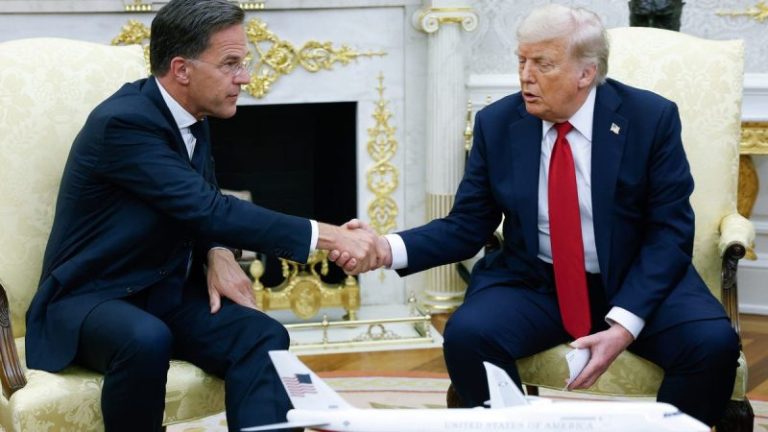
President Donald Trump met with NATO Secretary-General Mark Rutte Wednesday — days after Ukrainian President Volodymyr Zelenskyy visited the White House andafter calling off a meeting with Russian President Vladimir Putin.

‘We canceled the meeting with President Putin,’ Trump told reporters in the Oval Office with Rutte Wednesday. ‘It just it didn’t feel right to me. It didn’t feel like we were going to get to the place we have to get. So I canceled it. But we’ll do it in the future.’ 

Trump also shed insight into why he isn’t interested in arming Ukraine with Tomahawk missiles, after indicating earlier in October he might do so. 

‘There is a tremendous learning curve with the Tomahawk. It’s a very powerful weapon, very accurate weapon,’ Trump said. ‘And maybe that’s what makes it so complex. But it will take a year. It takes a year of intense training to learn how to use it, and we know how to use it. And we’re not going to be teaching other people. It will be just too far out into the future.’ 

Rutte said he visited the White House to discuss ways to end the war, although he said ‘no peace plan is on the table.’ 

‘That’s why I’m here — to dialog again with the president … how NATO, my colleagues and other colleagues in NATO can be of maximum support to get that,’ Rutte said. 

NATO announced Tuesday that Rutte would visit Washington Wednesday, as Trump has said he wants to direct his focus on ending the conflict between Russia and Ukraine following the ceasefire deal in the Middle East. 

Ahead of his arrival at the White House, Rutte said that Wednesday’s White House visit aimed to build on the momentum after securing the peace agreement in the Middle East. 

‘I was texting with the president after an enormous success in Gaza, and we said, ‘Hey, let’s have a meeting in Washington to discuss how we now can deliver his vision of peace in Ukraine,’’ Rutte told reporters on Capitol Hill Wednesday after meeting with lawmakers, according to The New York Times.

‘I have total confidence in President Trump. He’s the only one who can get this done,’ Rutte said. 

Rutte has visited the White House on several occasions during Trump’s second term, including in July and also in August after Trump’s Alaska summit with Putin. NATO has backed Ukraine since Russia first invaded, and has provided Kyiv with military equipment and other assistance since 2022. 

In August, Rutte and other European leaders joined Zelenskyy in an effort to advance peace talks to end the war in Ukraine. At the time, Trump said that European nations would shoulder the bulk of the burden by providing Ukraine with security guarantees in an attempt to deter future aggression from Russia. 

As part of these security guarantees, Ukraine has sought to become a member of NATO during the peace negotiations. However, Trump has routinely ruled that out as a possibility. 

Meanwhile, Russia’s list of demands has historically included prohibiting Ukraine from ever joining NATO, and concessions on some land that previously belonged to Kyiv. 

Additionally, Rutte’s meeting comes after Trump appeared to throw cold water on any hopes that the U.S. would arm Ukraine with Tomahawk missiles, like Trump had said he was considering doing days ahead of Zelenskyy’s visit. 

‘I would much rather have them not need Tomahawks,’ Trump told reporters Friday. ‘I would much rather have the war be over to be honest, because we’re in it to get the war over.’ 

Additionally, Trump changed his tune on whether Ukraine would need to cede territory it had lost to Russia as part of a peace deal. Although Trump altered his position in September and said that Ukraine could secure back its lost territory, Trump reverted to his previously held position on the matter. 

‘They can negotiate something later on down the line,’ Trump told reporters Sunday. ‘But I said cut and stop at the battle line. Go home. Stop fighting, stop killing people.’

The change in tone came after Trump spoke with Putin Thursday and the two were originally slated to meet this month in Budapest. However, plans for the meeting were scrapped after Secretary of State Marco Rubio’s call with Russian Foreign Minister Sergey Lavrov. 

‘Secretary Rubio and Foreign Minister Lavrov had a productive call,’ a senior official said in a statement Tuesday to Fox News. ‘Therefore an additional in-person meeting between the Secretary and Foreign Minister is not necessary and there are no plans for President Trump to meet with President Putin in the near future.’ 

Meanwhile, Trump has recently cast doubt on whether Ukraine can defeat Russia. 

‘They could still win it. I don’t think they will, but they could still win it,’ Trump told reporters Monday. 

Fox News’ Gillian Turner and The Associated Press contributed to this report. 

This post appeared first on FOX NEWS

The Democrats, or Socialists, or whatever they are these days, are hopping mad over President Donald Trump’s construction of a ballroom in the East Wing of the White House, and while it may be their silliest freakout of the entire Trump era, it is also quite telling.

The ladies on ABC’s ‘The View’ were apoplectic when they saw images of demolition, a fairly ordinary way to begin renovations, at 1600 Pennsylvania Avenue. They echoed one-time resident Hillary Clinton’s complaint that Trump doesn’t own the White House, even taking to song about it.

What makes this argument so absurd, is that Trump is not building this ballroom for his personal use or glory. It’s not a vanity project. It is a long-considered addition to an executive home that lacked the capacity to hold large indoor events.

Trump, as has always been his wont, is looking to create grandeur, and that seems to be something to which leftists reflexively object.

Trump is obviously not the first president to renovate the White House. President Franklin Delano Roosevelt put in a swimming pool. His successor, President Harry Truman, practically gutted the place to add a balcony. President Nixon covered the swimming pool but added a bowling alley. Finally, President Obama transformed the tennis court into a basketball court.

Note that these are all changes that were made to serve the respective president’s personal taste or enjoyment, like a Roman emperor adding a water feature to his personal dining area.

What Trump is doing is completely different. The ballroom he is constructing will likely survive as a symbol of American power long after we are all gone. It will be, in a sense, our generation’s contribution to the people’s home.

Trump wants this venue, this symbol of America, to be grand and classically inspired, a timeless marble monument to a United States that emerged from the 20th century as the world’s only super power.

And in a way, this is part of what the left objects to, not just in regard to the White House project, but to Trump’s proposed new arch in Washington, D.C., and great statuaries of American heroes, not to mention the recent massive military parade.

In the post-Cold War era, part of America’s international style and sensibility was to be understated. Like the star quarterback who is also a model and a chess prodigy, we learned not to rub it in.

In that time, very little public art or architecture was done on a grand and classic scale, and in more recent times, our society has been so hellbent on taking statues and monuments down, that we gave little thought to putting them up.

Trump instinctively understands that in 2025, America may still be the world’s only superpower, but not by so hegemonic a distance as in the recent past. China, among others have been catching up, and the ‘aw, shucks’ attitude of the past needs some adjusting.

World leaders as well those on public White House tours should have their breath taken away when they walk into the presidential ballroom. Such displays are as old as nations themselves, from the pyramids to the Coliseum, it’s nothing to be ashamed of.

Though this expansion of the White House would be well worth taxpayer money, Trump has found a way to build it with private donations, as well as his own funds. Still the left is throwing a fit. Why?

Recent polling showed that only 36% of Democrats are very, or even just somewhat, proud of America. This being the case, it’s easy to understand why they object to building testaments to its power and glory.

What Democrats and socialists are really objecting to here is not that Trump’s ballroom celebrates himself, it’s that his ballroom unabashedly celebrates America.

Fifty years from now, when King George VII of Great Britain dines at the White House, people will little remember that it was built by Trump, even if all the gold leaf remains. By then, it will simply be a great piece of American architecture we can all be proud of.

Americans want and deserve a big, beautiful ballroom for their nation’s executive mansion, and there has never been a president more capable of delivering it than our real estate mogul-in-chief.

Liberals can stamp their feet in anger all they want. But the ballroom is going to be built, and eventually, most of them will come to appreciate it.

This post appeared first on FOX NEWS

(TheNewswire)

Brossard (Québec), le 18 septembre 2025 – TheNewswire CORPORATION CHARBONE HYDROGÈNE (TSXV: CH,OTC:CHHYF , OTCQB: CHHYF, FSE: K47 ) (« Charbone » ou la « Société »), une compagnie spécialisée dans la production et la distribution d’hydrogène vert, est heureuse d’annoncer la signature de débentures convertibles de remplacement d’un montant de 2 050 000 $ (l’ « Débentures de remplacement » ) en modifiant certaines modalités des débentures convertibles garanties de la Société (chacune, une « Débenture ») que la Société avait émises dans le cadre du placement privé de débentures d’un montant en principal total de 1 746 366 $ de débentures convertibles garanties à 12 %.

Avant l’entrée en vigueur des débentures de remplacement le 30 septembre 2025, les débentures étaient convertibles en actions ordinaires de Charbone (chacune, une « Action de Débenture »), à un prix de conversion par action de 0.10$, jusqu’à l’échéance.

En vertu des nouvelles Débentures de remplacement :

  • La date d’échéance a été prolongée des 30 septembre et 31 octobre 2025 au 30 septembre 2026 ;

  • Le solde convertible, passe de 1,7 millions de dollars à 2,1 millions de dollars au même taux annuel de 12 %, payable mensuellement ; et

  • Le prix de conversion des débentures passe de 0,10$ par action à 0,07$ par action

Les nouvelles Débentures de remplacement seront assujetties à l’approbation de la Bourse de croissance TSX.

Ces changements annoncés aujourd’hui aux débentures existantes offrent une nouvelle flexibilité de financement à Charbone en prolongeant considérablement les échéances et nous fournissent un financement supplémentaire pour compléter et exécuter l’acquisition de l’équipement opérationnel de production et de ravitaillement en hydrogène, annoncée le 5 septembre 2025 , a déclaré Benoit Veilleux, Chef de la direction financière et secrétaire corporatif de Charbone. À mesure que nous gagnons en élan, nous travaillons continuellement à optimiser notre structure de capital et à faire progresser nos avantages de pionnier ainsi que les intérêts de nos actionnaires .

À propos de Charbone Hydrogène Corporation

Charbone est une entreprise intégrée spécialisée dans l’hydrogène ultrapur (UHP) et la distribution stratégique de gaz industriels en Amérique du Nord et en Asie-Pacifique. Elle développe un réseau modulaire de production d’hydrogène vert tout en s’associant à des partenaires de l’industrie pour offrir de l’hélium et d’autres gaz spécialisés sans avoir à construire de nouvelles usines coûteuses. Cette stratégie disciplinée diversifie les revenus, réduit les risques et augmente sa flexibilité. Le groupe Charbone est coté en bourse en Amérique du Nord et en Europe sur la bourse de croissance TSX (TSXV: CH,OTC:CHHYF); sur les marchés OTC (OTCQB: CHHYF); et à la Bourse de Francfort (FSE: K47). Pour plus d’informations, visiter www.charbone.com .

Énoncés prospectifs

Le présent communiqué de presse contient des énoncés qui constituent de « l’information prospective » au sens des lois canadiennes sur les valeurs mobilières (« déclarations prospectives »). Ces déclarations prospectives sont souvent identifiées par des mots tels que « a l’intention », « anticipe », « s’attend à », « croit », « planifie », « probable », ou des mots similaires. Les déclarations prospectives reflètent les attentes, estimations ou projections respectives de la direction de Charbone concernant les résultats ou événements futurs, sur la base des opinions, hypothèses et estimations considérées comme raisonnables par la direction à la date à laquelle les déclarations sont faites. Bien que Charbone estime que les attentes exprimées dans les déclarations prospectives sont raisonnables, les déclarations prospectives comportent des risques et des incertitudes, et il ne faut pas se fier indûment aux déclarations prospectives, car des facteurs inconnus ou imprévisibles pourraient faire en sorte que les résultats réels soient sensiblement différents de ceux exprimés dans les déclarations prospectives. Des risques et des incertitudes liés aux activités de Charbone peuvent avoir une incidence sur les déclarations prospectives. Ces risques, incertitudes et hypothèses comprennent, sans s’y limiter, ceux décrits à la rubrique « Facteurs de risque » dans la déclaration de changement à l’inscription de la Société datée du 31 mars 2022, qui peut être consultée sur SEDAR à l’adresse www.sedar.com; ils pourraient faire en sorte que les événements ou les résultats réels diffèrent sensiblement de ceux prévus dans les déclarations prospectives.

Sauf si les lois sur les valeurs mobilières applicables l’exigent, Charbone ne s’engage pas à mettre à jour ni à réviser les déclarations prospectives.

Ni la Bourse de croissance TSX ni son fournisseur de services de réglementation (tel que ce terme est défini dans les politiques de la Bourse de croissance TSX) n’acceptent de responsabilité quant à la pertinence ou à l’exactitude du présent communiqué.

Pour contacter Corporation Charbone Hydrogène :

Téléphone bureau: +1 450 678 7171

Courriel: ir@charbone.com

Benoit Veilleux

Chef de la direction financière et secrétaire corporatif

Copyright (c) 2025 TheNewswire – All rights reserved.

News Provided by TheNewsWire via QuoteMedia

This post appeared first on investingnews.com

Venezuelan opposition leader María Corina Machado said she presented President Donald Trump with her Nobel Peace Prize medal, describing it as a historic gesture recognizing his commitment to freedom and the fight against tyranny.

Machado spoke with reporters outside the U.S. Capitol Thursday, when she was asked whether she offered her Nobel Peace Prize to Trump.

‘I presented the president of the United States the medal … the Nobel Peace Prize, and I told him, ‘Listen to this, 200 years ago, General Lafayette gave Simón Bolívar a medal with George Washington’s face on it,’ Machado said. ‘He kept that medal for the rest of his life. Actually, when you see his portraits, you can see the medal.’

She said Lafayette gave the medal to Bolívar as a symbol of the partnership between the people of the U.S. and the people of Venezuela and their shared fight for freedom against tyranny.

‘Two hundred years in history, the people of Bolívar are giving back the heir of Washington, a medal, in this case the medal of the Nobel Peace Prize, as a recognition for his unique commitment with our freedom,’ Machado said.

Machado’s meeting with Trump came nearly two weeks after the U.S. captured Venezuelan dictator Nicolás Maduro and amid lingering questions about her political future. The meeting also followed comments from Trump casting doubt on Machado leading the country rather than endorsing the Venezuelan opposition leader.

‘I think it would be very tough for her to be the leader,’ Trump told reporters Jan. 3. ‘She doesn’t have the support within or the respect within the country. She’s a very nice woman, but she doesn’t have the respect.’

The Washington Post previously reported Trump was annoyed Machado won the Nobel Peace Prize in 2025, an award he had hoped to receive and that Machado dedicated to him, though the White House said the president’s decisions were based on ‘realistic decisions.’

Still, Machado floated the idea of transferring the prestigious award to Trump last week during an appearance on Fox News’ ‘Hannity.’

‘Did you at any point offer to give him the Nobel Peace Prize?’ Sean Hannity asked. ‘Did that actually happen?’

Machado responded, ‘Well, it hasn’t happened yet.’

‘I certainly would love to be able to personally tell him that we believe — the Venezuelan people, because this is a prize of the Venezuelan people — certainly want to give it to him and share it with him,’ Machado continued. ‘What he has done is historic. It’s a huge step toward a democratic transition.’

Despite her intent, the Norwegian Nobel Institute shut down the idea last Friday.

‘Once a Nobel Prize is announced, it cannot be revoked, shared or transferred to others,’ the institute said in a statement. ‘The decision is final and stands for all time.’

Fox News Digital has reached out to the White House for a reaction.

Fox News Digital’s Michael Sinkewicz contributed to this report.

This post appeared first on FOX NEWS