Author

admin

Browsing

Sen. Lindsey Graham warned that the U.S. mission in Venezuela must end with Nicolás Maduro removed from power, arguing that leaving the embattled leader in place after a major U.S. show of force would be a ‘fatal mistake to our standing in the world.’

‘If after all this, we still leave this guy in power… that’s the worst possible signal you can send to Russia, China, Iran,’ Graham, R-S.C., told reporters after a classified all-senator briefing with War Secretary Pete Hegseth and Secretary of State Marco Rubio.

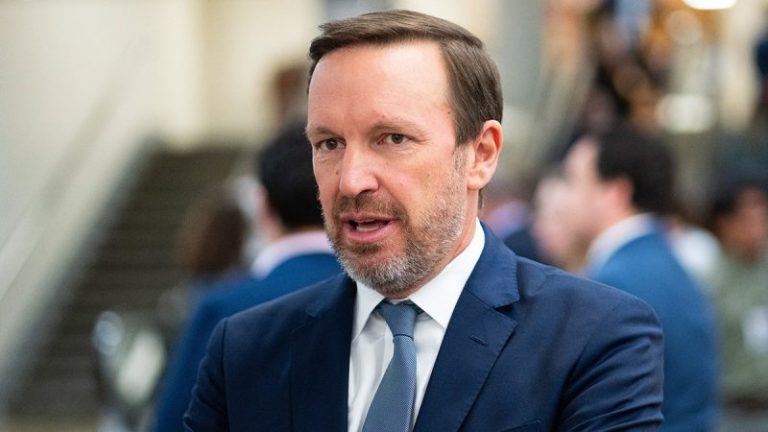
Trump administration officials did not say whether a series of narco-strikes in the Caribbean could escalate into direct strikes against Venezuelan territory or a broader campaign to oust Maduro. Sen. Richard Blumenthal, D-Conn., told Fox News Digital the briefing was ‘absent of specificity and detail’ and left ‘more questions than answers.’

‘I want to reassert, again, you cannot allow this man to be standing after this display of force, and I did not get a very good answer as to what happens,’ Graham said. ‘What I want is some clarity going forward. Is that in fact the goal?… If it’s not the goal, it is a huge mistake.’

Rep. Don Bacon, R-Neb., said he heard from briefers that there is a ‘very good process of determining if something’s a target or not’ before striking narco-trafficking boats, but the administration did not clarify its broader strategy toward the Maduro regime. 

‘Right now the focus has been on the boats,’ Bacon said. ‘I don’t know what we’re doing yet with Venezuela writ large.’

Rep. Gregory Meeks, D-N.Y., said the classified session also failed to address core questions. 

‘I actually think that was, for me, more of an exercise in futility. I really have no answers. Really didn’t gain anything more than what the public already has gotten,’ he said. He added that there was ‘really no conversation about why… we got 15,000 troops there,’ arguing the deployment ‘doesn’t seem to be just about narcotics trafficking.’ 

Meeks said briefers provided ‘no real rational decision or real answers’ about whether the U.S. is preparing for ‘a war in Venezuela,’ raising what he described as a pressing war powers issue. He said he plans to bring forward legislation this week addressing the recent strikes ‘in the Pacific, in the Caribbean’ as well as any potential move by Trump ‘to go into Venezuela.’

Rubio told reporters the mission is ‘focused on dismantling the infrastructure of these terrorist organizations that are operating in our hemisphere, undermining the security of Americans, killing Americans, poisoning Americans.’

Hegseth told reporters the War Department would not release video footage of the Sept. 2 narco-strikes — in which Adm. Frank Bradley ordered a ‘double tap’ strike to kill survivors — to the public. The video will instead be shown to the House and Senate Armed Services Committees.

Graham dismissed the footage as ‘the least of my concerns’ but said he urged Hegseth to release it so Americans could ‘make your own decisions.’

Hegseth and Rubio’s briefing came as the U.S. undertakes its largest military buildup in the region in decades: 15% of all naval assets are now positioned in the Southern Command theater. Graham cited the deployment as evidence that anything short of Maduro’s removal would undermine U.S. credibility. 

‘It got, yeah, 15% of the Navy pointed to this guy,’ he said.

Graham also pointed to historical precedent, arguing the U.S. has acted similarly when confronting hostile or destabilizing regimes. 

‘We have legal authority, in my view, to do in Venezuela what we did regarding Panama and Haiti,’ he said, recalling that in 1989 the U.S. ‘literally invaded Panama… took the president in power and put him in jail.’

He said he believes Trump intends a comparable outcome. 

‘Every indication by President Trump is that the purpose of this operation is to shut down the (Maduro) regime and replace it with something less threatening to the United States,’ Graham said.

Pressed on whether he meant regime change or lethal force, Graham replied: ‘I don’t care as long as he leaves.’

The public is now waiting to see whether the Trump administration will turn to direct strikes on Venezuelan territory as a means of pressuring Maduro to leave power — a step Graham argued is necessary for the operation to succeed.

This post appeared first on FOX NEWS

Ukrainian President Volodymyr Zelenskyy on Saturday outlined firm conditions for a ‘real peace’ ahead of a high-stakes meeting with President Donald Trump on Monday.

Zelenskyy posted to X following his call with Trump and then with European leaders, after Trump and Russian President Vladimir Putin met in Alaska to try and bring about an end to the 3 ½ year war.

‘The positions are clear. A real peace must be achieved, one that will be lasting, not just another pause between Russian invasions,’ Zelenskyy wrote.

‘Killings must stop as soon as possible, the fire must cease both on the battlefield and in the sky, as well as against our port infrastructure. All Ukrainian prisoners of war and civilians must be released and the children abducted by Russia must be returned.’

Zelenskyy wrote that thousands of Ukrainians remain in captivity and must all be released, while adding that pressure on Russia must be maintained while the ‘aggression and occupation continue.’

In a follow-up post, Zelenskyy warned of Russian ‘treachery’ that could lead to attacks in order to gain leverage amid ongoing negotiations.  

‘Based on the political and diplomatic situation around Ukraine, and knowing Russia’s treachery, we anticipate that in the coming days the Russian army may try to increase pressure and strikes against Ukrainian positions in order to create more favorable political circumstances for talks with global actors,’ he wrote. 

Zelenskyy is scheduled to meet with Trump in the White House on Monday as the three nations try and bring an end to the bloodshed.

Trump wrote on Truth Social following the Putin meeting that he felt a peace agreement, rather than a ceasefire, was ultimately the best way to solve the war. Trump had been calling for a ceasefire ahead of his meeting with Putin. 

‘It was determined by all that the best way to end the horrific war between Russia and Ukraine is to go directly to a Peace Agreement, which would end the war, and not a mere Ceasefire Agreement, which often times do not hold up,’ Trump wrote.

He said if Monday’s meeting with Zelenskyy also goes well, a meeting will be scheduled with Putin and ‘potentially, millions of people’s lives will be saved.’

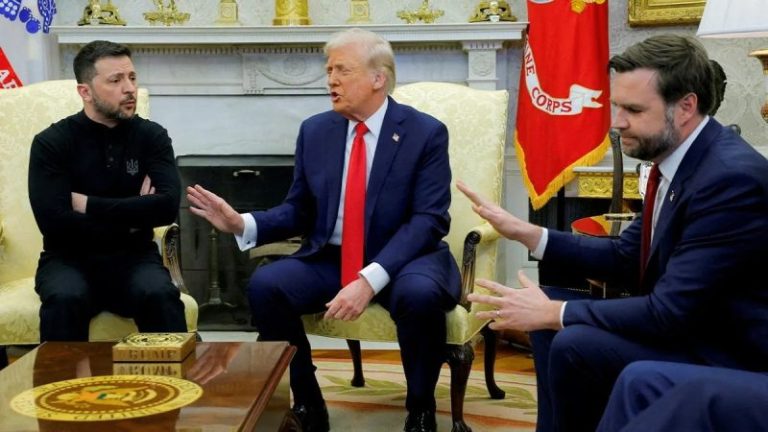
Zelenskyy’s visit will mark his first return to the Oval Office since February, when Trump berated him publicly for being ‘disrespectful’ during a remarkable press briefing, which led to the collapse of a U.S.-Ukraine minerals deal.

Though a peace agreement was not decided upon during the meeting on Friday, Trump described it as a successful meeting with ‘a lot of progress’ made. Putin expressed similar sentiments, adding the summit was a ‘constructive atmosphere of mutual respect.’

After his meeting with Putin, Trump also spoke to European leaders, who said they back Trump’s peace push but insist Ukraine must have ‘ironclad’ security guarantees to defend its sovereignty and territorial integrity.

The European leaders did not address whether a peace deal was preferable to a ceasefire.

‘It will be up to Ukraine to make decisions on its territory. International borders must not be changed by force,’ a statement signed by various leaders, including French President Emmanuel Macron, U.K. Prime Minister Keir Starmer and European Commission President Ursula von der Leyen.

‘No limitations should be placed on Ukraine’s armed forces or on its cooperation with third countries. Russia cannot have a veto against Ukraine‘s pathway to EU and NATO.’

During an interview with Fox News before returning to Washington, Trump insisted the onus going forward might be on Zelenskyy ‘to get it done,’ but said there would also be some involvement from European nations.

Fox News’ Elizabeth Pritchett and The Associated Press contributed to this report. 

This post appeared first on FOX NEWS

Congressional Democrats remained skeptical that any progress toward an end to the war in Ukraine would be made ahead of the meeting between President Donald Trump and Russian President Vladimir Putin.

The high-stakes meeting in Anchorage, Alaska, comes as lawmakers have grown anxious to see an end to the conflict between Russia and Ukraine, and with many ready to slap a bone-breaking sanctions package on Moscow and its allies unless Putin relents.

But Democrats are not so sure that Trump will yield results in his closed-door meeting with Putin, the first between U.S. and Russian leaders since the invasion of Ukraine in 2022.

‘I fear this meeting could once again end with America ceding ground to an autocrat who has spent his career undermining democratic values,’ Sen. Mark Warner, D-Va., and the top Democrat on the Senate Intel Committee, said.

He warned that there could be no concessions without Ukraine’s involvement, Russia’s withdrawal from Ukrainian territory and ‘enforceable guarantees’ for Ukraine’s security.

‘Anything less would be an invitation for further aggression from Moscow and every autocrat watching to see if the United States still has the backbone to defend the principles that have kept Americans safe since the Second World War,’ he said.  

House Minority Leader Hakeem Jeffries, D-N.Y., accused Trump of previously ‘playing footsie’ with Putin, but noted that it appeared that the president’s disposition toward his Russian counterpart had shifted.

He added that last year, House Democrats and Republicans worked together to pass another military aid package for Ukraine, and likened it to a ‘Churchill or Chamberlain moment.’

‘We are either going to appease the dictator or we’re going to aggressively oppose the dictator,’ Jeffries said. ‘And as we saw with Chamberlain, appeasing the dictator never works.’

Trump himself sought to set expectations for the summit, telling Fox News Radio earlier this week that there would be a 25% chance that the meeting would end in failure.

And aboard Air Force One, Trump told reporters that he wanted to ‘see a ceasefire rapidly.’

‘I don’t know if it’s going to be today, but I’m not going to be happy if it’s not today,’ he said. ‘Everyone said it can’t be today, but I’m just saying I want the killing to stop.’

The Trump administration has threatened to slap secondary tariffs on India, a major buyer of Russian oil, if the meeting did not go well. That comes after Trump gave Putin a 50-day deadline to reach a ceasefire agreement, which the president recently shortened to ’10 or 12′ days.

Sen. Jeanne Shaheen, the top Democrat on the Senate Foreign Intelligence Committee, told reporters that ‘people have been willing to give the White House and the president the benefit of the doubt.’

‘But if he doesn’t produce anything at this summit, after drawing red line after red line … there will be growing concern and a growing pressure to try and get something done,’ the New Hampshire Democrat said.

One area where many lawmakers in the upper chamber agree is the necessity for a sanctions package against Russia. Currently, Sens. Lindsey Graham, R-S.C., and Richard Blumenthal, D-Conn., have a bill in the works that would slap up to 500% tariffs on countries buying energy products from Moscow.

Blumenthal told MSNBC earlier this week if Trump stood firm and insisted on a ceasefire, Putin come to the table with European leaders and secure security guarantees ‘he has the makings of a potential agreement that could win him the Nobel Peace Prize.’

‘But my fear is that he will be the mercurial Donald Trump who allowed the deadline for sanctions to pass last Friday without any imposition of new levies on Russia, and that he will fail to adhere to those principles adopted yesterday by the European countries in their meeting,’ he said. 

This post appeared first on FOX NEWS

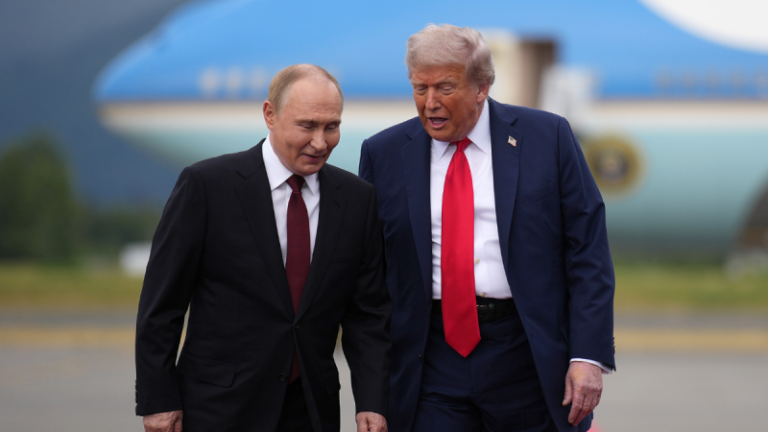
As President Donald Trump greeted Russian President Vladimir Putin on the tarmac at Joint Base Elmendorf-Richardson, a B-2 stealth bomber soared overhead, flanked by four F-35 jets. 

Putin looked up at the sky as the planes buzzed overhead while he walked alongside Trump, and then made a comment to the U.S. president. 

The display was as much a symbol as it was a show of force—a pointed reminder of America’s military reach at the very moment the two leaders prepared to discuss the future of global security.

The dramatic arrival underscored the high-stakes nature of the Alaska summit, the first face-to-face meeting between Trump and Putin since Trump’s return to the White House earlier this year. Joint Base Elmendorf-Richardson, situated just outside Anchorage, was chosen for its robust security, strategic location, and symbolic position—physically closer to Russia than Washington, D.C., yet firmly on American soil.

Onlookers in Anchorage and across social media quickly seized on the moment. Many called it an ‘insane flex,’ noting the B-2 bomber’s recent combat history.

Only two months ago, the stealth aircraft played a central role in U.S. and Israeli strikes on Iranian nuclear facilities, dropping bunker-buster bombs in a move that drew both praise and condemnation on the world stage.

The B-2 Spirit, built by Northrop Grumman, is one of the most advanced aircraft ever created—capable of penetrating dense air defenses and striking targets anywhere in the world without refueling. Its distinctive flying-wing design and radar-absorbent coating make it nearly invisible to enemy radar. 

With a range of over 6,000 nautical miles and the ability to carry both conventional and nuclear weapons, the B-2 serves as a critical component of America’s nuclear triad. Only 21 were ever built, and fewer than 20 remain in service, making any public appearance a rare and deliberate statement.

‘Absolutely incredible,’ wrote one X user. Another added, ‘Putin now knows what will be greeting him if he were to ever cross that line that should never be crossed.’

After the brief tarmac ceremony, Putin entered ‘The Beast’ alongside Trump. The heavily armored presidential limousine rolled past a row of American fighter jets lined up in silent formation, their presence another visual reminder of the stakes surrounding the talks.

The two leaders traveled to a secure meeting hall on the base, beginning discussions at about 3:30 p.m. Eastern Time. Trump has said he plans to ‘set the table’ during the meeting for a future summit that includes Ukrainian President Volodymyr Zelenskyy. But still, he told Fox News’ Bret Baier he ‘won’t be happy’ if Putin does not agree to a ceasefire in Ukraine. 

This post appeared first on FOX NEWS

It was a made-for-TV moment: The two leaders met on the tarmac at Joint Base Elmendorf–Richardson in Anchorage, Alaska, Air Force One and two F-35 fighters in the background. As they walked together, overhead came the roar of those F-35s, followed by the low, almost ghostly sweep of a B-2 stealth bomber — a display of U.S. airpower as much as a nod to the Cold War history between the nations.

Hours later, after their closed-door discussions, President Donald Trump and Russian President Vladimir Putin appeared again — this time on a raised stage, each behind a podium, U.S. and Russian flags flanking both sides, with a blue backdrop behind them that read ‘Pursuing Peace.’ It was the first U.S.-hosted summit between American and Russian presidents on U.S. military soil.

Trump had spent days rehearsing via secure calls with European leaders and Ukrainian President Volodymyr Zelenskyy, coordinating ‘red lines’ to take into the meeting: no territorial concessions to Russia, Ukraine in the room for all negotiations, and clear conditions for any sanctions relief. Yet, despite the military pomp and the careful stagecraft, what emerged from Alaska was not a deal, but a diplomatic pause — warm words, thin details, and the hard work still ahead.

Putin spoke first, describing the talks as ‘constructive and mutual respect.’ He recalled moments in history when the U.S. and Russia ‘worked together’ and said he sought a ‘long-term settlement.’ He acknowledged Russia’s ‘legitimate concerns’ and said it was ‘very important for our countries to turn the page.’ He described a ‘trustworthy tone’ in the conversation and praised Trump for having ‘a good idea of what he wants.’ In a line clearly aimed at the cameras back home, Putin claimed Trump told him that if he had been president earlier, ‘there would not have been war,’ and confirmed that he believed it was true.

Trump followed, also taking no questions. ‘We had productive meetings,’ he said. ‘Big agreements. No deal until there is a deal.’ He promised to call ‘NATO,’ to ‘call Zelenskyy,’ and declared, ‘We really made great progress today.’ He reminded the audience of his ‘fantastic relationship with Putin’ and judged there was ‘a good chance of getting there,’ even if ‘we’re not there yet.’ Most importantly, Trump said, ‘We need to stop thousands of people being killed every week.’

For all the positive tone, the substance was modest. Putin left Alaska dangling the prospect of a ceasefire — but with strings attached. We know from prior statements that he wants the U.S. to lift certain sanctions and drop tariff threats aimed at countries like India that buy Russian energy. He intends to keep control of two eastern Ukrainian provinces seized in 2022. Likely, Trump did not concede those points, but evidently they agreed to a follow-on meeting ‘soon.’ 

While the flags fluttered in Anchorage, the war did not stop. Russian forces pressed forward modestly near Dobropillia in Donetsk region, testing Ukrainian defenses in what looks like an attempt to improve their tactical position before any pause. Ukraine rushed reinforcements, stabilizing the line for now, but fighting remains intense.

Russia’s long-range bombardment shows no sign of abating. In July alone, Moscow launched more than 70 cruise missiles and thousands of Iranian-made Shahed drones at Ukrainian targets. Ukraine has answered with deep strikes — including a hit on a Russian oil refinery and the bombing of a cargo ship carrying drone parts in the Caspian Sea. Neither side is behaving as if the war’s end is imminent.

That’s why any ceasefire talk must be backed by ironclad verification: neutral observers on the ground, satellite surveillance, clearly mapped lines, and automatic ‘snap-back’ sanctions for violations. Without that, Moscow will have every incentive to rearm under the cover of diplomacy.

If nothing else, Alaska revealed the bottom lines.

For Putin, it’s about locking in territorial gains and relieving the economic pressure eroding his war machine. Rolling back sanctions on countries that help him skirt restrictions would boost his revenues and signal to others that U.S. economic warfare is negotiable.

For Trump, it’s about testing whether Putin can be moved toward de-escalation without sacrificing U.S. credibility. Involving Zelenskyy keeps Ukraine’s fate from being decided in absentia, and reaffirming NATO’s support reassures allies.

For Ukraine, it’s a double-edged sword. A follow-on meeting offers a diplomatic opening, but Putin’s explicit territorial demands remain a political, legal, and moral red line.

Washington must resist trading sanctions relief for vague promises. The sanctions regime is one of the few levers that works, and any easing must be tied to measurable, sustained compliance verified by independent intelligence as well as neutral monitors.

Putin leaves Alaska with the optics of being a willing negotiator — useful for his domestic image — but no immediate relief on sanctions or Western recognition of his land grabs. Expect him to probe Western unity with limited escalations in the next two weeks.

Kyiv has a brief window to reinforce its defenses and prepare a clear case for the next meeting: explicit security guarantees, timetables for arms deliveries, and a non-negotiable stance on sovereignty.

Allied capitals can point to a small win: the U.S. did not cut a side deal. But they must be ready to step up enforcement and fill any gaps if U.S. resolve wavers.

Beijing will study Alaska closely. If the West blinks on sanctions enforcement, it could embolden Chinese adventurism in the Pacific. A unified Western stand would send the opposite message.

If the U.S. wants these ceasefire talks to go anywhere, three steps are essential:

  1. Lock in Enforcement MechanismsBuild a monitoring framework that combines neutral observers, allied intelligence, and technological oversight. Make violations costly and automatic to deter cheating.
  2. Keep Ukraine at the Center‘No decision about Ukraine without Ukraine’ must remain non-negotiable. Zelensky needs a real voice and veto over any territorial terms.
  3. Use Sanctions as Leverage, Not CurrencyAny relief should be phased, conditional, and reversible. Sanctions should be the reward for sustained compliance, not an upfront concession.

The Alaska summit was not the breakthrough some hoped for, but it wasn’t a failure, either. It gave both sides a clearer picture of the negotiating terrain and bought time for positioning. But time favors the side that uses it best.

For the United States, that means holding firm on sanctions, bolstering Ukraine’s defenses, and treating any ceasefire as the start of a rigorous verification process, not the war’s conclusion. For Ukraine, it means preparing for two divergent paths: meaningful diplomacy or intensified conflict. For Russia, it means deciding whether continued war is worth the mounting cost when the West refuses to pay in land.

If Alaska was merely a pause, the next meeting will decide whether it becomes a bridge to peace — or a bridge to nowhere.

This post appeared first on FOX NEWS

Russian President Vladimir Putin said he agreed with Donald Trump’s claim that the war in Ukraine would not have ever even begun if he had not lost the 2020 election and was serving as president when the carnage began, instead of former President Joe Biden.  

‘I can confirm that,’ Putin said at the tail-end of a press conferece that took place Friday evening after the pair met for a summit at Joint Base Elmendorf-Richardson in Anchorage, Alaska. 

Trump made the assertion multiple times on the campaign trail, and continued saying it after he took back the White House. Trump has faced pushback on the claim, as well as on claims that Ukraine instigated the war’s inception and the Biden administration failed to do things that could have thwarted it from beginning in the first place.

‘I’d like to add one more thing,’ Putin said, as the two heads of state provided remarks to the press, according to a translation of the Russian president’s address. ‘I’d like to remind you that in 2022, during the last contact with a previous administration, I tried to convince my previous American colleague that the situation should not be brought to a point of no return when it would come to hostilities and I said it quite directly back then that it’s a big mistake. Today, when President Trump is saying that if he was the president back then there would be no war – I am quite sure that it would indeed be so. I can confirm that.’

Earlier in his address, Putin lamented that bilateral relations between the U.S. and Russia, prior to Trump, had ‘fallen to the lowest point since the Cold War,’ and highlighted the fact that there have been no summits between the U.S. and Russia over the last four years.

‘That’s not benefiting our counties and the world as a whole,’ Putin said, adding that it was ‘apparent that sooner or later [U.S. and Russia] had to amend the situation to move on from the confrontation to dialogue.’

Meanwhile, Putin praised Trump for ‘his strive to get to the crux of the matter and to understand this history,’ referring to the backstory surrounding the war. He called the commitment ‘precious.’ 

The Russian president also remarked during his address that he hopes this new chapter of foreign diplomacy under Trump will ‘help us rebuild and foster mutually beneficial and equal ties at this new stage, even during the hardest conditions.’

‘Overall, me and President Trump have built a very good business-like and trustworthy contact, and have every reason to believe that moving down this path we can come to the end of the conflict in Ukraine,’ Putin said Friday. 

The optics of Trump’s meeting with Putin were slammed by critics, who compared the scene Friday to when Ukrainian President Volodymyr Zelenskyy met with Trump at the White House. 

The infamous meeting saw Zelenskyy publicly argue back-and-forth with Trump and other top leaders in the administration, as President Trump criticized the Ukrainian president for his approach to ending the war.

‘Biden could’ve stopped it, Zelenskyy could’ve stopped it, and Putin should’ve never started it,’ Trump said in April about the war in Ukraine.

This post appeared first on FOX NEWS

A federal judge on Tuesday said he was ‘inclined to deny’ a bid to force the Trump administration to halt construction of the White House ballroom but warned officials not to undertake any irreversible work before a January hearing that could still stop the project.

U.S. District Judge Richard Leon said he will hold another hearing during the second week in January and hinted he may still order a pause.

‘Any below ground construction’ in the coming weeks that dictates above-ground work should be avoided, Leon said, adding, ‘be prepared to take that down.’

Lawyers for the National Trust for Historic Preservation in the U.S. argued the case is not about the need for a ballroom but about the need to follow the law.

They said any construction on federal land requires congressional approval.

Lawyers representing the National Park Service countered that President Trump has authority to direct construction at the White House, saying ‘work must continue for national security issues.’

‘See you in January,’ Leon said as he warned the government not to pursue anything irreversible.

Attorney General Pam Bondi weighed in Tuesday evening.

‘Today @TheJusticeDept attorneys defeated an attempt to stop President Trump’s totally lawful East Wing Modernization and State Ballroom Project,’ she wrote on X. ‘President Trump has faced countless bad-faith left-wing legal attacks – this was no different. We will continue defending the President’s project in court in the coming weeks.’

On Monday, the Trump administration argued in a court filing that pausing construction would undermine national security, citing a Secret Service declaration warning that halting work would leave the site unable to meet ‘safety and security requirements’ necessary to protect President Donald Trump.

The declaration said the East Wing, demolished in October and now undergoing below-grade work, could not be left unfinished without compromising essential security measures.

The National Trust for Historic Preservation sued last week to stop the project, arguing the government had to follow federal review procedures before any irreversible work began.

The group said the proposed 90,000-square-foot addition, now estimated at more than $300 million, would overwhelm the Executive Residence and permanently alter the White House’s historic design.

The administration countered that the lawsuit was premature, noting regulatory reviews were still coming and above-grade construction was not scheduled to begin until April 2026.

The National Trust said early intervention was necessary, citing warnings from architectural historians who said the ballroom would mark the most significant exterior change to the White House in more than 80 years.

Fox News Digital’s Ashley Carnahan contributed to this report.

This post appeared first on FOX NEWS

Ukrainian President Volodymyr Zelenskyy said on Saturday he will travel to Washington, D.C. on Monday to meet with President Donald Trump.

Zelenskyy’s announcement comes a day after Trump met with Russian President Vladimir Putin in Alaska on Friday to negotiate an end to the war in Ukraine.

‘On Monday, I will meet with President Trump in Washington, D.C., to discuss all of the details regarding ending the killing and the war. I am grateful for the invitation,’ Zelenskyy wrote on X.

This is a breaking news story. Check back for updates.

This post appeared first on FOX NEWS

The leaders of Armenia and Azerbaijan brushed off any threat of backlash from neighboring powers Iran and Russia following a U.S.-brokered peace accord – an agreement hailed as the start of a new era, ending more than three decades of war and hostility in the South Caucasus.

In exclusive Fox News Digital interviews, Armenian Prime Minister Nikol Pashinyan and Azerbaijani President Ilham Aliyev both praised President Donald Trump and his envoy for their role in brokering the framework agreement. They emphasized that the deal, which promised increased regional economic integration and political cooperation, is not directed at any third party – and may actually provide strategic advantages to Moscow and Tehran.

‘This is not a zero-sum game,’ Pashinyan said. The agreement ‘contains quite tangible benefits for Iran and for Russia as well.’

‘Iran would have access through railway from the Persian Gulf to the Black Sea and Russia and Iran will have opportunity to have a railway connection between the two countries.’

Russia – a long-standing ally of Armenia and a presence in the region through its border guards – welcomed peace but sent a warning about U.S. involvement. Its foreign ministry described the accord as ‘positive,’ expressing hope for stability in the Caucasus, but warned that foreign involvement should complement, not complicate, the peace process. 

The ministry emphasized that regional solutions should include neighbors like Russia, Iran and Turkey, and cautioned against repeating the pitfalls of Western-led interventions in the Middle East.

Aliyev echoed Pashinyan’s remarks and declined to see U.S. diplomatic involvement as a provocation toward Moscow. 

‘It will be very difficult for any country – whether far away or in our region – to say something bad about today’s agreement,’ he told Fox News Digital.’We’ve taken the final step toward peace.’ 

He added: ‘It’s not against anyone. It’s a connectivity project which will be one of the most important parts of international transportation.’

At the heart of the pact is the planned Trump Route for International Peace and Prosperity (TRIPP) – a roughly 27-mile transit route linking mainland Azerbaijan with its Nakhchivan exclave, passing through Armenian territory. Armenia has granted the U.S. exclusive development rights via a 99‑year lease, allowing for infrastructure projects such as roads, rail lines, pipelines, fiber optics and possibly power transmission, aimed at opening new trade and transit paths in the region.

This bold move shifts regional dynamics, offering Washington a powerful strategic foothold while bypassing traditional Russian and Iranian routes.

Iran, in contrast, has responded with hostility. 

Ali Akbar Velayati, a key advisor to Iran’s supreme leader, warned of serious consequences if the ‘Zangezur Corridor’ – as Iran calls the route – is enacted, asserting that it ‘will not become a passage owned by Trump, but rather a graveyard for Trump’s mercenaries,’ according to the semi-official news agency Tasnim.

Iran has even signaled readiness to use military means to block the route. 

Domestically, Pashinyan faces opposition. Armenian nationalists, already fierce critics of any deal with Azerbaijan, view the agreement as a betrayal. The Republican Party of Armenia has declared that Pashinyan lacks the mandate to sign such a treaty, demanding full transparency and an end to concessions made under external pressure.

Pashinyan, however, is undeterred. He said the accord could transform Armenia’s investment climate and attract foreign capital. 

‘We expect to have some criticism, and that’s part of democracy,’ he told Fox News Digital. ‘But we are confident we made the right decision.’ 

Once the dominant power in the South Caucasus, Russia is losing its grip. The war in Ukraine, mounting sanctions and resource strains have depleted its regional influence, enabling the U.S., Turkey and the European Union to expand their diplomatic reach.

Relations with Azerbaijan particularly soured following the December 2024 downing of Azerbaijan Airlines Flight 8243. Aliyev accused Moscow of accidentally shooting the passenger jet with Russian air defenses during operations against Ukrainian drones, killing 38 people. 

Aliyev told Fox News Digital he didn’t believe the incident was an intentional attack by Russian leadership, but demanded a formal admission of guilt, punishment for those responsible and full compensation – moves Russia has resisted, apologizing only vaguely for what they called a’tragic incident.’

And amid political divisions, Pashinyan finds himself in a conflict with one of the country’s most respected institutions  – the Armenian Apostolic Church, where figures like Archbishop Bagrat Galstanyan have led public protests against Pashinyan’s decision to return border villages to Azerbaijan.

On June 25, authorities arrested Galstanyan, a leading figure in the church and of the ‘Sacred Struggle’ opposition movement, accusing him of orchestrating a terrorist plot to overthrow the government. Armenia’s Investigative Committee alleged he had recruited more than 1,000 former police and military personnel to stage bombings, disrupt power grids and paralyze transportation networks. 

Pashinyan assured that the judiciary system acted independently of his government and ‘in full accordance with the law of Armenia, respecting all the rights of all people.’

This post appeared first on FOX NEWS

Smithsonian museums must represent the U.S. in a ‘fair’ manner and portray both the good and the bad of American history, according to President Donald Trump. 

Trump made his comments after the White House sent a letter to the Smithsonian Tuesday unveiling plans to conduct a review of its museums and exhibits in preparation for the 250th birthday of the United States in 2026.

‘We want the museums to treat our country fairly,’ Trump told reporters Thursday. ‘We want their museums to talk about the history of our country in a fair manner, not in a woke manner or in a racist manner, which is what many of them, not all of them, but many of them are doing.’ 

‘Our museums have an obligation to represent what happened in our country over the years. Good and bad,’ Trump said. ‘But what happened over the years in an accurate way.’ 

The Smithsonian told Fox News Digital it was reviewing the Trump administration’s letter and would work with the White House, Congress and its governing Board of Regents moving forward. 

‘The Smithsonian’s work is grounded in a deep commitment to scholarly excellence, rigorous research and the accurate, factual presentation of history,’ the Smithsonian said in a statement. 

Stephen Miller, White House deputy chief of staff, weighed in on the matter earlier Thursday, saying left-wing activists had ‘obscenely defaced’ the museum. 

‘The Smithsonian is supposed to be a global symbol of American strength, culture and prestige,’ Miller posted to X Thursday. ‘A place for families and children to celebrate American history and greatness. Instead, the exhibits have clearly been taken over by leftwing activists who have used the Smithsonian as yet one platform to endlessly bash America and rewrite / erase our magnificent story.

‘These activists have obscenely defaced this beloved institution,’ Miller added. ‘The Trump Administration will proudly and diligently restore the patriotic glory of America and ensure the Smithsonian is a place that once more inspires love and devotion to this nation, especially among our youngest citizens.’

The White House’s initial letter to the Smithsonian Tuesday said the review would evaluate social media, exhibition text and educational materials. This would be done to ‘assess tone, historical framing, and alignment with American ideals,’ the letter said. 

‘This initiative aims to ensure alignment with the President’s directive to celebrate American exceptionalism, remove divisive or partisan narratives, and restore confidence in our shared cultural institutions,’ the letter said.

The review will focus on the following museums: the National Museum of American History, the National Museum of Natural History, the National Museum of African American History and Culture, the National Museum of the American Indian, the National Air and Space Museum, the Smithsonian American Art Museum, the National Portrait Gallery and the Hirshhorn Museum and Sculpture Garden.

Trump has taken previous steps to alter what content is shown in the Smithsonian museums and signed an executive order in March that placed Vice President JD Vance in charge of overseeing the removal of programs or exhibits that ‘degrade shared American values, divide Americans based on race, or promote programs or ideologies inconsistent with Federal law and policy.’ 

Vance has already moved to shake things up at the Smithsonian. 

Artist Amy Sherald canceled an exhibit scheduled to arrive at the Smithsonian in September that included a portrait of a transgender Statue of Liberty at the National Portrait Gallery after Vance claimed the show featured woke and divisive content, Fox News Digital first reported. 

The Associated Press contributed to this report. 

This post appeared first on FOX NEWS