Author

admin

Browsing

As the year closes, Republicans are looking to the past for another dance with a partisan exercise that tested the party’s unity and delivered President Donald Trump his crowning legislative achievement of the year.

Budget reconciliation is how congressional Republicans rammed through Trump’s ‘big, beautiful bill,’ earlier this year. But it’s a time-consuming, labor-intensive process that laid bare intra-party divisions and nearly exploded before liftoff.

Still, some Republicans want to take another stab at reconciliation, which allows a party in power to advance legislation with just a simple majority in the Senate as long as it adheres to strict, budgetary parameters.

‘We can do two more reconciliation bills without a single Democratic vote,’ Sen. John Kennedy, R-La., told Fox News Digital. ‘Doesn’t mean we wouldn’t welcome Democratic votes, but we can do them without a single Democratic vote.’

Turning once again to reconciliation would help Senate Republicans, in particular, address one of Trump’s desires to kill the 60-vote filibuster threshold in the upper chamber without changing the precedent that Democrats, for years, have threatened to do.

But they need a plan, first.

That would come from Senate Budget Committee Chair Lindsey Graham, R-S.C., the de facto maestro of the reconciliation process. His committee was responsible for drafting the budget resolution that unlocked the process in the upper chamber earlier this year, and he is reportedly eying drafting another resolution in the new year.

‘It would be political malpractice not to do another reconciliation,’ Graham told Semafor.

But many Republicans acknowledged just how difficult reconciliation is, especially after the latest exercise that dominated much of Congress’ attention for the first half of the year.

Senate Majority Leader John Thune, R-S.D., told Fox News Digital that ‘it’s always hard, but it’s an option, and one that we’re not ruling in or ruling out.’

‘I would say you have to have a reason to do it, you know,’ Thune said. ‘I mean, you don’t just do reconciliation for the heck of it. You got to have a, you know, a specific purpose. And so we’ll see. I mean, that purpose may, you know, may start getting some traction.’

Kennedy floated using reconciliation to tackle affordability issues, but some see the painstaking process as an avenue to grapple with another issue that has dominated Congress for several months: healthcare.

Lawmakers left Washington, D.C., without a fix to expiring Obamacare subsidies, effectively setting up a drastic hike in out-of-pocket healthcare costs for millions of Americans. There are bipartisan negotiations in the works to deal with the issue when lawmakers return, but Republicans have a gnawing appetite to drastically change the program.

Sen. Jim Banks, R-Ind., told Fox News Digital that Republicans ‘have to do something’ on healthcare.

‘Reconciliation is one pathway to do something, but it also limits what we can do,’ Banks said. ‘So we need bipartisan support to pass something that will help everybody.’

And Sen. Jim Justice, R-W.Va., who has been critical of Republicans’ inability to get a healthcare solution across the line, told Fox News Digital that reconciliation ‘may be an answer.’

‘The healthcare situation is really, it’s a big deal,’ Justice said. ‘It’s more than difficult, you know? And so we need to, we need to try to fix it. That’s for sure.’

This post appeared first on FOX NEWS

Senate Republicans now have enough support within their conference to pass Trump-backed voter ID legislation, but a major hurdle remains.

The Safeguarding American Voter Eligibility (SAVE) America Act has secured the backing of 50 Senate Republicans, following a pressure campaign by the White House and a cohort of Senate conservatives over the past several weeks.

Sen. Mike Lee, R-Utah, has led the charge in the upper chamber, ramping up his efforts last week as the bill moved through the House.

Lee told Fox News Digital that he was ‘ecstatic’ about the progress made in shoring up support for the legislation and hoped the Senate would move as quickly as possible to consider it. 

‘I would love to see us turn to it next week, perhaps the day after the State of the Union address,’ Lee said. ‘I think that would be good timing. But I think this needs to get done sooner rather than later.’

That multifaceted campaign — both on social media and behind closed doors in the Senate — proved successful, drawing support from Senate Majority Leader John Thune, R-S.D., and several others.

Sen. Susan Collins, R-Maine, became the 50th senator to back the bill. That gives Republicans the internal support they need to advance the legislation procedurally, but only if they turn to the standing, or talking, filibuster.

Before leaving Washington, D.C., for a weeklong break last week, Lee and other supporters, including Sens. Ron Johnson, R-Wis., and Rick Scott, R-Fla., pitched the voter ID proposal and potential pathways to pass it to colleagues.

‘We had some good senators stand up and say, ‘No, we got to fight for this,’’ Johnson told Fox News Digital. ‘I’m with them. We need to fight for this.’

Still, the effort faces heavy resistance from Senate Democrats, who are nearly unified in their opposition.

The only potential outlier is Sen. John Fetterman, D-Pa., who has pushed back against Senate Minority Leader Chuck Schumer’s, D-N.Y., characterization of the bill as ‘Jim Crow 2.0’ but has not said whether he would ultimately support the SAVE America Act.

Despite that possibility, Schumer and most of his caucus plan to block the legislation.

‘We will not let it pass in the Senate,’ Schumer told CNN’s Jake Tapper. ‘We are fighting it tooth and nail.’

Not every Senate Republican is onboard, either. Sen. Lisa Murkowski, R-Alaska, has announced she will vote against the measure, while Sens. Mitch McConnell, R-Ky., and Thom Tillis, R-N.C., have not signed on as co-sponsors.

One option to bypass Democratic opposition would be nuking the filibuster and its 60-vote threshold — a move some congressional Republicans argue has effectively become a ‘zombie filibuster,’ since legislation can be blocked simply by withholding votes rather than holding the floor.

Despite previous pressure from President Donald Trump to eliminate the filibuster, the move does not have the votes among Republicans to succeed — a point Thune underscored last week.

‘There aren’t anywhere close to the votes — not even close — to nuking the filibuster,’ Thune said.

That leaves a return to the standing, or talking, filibuster — the precursor to today’s procedural hurdle. Under that approach, Senate Democrats would be required to hold the floor and publicly debate their opposition, as senators did for decades before the modern filibuster became standard practice.

The idea appears to be gaining traction among some Republicans, though critics warn it could effectively paralyze the upper chamber for days, weeks or even months, depending on Democrats’ resolve.

Lee said that many senators he’s spoken with are open to the idea, and that those who were reluctant didn’t believe it wouldn’t work. 

‘I understand why people might have questions about a procedure that we’re not familiar with,’ Lee said. ‘It doesn’t mean we don’t have to do it, because we do.’

Meanwhile, Trump has suggested he could take matters into his own hands if Congress cannot pass the SAVE America Act.

In a Truth Social post last week, Trump called the legislation a ‘CAN’T MISS FOR RE-ELECTION IN THE MIDTERMS, AND BEYOND.’

‘This is an issue that must be fought, and must be fought, NOW! If we can’t get it through Congress, there are legal reasons why this SCAM is not permitted,’ Trump wrote. ‘I will be presenting them shortly, in the form of an Executive Order.’

This post appeared first on FOX NEWS

A man who pleaded guilty to attempting to kill Supreme Court Justice Brett Kavanaugh in 2022 is now using a female name and pronouns, according to a court document filed Friday. 

Nicholas Roske, who is scheduled to be sentenced next month, is using the name Sophie Roske and a ‘Ms.’ title for the first time in a court filing in a case that has stretched for three years.

The court filing was a routine request in anticipation of Roske’s sentencing, which is set for Oct. 3. But the filing referenced Roske by the name ‘Sophia,’ while a footnote revealed that Nicholas remains Roske’s legal first name.

‘Out of respect for Ms. Roske, the balance of this pleading and counsel’s in-court argument will refer to her as Sophie and use female pronouns,’ the footnote stated.

It is unclear if Roske is undergoing any treatments to become transgender. Fox News Digital reached out to the defendant’s defense team for comment.

Roske arrived at Kavanaugh’s house June 8, 2022, with a pistol, ammunition, a knife, a crowbar and tactical gear. Roske eventually called 9-1-1 and turned himself in after receiving a call from his sister and observing U.S. marshals in front of the justice’s house.

The incident occurred just two weeks before the Supreme Court handed down its landmark decision overturning Roe v. Wade, an expected decision that had drawn protesters to the Supreme Court building and conservative justices’ houses for weeks leading up to it.

The Department of Justice is seeking a 30-year sentence. In a sentencing memorandum, prosecutors referenced ‘mental health issues’ the defendant has had for about a decade that included thoughts of violently murdering his sister. He has received treatment for the issues, specifics of which were not included in the memorandum.

‘While the defendant has mental health issues, those issues do not detract from the gravity of the defendant’s crime: the defendant researched and targeted multiple members of the judiciary, and intended to alter the composition of the Supreme Court for ideological reasons,’ prosecutors wrote.

The revelation of the gender label switch comes as the DOJ has internally discussed concerns with transgender people owning guns and as conservative activist Charlie Kirk’s alleged assassin, Tyler Robinson, was discovered to have been in a romantic relationship with a transgender person. While the investigation remains open and authorities are still developing an understanding of the motive, authorities have said Robinson felt Kirk spread hate, which drove him to carry out the killing.

A Bureau of Prisons spokesperson said in a statement to Fox News the bureau could not confirm details about any gender-related treatments Roske may have received.

‘For privacy, safety and security reasons, the Bureau of Prisons (BOP) does not comment on the conditions of confinement for any incarcerated individual, including health information status or treatments,’ the spokesperson said.

This post appeared first on FOX NEWS

As conservatives reflect on the legacy of Turning Point USA founder Charlie Kirk ahead of his celebration of life in Arizona on Sunday, some Republicans credit him with helping President Donald Trump win over young voters in 2024. 

Former TPUSA staffer Anthony DeWitt explained that the grassroots element of Kirk’s work likely played a ‘monumental’ role in ‘energizing the youth to get out and vote in 2024.’

‘Charlie created something that finally lifted the voices and work of not only grassroots, but young people, people like myself who were just entering politics and gave us something that traditionally was only achieved by those who have had a lifetime in politics,’ DeWitt stated.

‘Getting young people knocking doors, chasing ballots, getting signatures, signing up new voters, attending conferences — that was the key to winning the 2024 election.’

A Fox News voter analysis had Trump wooing 47% of voters aged 18-29, with former Vice President Kamala Harris narrowly winning the demographic with 51%.

In the battleground state of Michigan, the analysis found that Trump won the age group with 50%, compared to 48% for Harris. He also came close with 48% in Arizona, where TPUSA is headquartered, with 51% of those surveyed backing Harris.

Trump ultimately ended up sweeping the battleground states, including Michigan and Arizona, winning 312 electoral votes and the popular vote.

However, it is an 11% increase from the 36% of voters in the same age range in 2020, with former President Joe Biden carrying the demographic with 61%.

Colin Reed, a Washington, D.C.-based Republican strategist, noted how Kirk plays a unique role in ‘expanding the tent’ for the party.

‘A generation ago, it would have been unthinkable for a Republican candidate to run nearly equal among younger voters against a Democratic standard-bearer who had every Hollywood and celebrity endorser under the sun, but that’s precisely what happened in 2024,’ Reed wrote to Fox News Digital, alluding to Harris’ star-studded, but short campaign after Biden dropped out in July.

‘Charlie opened the doors for younger people to not only consider the conservative movement but embrace it and champion its principles as a ticket to prosperity and happiness.’

Those close to Kirk, including Turning Point Action’s leader Tyler Bowyer, dubbed 2026 the ‘Charlie Kirk election’ at a vigil at Arizona State University Monday.

‘2028 will be the Kirk-Vance election,’ he said, and the organization is expected to rally around Vice President JD Vance to be Trump’s successor.  

This post appeared first on FOX NEWS

Former Vice President Kamala Harris revealed in her upcoming book, ‘107 Days,’ that then-President Joe Biden rattled her right before she went head-to-head with then-candidate Donald Trump on the debate stage.

Biden reportedly called Harris as she sat in a hotel room preparing for the only debate of her abbreviated campaign. He apparently wanted to wish her luck — and to scold her.

The then-president said, ‘My brother called. He’s been talking to a group of real power brokers in Philly,’ according to an excerpt of the book in The Guardian. He then allegedly asked if Harris was familiar with several people related to the matter, which she was not.

‘His brother had told him that those guys were not going to support me because I’d been saying bad things about him. He wasn’t inclined to believe it, he claimed, but he thought I should know in case my team had been encouraging me to put daylight between the two of us,’ Harris wrote in the book, according to an excerpt of the book in The Guardian.

Biden then went on to talk about his past debate performances, leaving Harris confused, ‘angry and disappointed,’ according to The Guardian. She was upset that her boss had called before a critical moment in her political career and made ‘it all about himself.’ Harris added that Biden was ‘distracting me with worry about hostile power-brokers in the biggest city of the most important state.’

Then-first gentleman Doug Emhoff apparently noticed his wife was in distress and advised her to ‘let it go’ before facing off against Trump.

While Harris avoided criticizing Biden during her campaign, she has used her upcoming book to shed light on the tensions between them as she took his place as the Democratic presidential nominee. Harris’ book is set to hit shelves on Sept. 23, but it has already sparked conversations about the 2024 election cycle.

In another section, Harris said while ‘it’s Joe and Jill’s decision’ became a mantra ahead of the 2024 election cycle, she said it was ‘recklessness,’ rather than ‘grace,’ according to an excerpt released by The Atlantic.

”It’s Joe and Jill’s decision.’ We all said that, like a mantra, as if we’d all been hypnotized. Was it grace, or was it recklessness? In retrospect, I think it was recklessness. The stakes were simply too high. This wasn’t a choice that should have been left to an individual’s ego, an individual’s ambition. It should have been more than a personal decision,’ Harris wrote.

Harris also revealed in her book that then-Transportation Secretary Pete Buttigieg was her ‘first choice’ as running mate, not Minnesota Gov. Tim Walz. However, she said it was ‘too big of a risk’ because the campaign was ‘already asking a lot of America: to accept a woman, a Black woman, a Black woman married to a Jewish man.’

Fox News Digital’s Deirdre Heavey and Greg Norman contributed to this report.

This post appeared first on FOX NEWS

President Donald Trump’s second-term agenda is a bold roadmap for American renewal, aggressively implementing conservative ideas to drive economic growth and energy self-sufficiency. It’s squarely focused on delivering for what Trump terms the ‘forgotten Americans’ — the working men and women whose interests have long been ignored by elites from both political parties. This agenda is exactly what Trump ran on last year. Yet today, a group of Democrat trial lawyers are trying to short-circuit Trump on issue after issue — working to achieve through lawfare what they failed to at the ballot box.

Weaponizing the law against political opponents — known as lawfare — is most commonly associated with the actions of the FBI against President Trump during the Obama and Biden years. We now see this playbook being used by activist attorneys to systematically block key elements of the Trump agenda from being enacted – all while collecting big legal fees.

Most recently, lawfare has come for an executive order Trump signed in August that aims to democratize access to alternative assets in 401(k) plans. The EO aims to allow the 90 million-plus everyday Americans who save for retirement through traditional 401(k) plans to invest in assets typically reserved for the wealthy and well-connected – namely, private equity and cryptocurrencies. These investments have regularly outperformed the public stock market and help diversify investors’ portfolios, which many believe are too heavily exposed to the ‘Magnificent 7’ Big Tech stocks. This is why major investors like large state pension funds tend to hold around one-third of their assets in private market investments.

The order directs the Department of Labor (DOL) to reexamine fiduciary duties under the Employee Retirement Income Security Act (ERISA) and propose rules that could include a legal safe harbor for plan sponsors choosing to include high-quality alternative investment options. A few days later, the DOL rescinded Biden-era language that had discouraged such options, opening the door for American savers to these asset classes, which are typically limited to so-called ‘accredited investors,’ with high income and net worth.

Yet trial lawyers are already plotting lawsuits to cancel this reform before it can start, and aim to win a big payday in doing so. As a prominent plaintiffs’ lawyer stated recently to Bloomberg Law: ‘I would joke and say that I hope employers add alternative investments, because I have some kids I need to put through college.’ Indeed, unless the Trump administration insists on strong rulemaking and clear safe harbor in place, these lawyers plan to use the court system to extract multimillion dollar settlements that benefit themselves, while denying average Americans the wealth-building tools that have long been reserved for the elite.

On energy, President Trump made a decisive move with his executive order unleashing American energy, encouraging exploration on federal lands, eliminating burdensome electric vehicle mandates, revoking outdated climate-related directives, and streamlining permitting processes. Yet, environmental trial lawyers have mounted a fierce counteroffensive, using lawfare to hold up these vital changes, resulting in delays that keep energy prices higher, stifle job growth in America’s heartland, and prolong reliance on America’s adversaries for energy resources.  

The pattern continues with Trump’s drive for a smaller, more efficient federal workforce. In March, he signed an executive order to address workforce efficiency, instructing agencies to terminate collective bargaining agreements – some of which were signed in the final days of the Biden Administration to hamstring President Trump. Labor union lawyers have deployed lawfare to preserve the entrenched system and challenge the order in multiple federal courts, securing court stays. Their efforts delay essential efficiencies, perpetuating a bloated federal workforce that drains taxpayer dollars and slows government responsiveness.

CLICK HERE TO DOWNLOAD THE FOX NEWS APP

This well-coordinated effort shows the threat to Trump’s agenda from those trying using the courts to override the will of the American voter. These trial lawyers, motivated by both ideology and profit, seek to accomplish through the courts what they couldn’t in the 2024 election: Stop Trump at any cost. Our movement’s challenge is to fight back, reclaiming policy-making from the courts and restore it to the people’s representatives.

This post appeared first on FOX NEWS

President Donald Trump renewed his criticism against former President Joe Biden and his administration over the use of an autopen to sign off on important orders — including pardons — during Biden’s tenure in the White House. 

Trump has railed against Biden’s use of the autopen for months, claiming thousands of pardons Biden signed were void and that the former president did not know what documents he was signing through the automated device. 

‘It was illegally used. He never gave the orders,’ Trump told reporters Thursday during a trip to the U.K. ‘He never told them what to do. And I guess the only one he signed, or one of the few he signed, was the pardon for his son.’

A spokesperson for Biden did not immediately respond to a request for comment from Fox News Digital. 

A White House official previously told Fox News Digital that Trump uses his hand signature for every legally operational or binding document. Even so, Trump has admitted that he uses an autopen for letters. 

Meanwhile, Biden’s chief of staff issued final approval for multiple high-profile preemptive pardons during Biden’s final days in office, the New York Times reported in July. 

Although Biden reportedly made the decision about the pardons in a meeting, Biden’s chief of staff Jeff Zients is the one who gave final approval for the use of the autopen — at least in the case of former chief medical advisor to the president, Anthony Fauci, and former chairman of the Joint Chiefs of Staff Gen. Mark Milley, the Times reported. 

Even so, Biden told the Times that he made every clemency decision of his own accord. 

Meanwhile, Trump’s comments come as Zients is slated to appear before the House Oversight Committee Thursday for its probe into Biden’s mental acuity. Part of that investigation is also examining if the former president was fully cognizant of clemency orders and executive actions he signed using the autopen. 

Biden granted a total of 4,245 acts of clemency during his administration, 96% of which were granted during his final months in office between October 2024 and January 2025, according to the Pew Research Center. 

An autopen is a machine that physically holds a pen and follows programming to imitate a person’s signature.

Unlike a stamp or a digitized print of a signature, the autopen has the capability to hold various types of pens, from  a ballpoint to a permanent marker, according to descriptions of autopen machines for sale online. 

Fox News’ Liz Elkind contributed to this report. 

This post appeared first on FOX NEWS

Attorney General Pam Bondi announced in a letter on Saturday that ‘all’ Epstein files have been released consistent with Section 3 of the Epstein Files Transparency Act.

The letter addressed to Senate Judiciary Committee Chairman Chuck Grassley, Ranking Member Dick Durbin, House Judiciary Committee Chairman Jim Jordan, and Ranking Member Jamie Raskin was obtained by Fox News Digital.

‘In accordance with the requirements of the Act, and as described in various Department submissions to the courts of the Southern District of New York assigned to the Epstein and Maxwell prosecutions and related orders, the Department released all ‘records, documents, communications and investigative materials in the possession of the Department’ that ‘relate to’ any of nine different categories,’ the letter read.

The letter includes a list of more than 300 high-profile names, including President Donald Trump, Barack and Michelle Obama, Prince Harry, Bill Gates, Woody Allen, Kim Kardashian, Kurt Cobain, Mark Zuckerberg and Bruce Springsteen.

The letter adds, ‘No records were withheld or redacted ‘on the basis of embarrassment, reputational harm, or political sensitivity, including to any government official, public figure, or foreign dignitary.”

The document outlines the broad range of Epstein-related materials the Justice Department says are encompassed, including records concerning Jeffrey Epstein and Ghislaine Maxwell; references to individuals—up to and including government officials—connected to Epstein’s activities; and documents tied to civil settlements and legal resolutions such as immunity deals, plea agreements, non-prosecution agreements, and sealed arrangements. 

It also includes information on organizations and networks allegedly linked to Epstein’s trafficking and financial operations across corporate, nonprofit, academic, and governmental spheres, as well as internal DOJ emails, memos, and meeting notes reflecting decisions about whether to charge, decline, or pursue investigations.

The documents also cover records addressing potential destruction or concealment of relevant material and documentation surrounding Epstein’s detention and death, including incident reports, witness interviews, and medical examiner/autopsy-related records.

The letter adds, ‘No records were withheld or redacted ‘on the basis of embarrassment, reputational harm, or political sensitivity, including to any government official, public figure, or foreign dignitary.”

‘Any omissions from the list are unintentional and, as explained in the previous letters to Congress, a result of the volume and speed with which the Department complied with the Act,’ the letter states. ‘Individuals whose names were redacted for law-enforcement sensitive purposes are not included.’

The letter says the redaction process was ‘extensive’ including consultation with victims and victim counsel, to redact ‘segregable portions’ that contain information identifiable to victims, such as medical files that could jeopardize an active federal investigation or ongoing prosecution, or depict/contain images of death, physical abuse, or injury. 

‘Any omissions from the list are unintentional and, as explained in the previous letters to Congress, a result of the volume and speed with which the Department complied with the Act,’ the letter states. ‘Individuals whose names were redacted for law-enforcement sensitive purposes are not included.’ 

This post appeared first on FOX NEWS

The State Department announced on Saturday that it was halting all visitor visas to individuals from Gaza while it reviews the issuing process.

‘All visitor visas for individuals from Gaza are being stopped while we conduct a full and thorough review of the process and procedures used to issue a small number of temporary medical-humanitarian visas in recent days,’ a post on X from the State Department read.

Neither the State Department nor Secretary of State Marco Rubio commented on what triggered the sudden review.

In June, the Trump administration began cracking down on vetting for visa applicants. This involved the introduction of a ‘comprehensive and thorough’ review of all applicants’ ‘online presence.’

‘Every visa adjudication is a national security decision. The United States must be vigilant during the visa issuance process to ensure that those applying for admission into the United States do not intend to harm Americans and our national interests, and that all applicants credibly establish their eligibility for the visa sought, including that they intend to engage in activities consistent with the terms for their admission,’ the State Department said at the time.

Earlier this month, France suspended evacuations from Gaza after a Palestinian student allegedly shared a social media post with an image of Adolf Hitler that called for killing Jews.

French Foreign Minister Jean-Noël Barrot told France Info radio that the woman ‘must leave the country’ and that she ‘has no place’ in France.

‘No evacuation of any kind will take place until we have drawn the necessary conclusions from this investigation,’ Barrot said in the interview. He also vowed there would be a probe into how the Palestinian woman was able to get a student visa.

The student, later identified as Nour Attaalah, left France for Qatar after the incident.

As of Jan. 1, 2025, the population in Gaza had dropped by 6% since the beginning of the Israel-Hamas war in October 2023, according to Reuters, which cited the Palestinian Central Bureau of Statistics (PCBS). The outlet noted that this includes approximately 100,000 Palestinians who fled the enclave.

Fox News Digital reached out to the State Department. 

This post appeared first on FOX NEWS

President Donald Trump closed out his 30th week in office of his second term with a high-stakes meeting with Russian President Vladimir Putin Friday in Anchorage, Alaska, in an attempt to end the war between Russia and Ukraine. 

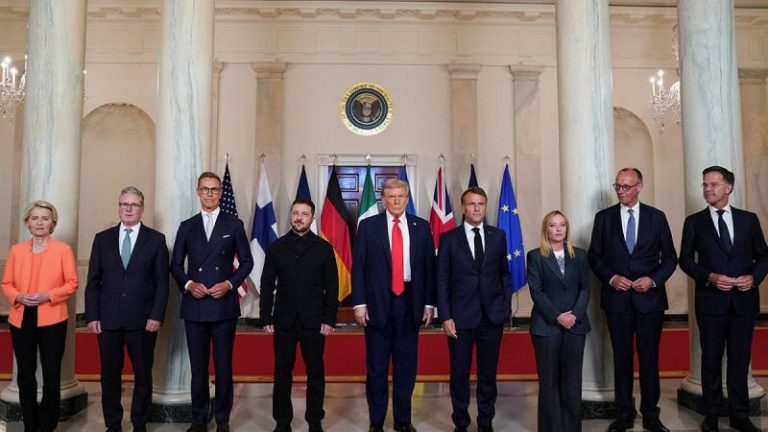
The two did not reach a peace agreement, but Trump said that the meeting was a success and that Ukrainian President Volodymyr Zelenskyy will visit the White House in Washington Monday. 

‘It was determined by all that the best way to end the horrific war between Russia and Ukraine is to go directly to a Peace Agreement, which would end the war, and not a mere Ceasefire Agreement, which often times do not hold up,’ Trump said in a Saturday post on Truth Social. 

If the meeting in Washington with Zelenskyy goes well, Trump said that a trilateral meeting between the U.S., Russia and Ukraine will be scheduled. 

Trump described the meeting with Putin as ‘very warm,’ and said that he believed a deal was imminent. 

‘I can tell you, the meeting was a very warm meeting,’ Trump told Fox News host Sean Hannity in an exclusive interview. ‘You know, he’s a strong guy, he’s tough as hell on all of that, but the meeting was a very warm meeting between two very important countries, and it’s very good when they get along. I think we’re pretty close to a deal. Now look, Ukraine has to agree to it.’

Here’s what also happened this week: 

Crime crackdown 

On Monday, Trump announced he would activate approximately 800 National Guard troops and would take over the Metropolitan Police Department to address crime in Washington. The move came after Trump already bolstered federal law enforcement presence in the nation’s capital Saturday. 

‘I’m deploying the National Guard to help reestablish law, order and public safety in Washington, D.C.,’ Trump told reporters at a Monday press conference. ‘And they’re going to be allowed to do their job properly.’

Trump initially suggested federalizing Washington’s Metropolitan Police Department and dispatching National Guard troops to address crime in Washington Aug. 6 in response to the assault of a former Department of Government Efficiency (DOGE) staffer. 

Although a temporary federal takeover of the Metropolitan Police Department is warranted for emergency situations, Washington officials filed a lawsuit challenging the Trump administration’s move Friday. 

‘By illegally declaring a takeover of MPD, the Administration is abusing its temporary, limited authority under the law,’ Washington Attorney General Brian Schwalb wrote in a Friday X post. ‘This is the gravest threat to Home Rule DC has ever faced, and we are fighting to stop it.’

Smithsonian review

The White House sent a letter to the Smithsonian Tuesday, announcing it would conduct a review of its museums and exhibits leading up to the 250th birthday of the United States in 2025.

‘We want the museums to treat our country fairly,’ Trump told reporters Thursday. ‘We want their museums to talk about the history of our country in a fair manner, not in a woke manner or in a racist manner, which is what many of them, not all of them, but many of them are doing.’

‘Our museums have an obligation to represent what happened in our country over the years. Good and bad,’ Trump said. ‘But what happened over the years in an accurate way.’ 

The White House said in a letter Tuesday the review would involve examining social media, exhibition text and educational materials to ‘assess tone, historical framing, and alignment with American ideals.’ 

‘This initiative aims to ensure alignment with the President’s directive to celebrate American exceptionalism, remove divisive or partisan narratives, and restore confidence in our shared cultural institutions,’ the letter said.

The Smithsonian told Fox News Digital it would coordinate with the White House, Congress and its governing Board of Regents on the matter. 

‘The Smithsonian’s work is grounded in a deep commitment to scholarly excellence, rigorous research and the accurate, factual presentation of history,’ the Smithsonian said in a statement.

This post appeared first on FOX NEWS