
Author

admin

Browsing

Albemarle (NYSE:ALB) is raising its long-term lithium demand outlook after a breakout year for stationary energy storage, underscoring a shift in the battery materials market that is no longer driven solely by electric vehicles.

The US-based lithium major reported fourth quarter 2025 net sales of US$1.4 billion, up 16 percent year-over-year, with adjusted EBITDA rising 7 percent to US$269 million.

For the full year, Albemarle delivered US$5.1 billion in revenue and US$1.1 billion in adjusted EBITDA, results that CEO Kent Masters said were supported by “strong growth in energy storage and significant cost and productivity improvements.”

But the most consequential update came in the company’s demand outlook.

“We are seeing a diversification of lithium end markets, with stationary storage becoming an increasingly significant demand driver,” Masters told investors during a February 12 conference call, adding that Albemarle has increased its 2030 global lithium demand forecast by 10 percent to a range of 2.8 million to 3.6 million metric tons.

Storage steps into the spotlight

Global lithium demand reached 1.6 million metric tons in 2025, up more than 30 percent year-over-year and in line with Albemarle’s prior projections. Demand growth outpaced supply, tightening inventories and lifting prices into year-end.

For 2026, Albemarle now expects global lithium demand to rise to between 1.8 million and 2.2 million metric tons — growth of 15 to 40 percent — driven by both EV adoption and accelerating deployments of stationary energy storage systems (ESS).

While global EV sales climbed 21 percent in 2025, energy storage was the standout. ESS demand surged more than 80 percent year-over-year, with strong growth across China, North America and Europe.

China, which accounted for roughly 40 percent of ESS shipments, saw demand rise 60 percent. North American shipments jumped 90 percent, reflecting grid stability needs and rising electricity consumption linked to data centers and artificial intelligence. European shipments more than doubled as countries expanded renewables and sought greater energy security.

Demand outside the three major regions grew 120 percent and represented more than 20 percent of global ESS shipments, with Southeast Asia, the Middle East and Australia emerging as key growth markets.

The shift is already visible in Albemarle’s financials. In 2025, energy storage volumes reached 235,000 metric tons of lithium carbonate equivalent, up 14 percent year-over-year and above the high end of the company’s guidance range.

Fourth quarter energy storage net sales rose 23 percent from a year earlier, while segment EBITDA climbed 25 percent, supported by higher lithium pricing and cost improvements.

CFO Neal Sheorey said Albemarle’s updated 2026 scenarios reflect both pricing and operational gains.

Cost discipline, portfolio reset

After weathering a sharp downturn in lithium prices over the past two years, Albemarle has focused on strengthening its balance sheet and lowering its cost base.

In 2025, the company delivered approximately US$450 million in run-rate cost and productivity improvements and is targeting an additional US$100 million to US$150 million in 2026.

Albemarle also announced it will idle operations at its Kemerton lithium hydroxide plant in Western Australia, citing a structural cost gap between Western and Chinese conversion assets.

“There is a gap there between China and the West,” Masters said, pointing to higher labor, power and waste management costs in Australia. Idling the plant is expected to improve adjusted EBITDA beginning in the second quarter, with no impact on sales volumes.

At the same time, Albemarle is streamlining non-core assets.

The company closed the sale of its stake in the Eurocat joint venture in January and expects to complete the sale of a majority stake in its refining catalysts business in the first quarter. Together, the transactions are expected to generate approximately US$660 million in pre-tax proceeds.

“We are committed to maintaining our investment-grade credit profile,” Masters said, adding that deleveraging and disciplined capital allocation remain priorities.

Growth with limited new capital

Despite pulling back on large-scale capital spending, Albemarle expects to deliver a five-year compound annual growth rate of roughly 15 percent in energy storage sales volumes, building on a 25 percent CAGR over the past four years.

Incremental expansions at the Greenbushes mine in Australia, yield improvements at the Salar de Atacama in Chile and higher utilization at the Wodgina joint venture are expected to support growth with minimal additional capital.

Looking ahead, Masters said the company is better positioned to navigate lithium’s still-maturing cycle.

“We’ve been through two cycles since the advent of EVs,” he said, describing the market as early in its development from a commodity perspective.

With stationary storage now emerging as a second structural demand pillar alongside EVs, Albemarle’s revised outlook suggests the lithium market’s next phase will be shaped as much by grid resilience and energy security as by transportation electrification — broadening the base of demand for years to come.

Lithium prices rebound sharply in early 2026

Lithium prices have surged since the start of 2026, underscoring the market’s renewed volatility.

According to Fastmarkets, spot battery-grade lithium carbonate on the seaborne market climbed from about US$11 per kilogram in early December to more than US$16 per kilogram by early January, a jump of nearly 50 percent in a matter of weeks.

The rally has been driven by tightening supply, including delays to the reopening of CATL’s (SZSE:300750,HKEX:3750) Jianxiawo lepidolite mine and maintenance at other production facilities, alongside aggressive restocking tied to long-term contract negotiations.

Speculative buying has amplified the move, with bullish sentiment and geopolitical risk adding to momentum. At the same time, thin spot liquidity reflects a cautious market, as buyers and sellers hesitate to commit amid rapid price swings.

Spodumene prices have followed suit, rising above US$2,000 per metric ton in January, levels not seen since October 2023. The rebound has improved margins for Australian producers, many of whom curtailed output when prices fell below US$900 per metric ton. Sustained pricing at current levels could prompt a wave of mine restarts, potentially easing supply tightness later this year.

Still, Fastmarkets cautioned that prices may be running ahead of fundamentals.

“Lithium prices appear to have moved ahead of the fundamentals, propelled by speculative buying, bullish sentiment and a backdrop of heightened geopolitical risk,” wrote Paul Lusty. “The key takeaway is to brace for more volatility.”

Securities Disclosure: I, Georgia Williams, hold no direct investment interest in any company mentioned in this article.


This post appeared first on investingnews.com

Latvian startup Deep Space Energy announced it has raised approximately US$1.1 million in a combination of private investment and public funding to advance a radioisotope-based power generator designed to operate on the Moon.

The company closed a US$416,500 pre-seed round led by Outlast Fund and angel investor Linas Sargautis, a former co-founder of NanoAvionics. It also secured an additional US$690,200 in public contracts and grants from the European Space Agency (ESA), NATO’s Defense Innovation Accelerator for the North Atlantic (DIANA), and the Latvian government.

Deep Space Energy is building a compact power system that uses radioisotopes, which are materials derived from nuclear waste that generate heat through natural decay, to produce electricity.

Founder and CEO Mihails Ščepanskis said the system converts that heat into electrical power while using significantly less fuel than conventional radioisotope thermoelectric generators (RTGs) currently deployed in space.

“Our technology, which has already been validated in the laboratory, has several applications across the defense and space sectors.

“First, we’re developing an auxiliary energy source to enhance the resilience of strategic satellites. It provides the redundancy of satellite power systems by supplying backup power that does not depend on solar energy, making it crucial for high-value military reconnaissance assets,” Ščepanskis said.

The company emphasized that the generator is not designed for weapons applications. Instead, it is targeting dual-use satellites operating in Medium Earth Orbit (MEO), Geostationary Orbit (GEO) and Highly Elliptical Orbit (HEO), all of which focus on communications, early warning systems, and reconnaissance capabilities.

These satellites support defense functions including synthetic aperture radar for detecting troop movements, signal intelligence systems, and missile-launch detection platforms.

According to Ščepanskis, recent geopolitical events have underscored their importance.

The war in Ukraine demonstrated the decisive role of satellite-based reconnaissance data. In 2025, Ukraine lost its beachhead in Russia’s Kursk Oblast during a period when the US temporarily halted the sharing of satellite intelligence.

“As Europe is trying to become more independent, it is imperative to produce satellites with advanced capabilities on our own. Our technology provides an auxiliary energy source for satellites, which makes them more resilient to non-kinetic attacks and malfunctions,” he added.

Beyond defense, Deep Space Energy is positioning its technology for lunar exploration. The company says its generator could support upcoming programmes such as NASA and ESA’s Artemis and Argonaut initiatives, as well as future lunar rover missions and the Moon Village framework.

On the Moon, temperatures can fall below minus 150 degrees Celsius during night cycles that last roughly 354 hours, making solar power unreliable.

Deep Space Energy estimates that about two kilograms of Americium-241 could generate 50 watts of power for a rover, compared with around 10 kilograms required by legacy RTG systems for similar output.

By reducing fuel requirements, the company argues it could extend rover lifetimes across multiple lunar day-night cycles, potentially lasting years.

Securities Disclosure: I, Giann Liguid, hold no direct investment interest in any company mentioned in this article.

This post appeared first on investingnews.com

North Korean leader Kim Jong Un said Thursday that his country could ‘completely destroy’ South Korea if it feels threatened, escalating rhetoric while ruling out renewed talks.

Speaking at North Korea’s week-long Ninth Congress of the ruling Workers’ Party in Pyongyang, Kim labeled South Korea the ‘most hostile enemy’ and said ‘the conciliatory attitude that South Korea’s current government advocates on the surface is clumsily deceptive and crude,’ according to state media Korean Central News Agency (KCNA).

Kim said North Korea ‘can initiate arbitrary action’ if South Korea engages in ‘obnoxious behavior’ directed at his country, dismissing recent efforts by Seoul to improve relations.

‘South Korea’s complete collapse cannot be ruled out,’ Kim said, according to KCNA.

During the congress, Kim outlined sweeping five-year policy goals centered on expanding North Korea’s nuclear arsenal. The country is believed to possess around 50 warheads and enough fissile material to produce up to 40 more, according to an estimate last year from the Stockholm International Peace Research Institute.

The North Korean leader said the country’s ‘international status has risen extraordinarily.’

‘It is our party’s firm will to further expand and strengthen our national nuclear power, and thoroughly exercise its status as a nuclear state,’ Kim said, according to KCNA. ‘We will focus on projects to increase the number of nuclear weapons and expand nuclear operational means.’

Kim laid out plans for North Korea to develop more advanced intercontinental ballistic missiles capable of underwater launches, along with artificial intelligence-driven weapons systems and unmanned drones, KCNA reported.

Kim, who met with President Donald Trump three times during Trump’s first term, signaled he may be open to future negotiations with Washington but placed responsibility squarely on the United States.

‘Whether it’s peaceful coexistence or permanent confrontation, we are ready for either, and the choice is not ours to make,’ he said.

Kim said that if the U.S ‘withdraws its policy of confrontation’ with North Korea and acknowledges the country’s ‘current status,’ there would be ‘no reason why we cannot get along well with the U.S.’

Following the congress, Kim’s teenage daughter attended a military parade in Pyongyang on Wednesday, according to KCNA. Ju Ae, believed to be 13 or 14, was photographed standing beside her father and senior military leaders.

Her appearance comes after South Korean media reported that Kim recently gave her a leadership role in the regime’s powerful ‘Missile Administration,’ which oversees Pyongyang’s nuclear forces.

Fox News Digital’s Emma Bussey, along with Reuters and the Associated Press contributed to this report.

Related Article

Trump says he’d be willing to extend Asia trip to meet with North Korea’s Kim Jong Un
This post appeared first on FOX NEWS

Apple clinched a major win Monday after the U.S. government announced that the U.K. had agreed to drop its demand for the company to provide a “back door” granting officials access to users’ encrypted data.

The iPhone maker won’t be alone to rejoice in the outcome.

The development came after extensive talks between Britain and the U.S., which had raised national security concerns over the request.

At the root of the row was end-to-end encryption, a technology which secures communications between two devices in a way that means not even the company providing a chat service can view any messages.

The story of Apple’s U.K. privacy battle started earlier this year, when it was reported that the British government had demanded access to the company’s encrypted cloud service via a technical “back door.”

Such a back door has long been contested by Apple. In 2016, the Federal Bureau of Investigation tried to get Apple to create software that would enable it to unlock an iPhone it recovered from one of the shooters involved in the 2015 terror attack in San Bernardino, California.

Other companies have also had to fend off government attempts to undermine end-to-end encryption. For example, when Meta announced plans to encrypt all messages on its Facebook Messenger app, the move drew condemnation from the U.K. Home Office. Meta had already offered encryption on WhatsApp.

The Monday news could have broader implications for the debate around end-to-end encryption globally.

Governments and law enforcement agencies have long pushed for methods to break such encryption systems to assist with criminal investigations into terrorism and child sexual abuse.

However, tech companies have said that building an encryption back door would not only undermine user privacy, but also expose them to possible cyberattacks. Cybersecurity experts say that any back door built for a government would eventually be found and exploited by hackers.

U.S. national intelligence officials were also worried by the ramifications of Apple offering such a back door.

For Apple, the U.K.‘s concession over encryption could mean that the company can bring back its most secure service for users’ cloud data, Advanced Data Protection (ADP), which the company stopped offering to Brits in February.

It is not yet clear if Apple will reintroduce its ADP service to the U.K. market.

CNBC has reached out to Apple and the U.K. government for comment.

This post appeared first on NBC NEWS

The House Republican majority just got reduced to a perilously slim one-vote margin thanks to a Democrat’s victory in Texas over the weekend.

Speaker Mike Johnson, R-La., swore in newly minted Rep. Christian Menefee, D-Texas, on Monday evening, bringing the overall House of Representatives margin to 218 Republicans and 214 Democrats.

That means if a bill gets no Democratic support and the House is in full attendance, losing more than one GOP vote will result in a 216-216 tie — meaning it would fail to pass.

Johnson is no stranger to dealing with slim margins and has eked out significant GOP victories while dealing with majorities between two and three seats. 

But this is a particularly difficult week for House GOP leaders who are scrambling to end an ongoing partial government shutdown.

The House is expected to vote on a funding compromise hashed out between Senate Democrats and the White House sometime on Tuesday, and Republicans will need nearly everyone in lockstep for the legislation to survive a chamber-wide ‘rule vote.’

Rule votes are procedural hurdles that traditionally fall along partisan lines.

Menefee, a former attorney for Houston’s Harris County, won a special congressional election in a left-leaning district in Texas that has been vacant for nearly a year.

He’s replacing the late Rep. Sylvester Turner, D-Texas, who died while in office in March 2025.

The Associated Press reported that Menefee defeated former Houston City Council member Amanda Edwards, a fellow Democrat, in Saturday’s runoff election to fill the seat left vacant when Democratic Rep. Sylvester Turner died last March.

Sylvester, a former longtime state lawmaker, served two terms as Houston mayor before winning election to Congress in 2024 to fill the seat of the late longtime Democratic Rep. Sheila Jackson Lee.

While Texas has redrawn its congressional maps for the 2026 midterms, as part of the high-stakes redistricting battle between President Donald Trump and Republicans versus Democrats, the special election used the state’s current district lines.

The addition of another lawmaker into the House Democrats’ ranks will give Republican leadership in the chamber further headaches.

And House GOP leaders are painfully aware of the politically difficult situation they’re in.

‘They’d better be here,’ Johnson said of his Republican members last month. ‘I told everybody, and not in jest, I said, no adventure sports, no risk-taking, take your vitamins. Stay healthy and be here.’

This post appeared first on FOX NEWS

Relations between President Donald Trump and Colombian President Gustavo Petro have swung sharply from open confrontation to cautious engagement over the past year, setting the stage for a pivotal White House meeting scheduled for Tuesday.

Once considered a model partnership in the Western Hemisphere, U.S.–Colombia ties are now being tested by deep disagreements over drug policy, security cooperation and migration.

Speaking to reporters ahead of the visit, President Donald Trump suggested the tone between the two leaders has shifted in recent weeks, while underscoring that drug trafficking will dominate the talks.

‘I mean, he’s been very nice over the last month or two,’ Trump said during a press availability. ‘They were certainly critical before that. But somehow after the Venezuelan raid, he became very nice. He changed his attitude. Very much so.’

Trump said he is looking forward to meeting Petro in person, while making clear that narcotics remain a central concern. ‘He’s coming in. We’re going to be talking about drugs because tremendous amounts of drugs come out of his country,’ Trump said. ‘And I look forward to seeing him. We’re going to have a good meeting.’

Colombia has long been one of Washington’s closest partners in South America, particularly on counternarcotics and security. Bilateral cooperation expanded dramatically under Plan Colombia beginning in 2000, with U.S. military and law-enforcement assistance playing a central role in Colombia’s fight against insurgent groups and drug trafficking networks. That cooperation helped stabilize the country and eventually led the United States to designate Colombia a major Non-NATO ally. U.S. officials and analysts say that foundation has eroded in recent years amid diverging priorities and growing mistrust.

Tensions first erupted in January 2025, when Petro initially refused to allow U.S. deportation flights carrying Colombian nationals to land. The standoff prompted Trump to threaten tariffs, travel bans and visa restrictions before Colombia reversed course and agreed to accept the flights. The episode marked the first major rupture between the two leaders following Trump’s return to office.

Relations deteriorated further in September 2025, when Petro traveled to New York for the United Nations General Assembly, participated in protests and publicly urged U.S. soldiers to ‘disobey the orders of Trump.’ The remarks prompted the U.S. State Department to revoke Petro’s visa on Sept. 27, 2025. The following month, the Trump administration announced punitive measures targeting Petro and members of his inner circle, citing concerns about drug trafficking and security cooperation.

Colombian officials denounced the moves as politically motivated. Trump publicly labeled Petro a ‘drug leader,’ suspended U.S. aid and threatened additional punitive measures, pushing relations to what observers described as their lowest point in decades.

Signs of de-escalation emerged last month when the two leaders spoke by phone for the first time since the diplomatic breakdown. Trump later described the call as a ‘great honor,’ saying he appreciated Petro’s tone and looked forward to meeting him in person. Both sides agreed to restart dialogue on contentious issues, including counternarcotics, migration and trade. Colombia subsequently resumed U.S. deportation flights as part of broader efforts to stabilize relations, paving the way for Tuesday’s face-to-face meeting.

Melissa Ford Maldonado, director of the Western Hemisphere Initiative at the America First Policy Institute, said the visit highlights how much is now at stake for both countries.

‘Colombia remains the most important U.S. partner in South America, but that status is conditional, and lately it’s been under real strain, largely because of President Gustavo Petro’s tolerance for criminal networks that threaten both Colombian sovereignty and American security,’ Maldonado told Fox News Digital.

She said the Trump administration’s objectives heading into the meeting are likely focused on restoring what she described as ‘real cooperation’ on counternarcotics and security after years of drift.

‘Counternarcotics and security cooperation will likely dominate the conversation,’ Maldonado said, pointing to record cocaine production and what she described as growing tolerance within parts of the Colombian state for criminal networks. She argued that Washington has increasingly treated Colombia as failing to meet U.S. expectations in the fight against illegal drugs.

Maldonado said the administration has signaled it is no longer willing to accommodate governments it believes enable narco-criminal ecosystems.

‘What to watch going forward is whether Colombia chooses to course-correct or continues drifting toward the model next door, which blurred the line between the state and organized crime,’ she said. ‘Colombia earned its status as a major Non-NATO Ally through decades of sacrifice. That trust has been badly damaged, but it is not beyond repair if Colombia demonstrates genuine resolve against cartels, rejects political cover for criminal groups and realigns clearly with the United States on hemispheric security.’

She added, ‘This visit should make one thing unmistakable: the United States wants a strong, sovereign Colombia. It is in America’s best interest. However, it will not tolerate ambiguity when it comes to narco-terrorism, regional security or the safety of the American people,’ Maldonado said.  

This post appeared first on FOX NEWS

The Senate’s compromise to end the ongoing partial government shutdown survived an important hurdle on Monday night, teeing up the legislation for a vote in the House of Representatives on Tuesday.

The House Rules Committee, the final gatekeeper before most bills get a chamberwide vote, advanced the upper chamber’s deal with the White House with little internal discord among Republicans on the panel.

But the measure could face issues on the House floor during a second procedural hurdle called a ‘rule vote,’ which needs a simple majority of lawmakers to unlock debate and a vote on final passage. House votes normally fall along partisan lines, and Speaker Mike Johnson, R-La., will need virtually all GOP lawmakers to vote in lockstep to succeed.

The current partial shutdown, affecting roughly 78% of the federal government, is in its third day after Congress failed to send its remaining spending bills to President Donald Trump’s desk by Jan. 30.

House lawmakers passed an initial set of bipartisan bills to finish funding the government through the end of fiscal year (FY) 2026, Sept. 30, but Democrats rebelled against the plan en masse in protest of Trump’s immigration crackdown in Minneapolis.

Senate Democrats walked away from the deal in protest of its funding for the Department of Homeland Security (DHS), after federal law enforcement shot and killed a second U.S. citizen during anti-Immigration and Customs Enforcement (ICE) demonstrations in Minneapolis.

Trump has responded by removing Customs and Border Protection (CBP), whose agents shot the second person, from the Midwest city, and replacing senior officials leading the crackdown there.

But Democrats are demanding further guardrails, like judicial warrants, to restrict agents in Minneapolis even further.

The resulting compromise would fund areas of government that were caught up in the political standoff — the departments of War, Health and Human Services, Transportation, Housing and Urban Development, Labor, and Education — while simply extending the current federal spending levels for DHS for two weeks.

That two-week span is aimed at giving lawmakers time for more bipartisan negotiations on a longer-term deal.

The Senate passed the new deal on Friday, but House Minority Leader Hakeem Jeffries, D-N.Y., is sharply divided from his counterpart, Senate Minority Leader Chuck Schumer, D-N.Y., in his position.

Despite Schumer and Senate Democrats negotiating the plan with Trump’s White House, Jeffries told Johnson not to rely on House Democrats’ support to pass the bill.

It’s a stunning division between the top two Democrats in Congress, and one that will leave House Republicans largely on their own for much of the process of ending the shutdown.

But Trump managed to quell another rebellion on the conservative side earlier on Monday, easing at least one headache for House GOP leaders.

At least four House Republicans signaled they could vote against their own party during the rule vote on Tuesday over its exclusion of an unrelated measure requiring proof of citizenship in the voter registration process.

The president posted on Truth Social earlier Monday demanding ‘NO CHANGES’ to the current deal, effectively undercutting conservatives’ push for the legislation.

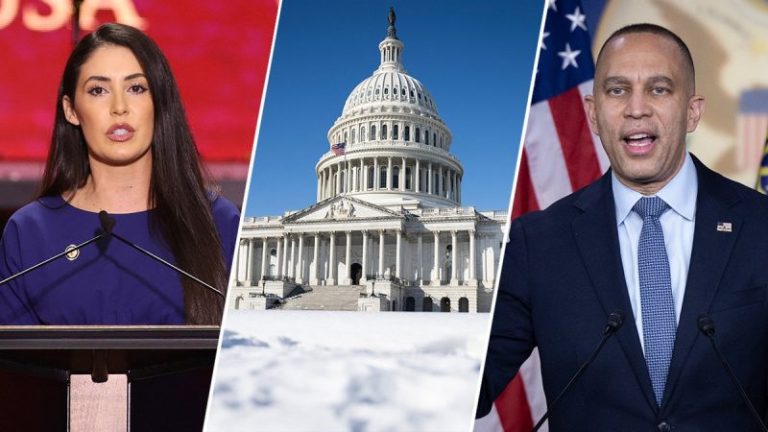
Rep. Anna Paulina Luna, R-Fla., had been leading a group of conservatives threatening to tank the rule vote if the SAVE America Act was not attached.

But Luna told reporters on Monday night that she and Rep. Tim Burchett, R-Tenn., both changed their minds after getting assurances from the White House that Senate Majority Leader John Thune, R-S.D., would force a vote on the bill — called the SAVE America Act.

‘As of right now, with the current agreement that we have, as well as discussions, we will both be a yes on the rule,’ Luna said. ‘There is something called a standing filibuster that would effectively allow Senator Thune to put voter ID on the floor of the Senate. We are hearing that that is going well and he is considering that…so we are very happy about that.’

It’s not clear if it’s enough for other House Republicans, however, some of whom are upset over the new deal opening up the need for bipartisan discussions on reining in Trump’s immigration crackdown.

Johnson can only lose one House GOP vote for the funding deal to survive a chamber-wide rule vote.

In the meantime, nearly 14,000 air traffic controllers are expected to work without pay. Members of the military could also miss paychecks if the shutdown goes on long enough, and the Centers for Disease Control and Prevention (CDC) will be limited in its ability to communicate public health updates to Americans.

This post appeared first on FOX NEWS

Planned Parenthood announced it is voluntarily dropping its lawsuit challenging the Trump administration’s ability to withhold Medicaid payments under a provision in President Donald Trump’s tax bill.

The organization sued in July after President Donald Trump signed a spending bill that included prohibiting federal funding from going to abortion providers, a section of the legislation that Planned Parenthood attorneys argued unfairly targeted their clinics and would leave patients with even fewer health care options.

In December, a federal appeals court ruled that the administration could continue to withhold Medicaid funding from Planned Parenthood and other abortion providers.

A separate lawsuit filed by a group of mostly Democratic states suffered a similar setback in January but remains ongoing, and a related case filed in Maine was voluntarily dismissed in October.

A third lawsuit filed in Maine by a network of medical clinics that was also impacted by the spending bill was voluntarily dismissed in October.

Planned Parenthood moved on Friday to voluntarily dismiss the lawsuit in the U.S. District Court of Massachusetts.

‘The goal of this lawsuit has always been to help Planned Parenthood patients get the care they deserve from their trusted provider. Based on the 1st Circuit’s decision, it is clear that this lawsuit is no longer the best way to accomplish that goal,’ the Planned Parenthood Federation of America, Planned Parenthood League of Massachusetts and Planned Parenthood Association of Utah said in a joint statement.

Under the tax provision in Trump’s spending bill, Medicaid payments would be stopped if providers like Planned Parenthood primarily offered certain services, including abortion, and received more than $800,000 from Medicaid in 2023.

Planned Parenthood was not specifically named in the legislation, but the organization’s leaders have said the law is intended to affect their clinics across the country, as Republicans at the federal and state level continue to target the organization.

Federal law bans taxpayer money from covering most abortions, but many Republicans have long argued that abortion providers such as Planned Parenthood used Medicaid money for other health services to subsidize abortion.

Planned Parenthood said 23 of their health clinics have been forced to close due to Trump’s spending bill. More than 50 clinics closed in 18 states last year, with most located in the Midwest.

‘President Trump and his allies in Congress have weaponized the federal government to target Planned Parenthood at the expense of patients — stripping people of the care they rely on,’ Alexis McGill Johnson, president and CEO of Planned Parenthood Federation of America, said in a statement.

‘Through every attack, Planned Parenthood has never lost sight of its focus: ensuring patients can get the care they need from the provider they trust,’ she continued. ‘That will never change. Care continues, as does our commitment to fighting for everyone’s freedom to make their own decisions about their bodies, lives, and futures.’

The Associated Press contributed to this report.

This post appeared first on FOX NEWS

The ongoing partial government shutdown is now in its fourth day, but House GOP leaders are confident that the end is near.

House Speaker Mike Johnson, R-La., is aiming to hold a chamber-wide procedural vote on the Senate’s funding compromise on Tuesday afternoon, teeing up a subsequent vote on final passage potentially later in the day.

It comes after he and President Donald Trump quelled a burgeoning rebellion by House conservatives who were threatening to tank the measure if an unrelated election integrity bill was not attached to the funding legislation.

House GOP leaders had been watching anxiously for signs of defections on a House-wide ‘rule vote’ that appears to have been largely abated after the rebellion’s ringleader, Rep. Anna Paulina Luna, R-Fla., told reporters she was backing off her threats on Monday night.

A rule vote allows for lawmakers to open up debate on a given bill, and normally falls on partisan lines even if the underlying legislation has bipartisan support.

Under current House margins, Johnson can only lose support from one GOP lawmaker to still advance legislation on a party-line vote.

Meanwhile, Luna had corralled a group of conservatives to vote against advancing the rule if a bill called the SAVE America Act was not attached to the final funding bill.

The SAVE America Act would require voter ID for casting ballots in federal elections and mandate proof of citizenship in the voter registration process, among other election safeguards.

Luna and Rep. Tim Burchett, R-Fla., had both signaled to Fox News Digital that they would vote against the rule if it was not attached.

But such a move, if successful, would force the bill to be returned to the Senate, where Minority Leader Chuck Schumer, D-N.Y., warned it would be dead on arrival.

Luna told reporters on Monday night that she and Burchett both changed their minds, however, after getting assurances from the White House that Senate Majority Leader John Thune, R-S.D., would force a vote on the SAVE America Act.

‘As of right now, with the current agreement that we have, as well as discussions, we will both be a yes on the rule,’ Luna said. ‘There is something called a standing filibuster that would effectively allow Senator Thune to put voter ID on the floor of the Senate. We are hearing that that is going well and he is considering that…so we are very happy about that.’

The Senate compromise would fully fund the departments of War, Health and Human Services (HHS), Transportation, Housing and Urban Development (HUD), Education and Labor through the end of the fiscal year on Sept. 30, lining up with previously passed spending bills.

But Department of Homeland Security (DHS) funding would only see current levels extended for two weeks in order to give Democrats and Republicans time to negotiate a bill that would more significantly rein in Trump’s immigration crackdown.

It passed the Senate on Friday after Democrats there walked away from an earlier bipartisan deal that would have also fully funded DHS. Left-wing lawmakers demanded further guardrails on Trump’s immigration enforcement after the second of two U.S. citizens were shot and killed by federal agents in Minneapolis during anti-Immigrations and Customs Enforcement (ICE) protests there.

And despite House Minority Leader Hakeem Jeffries, D-N.Y., indicating to Johnson that Democrats would not help him pass the new deal, there are some signs that it will get bipartisan support.

Rep. Rosa DeLauro, D-Conn., the top Democrat on the House Appropriations Committee, said she would vote for the legislation after voting against the original House-passed deal.

‘I will take those ten days and see what we can get,’ she said of the stopgap funding for DHS. ‘And at the end of those ten days, if if we can’t decide to go with it, then it’s a no vote, and Department of Homeland Security is shuttered…but not the other five bills because they’re good bills with good things for the people that we care about.’

In the meantime, nearly 14,000 air traffic controllers are expected to work without pay. Members of the military could also miss paychecks if the shutdown goes on long enough, and the Centers for Disease Control and Prevention (CDC) will be limited in its ability to communicate public health updates to Americans.

This post appeared first on FOX NEWS

Republican and Independent voters reacted favorably when President Donald Trump brought up how his administration has cracked down on drug cartels and fentanyl, but Democrats appeared less motivated by Trump’s aggressive foreign policy stance. 

‘For years, large swaths of territory in our region, including large parts of Mexico, really large parts of Mexico, have been controlled by murderous drug cartels. That’s why I designated these cartels as foreign terrorist organizations, and I declared illicit fentanyl as a weapon of mass destruction,’ Trump said to applause as he turned to look at Republicans. 

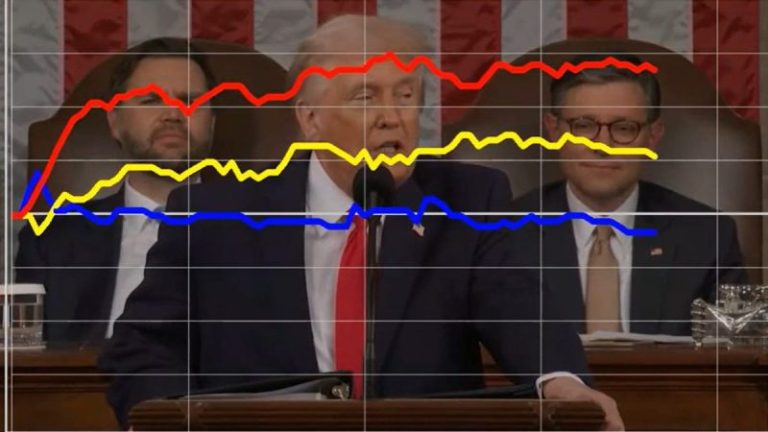
Per a panel assembled by polling group Maslansky & Partners of 29 Democrats, 30 Independents, and 40 Republicans, which tracked their real-time reactions during Trump’s SOTU address, Democrats appeared to go slightly below baseline when Trump began touting his aggressive stance towards cartels in Central and South America, specifically his administration’s bombing campaign against them which has included attacks in the open ocean off the South American coastline and in the eastern Pacific.

Meanwhile, Republicans and Independents showed a much stronger favorable reaction to the president’s remarks about the actions his administration has taken against drug cartels and illegal fentanyl. 

During his address, Trump also highlighted the U.S.’s help in capturing drug kingpin ‘El Mencho’ earlier this month in Mexico. Ruben ‘Nemesio’ Oseguera Cervantes, known as ‘El Mencho,’ the leader of the CJNG, was killed Sunday in a Mexican military operation in Tapalpa, Mexico, authorities said. Though the operation was carried out by Mexican forces, the United States laid the groundwork, making El Mencho’s fall possible.

On President Donald Trump’s first day in office, he signed an executive order directing the State Department to designate several cartels and international criminal groups ‘foreign terrorist organizations’ (FTOs), a designation unlocking military-grade surveillance and ‘material support’ prosecutions. Though lesser known than MS-13 or Tren de Aragua, CJNG was one of the groups designated an FTO by the administration.

Shortly after Trump’s executive order, Attorney General Pam Bondi sent a policy memorandum to all Department of Justice employees, announcing a ‘fundamental change in mindset and approach’ to cartels and transnational criminal organizations to a policy of ‘total elimination.’

The Trump administration has engaged in an aggressive bombing campaign against cartel boats throughout both 2025 and 2026. The U.S. has also conducted non-lethal maritime drug interdiction efforts as well.

In early 2026, Venezuelan President Nicholas Maduro was captured by U.S. forces and extradited to New York on drug trafficking and narco-terrorism charges, with Trump accusing him at the time of being a ‘kingpin of a vast criminal network.’

The recent violence and capture of El Mencho this month has led American tourists to be trapped in Mexico. According to White House Press Secretary Karoline Leavitt, the State Department has been taking ‘hundreds of calls a day’ providing Americans with travel support and advice.

‘We are unaware of any reports of any Americans being hurt, kidnapped, or killed, and the Mexican drug cartels know not to lay a finger on a single American or they will pay severe consequences under this president – and they already are,’ Leavitt told Fox News. 

Fox News Digital’s Peter Pinedo contributed to this report.

Related Article

Trump gets high marks from Republicans when ticking off economic accomplishments
This post appeared first on FOX NEWS