
Author

admin

Browsing

For months, headlines warned of an impending famine in Gaza — images of starving children, shattered infrastructure and humanitarian collapse filled the news. On Aug. 22, 2025, the Integrated Food Security Phase Classification (IPC) declared that while full data was lacking, expert inference indicated famine was underway. Governments pledged aid; humanitarian agencies sounded alarms. Yet today, the word ‘famine’ has nearly vanished from headlines. What happened?

This is not to deny the human suffering in Gaza; it is to ask difficult, necessary questions. Was famine averted, exaggerated or politically reframed?

Famine has been described as a tree swaying in the wind — at some point it cannot recover and cannot be returned upright. But Gaza’s ‘famine tree’ never appeared to fully sway. If aid efforts or local resilience truly prevented catastrophe, where is the evidence? On August 22, 2025, famine was declared, and the global press carried that narrative. Then came a shift to the word ‘starvation.’ Now, even that language has faded.

The distinction matters. Famine is a technical classification grounded in data — household food security surveys, acute malnutrition rates and mortality. Starvation, by contrast, is a moral and legal term implying intent; under international law, using starvation as a weapon constitutes a war crime. In Gaza, this rhetorical shift occurred before comprehensive data was gathered — an escalation of accusation without empirical foundation.

Recovery from famine typically takes eight to 12 months, even under ideal conditions with full humanitarian access and functioning medical systems. Historical precedents — Somalia in 2011, South Sudan in 2017 and Sudan in 2023 — show that malnutrition persists long after headlines fade. If Gaza truly met famine standards this summer, the signs would still be unmistakable: rising mortality, overwhelmed clinics and a generation of weakened children. Yet no such surge has been confirmed by independent medical reporting.

Another inconsistency is behavioral. True famine unleashes chaos — hunger overrides social norms and people fight to survive. In August, 84% of Gaza aid convoys were reportedly looted. Yet after the Oct. 10 ceasefire, U.N. 2720 data show interceptions fell to 6%, and by November, below 1%. Where did the desperation go? Where is the looting? Where are the crowds of thousands?

Following the ceasefire, Hamas rapidly reasserted control, executing accused defectors and projecting an image of order. Recent videos show bustling markets and calm streets — a façade of normalcy meant to reinforce legitimacy. Within six weeks, famine conditions seemingly vanished. Can that be real?

If famine had truly taken hold, it would not have dissipated so quickly. Either the crisis was overstated, the data manipulated or public perception deliberately managed.

We cannot shy away from uncomfortable questions. Asking what happened to the famine in Gaza is responsible, not callous. Truth demands transparency, even when it challenges narratives we’ve grown accustomed to believing.

This post appeared first on FOX NEWS

Former Rep. Louie Gohmert blasted ex-Special Counsel Jack Smith for allegedly targeting his personal phone records as part of his investigation into the Jan. 6, 2021 Capitol riots, telling Fox News Digital in an exclusive interview that his action ‘destroys the checks and balances that the founders counted on.’

Fox News Digital exclusively reported Thursday morning that Smith targeted then-House Speaker Kevin McCarthy’s personal, private phone records, as well as Gohmert’s. 

Fox News Digital exclusively reviewed the document that FBI Director Kash Patel recently shared with Senate Judiciary Committee Chairman Chuck Grassley and Sen. Ron Johnson containing the explosive revelations. Grassley and Johnson have been leading a joint investigation into Smith’s ‘Arctic Frost’ probe.

According to the document, Smith, on Jan. 24, 2023, allegedly sought the ‘toll records for the personal cell phones of U.S. Speaker of the House Kevin McCarthy (AT&T) and U.S. Representative Louie Gohmert (Verizon.)’

The information was included as part of a ‘significant case notification’ drafted by the FBI’s Criminal Investigative Division May 25, 2023.

‘It is astounding that Jack ‘Frost’ Smith went on this persecution,’ Gohmert told Fox News Digital Thursday. ‘Apparently, this guy has never read the Fourth Amendment because you have to describe with particularity what it is you’re going after — there should be probable cause, and they had no probable cause. They were going on a witch hunt.’

Smith had sought Gohmert’s personal cellphone records from November 2020 through the end of January 2021.

‘They don’t have any regard for the Fourth Amendment,’ he said. ‘It makes Watergate look like school yard folly.’

But Gohmert said it is the ‘principle.’

‘It is the separation of powers that is the problem,’ Gohmert explained. ‘People and whistleblowers contacted me regularly from within the DOJ and the FBI about overreach within the FBI and DOJ. By grabbing my records, they could stifle reporting of potential crimes by people within the agencies.’

‘You can’t just go seize members of Congress’ records even with a warrant because of that separation of powers,’ Gohmert said. ‘There has to be a wall and that’s what troubles me more than anything.’

Gohmert told Fox News Digital that he didn’t remember who he spoke with during the time period Smith sought records, but said that ‘the last thing I want is for someone who trusted me to keep their name private to have some jack-booted thug like Jack ‘Frost’ Smith grab my records and find out who is tattle tailing on him.’ 

He added: ‘It violates and destroys the checks and balances that the founders counted on.’

Gohmert, though, told Fox News Digital that he trusts the current Justice Department and FBI leadership.

‘I trust the DOJ and trust the people running the FBI,’ he said. ‘We’ll see if there were any crimes committed and, if following the Constitution, they can be properly prosecuted.’ 

Meanwhile, McCarthy said he will take legal action against Smith. 

‘Jack Smith’s radical and deranged investigation was never about finding the truth,’ McCarthy told Fox News Digital. ‘It was a blatant weaponizing of the Justice Department to attack political opponents of the Biden administration. Perhaps no action underscores this point more than the illegal attempt to access the phone records of sitting members of the House and Senate — including the Speaker of the House.’ 

‘His illegal targeting demands real accountability,’ McCarthy continued. ‘And I am confident Congress will hold hearings and access documents in its investigation into Jack Smith’s own abuses.’ 

‘At the same time, I will ask my own counsel to pursue all areas of redress so this does not happen to anyone else,’ McCarthy said. 

The revelations come after Fox News Digital exclusively reported in October that Smith and his ‘Arctic Frost’ team investigating the Jan. 6, 2021, Capitol riots were tracking the private communications and phone calls of nearly a dozen Republican senators as part of the probe, including Sens. Lindsey Graham of South Carolina, Marsha Blackburn of Tennessee, Ron Johnson of Wisconsin, Josh Hawley of Missouri, Cynthia Lummis of Wyoming, Bill Hagerty of Tennessee, Dan Sullivan of Alaska, Tommy Tuberville of Alabama and GOP Rep. Mike Kelly of Pennsylvania.

An official told Fox News Digital that those records were collected in 2023 by Smith and his team after subpoenaing major telephone providers. 

Smith has called his decision to subpoena and track Republican lawmakers’ phone records ‘entirely proper’ and consistent with Justice Department policy.

‘As described by various Senators, the toll data collection was narrowly tailored and limited to the four days from January 4, 2021 to January 7, 2021, with a focus on telephonic activity during the period immediately surrounding the January 6 riots at the U.S. Capitol,’ Smith’s lawyers wrote in October to Grassley.

Grassley, R-Iowa, and Johnson, R-Wis., have been investigating the matter. 

An FBI official told Fox News Digital that ‘Arctic Frost’ is a ‘prohibited case,’ and that the review required FBI officials to go ‘above and beyond in order to deliver on this promise of transparency.’ The discovery is part of a broader ongoing review, Fox News Digital has learned.

Smith, after months of investigating, charged President Donald Trump in the U.S. District Court for Washington, D.C., in his 2020 election case, but after Trump was elected president, Smith sought to dismiss the case. Judge Tanya Chutkan granted that request. 

Smith’s case cost taxpayers more than $50 million. 

Smith did not immediately respond to Fox News Digital’s request for comment.

This post appeared first on FOX NEWS

The biotech sector is entering 2026 with a positive outlook, characterized by reasonable valuations, robust oncology momentum and supportive policy tailwinds. This combination is setting the stage for a continued recovery, driven in part by the integration of artificial intelligence (AI).

However, this sectoral resurgence must navigate a tug-of-war between supportive stimulus and structural risks, which have the potential to challenge the pace of recovery.

Biotech sector rebounding after US uncertainty

According to Song, biotech has rebounded since its lows in April of this year.

Company valuations are trading at a 15 percent discount to broader markets on forward price-to-earnings, with secular demand intact for oncology, obesity and chronic diseases. In Song’s view, the biotech industry’s rebound stems from reduced uncertainty under the administration of US President Donald Trump.

Song added that valuations across healthcare are reasonable, noting rotational flows from cooling AI hype.

“I can’t deny that there have been some rotational effects that not just biotech has benefited (from), but healthcare in general,’ he commented. “While AI is an important driver in healthcare, to our view, it certainly is not priced in to the largest extent in many pockets of healthcare.”

Key biotech sector catalysts in 2026

Song sees healthcare’s recovery extending into 2026, with oncology remaining the primary growth engine.

He characterized the current sector resurgence as a durable structural shift being fueled by key developments that present tangible investment opportunities, including anticipated positive clinical trial outcomes, such as those for Revolution Medicines’ (NASDAQ:RVMD) pancreatic cancer drug.

“They have a lead drug that blocks an important pathway called RAS … and they could have a potential breakthrough in pancreatic cancer. They’re running a Phase III trial to demonstrate a potential survival benefit. There could be meaningful progress there,” Song noted. A data readout is expected next year.

Outside oncology, Song flagged high-profile biotech catalysts that could broaden the sector’s 2026 rally.

“Non-peptide oral GLP-1s … are clearly going to be an important data set readout and launch that could occur next year,” he explained, citing Eli Lilly’s (NYSE:LLY) orforglipron, a daily pill that hit Phase III success for type 2 diabetes and obesity in 2025. Approval is expected in 2026, and he believes it could be a potential game changer in obesity and chronic disease treatments, an area dominated by biotech innovators.

Song also sees validation ahead for platform technologies.

A dual-track recovery for biotech

While macro analysts see a broad cyclical recovery in 2026, Song predicts that the market will be defined by a dual-track recovery: a diagnostics-led initial public offering (IPO) surge, and a biopharma M&A environment focused on companies with the clinical validation required to alter the current standard of care.

Renaissance Capital predicts a faster pace for biotech IPOs, with a strong pipeline of companies such as Aktis Oncology, a radiopharma diagnostics firm targeting solid tumors, ready to list for US$100 million.

Additionally, AlphaSense forecasts steady M&A flow as companies rebuild their pipelines in the new year, a trend that Song sees as a structural necessity rather than a simple trend. “It’s an important pillar where Big Pharma needs to replenish their pipelines, and they can’t all do it internally,” he explained.

Consequently, he believes the primary “hunting ground” for these deals is mid-cap territory, where acquiring one or two proven drugs can effectively move the needle for a large pharmaceutical giant.

AI in the biotech sector

Song maintained that AI has not reached full valuation in the sector, and its role is expected to grow, with significant future productivity gains predicted in biopharma, drug discovery, clinical development and healthcare delivery.

“We’ve done some preliminary work that that that suggests there could be … productivity gains in areas like biopharmaceuticals and drug discovery and clinical development,” Song explained, adding that these are long-term projections. He sees a more immediate economic impact in how care is managed.

“Since healthcare is a large part of the US and global economy, and growing quickly in terms of healthcare costs, there are also opportunities for efficiency gains, which could lead to margin and consumer gains,” he noted. This revolution in delivery is already a key focus for his firm’s Tema Oncology ETF (NASDAQ:CANC).

However, life science market analyst Anastasia Bystritskaya warned that valuation and productivity are not synonymous, as high-performing models do not automatically become revenue-producing products. For investors, the real inflection point is operational integration rather than operating as a standalone prototype.

Drive for efficiency is expected to take a practical form in 2026 through what Sergey Jakimov, managing partner at longevity and biotech venture capital firm LongeVC, described as the “doctor in your hand.”

This AI companion manages routine, low-complexity tasks between clinic visits.

LongeVC anticipates that this shift to a regulated digital workflow will allow AI to identify meaningful clinical signals continuously without overburdening primary care teams.

This democratization of discovery creates a new competitive landscape for the hunting ground Song described; if AI-enabled teams can dissect complex pathways without a billion-dollar balance sheet, the traditional R&D model of Big Pharma faces a permanent disruption. In this new era, the innovation gap could be filled by agile players who use technology to act with the scale of a giant, but the speed of a startup.

Investor takeaway

Despite sector momentum, headwinds remain, particularly regarding the stability of clinical research funding.

A November report in JAMA Internal Medicine reveals that 383 clinical trials recently had their grants terminated, disrupting progress for over 74,000 participants. Dr. Gary K. Zammit, founder of Clinilabs, warned these reductions in National Institutes of Health funding risk slowing future commercial development of innovative therapies.

Macroeconomic headwinds, including rising tariffs and early labor market weakness, also present a material challenge.

Ultimately, the 2026 biotech outlook balances promising catalysts with the need for strategic capital deployment and a focus on clinically validated platform technologies, ensuring a durable expansion for the sector.

Securities Disclosure: I, Meagen Seatter, hold no direct investment interest in any company mentioned in this article.

This post appeared first on investingnews.com

A rare filing from economic heavyweights could shape how Supreme Court justices view the limits of presidential control over the Federal Reserve and U.S. monetary policy.

On Wednesday, the nation’s highest court heard oral arguments for two hours on whether President Donald Trump has the authority to remove Lisa Cook from the Federal Reserve’s Board of Governors. 

That debate has drawn an extraordinary amicus brief from some of the most influential figures in U.S. economic policy. An amicus brief is a submission from a group not directly involved in a suit that offers information, expertise or arguments to help a court decide the matter.

It was signed by every living former chair of the Federal Reserve, Alan Greenspan, Ben Bernanke and Janet Yellen, as well as six former Treasury secretaries who served presidents of both parties.

The group, which also includes seven former White House economic advisers, spans roughly five decades of U.S. economic policymaking.

Such intervention is almost unheard of, as former Fed chairs and Treasury secretaries typically steer clear of public legal battles.

In the 32-page amicus brief, the group argues that allowing the Trump administration to remove a sitting Fed board member would ‘erode public confidence in the Fed’s independence and threaten the long-term stability of the economy.’

Expanding the president’s power over Fed board membership is ‘neither necessary nor appropriate’ and would be counterproductive, the group writes, because it would weaken the central bank’s independence and lead to higher inflation and economic instability.

That concern, the group argues, is already playing out in real time. 

‘Sectors that pay close attention to the Federal Reserve — including the financial markets, the public, employers and lenders — are watching the current dispute over the President’s removal of Governor Cook to judge how credible the Fed will be going forward.’

John Sauer, the solicitor general, said Cook’s amici filing did not address the ‘legal issues at the heart of this case.’

‘Most of Cook’s amici emphasize policy arguments, touting the perceived benefits of the Federal Reserve Board’s independence in setting monetary policy,’ Sauer wrote, adding that ‘policy preferences are not the law, and these particular preferences lack any logical limit.’

In deciding Cook’s case, the justices could also shape Federal Reserve Chair Jerome Powell’s future at the Fed.

In a notable departure from his typically measured and low-profile approach, Powell attended the oral arguments at the Supreme Court. His appearance comes amid a criminal investigation by the U.S. Attorney’s Office in Washington, D.C., related to his congressional testimony on a multibillion-dollar renovation of the Fed’s headquarters. 

Powell described the investigation as ‘unprecedented,’ calling it another instance of the Trump administration using legal threats to pressure the central bank on policy decisions.

Cook’s ascent to the Federal Reserve was historic from the start. 

Now, she stands at the center of an even more consequential moment, as President Donald Trump moves to fire her — a step that would be unprecedented in the Fed’s 112-year history.

The court is expected to issue a ruling on Cook’s case by the summer.

This post appeared first on FOX NEWS

Perth, Australia (ABN Newswire) – OTC Markets Group Inc. (OTCMKTS:OTCM), operator of regulated markets for 12,000 U.S. and international securities, today announced that Locksley Resources Ltd (ASX:LKY,OTC:LKYRF) (FRA:X5L) (OTCMKTS:LKYRF), an exploration and development company focused on rare earths and antimony critical minerals, has qualified to trade on the OTCQX Best Market.

Highlights

– Locksley Resources Limited has qualified to trade on the OTCQX(R) Best Market, upgrading from the OTCQB(R) Venture Market

– Trading on OTCQX enhances Locksley’s visibility and accessibility to U.S. investors, supporting its U.S. focused critical minerals strategy

– Locksley’s flagship Mojave Project in California is strategically located adjacent to MP Materials’ Mountain Pass Mine, targeting rare earth elements (REEs) and antimony as part of a fully integrated mine-tomarket strategy

– The Company’s downstream technology partnerships underpin its role in re-establishing U.S. domestic supply chains for critical materials, with a particular focus on antimony

– Rare earths and Antimony are front and center in the global race to secure critical materials, with Locksley’s Mojave Project positioned at the heart of America’s efforts to restore domestic supply independence through a 100% U.S. mine-to-market strategy

Locksley has upgraded to OTCQX from the OTCQB Venture Market, and the symbol remains as ‘LKYRF.’ U.S. investors can find current financial disclosure and Real-Time Level 2 quotes for the company on www.otcmarkets.com.

The OTCQX Market is designed for established, investor focused U.S. and international companies. To qualify for OTCQX, companies must meet high financial standards, follow best practice corporate governance, and demonstrate compliance with applicable securities laws. Graduating to the OTCQX Market marks an important milestone for companies, enabling them to demonstrate their qualifications and build visibility among U.S. investors.

Rare Earths & Antimony – Front and Centre in a Shifting Global Landscape

Locksley’s progression to the OTCQX comes amid escalating global focus on rare earth security, following new export restrictions and rising trade tensions. As nations move to safeguard access to critical materials, Locksley’s Mojave Project stands at the center of America’s effort to restore domestic supply independence. With a fully integrated mine-to-market strategy across antimony and rare earths, the Company is advancing a 100% American made approach that aligns directly with U.S. national policy priorities and the reshoring of strategic materials.

Nathan Lude – Head of Strategy, Capital Markets & Commercialisation commented

‘Graduating to the OTCQX Market in record time since our initial listing just over three months ago, is a significant milestone for Locksley as we broaden our visibility and accessibility to U.S. investors. Our Mojave Rare Earths and Antimony Critical Minerals Project are strategically located in a tier-one jurisdiction adjacent to MP Materials’ Mountain Pass Mine. Locksley is positioned to play a pivotal role in re-establishing domestic supply chains through its mine-to-market strategy for critical materials, with a particular focus on antimony.’

About Locksley Resources Limited:

Locksley Resources Limited (ASX:LKY,OTC:LKYRF) (FRA:X5L) (OTCMKTS:LKYRF) is an ASX listed explorer focused on critical minerals in the United States of America. The Company is actively advancing exploration across two key assets: the Mojave Project in California, targeting rare earth elements (REEs) and antimony. Locksley Resources aims to generate shareholder value through strategic exploration, discovery and development in this highly prospective mineral region.

Mojave Project

Located in the Mojave Desert, California, the Mojave Project comprises over 250 claims across two contiguous prospect areas, namely, the North Block/Northeast Block and the El Campo Prospect. The North Block directly abuts claims held by MP Materials, while El Campo lies along strike of the Mountain Pass Mine and is enveloped by MP Materials’ claims, highlighting the strong geological continuity and exploration potential of the project area.

In addition to rare earths, the Mojave Project hosts the historic ‘Desert Antimony Mine’, which last operated in 1937. Despite the United States currently having no domestic antimony production, demand for the metal remains high due to its essential role in defense systems, semiconductors, and metal alloys. With significant surface sample results, the Desert Mine prospect represents one of the highest-grade known antimony occurrences in the U.S.

Locksley’s North American position is further strengthened by rising geopolitical urgency to diversify supply chains away from China, the global leader in both REE & antimony production. With its maiden drilling program planned, the Mojave Project is uniquely positioned to align with U.S. strategic objectives around critical mineral independence and economic security.

Tottenham Project

Locksley’s Australian portfolio comprises the advanced Tottenham Copper-Gold Project in New South Wales, focused on VMS-style mineralisation

About OTC Markets Group Inc.:

OTC Markets Group Inc. (OTCQX:OTCM) operates regulated markets for trading 12,000 U.S. and international securities. Our data-driven disclosure standards form the foundation of our public markets: OTCQX(R) Best Market, OTCQB(R) Venture Market, OTCID(TM) Basic Market and Pink Limited(TM) Market. Our OTC Link(R) Alternative Trading Systems (ATSs) provide critical market infrastructure that broker-dealers rely on to facilitate trading.

Our innovative model offers companies more efficient access to the U.S. financial markets.

OTC Link ATS, OTC Link ECN, OTC Link NQB, and MOON ATS(TM) are each SEC regulated ATS, operated by OTC Link LLC, a FINRA and SEC registered broker-dealer, member SIPC.

Source:
Locksley Resources Limited OTC Markets Group Inc.

Contact:
Locksley Resources Limited
T: +61 8 9481 0389
E: info@locksleyresources.com.au

News Provided by ABN Newswire via QuoteMedia

This post appeared first on investingnews.com

White House press secretary Karoline Leavitt said Wednesday that President Donald Trump ‘remains in exceptional physical health’ after concerns have swirled in recent months, including when the president received an MRI scan in October. 

‘As stated in the memo provided on October 10th, President Trump received advanced imaging at Walter Reed Medical Center as part of his routine physical examination,’ Leavitt said during Wednesday’s White House press briefing. ‘The full results were reviewed by attending radiologists and consultants, and all agreed that President Trump remains in exceptional physical health.’ 

The response followed a member of the media asking for additional details as to why Trump received an MRI during a checkup at Walter Reed National Military Center in Maryland in October. 

‘I got an MRI, it was perfect,’ Trump told reporters on Air Force One in October. 

‘I gave you the full results,’ he added. ‘We had an MRI, and the machine, you know, the whole thing, and it was perfect.’ 

The checkup in October has been described as routine by the administration, with Trump’s physician reporting that Trump is in ‘exceptional health.’ 

Media outlets and others have fanned the flames of concerns around Trump’s health earlier in 2025 when he was spotted with swollen legs in July while attending the FIFA Club World Cup final in New Jersey, as well as when other photos that same month showed him with bruises on his hands.

Leavitt said in July, while reading a health memo, that Trump’s swollen legs were part of a ‘benign and common condition’ for individuals older than age 70, while the bruising on his hands was attributable to ‘frequent handshaking and the use of aspirin.’

Navy Capt. Sean P. Barbabella, the physician to the president, wrote in a memorandum to Leavitt following the October checkup that the visit was part of an ongoing health maintenance plan that included ‘advanced imaging, laboratory testing and preventative health assessments conducted by multidisciplinary team of specialists.’

Barbabella said in his October summary that Trump, ‘remains in exceptional health, exhibiting strong cardiovascular, pulmonary, neurological, and physical performance.’ 

The checkup was Trump’s second in 2025, following an April visit that Barbabella said found Trump ‘remains in excellent health.’

Leavitt added Wednesday that Trump is slated to hold a dinner later that evening, which she said might include press attendance where the media could see Trump’s physical state themselves. 

‘I know all of you will see with your own eyes later this evening when he opens up his dinner to the press, and perhaps you will see him when he signs the bill to reopen the federal government,’ she said. ‘So stay tuned on plans for that.’ 

Fox News Digital’s Brie Stimson contributed to this report. 

This post appeared first on FOX NEWS

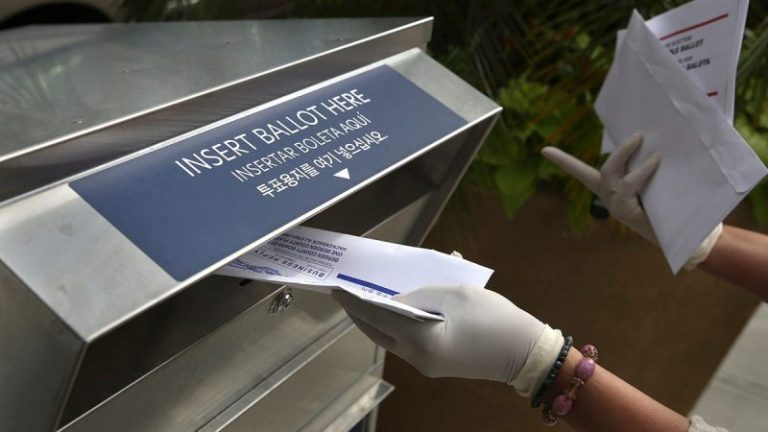
The Supreme Court revealed on Monday it will consider a lawsuit, originally brought by the Republican National Committee, over whether counting ballots that arrive after Election Day is lawful.

The case will examine a state law in solid red Mississippi that allows ballots postmarked by Election Day to be counted if they are received up to five days after the election. 

The RNC, which has fought to stop late-arriving ballots over allegations that they undermine trust in the vote counting process, argues the state law conflicts with federal law and is hoping the Supreme Court will ban them nationwide.

David Becker, executive director of the Center for Election Innovation & Research, emphasized that the court would not be weighing in on the legality of mail-in ballots, which are accepted in some form in every state, or whether ballots could be cast after Election Day.

‘What this case is about is whether a ballot that was cast on or before Election Day, sealed in an envelope, placed in the U.S. Mail and received by a state some days later can be counted if a state law says that that’s okay,’ Becker told Fox News Digital.

Mississippi’s rule went into effect in 2020, when many states implemented new emergency election policies over COVID-19. Well over a dozen, both red and blue, accept late mail-in ballots if they are postmarked by Election Day. 

The RNC sued over the law and secured a win at the conservative U.S. Court of Appeals for the 5th Circuit, leading Mississippi to bring the matter to the Supreme Court. The state argues ‘election’ means voters’ final choice, which occurs when ballots are cast by Election Day. Receipt of ballots that are marked and submitted effectuates the voters’ choice but are ‘not part of the election itself,’ Mississippi told the Supreme Court in a filing. As such, the state argues, federal law does not prohibit short, post-Election Day windows to receive ballots cast on time. 

Becker warned of repercussions that could come of the Supreme Court upholding the 5th Circuit’s ruling, saying it could invite a host of new litigation because close races could come down to ballots cast by Election Day that arrive a day or two after the election because of U.S. Postal Service delays.

‘We as a society do not want a bunch of ballots coming in the day or two after, delivered late, not because of the voter but because of the Postal Service, and having those ballots being the margin of victory in a close race,’ Becker said.

In a statement, RNC chairman Joe Gruters echoed broader sentiments of election security hawks who have taken issue with late-arriving ballots.

‘Allowing states to count large numbers of mail-in ballots that are received after Election Day undermines trust and confidence in our elections,’ Gruters said.

‘Elections must end on Election Day, which is why the RNC led the way in challenging this harmful state law. The RNC has been hard at work litigating this case for nearly two years, and we hope the Supreme Court will affirm the Fifth Circuit’s landmark decision that mail-in ballots received after Election Day cannot be counted.’

This post appeared first on FOX NEWS

Mayfair Gold (TSXV: MFG,NYSE American: MINE) is a development-stage company focused on advancing the Fenn-Gib gold project, a large, bulk-tonnage open-pit deposit situated in one of Canada’s most prolific gold districts. The company’s technical team is actively progressing provincial permitting, engaging in Indigenous consultation, advancing engineering, and conducting ongoing exploration to expand the deposit beyond its current pit boundaries.

The Preliminary Feasibility Study (PFS), prepared in accordance with NI 43-101 standards and filed in January 2026, outlines a base-case economic model with an after-tax NPV (5 percent) of C$652 million and an IRR of 24 percent, based on conservative gold prices, demonstrating rapid payback potential. Under a spot price scenario, project economics improve markedly, highlighting the asset’s strong leverage to higher gold prices. Once in operation, the project is expected to generate over $200 million in annual free cash flow, providing a robust source of capital to fund growth initiatives.

Mayfair Gold’s flagship Fenn-Gib gold project is located within the established Timmins Gold District in Ontario, which has produced more than 100 million ounces of gold historically.

Fenn-Gib is Mayfair’s flagship asset, encompassing a significant indicated mineral resource of 181.3 million tonnes grading 0.74 g/t gold for 4.3 million contained ounces, and additional inferred ounces. The project benefits from excellent access via Highway 101 and proximity to regional mining services.

Company Highlights

  • Robust Pre-feasibility Study: The 2026 PFS highlights compelling returns on a modest initial throughput design while leveraging a large resource base.
  • High-grade Early Focus: The staged plan targets higher-grade, near-surface material to optimize permitting timelines, construction risk, financing, and ultimately accelerate value capture.
  • Strategic Location: Fenn-Gib sits on the highly prospective Timmins Gold District, Ontario — a tier-one mining jurisdiction with established infrastructure and a long history of mining-related activity and supportive communities.
  • Strong Financial Backing: The company has a committed shareholder base, including Muddy Waters, Heeney Capital, Oaktree and Vestcor. With a tight share structure and strong Insider ownership of 35% there is clear alignment for long-term shareholder value creation.
  • Exploration Optionality: Mineralization at Fenn-Gib remains open at depth and along strike, with multiple underexplored targets identified across the property. This includes a Southern Block that has not been explored but sits directly on the prolific Porcupine-Destor fault.
  • Long-term optionality: With a truncated timeline to production the company will be in an advantageous spot for growth initiatives that can be funded with free cash flow.
  • CEO Nick Campbell, heads a technically strong and capital-markets-savvy team with a demonstrated ability to unlock value from high-quality gold assets (previously at Artemis Gold and Silvercrest Metals) and position projects for long-term growth.
  • COO Drew Anwyll is an experienced mine builder; he successfully permitted the Marathon PGM project in Ontario and was a senior executive during the construction, commissioning and start-up of Detour Lake, Canada’s largest gold mine.

This Mayfair Gold profile is part of a paid investor education campaign.*

Click here to connect with Mayfair Gold (TSXV:MFG) to receive an Investor Presentation

This post appeared first on investingnews.com