
Author

admin

Browsing

New York City Mayor Zohran Mamdani is facing criticism from local politicians and onlookers on social media over comments he made that critics say places blame on guns rather than criminals in an incident involving the shooting death of a 7-month-old child in Brooklyn.

“This is not our first family to know this pain,” Mamdani said in response to a 7-month-old baby girl, Kaori Patterson-Moore, who was killed by a stray bullet on Wednesday afternoon when a gunman on a moped opened fire on a Brooklyn street in a suspected gang-related incident. 

“Too many children have never grown up into becoming adults. To parents who’ve had to bury those they love most. We cannot accept it as normal in our city. We cannot grow numb to this pain, and today is a devastating reminder of just how much more work there is to be done… to combat gun violence across the city.”

The clip, along with other comments by Mamdani, have sparked criticism from local politicians, experts and onlookers who say the mayor is blaming guns instead of criminals and implementing policies that embolden those criminals.

HOLOCAUST SURVIVOR, 86, PRICED OUT OF NYC SAYS MAMDANI SKIPPED SCHEDULED HOUSING MEETING

“Literally anything but blaming the criminals who our system releases onto our streets repeatedly, over and over again, with no consequences,” NYC Republican Councilwoman Vickie Paladino posted on X. “Absolute disgrace.”

“If only New York had strict gun laws,” Power the Future Executive Director and New York City native Daniel Turner posted on X.

Manhattan Institute fellow Rafael A. Mangual told Fox News Digital that Mamdani’s “references to the means by which this heinous crime was committed suggests that he is uncomfortable with acknowledging that the murder of Kaori Patterson-Moore was committed by two evil thugs whose callous disregard for the value of human life should disqualify them from ever experiencing freedom.”

MAMDANI IGNITES SOCIAL MEDIA OUTRAGE AFTER PHOTO-OP AT NOTORIOUS NYC JAIL: ‘F—ING RIDICULOUS’

Mangual continued, “Framing this as a gun problem rather than an evil gangbanger problem is more familiar territory for a self-styled progressive whose political base is constituted by people simultaneously (if dissonantly) committed to the cause of ‘gun control’ as well as efforts to reorient the criminal justice system to be more lenient toward the offenders who pull triggers. But, as the recent killing of Richard Williams illustrates clearly, criminals can and do take lives without any weapons at all.”

Richard Williams, an 83-year-old Air Force veteran, was recently allegedly shoved onto subway tracks in New York City by an illegal immigrant with a long criminal history and later died from his injuries in an incident Mamdani has faced criticism for not addressing. 

“An 83-year old veteran was killed in New York City last month after being randomly pushed onto the subway tracks by an illegal alien,” Media Research Center Managing Editor Brittany Hughes posted on X. “Mamdani didn’t say a word because trains aren’t a good political prop, and he won’t condemn criminal aliens.”

Fox News Digital reached out to Mamdani’s office for comment. 

Mamdani, who has faced intense criticism over past calls to defund the police and proposed slashing the NYPD’s budget in February, did thank the department in a post on X, but that didn’t appear to assuage his critics.

“We should focus on the family’s loss today,” attorney Jim Walden, who ran against Mamdani for mayor, posted on X. “But every time you now ‘thank NYPD’ it burns my blood after you spent your career attacking them and coddling criminals. You really should be ashamed of yourself, @NYCMayor. But we all know you still hate police and policing and would dine with this vile criminal if you could get away with it, politically.”

President Donald Trump is used to bending financial markets to his will.

But with the war in Iran, he may have reached the limit of his ability to do so.

On Friday, the S&P 500 closed down 1.7% and notched its fifth-straight weekly decline, its worst stretch since 2022 and a sign of rapidly faltering confidence in a swift resolution to the Iran war.

Since the U.S. attacked Iran on Feb. 28, the S&P 500 has declined about 7%.

The Dow Jones Industrial Average fell 1.7% Friday and has lost nearly 4,000 points since the start of the war. It is now down more than 10% from its most recent high, a correction in technical terms.

The tech-heavy Nasdaq fell further into correction territory Friday, closing down 2% and off 13% since its record close in October.

Oil prices also rose sharply, with U.S. crude topping $100 a barrel and global Brent crude at approximately $114 at around 4 p.m. ET. The yield on the 10-year Treasury note surged to 4.4%, the highest since last summer. Some energy stocks, like Exxon, traded near all-time highs.

Shortly after stock markets had closed Thursday, Trump announced he was pausing attacks on Iranian energy sites for 10 days. But stocks barely budged.

Just days earlier, they had rocketed higher Monday when the president announced there had been “productive” talks with Iranian representatives, so he would pause strikes on Iranian power facilities for five days.

“The market is looking beyond commentary from the administration,” said Adam Turnquist, chief strategist at LPL Financial investment group, which manages nearly $2 trillion in assets. “They actually want concrete details and a resolution. And actions speak louder than words, that’s really present in [current] price action.”

This new reality stands in contrast to Trump’s ability to move markets throughout his first term and into the outset of his second.

Trump spent the better part of 2025 whipsawing traders via frequent changes regarding tariff levels. Eventually, a pattern emerged: The president would announce a new import duty, markets would fall, and Trump would usually end up reversing himself in some way.

The trend even got a nickname, coined by a columnist for the Financial Times: “TACO” — for “Trump Always Chickens Out.” (Last month, the Supreme Court struck down many of the tariffs.)

This time, the chain of events unleashed by Trump’s decision to attack Iran are such that a return to prewar conditions — and market levels — is virtually impossible in the short or even medium term, experts say.

The disruption to flows of oil and gas has been so substantial that transport costs, and ultimately the price paid per barrel, are likely to stay elevated indefinitely. Even when the Strait of Hormuz, which Iran has used as a chokepoint to drive concessions from the West, eventually reopens, the cost of transiting through it has likely gone up for the foreseeable future.

And the broader fallout on the economy and consumer purchases is already being felt.

That, in turn, has made interest rate cuts by the Federal Reserve less likely, because the higher oil costs are set to contribute to already sticky inflation. The odds of a rate hike before the end of the year have now outpaced the odds of a cut.

“Let’s say hostilities end tomorrow — the market will rally, but it’s not necessarily ripping back to where it was before because of the disruptions that have occurred,” said Steve Sosnick, chief strategist at Interactive Brokers financial group. “You’re not going to see oil go back to where it was immediately. You’re not going to see markets price in rate cuts the way they were before.”

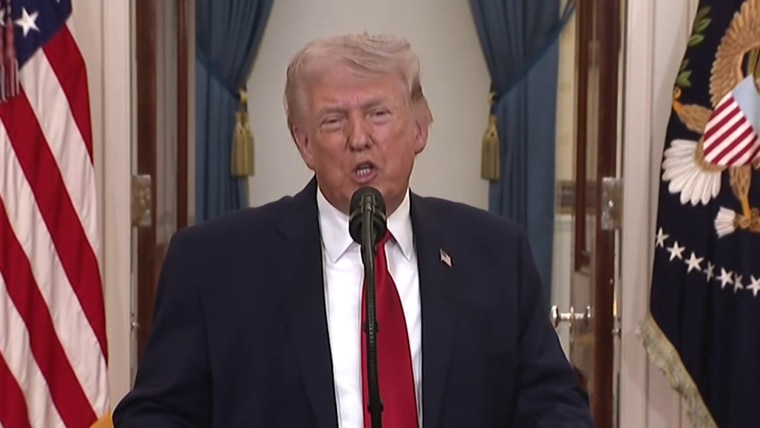
White House spokesman Kush Desai said Friday that Trump “continues to be a powerful force driving the market’s confidence in the United States as the most dynamic, pro-business economy in the world.”

“Once the military objectives of Operation Epic Fury have been achieved and the market’s short-term disruptions are behind us, everyday investors are set to reap a windfall in a booming American economy,” Desai said.

A day earlier, the president said he was not concerned about the market’s recent performance.

Oil prices “have not gone up as much as I thought, Scott, to be honest with you,” he said during a Cabinet meeting, addressing Treasury Secretary Scott Bessent. “It’s all going to come back down to where it was and probably lower.”

Markets have not fallen further because the outlook for earnings growth remains bullish, Turnquist said — though that could change the longer the conflict drags on and further impinges on consumer spending and business investment.

And compared to prior oil shocks, the U.S. economy is less oil-intensive, as it has transitioned to one that is largely service-oriented. Global oil markets have also been supported by America’s oil production boom over the past decade — with more supplies online, overall prices are less likely to rise as much.

Yet by some metrics, stocks were already considered expensive prior to the hostilities. Having already contended with stretched valuations, traders may find it much harder to power stock prices back to the record levels seen just prior to the start of the latest conflict.

“The risk-reward is still very heavily weighted toward [the] risk” of further stock-price declines,” said Matt Maley, chief market strategist at Miller Tabak financial group.

Should hostilities persist, Trump’s ability to influence markets will only further erode, Sosnick predicted.

“He now realizes he’d like to jawbone his way out of it, but it’s not that easy at this point because the situation encompasses so many moving parts and difficult variables,” Sosnick said. “It doesn’t lend itself to a quick set of comments mollifying investors.”

A flurry of bets made prior to major announcements about the Iran war has ramped up speculation that individuals or groups with advance knowledge of U.S. military plans are cashing in on insider information.

And while prediction market platforms Polymarket and Kalshi now say they are taking more proactive measures designed to prevent such illicit activity, experts say there have been few signs so far that Trump administration regulators are cracking down.

“You need the deterrent factor that exists on the government side,” said Chris Ehrman, an attorney who previously served as head of the Commodity Futures Trading Commission’s whistleblower office. Without it, he said, simply allowing the platforms to self-regulate often amounts to “whipping them with a wet noddle.”

So far, the suspect bets have been largely concentrated on Polymarket, a platform that allows users to wager on the likelihood of certain events taking place. But in at least one case, speculation about a possible insider trade has migrated to a more traditional market.

The CFTC did not respond to a request for comment. In an interview this week with the Washington Reporter, an online conservative publication, CFTC Chairman Michael Selig pushed back on the idea that his office was not taking on the issue.

“There’s this false media narrative that CFTC-regulated markets are the Wild West and have no regulation and that’s blatantly false,” he said. “The CFTC uses complex surveillance tools and has seasoned career staff that pro-actively monitor these markets for insider trading and fraud.”

The CFTC recently issued guidance that reminded prediction market platforms of their responsibilities to limit insider trading.

Noah Solowiejczyk, a partner at law firm Fenwick & West and a former federal prosecutor, said the agency has recently shown signs it wants to take insider trading cases more seriously.

“I think you’ll see an enforcement action or prosecution happen” in an events-driven insider trading case, Solowiejczyk predicted.

Once relegated to the world of finance, insider has become a major topic in recent years as concerns about everything from politicians’ stock trades to professional athletes’ performances are now widely scrutinized for evidence of manipulation — fueled in part by the ongoing creep of investing and gambling onto smartphones and into everyday life.

Data suggests traders with advanced knowledge of geopolitical events may have collectively pocketed millions from recent bets on Polymarket. Last month, in the run-up to the latest round of American and Israeli attacks on Iran, some $529 million was traded on the platform tied to the timing of the strikes, Bloomberg News reported.

Earlier this week, analytics firm Bubblemaps said a series of connected Polymarket accounts had earned $1 million over the past two years predicting U.S. and Israeli strikes in the Middle East.

On Monday, approximately 15 minutes before President Donald Trump posted that there had been “productive” talks with Iran, stocks and oil futures trades on the main exchange run by longtime markets firm CME Group saw an unusual burst of volume compared to the relatively subdued backdrop seen the rest of that morning.

The bets predicted stocks would rise and oil prices would fall that day — precisely what happened once Trump made his announcement.

Depending on when they closed, the trades could have yielded millions — though shortly after Trump’s post, Iran denied there had been direct talks, and the market moves reversed somewhat.

Polymarket did not respond to a request for comment. A CME spokespersn declined to comment.

Solowiejczyk said the CFTC has likely been hampered by staffing shortages, which may be impacting its ability to take on new cases. Barron’s magazine recently reported that the CFTC has made significant cuts in its enforcement division, including the loss of all enforcement attorneys in its Chicago office.

It is not clear to what extent the anonymity that’s available to traders on Polymarket and Kalshi would hinder a federal investigation into illicit trading.

While part of Polymarket is registered in the U.S., making it subject to federal know-your-customer requirements, another part is registered in Panama — something that could make it harder to trace individuals making insider bets. Experts also say traders can circumvent geographic restrictions by using virtual private networks, or VPNs, that mask which country they are operating in.

So far, no American has faced federal charges in connection with insider trading on event-driven news. In February, Israel charged two of its military service members with using classified information to place bets on Polymarket related to unspecified combat operations.

Polymarket only recently began accepting trades from U.S.-based users, following an effort by the Trump administration to end a Biden-era push to restrict its use here.

Kalshi is fully registered in the U.S., and recently suspended an editor for influencer MrBeast in connection with alleged insider trading.

Many of the suspect bets on Polymarket are placed by accounts that are either new or solely focused on one specific outcome, further suggesting insiders could be behind them.

Even prior to the recent military operations and the accompanying suspicious bets, accusations of insider trading on Polymarket had begun to surface.

In January, a Polymarket user earned some $400,000 betting that then-Venezuelan President Nicolás Maduro would soon be out of office. One trader appeared to make approximately $1.2 million forecasting whom Google would announce as the most-searched people of 2025.

In response to a question about insider trading in November, Polymarket CEO Shayne Coplan told “60 Minutes” that “having an edge” is “a good thing.”

Coplan said that while he was focused on the ethics of insider transactions, it was “sort of an inevitability that this will happen, and there’s a lot of benefits from it.”

This week, Polymarket and Kalshi both unveiled measures designed to further crack down on insider trading.

Polymarket announced new rules explicitly stating users cannot act on insider information or trade on events whose outcome they could influence.

Kalshi said it was deploying technology that would “preemptively block politicians, athletes, and other relevant people” from trading in politics and sports markets. It also said it was adding a whistleblower function to its markets homepage that would allow users to flag potential violations.

A representative for Kalshi said the company has not been involved in the recent suspect trades. “We ban insider trading and enforce it,” a spokeswoman said in an email.

Polymarket, recently valued at $9 billion, counts Donald Trump Jr. as an investor. The president’s eldest son is also a strategic adviser to Kalshi, its top competitor.

White House representatives denied any wrongdoing originated from the administration and blasted insinuations that they were.

“All federal employees are subject to government ethics guidelines that prohibit the use of nonpublic information for financial benefit,” White House spokesman Kush Desai said in a statement.

“However, any implication that Administration officials are engaged in such activity without evidence is baseless and irresponsible reporting.”

“The President has no involvement in business deals that would implicate his constitutional responsibilities,” David Warrington, White House counsel, said in a statement. “President Trump performs his constitutional duties in an ethically sound manner and to suggest otherwise is either ill-informed or malicious.”

“Don does not interface with the federal government as part of his role with any company that he invests in or advises and has no influence or involvement with administration policies relating to prediction markets,” a representative for Donald Trump Jr. said in a statement.

Members of Congress have taken a more circumspect view of event-market platforms, putting forward legislation that would ban elected officials and government employees from using them and restricting the types of events, such as war or deaths, users can wager on.

The most recent bill, introduced by Sen. Chris Murphy, D-Conn., and Rep. Greg Casar, D-Texas, would ban trades on government actions, terrorism, war, assassination and events “where an individual knows or controls the outcome.”

“There’s no getting around the fact that any prediction market where somebody knows or controls the outcome of a bet is ripe for corruption,” Murphy said in a statement.

“Even worse, prediction markets are also an avenue by which government decisions get influenced by who’s making money off them, and that should be unforgivable to the American public,” he said.

FIRST ON FOX: The State Department has added business formal dress code guidance to its internal policy manual for the first time, establishing department-wide standards for employee attire.

The changes, implemented in recent days in the Foreign Affairs Manual — the department’s central repository for policies — mark the first time the agency has formally codified expectations for how diplomats and staff should dress in official settings.

“Representing the United States of America is an honor — and this new policy ensures our diplomats project credibility, respect, and the dignity of the nation we serve,” Assistant Secretary Dylan Johnson told Fox News Digital.

The updated policy applies broadly across the department for both civil service and foreign service employees.

DEPARTMENT TO ASK FOR BONDS OF UP TO $15,000 FOR VISA APPLICATIONS FROM A DOZEN MORE COUNTRIES

The move underscores a broader recalibration at the State Department, where Trump administration officials have sought to impose clearer standards around discipline, appearance and adherence to policy. 

A State Department official said the change was driven in part by concerns that some diplomats had been dressing “pretty informally” in recent years. 

“This should have happened a long time ago,” the official said. 

The formal dress code represents a shift away from Biden-era personnel policies that prioritized flexibility and cultural inclusivity, toward a more uniform and prescriptive standard for how U.S. diplomats present themselves.

“Appropriate attire and appearance will depend on the duties performed, the work environment, and the level of interaction with foreign interlocutors and other external stakeholders,” reads the manual, viewed by Fox News Digital. “For staff participating in meetings or other official engagements with foreign interlocutors, dress is Business Formal and personal appearance is polished and professional unless otherwise specified.”

The dress code update follows other recent changes to how the State Department evaluates and manages its workforce, including revisions to hiring and promotion criteria for Foreign Service officers. 

Earlier in 2026, the department replaced diversity, equity and inclusion-related benchmarks with a new core precept focused on “fidelity,” emphasizing adherence to U.S. government policy and chain-of-command authority.

Under the updated guidance, mid- and senior-level diplomats are expected to demonstrate loyalty by “zealously executing U.S. government policy” and resolving ambiguity in favor of leadership direction, according to internal documents previously reported by Fox News Digital.

Those changes came alongside broader efforts to restructure the department’s workforce, including plans to reduce staffing and consolidate offices, signaling a shift toward more standardized expectations for diplomatic personnel. The addition of a formal dress code marks the latest step in that direction.

WASHINGTON — The Senate agreed unanimously early Friday to fund the Department of Homeland Security, but without funding for immigration enforcement and deportation operations.

Senators approved the package at 2:20 a.m. by voice vote following a marathon session.

The 42-day funding lapse has seen them go without pay, leading many to call out of work and causing long lines at airports. While the measure still needs to pass the House, the Senate vote paves the way to allow airports to fully function again.

The legislation would fund all of DHS except Immigration and Customs Enforcement and Customs and Border Protection, which Democrats have refused to vote for without significant reforms to immigration raids and deportation practices.

The deal followed arduous bipartisan negotiations that occurred in fits and starts over the last six weeks, succumbing to the impasse around policy changes to immigration enforcement. Under the new plan, Democrats get their weeks-long demand to fund the department with the exceptions of ICE or CBP, but also without the restrictions they sought on how immigration officers may conduct operations.

“This could have been done three weeks ago,” Senate Minority Leader Chuck Schumer, D-N.Y., said. “This is exactly what we wanted.”

Long wait lines at a TSA checkpoint at New York’s LaGuardia airport Friday.Gabrielle Korein / NBC News

The bill faces an uncertain future in the Republican-controlled House. It is expected to have President Donald Trump’s support, which could help corral conservatives who have been skeptical about splitting off ICE funding from the underlying bill.

“Hopefully they’ll be around, and we can get at least a lot of the government opened up again, and then we’ll go from there,” Senate Majority Leader John Thune, R-S.D., said of the House and a potential vote on Friday. He said he texted with Speaker Mike Johnson, R-La., on Thursday night.

The Senate adjourned for a two-week recess, leaving the House with few options other than to accept their bill as written.

Thune separately blamed Democrats. “President Trump should never have had to step in to rescue TSA workers and U.S. air travel. We are here because, thanks to Democrats’ determined refusal to reach an agreement, there will be no Homeland Security funding bill this year.”

Speaking after the vote, Schumer said: “In the wake of the murders of Renee Good and Alex Pretti, Senate Democrats were clear. No blank check for a lawless ICE and Border Patrol.”

He added that the “long overdue agreement” funds TSA, the Coast Guard, the Federal Emergency Management Agency and the Cybersecurity and Infrastructure Security Agency, and “strengthens security at the border and the ports of entry, and keeps Americans safe.”

He added that the deal “could have been accomplished weeks ago if Republicans hadn’t stood in the way.”

The White House and Republicans declined to grant Democrats’ demands to restrict Trump’s immigration practices. They now plan to pursue the remainder for funding for ICE and CBP in a separate party-line bill, which they could also use to pass Iran war funding and elements of the Trump-backed SAVE America Act.

Senate Republicans held a vote open for hours Thursday as the two sides continued to negotiate, having traded offers for days.

Trump, meanwhile, announced earlier Thursday that he would instruct newly sworn-in Homeland Security Secretary Markwayne Mullin to “immediately pay our TSA Agents in order to address this Emergency Situation.”

That move may not be needed if the House passes the Senate legislation, according to a senior administration official, who said the White House is waiting to see what will happen.

This official also said the funds to pay TSA agents would come from the so-called One Big Beautiful Bill, the tax-cut and spending legislation Trump signed into law in July. It’s not clear exactly how that would work, but the administration has dipped into those unspent funds before to cover pay gaps during funding lapses.

The House can either debate and vote out the Senate-passed measures in the Rules Committee before bringing them to the floor under a simple majority vote, or Johnson can seek to fast-track it to the floor.

The House was set to hold an unrelated vote at 10 a.m. before leaving for recess.

We’d like to hear from you about how you’re experiencing the partial government shutdown, whether you’re a TSA agent who can’t work right now or a federal employee who is feeling the effects at your agency. Please contact us at tips@nbcuni.com or reach out to us here.

TSA officers missed their first full paychecks in mid-March, leading many to call out of work. Call-out rates for TSA officers have exceeded 11% nationally, with rates at some airports passing 40%.

Trump sent ICE agents to airports to help TSA earlier this week. Unlike TSA officers, ICE agents continue to receive paychecks during the partial shutdown as a result of funding from the so-called One Big Beautiful Bill, a sweeping GOP domestic policy package, that Trump signed into law last year.

Questcorp Mining Inc. (CSE: QQQ,OTC:QQCMF) (OTCQB: QQCMF) (FSE: D910) (the ‘Company’ or ‘Questcorp’) is pleased to announce the successful completion of 12.8 line kilometres of induced polarization (‘IP’) surveying over the Marisa Zone at its 1,168-hectare North Island Copper Project located near Port Hardy on Vancouver Island, British Columbia.

The Company is currently reviewing the newly acquired geophysical data and will release a detailed interpretation once the technical team has completed its evaluation. As part of this process, Peter E. Walcott and Associates Limited will integrate the historical 1992 IP survey data with the new 2026 survey results to generate a comprehensive 3D inversion model of the target area.

The results of this work are expected to assist in defining priority drill targets. Subject to final interpretation and permitting timelines, the Company intends to initiate permitting for a drill program in late H1 or early H2 2026.

Previous exploration at the Marisa Zone identified copper mineralization associated with an IP chargeability anomaly. In 1992, two of five diamond drill holes were completed to test the anomaly intersected copper mineralization, including:

  • 0.078% copper over 56.39 metres (DDH92-01)
  • 0.041% copper over 70.71 metres (DDH92-03)

Both intercepts were encountered within altered quartz diorite, with copper grades increasing with depth in DDH92-03.

Source: Geophysical and Diamond Drilling Report on the Marisa Property, G.J. Allen and P.G. Dasler, February 29, 1992, prepared for Great Western Gold Corporation.

‘This recently completed IP survey represents an important step in advancing the Marisa Zone target,’ stated Saf Dhillon, President & Chief Executive Officer of Questcorp Mining. ‘The survey has successfully confirmed the presence of the historical chargeability anomaly identified in earlier work. Once Walcott and Associates completes the 3D inversion and our technical team finishes reviewing the results, we expect to refine potential drill targets and move toward a drill program later in 2026.’

The Company cautions that a Qualified Person has not verified the historical exploration data referenced in this release. The presence of mineralization on adjacent or nearby properties, including NorthIsle Copper and Gold and BHP properties, is not necessarily indicative of mineralization on the North Island Copper Project.

The technical content of this news release has been reviewed and approved by R. Tim Henneberry, P. Geo (BC), a Director of the Company and a Qualified Person under National Instrument 43-101 – Standards of Disclosure for Mineral Projects.

About Questcorp Mining Inc.

Questcorp is engaged in the business of the acquisition and exploration of mineral properties in North America, with the objective of locating and developing economic precious and base metal properties of merit. The Company holds an option to acquire an undivided 100-per-cent interest in and to mineral claims totalling 1,168.09 hectares comprising the North Island Copper property, on Vancouver Island, B.C., subject to a royalty obligation. The Company also holds an option to acquire an undivided 100-per-cent interest in and to mineral claims totalling 2,520.2 hectares comprising the La Union project located in Sonora, Mexico, subject to a royalty obligation.

ON BEHALF OF THE BOARD OF DIRECTORS,

Saf Dhillon
President & CEO

Questcorp Mining Corp.
saf@questcorpmining.ca
Tel. (604-484-3031)
Suite 550, 800 West Pender Street
Vancouver, British Columbia
V6C 2V6

https://questcorpmining.ca

This news release includes certain ‘forward-looking statements’ under applicable Canadian securities legislation. Forward-looking statements include, but are not limited to, statements with respect to the intended use of proceeds from the Offering; and closing of subsequent tranches of the Offering. Forward-looking statements are necessarily based upon a number of estimates and assumptions that, while considered reasonable, are subject to known and unknown risks, uncertainties, and other factors which may cause the actual results and future events to differ materially from those expressed or implied by such forward-looking statements. Such factors include, but are not limited to general business, economic, competitive, political and social uncertainties, uncertain capital markets; and delay or failure to receive board or regulatory approvals. There can be no assurance that such forward-looking statements will prove to be accurate, as actual results and future events could differ materially from those anticipated in such statements. Accordingly, readers should not place undue reliance on forward-looking statements. The Company disclaims any intention or obligation to update or revise any forward-looking statements, whether as a result of new information, future events or otherwise, except as required by law.

Neither the Canadian Securities Exchange nor its Regulation Services Provider (as that term is defined in the policies of the Canadian Securities Exchange) accepts responsibility for the adequacy or accuracy of this release.

To view the source version of this press release, please visit https://www.newsfilecorp.com/release/288086

News Provided by TMX Newsfile via QuoteMedia

This post appeared first on investingnews.com

A federal judge in California has blocked the Trump administration from designating Anthropic as a supply chain risk to national security and cutting off the AI company’s work with federal agencies.

Anthropic sued the Defense Department and other federal agencies this month after the Pentagon labeled it a “supply-chain risk to national security.” President Donald Trump said he would also ban the use of Anthropic’s products across other federal agencies.

“Defendants’ designation of Anthropic as a ‘supply chain risk’ is likely both contrary to law and arbitrary and capricious,” U.S. District Judge Rita Lin of Northern California wrote in her order Thursday night. “The Department of War provides no legitimate basis to infer from Anthropic’s forthright insistence on usage restrictions that it might become a saboteur.”

Lin paused her order for a week to allow the administration time to appeal.

The Defense Department and the White House did not immediately respond to a request for comment Thursday evening.

“We’re grateful to the court for moving swiftly, and pleased they agree Anthropic is likely to succeed on the merits,” an Anthropic spokesperson said in a statement Thursday. “While this case was necessary to protect Anthropic, our customers, and our partners, our focus remains on working productively with the government to ensure all Americans benefit from safe, reliable AI.”

The supply chain risk designation requires the Pentagon and its contractors to stop using Anthropic’s commercial AI services for all defense business.

Defense Secretary Pete Hegseth said on X in late February that he was issuing a directive to give the company the “supply chain risk” label. Trump also said he was ordering all federal agencies, including the Treasury and State departments, to cease using Anthropic’s AI technology.

“The record reflects that the Challenged Actions were taken without any meaningful notice or pre-deprivation process (and, in the case of the Presidential Directive and the Hegseth Directive, without any post-deprivation process either),” Lin wrote in her order.

The order Thursday also bars other agencies from cutting off their work with Anthropic. Lin wrote that the order restores the status quo.

“This Order does not require the Department of War to use Anthropic’s products or services and does not prevent the Department of War from transitioning to other artificial intelligence providers, so long as those actions are consistent with applicable regulations, statutes, and constitutional provisions,” the order said.

Anthropic filed two lawsuits against the Defense Department — one in U.S. District Court for Northern California and the other in U.S. Circuit Court of Appeals for Washington, D.C. — alleging that the federal government’s moves go beyond a normal contract dispute and instead are an “unlawful campaign of retaliation” that followed months of heated negotiations about how the military should be able to use Anthropic’s AI systems.

Anthropic had sought stronger guarantees that the Pentagon would not use its AI systems for autonomous weapons or mass domestic surveillance.

Anthropic is the creator of the Claude chatbot system and the only AI company whose services were cleared for use on the Defense Department’s classified networks.

Hours after Hegseth’s announcement last month, OpenAI CEO Sam Altman said his company had reached an agreement with the Pentagon to use its services in classified settings.

Lin wrote: “Although Anthropic was on notice that the government objected to its contracting terms, it had no notice or opportunity to object before Defendants publicly barred it from all federal government work and blacklisted it with private companies working with the U.S. military. It also had no notice or opportunity to object to the factual basis for its designation as a supply chain risk, which it learned of in this litigation.”

Investor Insight

With a strong asset foundation, C$8 million in cash, and an experienced technical team, Prince Silver is well-positioned to capitalize on the current macro tailwinds in the silver and manganese markets. The project has a US Critical Minerals advantage, hosting silver, zinc, lead, and manganese, in addition to gold.

Overview

Prince Silver (CSE:PRNC,OTCQB:PRNCF) is a Vancouver-based exploration company focused on unlocking value at the Prince silver project in southeastern Nevada.

In July 2025, the company completed a transformational acquisition of Stampede Metals Corporation and subsequently rebranded from Hawthorn Resources to Prince Silver Corp.

The flagship asset is a district-scale, past-producing silver-gold-zinc-manganese carbonate replacement system, historically mined through the early to mid-1900s. The immediate objective is to validate and expand upon the 129 historic drill holes (over 16,600 meters) to convert the exploration target into a maiden NI 43-101 mineral resource, targeted for the fourth quarter of 2026.

Company Highlights

  • Flagship Project: 100 percent ownership of the historic Prince silver mine in Lincoln County, Nevada, an open, near-surface silver-gold-zinc carbonate replacement deposit. It has an exploration target of 23 to 45 million tons, with strong historic grades.
  • Fully Funded Drilling Program Underway: A 9,000-meter reverse-circulation drill program is now underway with a steady stream of assay results expected from January to May 2026. This follows an recent funding raise of approximately C$4.75 million in gross proceeds.
  • Clean Corporate Reset: Hawthorn Resources completed the Stampede Metals acquisition and re-listed as Prince Silver Corp. on July 11, 2025.
  • Tight Share Structure: The company has 58.9 million shares issued and outstanding as of February 23, 2026.
  • US Critical Minerals Leverage: The Prince Project hosts critical and strategic minerals on the 2025 USGS list: silver, zinc, lead, and manganese, in addition to gold.
  • Experienced, Hands-on Leadership: President Ralph Shearing, CEO Derek Iwanaka, and new directors Marco Montecinos, Robert Wrixon and Darrell Rader add mine-building, corporate, and capital-markets depth to the leadership team.
  • Expanded Land Position: The land package at the Prince Silver Project has more than doubled, securing over 7 kilometers of prospective strike length along the mineralized fault system.

Key Projects

Prince Silver Project

The Prince silver project is a large-scale, polymetallic Carbonate Replacement Deposit (CRD) located just west of Pioche, a historic mining district in southeastern Nevada. The project hosts a structurally and stratigraphically controlled system of silver-rich mantos, breccias, and fissure veins. Historic underground production between 1912 and 1949 totaled approximately 1.12 million tons (Mt) at average grades of 100 grams per ton (g/t) silver, 4.5 percent zinc, and 10 percent manganese.

Highlights

  • Geological compilation work has defined an exploration target ranging between 23 and 45 Mt, grading approximately 37 to 40 g/t silver, 1.5 percent zinc, and 0.8 percent lead.
  • The fully-funded 9,000 meter drill program is underway with a steady stream of assay results expected from January to May 2026, targeting a maiden NI 43-101 Mineral Resource Estimate (MRE) in the fourth quarter of 2026.
  • The company recently expanded its land position, securing over 7 kilometers of prospective strike length along the mineralized fault system.

Stampede Gap Copper-Gold-Molybdenum Project

The Stampede Gap Copper-Gold-Molybdenum Project is a large, early-stage porphyry target in Nevada featuring over 200 claims. Historical geophysics have identified multiple IP-resistivity anomalies, and a single 700 meter drill hole encountered extensive skarn alteration. Its location is only 150 kilometers south of KGHM’s Robinson copper-gold-silver-molybdenum mine. The project presents a deep-seated exploration target that has the hallmarks of a large-scale copper-molybdenum deposit.

Management Team

Derek Iwanaka – Chief Executive Officer and Director

Derek Iwanaka is a mining-sector executive with over 23 years of investor relations, corporate development, and capital markets experience. He has supported more than 20 corporate transactions and helped raise over US$100 million, including one of Canada’s first at-the-market financings. Iwanaka previously held senior roles at BeMetals and First Mining Gold Corp., contributing to strategic acquisitions, project advancement, and significant market-cap growth.

Ralph Shearing – President and Director

Ralph Shearing is a professional geologist and mine developer with over 35 years in mineral exploration development and public company management. Since 1987, Shearing has held senior executive positions with public junior mining and exploration companies, notably Luca Mining, a company he founded and guided through exploration, development, construction, and pre-production of the Tahuehueto mine in Mexico. He currently acts as a Qualified Person for Prince Silver’s technical disclosure.

Rob Scott – Chief Financial Officer and Corporate Secretary

Rob Scott’s professional experience has helped raise over $200 million in equity with past and current executive and board positions with TSXV issuers, including Great Bear Resources, Valore Metals, Riverside Resources, Capitan Silver, and First Helium.

Dr. Robert Wrixon – Independent Director

Robert Wrixon is the managing director of Starboard Global, a Hong Kong-based project incubator and VC firm. Wrixon is a seasoned executive and engineer with over 20 years’ experience across ASX- and LSE-listed mining companies. He holds a PhD in mineral engineering from UC Berkeley and brings deep technical, corporate development, and mergers and acquisitions experience.

Darrell Rader – Independent Director

Darrell Rader is the president and chief executive officer of Minaurum Gold, a silver explorer in Mexico. He has directly raised over $150 million for mineral exploration and development and has strong relationships with institutional investors and bankers. Rader founded Defiance Silver Corp, a silver developer, and previously was the head of corporate development at IMPACT Silver. Rader holds a BBA in Finance from Simon Fraser University.

Marco Montecinos – Independent Director

Marco Montecinos has over 40 years of mineral exploration experience across the Americas, including a key role in the three-million-ounce Marlin Gold discovery, multiple gold discoveries, and current roles as chief president of exploration at Gunpoint Exploration and US Critical Metals, as well as president of Tigren, Inc.

This post appeared first on investingnews.com

Americans’ personal data could be collected and stored overseas — even if they’ve never downloaded a foreign-developed app themselves — according to a new FBI alert warning about the risks tied to popular mobile platforms.

That means information like a person’s name, email address or phone number could be pulled from someone else’s contact list and potentially stored abroad if a friend or family member grants an app access to their device.

The warning comes after years of scrutiny over TikTok’s ties to China, but the FBI alert suggests the concerns extend beyond any single platform to a broader range of foreign-developed apps.

In a public service announcement, the FBI said many widely used apps developed overseas, particularly those tied to China, may access extensive data once permissions are granted, including address books containing information on both users and non-users.

5 SIMPLE TECH TIPS TO IMPROVE DIGITAL PRIVACY

The bureau also warned that some apps may continue collecting data in the background after access is granted and, in certain cases, store that information on servers in countries where local laws could allow government access.

“Developer companies can store collected data on users’ private information and address books, such as names, e-mail addresses, user IDs, physical addresses, and phone numbers of their stored contacts,” the FBI said. “The app can persistently collect data and users’ private information throughout the device, not just within the app or while the app is active.”

CHINESE HACKERS REPORTEDLY BREACHED PHONES AT ‘HEART OF DOWNING STREET’ IN GLOBAL SPY CAMPAIGN

The FBI did not name specific companies, but the warning could apply to a range of widely used apps developed by Chinese firms — including video-editing platform CapCut, shopping apps like Temu and SHEIN, and social media platforms such as Lemon8 — several of which rank among the most downloaded apps in the United States.

U.S. officials have long warned that data collected by Chinese-linked platforms could be used to build detailed profiles of Americans, map personal and professional networks, and potentially support intelligence-gathering efforts, particularly if accessed under China’s national security laws.

The FBI added that apps operating in China are subject to the country’s national security laws, which could allow the government to access user data.

The FBI also pointed to possible warning signs that an app may be collecting more data than expected, including unusual battery drain, spikes in data usage, or unauthorized account activity after installation — indicators that could suggest background data collection or other suspicious behavior.

The bureau urged users to limit unnecessary data sharing, download apps only from official app stores, and regularly review permissions granted to mobile platforms. The bureau also warned that apps obtained from third-party sites may carry malware designed to gain unauthorized access to personal data.

Years of scrutiny over TikTok culminated in a 2026 deal that forced its Chinese parent company to relinquish control of U.S. operations to an American-led group in order to address fears over data access and national security.

The FBI’s latest warning suggests those risks may extend beyond a single platform to a broader range of foreign-developed apps used by millions of Americans.

The Chinese embassy could not immediately be reached for comment. 

Liberal Supreme Court Justice Ketanji Brown Jackson faced viral backlash from conservatives over a comment during oral arguments about birthright citizenship where she floated an analogy comparing the issue to stealing a wallet in Japan. 

“I was thinking, you know, I’m a U.S. citizen and visiting Japan and what it means is that, you know, if I steal someone’s wallet in Japan, the Japanese authorities can arrest me and prosecute me,” Jackson said during Wednesday’s oral arguments centered on President Trump’s 2025 executive order advancing a narrower interpretation of the 14th Amendment’s citizenship clause.

“It’s allegiance, meaning, they can control you as a matter of law. I can also rely on them if my wallet is stolen to, you know, under Japanese law, go and prosecute the person who has stolen it. So there’s this relationship based on, even though I’m a temporary traveler, I’m just on vacation in Japan, I’m still locally owing allegiance in that sense. Is that the right way to think about it? And if so, doesn’t that explain why both temporary residents and undocumented people would have that kind of, quote-unquote, allegiance, just by virtue of being in the United States?”

KAGAN TURNS ON LIBERAL ALLY JACKSON WITH FOOTNOTE JAB OVER FREE SPEECH

Conservatives and Republican politicians quickly seized on Jackson’s comment equating territorial jurisdiction with political allegiance, arguing that her analogy fundamentally misreads the 14th Amendment’s birthright-citizenship clause.

“I don’t think KBJ knows what words mean,” conservative communicator Steve Guest posted on X.

“Leave it to Justice Jackson to defend the suicide pact of birthright citizenship for illegals by not understanding the difference between territorial jurisdiction (obeying local laws), and political allegiance,” Turning Point USA’s Andrew Kolvet posted on X. “If territorial jurisdiction means allegiance, every tourist is a US citizen, which is insane. The whole thing is so low IQ and embarrassing for the Court.”

“Oh, good grief, come on now!” Florida Gov. Ron DeSantis posted on X.

“That’s not what allegiance means,” GOP Sen. Ted Cruz posted on X.

“We only have thirty more years of this, guys,” Outkick founder Clay Travis posted on X.

“Because nothing says ‘allegiance’ quite like going to a new country and immediately breaking its laws,” conservative commentator Greg Price posted on X.

“This is exactly how bad arguments get dressed up to sound intellectual,” conservative commentator A Gene Robinson posted on X.

“‘Subject to the laws’ does NOT equal allegiance. That’s where this entire thing collapses. If you step into a country… you are bound by its laws. That’s jurisdiction. It’s not loyalty. It’s not consent. It’s not allegiance. A criminal is ‘subject to the law’ the moment he commits a crime…That doesn’t make him part of the nation. It makes him accountable to it. That wallet analogy proves the opposite of what it’s trying to argue.”

TRUMP MAKES HISTORIC SCOTUS APPEARANCE FOR BIRTHRIGHT CITIZENSHIP CASE

“Not sure if she’s aware but of all the countries to mention Japan is probably the least helpful to her cause,” journalist Miranda Devine posted on X. “Babies born in Japan can only become citizens if they have Japanese blood and are born to registered Japanese citizens whose names appear in a special book.”

“No words,” GOP Rep. Derrick Van Orden posted on X.

“Peak moron,” conservative radio host Dana Loesch posted on X.

“I cannot believe this woman is on the court, and I cannot believe anyone on the left thinks letting her air these thoughts out loud does them any favors,” Real Clear Investigations senior writer Mark Hemingway posted on X.

Wednesday’s oral arguments centered on Trump’s 2025 executive order advancing a narrower interpretation of the 14th Amendment’s citizenship clause so that children born in the United States to parents who are in the country illegally or temporarily would not automatically receive U.S. citizenship. 

At issue in the case before the Supreme Court is the language in the amendment that says anyone born in the United States and “subject to the jurisdiction thereof” is automatically a citizen. President Donald Trump and conservative legal analysts have argued the provision was a relic of the Civil War and intended for freed slaves rather than a justification of birth tourism and illegal immigration.

Fox News Digital’s Ashley Oliver contributed to this report.