Author

admin

Browsing

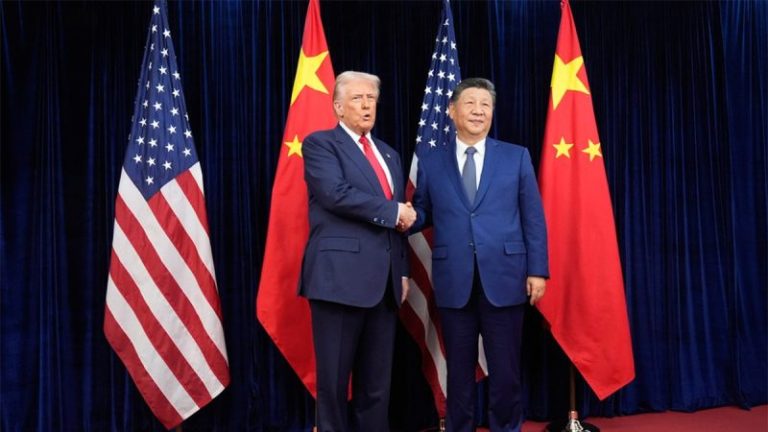
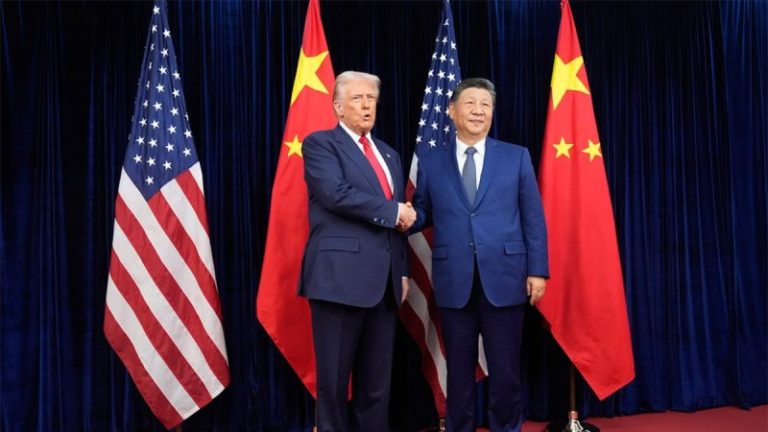
U.S. President Donald Trump on Thursday met face-to-face with Chinese leader Xi Jinping in Busan, South Korea – just hours after Trump hinted online at potential shifts in U.S. defense and trade policy. 

The meeting marked the final stop of Trump’s Asia trip, which also included stops in Malaysia and Japan, and focused on cooling the economic standoff between Washington and Beijing. 

Since returning to the White House in January, Trump has levied major tariffs on Chinese imports – a move that prompted Beijing to tighten its control over exports of rare earth elements. Both leaders signaled interest in reducing tensions to avoid further shocks to the global economy. 

Ahead of Thursday’s summit, U.S. and Chinese aides signaled the discussion would center on tariffs, advanced technology exports, and supply chain competition – key sticking points that have long defined the relationship between the two powers. Trump told reporters he believed the two sides could reach common ground. 

After the talks, Trump said he and Xi had ‘an amazing meeting’ and that both sides had reached ‘an outstanding group of decisions’ on key economic and security issues. The president said Xi agreed to begin immediate purchases of U.S. soybeans and other farm goods and that China would work ‘very hard’ to block fentanyl from entering the U.S.

Trump said he would cut the tariff rate on Chinese imports from 20% to 10% in response to Xi’s promise to crack down on the flow of fentanyl.

‘I believe he’s going to work very hard to stop the death that’s coming in,’ Trump said.

The two sides also reached an understanding on rare earth exports, as China agreed to pause planned export controls for a year, Trump said. A senior administration official later clarified that both leaders agreed to revisit the agreement next year, and that the arrangement could be extended at that time.

The U.S. president also said he spoke to Xi about chip technology. He said China would be in discussions with Nvidia about additional semiconductor purchases but that the company’s newest generation of advanced processors were not part of the conversation.

The president described the outcome of the deal as a one-year framework agreement aimed at being renewed annually.

‘We have a deal,’ Trump said. ‘Every year we’ll renegotiate the deal, but I think it’ll go on for a long time.’

Trump also said the administration announced plans for reciprocal visits, with the U.S. president traveling to China in April and Xi visiting the U.S. later this year.

The meeting, which lasted roughly an hour and forty minutes, concluded with a brief photo opportunity before the two leaders went their separate ways. Afterward, neither side released details about what was discussed. Trump departed Busan without taking questions, waving to the press pool as he climbed the steps to Air Force One. 

As cameras clicked, Trump leaned toward Xi and appeared to speak quietly before shaking hands and boarding the plane. 

Trump and Xi spoke briefly to the press before heading into a closed-door session for less than two hours with senior aides.

‘It’s an honor to be with a friend of mine,’ Trump said of Xi, adding that while some issues remain unresolved, ‘I think we’ve already agreed to a lot of things.’

Xi said in his opening remarks that ‘it feels very warm seeing you again because it’s been many years.’ 

The Chinese leader acknowledged that occasional friction between major powers is natural, adding that the U.S. and China ‘can still find ways to thrive side by side.’ 

Earlier aboard Air Force One en route to South Korea, Trump suggested he may reduce tariffs imposed on China due to Beijing’s cooperation in curbing fentanyl exports.

‘I expect to be lowering that because I believe that they’re going to help us with the fentanyl situation,’ Trump said, adding, ‘The relationship with China is very good.’

The Associated Press contributed to this report.

This post appeared first on FOX NEWS

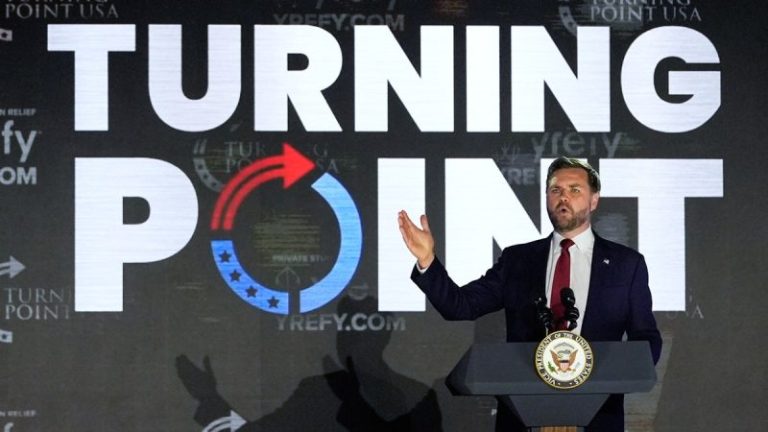
Vice President JD Vance spoke at length during a large Turning Point USA gathering at the University of Mississippi (Ole Miss) in honor of Charlie Kirk, during which he shared the slain conservative activist’s impact on his faith and told students that ‘a properly rooted Christian moral order’ is key to the future of the country.

After the audience heard from Kirk’s widow, Erika, Vance took the stage and spoke for a brief time before taking questions from the audience on a range of issues from immigration to National Guard deployments and the Second Amendment. But several of the questions revolved around Vance’s faith and the impact it has had on how he governs as Vice President. Some asked about his views on religious liberty while another questioned how he was raising his family in a dual-religion household where his wife is Hindu.   

‘I make no apologies for thinking that Christian values are an important foundation of this country,’ Vance said when responding to a question about the separation of church and state. ‘Anybody who’s telling you their view is neutral likely has an agenda to sell you. And I’m at least honest about the fact that I think the Christian foundation of this country is a good thing.’

Meanwhile, Vance railed against contemporary liberalism in his comments about faith Wednesday night, calling it a ‘perverted version of Christianity.’  

‘There’s nothing wrong, of course, with focusing on people who are disenfranchised, for example. That’s the focus of liberalism. But if you completely separate it from any religious duty or any civic virtue, then that can actually become, for example, an inducement to lawlessness,’ Vance said while responding to a questioner. ‘You can’t just have compassion for the criminal. You also have to have justice too. Which is why I think that a properly rooted Christian moral order is such an important part of the future of our country.’

Vance went on to say that he does not think God must be kicked out of the public square, adding he did not believe that is what the founders intended. 

‘Anybody who tells you it’s required by the Constitution is lying to you,’ Vance argued. ‘What happened, is, the Supreme Court interpreted ‘Congress shall make no law respecting an establishment of religion’ to effectively throw the church out of every public place at the federal, state and local level. I think it was a terrible mistake, and we’re still paying for the consequences of it today.’

In addition to taking tough policy-oriented questions about faith and religion, Vance was also asked at one point about living in an interfaith household. Vance’s wife is Hindu. 

Vance noted how when the pair met he was not a Christian, but over time he and his wife, Usha, decided to raise their boys Christian. Vance said open communication and respect for each other’s beliefs played a part in his marriage and his family’s decision to raise their kids Christian.   

‘Most Sundays she will come with me to church. As I’ve told her, and I’ve said publicly, and I’ll say now in front of 10,000 of my closest friends, ‘Do I hope eventually that she is somehow moved by the same thing that I was moved in by church? Yeah, I honestly, I do wish that.’ Because I believe in the Christian gospel and I hope eventually my wife comes to see it the same way. But if she doesn’t, then God says everybody has free will, and so that doesn’t cause a problem for me.’

Vance also spoke about the impact Kirk has had on his faith during the Wednesday night event honoring the slain activist. Vance said that, at least in part, Kirk moved him to be more vocal about his faith.

‘This is another way in which Charlie has affected my life – I would say that I grew up again in a generation where even if people had very deep personal faith, they didn’t talk about their faith a whole lot,’ Vance told the crowd while remembering his late friend. 

‘But the reason why I try to be the best husband I can be, the best father I can be, the reason why I care so much about all the issues that we’re going to talk about, is because I believe I’ve been placed in this position for a brief period of time to do the most amount of good for God and for the country that I love so much. And that’s the most important way that my faith influences me.’

This post appeared first on FOX NEWS

U.S. President Donald Trump met face-to-face with Chinese leader Xi Jinping on Thursday, the final day of Trump’s trip to Asia that included stops in Malaysia, Japan and South Korea, in an attempt to resolve the ongoing trade disputes between the two sides.

Trump has imposed substantial tariffs on China since returning to the White House in January, and Beijing retaliated with limits on exports of rare earth elements. Both sides want to avoid the risk of blowing up the world economy, which would harm their own countries.

The leaders of the world’s two largest economies spoke to the press in brief introductory remarks before meeting behind closed doors along with their top officials.

Xi said in his opening remarks that ‘it feels very warm seeing you again because it’s been many years.’

‘We do not always see eye to eye with each other,’ Xi said, noting that ‘it is normal for the two leading economies of the world to have frictions now and then.’

The Chinese leader added that the two countries ‘are fully able to help each other succeed and prosper together.’

The Associated Press contributed to this report.

This is a developing story. Check back for updates.

This post appeared first on FOX NEWS

As President Donald Trump and Chinese leader Xi Jinping prepare to meet Thursday, one soft-spoken U.S. export star will take center stage: soybeans. 

The humble crop, a $30 billion pillar of U.S. agriculture exports, has become a powerful symbol of the economic interdependence and political tension between Washington and Beijing. 

In short, soybeans have come to embody the volatility of the U.S.–China trade war. Beijing halted purchases of American soybeans in response to Trump’s earlier tariffs on Chinese goods. 

China pivoted to suppliers in Brazil and Argentina, a move that underscored how quickly global trade patterns can shift and how vulnerable U.S. farmers are to diplomatic rifts between Washington and Beijing.

What began as tit-for-tat posturing between the world’s two largest economies has turned into a symbolic and economic gut punch for Trump’s rural base, whose livelihoods depend on the very trade ties now caught in the crossfire.

According to the American Soybean Association, the U.S. has traditionally served as China’s leading soybean source. Prior to the 2018 trade conflict, roughly 28% of U.S. soybean production was exported to China. Those crop exports fell sharply to 11% in 2018 and 2019, recovered to 31% by 2021 amid pandemic-era demand and eased back to 22% in 2024.

But some policy experts argue that China’s shift away from U.S. soybeans was already underway.

‘China was always going to reduce its reliance on the United States for food security,’ Bryan Burack, a senior policy advisor for China and the Indo-Pacific at the Heritage Foundation told Fox News Digital. ‘China started signing purchase agreements with other countries for soybeans well before President Trump took office.’ 

He added that Beijing has ‘been decoupling from the U.S. for a long time.’

‘Unfortunately, the only way for us to respond is to do the same, and that process is painful and excruciating,’ Burack said.

But for farmers thousands of miles from Washington and Beijing, those policy shifts translate into shrinking markets and tighter margins.

‘We rely on trade with other countries, specifically China, to buy our soybeans,’ Brad Arnold, a multigenerational soybean farmer in southwestern Missouri, told FOX Business. He said China’s decision to boycott U.S. soybean purchases ‘has huge impacts on our business and our bottom line.’

‘There are domestic uses for soybeans, looking at renewable diesel, biodiesel specifically produced from soybeans,’ Arnold said. ‘In the grand scheme of things, that’s such a small percentage currently, you know it’s going to take a customer like China to buy beans to make a noticeable impact. You can’t take our No. 1 customer, shut them off and just overnight find a replacement.’

That reliance on China adds new weight to the diplomatic stage this week as Trump and Xi prepare to meet in South Korea. The two leaders will meet on the sidelines of the Asia-Pacific Economic Cooperation Summit in Busan, South Korea, marking their first in-person talks since Trump’s return to office. 

Ahead of the meeting, Treasury Secretary Scott Bessent said he expected China to delay rare earth restrictions and resume U.S. soybean purchases, calling it part of a ‘substantial framework’ both sides aim to maintain. Bessent also said that trade negotiations were moving toward averting a fresh 100% U.S. tariff on Chinese goods.

And in a possible gesture of easing tensions, Reuters reported that China bought around 180,000 metric tons of U.S. soybeans in the run-up to Trump and Xi’s meeting.

Whether it marks a true thaw in U.S.–China trade relations or just a temporary reprieve, the purchase underscores how deeply intertwined diplomacy and agriculture remain.

Fox Business’ Eric Revell contributed to this report.

This post appeared first on FOX NEWS

VANCOUVER, BC / ACCESS Newswire / December 31, 2025 / Goldgroup Mining Inc. (‘Goldgroup‘ or the ‘Company‘) (TSXV:GGA,OTC:GGAZF)(OTCQX:GGAZF).

Goldgroup announces that, subject to the final approval of the TSX Venture Exchange (the ‘TSXV‘), it has entered into an agreement with a private arm’s length British Columbia company under which it has agreed to sell all of the issued and outstanding Class ‘A’ shares and Class ‘B’ common shares in the capital (collectively the ‘Apolo Shares‘) of Minera Apolo, S.A. de C.V. (‘Apolo‘), which owns all the issued and outstanding shares of Minera Catanava, S.A. de C.V. (‘MC‘). Apolo and MC collectively hold a 100% interest in the Pinos gold/silver project (‘Pinos‘) located in Zacatecas State, the second largest mining state in Mexico. Pinos comprises 30 contiguous mining concessions over 3,816 hectares. The sale of Apolo is an Arm’s Length Transaction and there are no finder’s fees payable.

Ralph Shearing, Chief Executive Officer, commented: ‘Having received an unsolicited bid for Pinos, management determined that it would be the best use of the Company’s resources to dispose of the Pinos asset based on the Company’s recent acquisition of the San Francisco gold mine, which is a much larger and more advanced project than Pinos. The Company’s focus will be the continued development and optimization of our flagship Cerro Prieto heap-leach gold mine and advancing towards a re-start of gold production at the San Francisco gold mine (see news release dated December 24, 2025). Both assets are located within 44km in a straight line from each other in the state of Sonora, Mexico. The San Francisco gold mine represents a unique opportunity to consolidate a highly prospective gold district.’ Mr. Shearing further stated: ‘At this stage of our Company’s development, with Pinos being a non-core asset, management and the board of directors has elected to monetize Pinos with an attractive, high cash purchase offer, deploying the sale proceeds towards Cerro Prieto optimization and re-starting gold production at San Francisco.

Under the terms of the Share Purchase Agreement, Goldgroup has agreed to sell all the Apolo Shares to a private arm’s length British Columbia company (the ‘Purchaser‘) in consideration of the payment to Goldgroup of US$5,000,000 in stages, with US$2,450,000 deposit payable on signing which will be refunded if the transaction does not close by February 16, 2026, US$550,000 to be paid on closing and US$2,000,000 to be secured by a Promissory Note and paid on or before the date that is six (6) months from the Closing Date. Further, the Purchaser has agreed to assume any and all liabilities of Goldgroup associated with Apolo, MC and the Pinos project, including the assumption of US$400,000 remaining payable on the original purchase agreement in addition to debt in the amount of US$1,500,000 payable to the previous owners of Apolo that will be triggered by the sale of Apolo. Goldgroup, the Purchaser and the previous owners of Apolo have also agreed to enter an Assumption and Acknowledgement Agreement under which the previous owners acknowledge and agree that they will have no further recourse against Goldgroup for any liabilities related to Apolo, MC and the Pinos project, all of which have been assumed by the Purchaser.

Cautionary Statement
The closing of the sale of Apolo is subject to the approval of the TSX Venture Exchange.

Clarification regarding Investor Relations Agreement
At the request of the TSXV, Goldgroup wishes to clarify its news release of October 13, 2025, regarding the retention of Machai Capital Inc. to provide digital marketing services on behalf of the Company. Goldgroup advises that it paid Machai Capital Inc. $200,000 as an upfront fee. Further Goldgroup advises that neither Machai Capital Inc. nor its principal Suneal Sandhu owned any securities of Goldgroup as at October 13, 2025.

About Goldgroup
Goldgroup is a Canadian-based mining Company with two high-growth gold assets in Mexico. In addition to the San Francisco gold mine, the Company has a 100% interest in the producing Cerro Prieto heap-leach gold mine located in the State of Sonora. An optimization and exploration program is underway at Cerro Prieto to significantly increase existing production and resources. The acquisition of Molimentales del Noroeste, S.A. de C.V. (‘Molimentales‘), the owner of the San Francisco gold mine is subject to final approval from the TSXV.

Goldgroup is led by a team of highly successful and seasoned individuals with extensive expertise in mine development, corporate finance, and exploration in Mexico.

For further information on Goldgroup, please visit www.goldgroupmining.com

On behalf of the Board of Directors

‘Ralph Shearing’
Ralph Shearing, CEO

For more information:
+1 (604) 306-6867
410 – 1111 Melville St.
Vancouver, BC, V6E 3V6
www.goldgroupmining.com
ir@goldgroupmining.com

Neither the TSX Venture Exchange nor its Regulation Services Provider (as that term is defined in the policies of the TSX Venture Exchange) accepts responsibility for the adequacy or accuracy of this press release.

CAUTIONARY NOTES REGARDING FORWARD-LOOKING INFORMATION
Certain information contained in this news release, including any information relating to future financial or operating performance, may be considered ‘forward-looking information’ (within the meaning of applicable Canadian securities law) and ‘forward-looking statements’ (within the meaning of the United States Private Securities Litigation Reform Act of 1995). These statements relate to analyses and other information that are based on forecasts of future results, estimates of amounts not yet determinable and assumptions of management. Actual results could differ materially from the conclusions, forecasts and projections contained in such forward-looking information.

These forward-looking statements reflect Goldgroup’s current internal projections, expectations or beliefs and are based on information currently available to Goldgroup. In some cases forward-looking information can be identified by terminology such as ‘may’, ‘will’, ‘should’, ‘expect’, ‘intend’, ‘plan’, ‘anticipate’, ‘believe’, ‘estimate’, ‘projects’, ‘potential’, ‘scheduled’, ‘forecast’, ‘budget’ or the negative of those terms or other comparable terminology. Such forward-looking statements involve known and unknown risks, uncertainties and other factors which may cause actual results, performance or achievements to be materially different from any future results, performance or achievements expressed or implied by the forward-looking statements.

Forward-looking information is subject to a variety of known and unknown risks, uncertainties and other factors that could cause actual events or results to materially differ from those reflected in the forward-looking information, and are developed based on assumptions about such risks, uncertainties and other factors including, without limitation: receipt of all required TSXV, regulatory and other interested party approvals in connection with the Concurso Mercantilprocess; uncertainties related to actual capital costs operating costs and expenditures; production schedules and economic returns from Goldgroup’s projects; timing to integrate acquisitions (San Francisco Mine) and timing to complete additional exploration and technical reports; uncertainties associated with development activities; uncertainties inherent in the estimation of mineral resources and precious metal recoveries; uncertainties related to current global economic conditions; fluctuations in precious and base metal prices; uncertainties related to the availability of future financing; potential difficulties with joint venture partners; risks that Goldgroup’s title to its property could be challenged; political and country risk; risks associated with Goldgroup being subject to government regulation; risks associated with surface rights; environmental risks; Goldgroup’s need to attract and retain qualified personnel; risks associated with potential conflicts of interest; Goldgroup’s lack of experience in overseeing the construction of a mining project; risks related to the integration of businesses and assets acquired by Goldgroup; uncertainties related to the competitiveness of the mining industry; risk associated with theft; risk of water shortages and risks associated with competition for water; uninsured risks and inadequate insurance coverage; risks associated with potential legal proceedings; risks associated with community relations; outside contractor risks; risks related to archaeological sites; foreign currency risks; risks associated with security and human rights; and risks related to the need for reclamation activities on Goldgroup’s properties, as well as the risk factors disclosed in Goldgroup’s MD&A. Any and all of the forward-looking information contained in this news release is qualified by these cautionary statements.

Although Goldgroup believes that the forward-looking information contained in this news release is based on reasonable assumptions, readers cannot be assured that actual results will be consistent with such statements. Accordingly, readers are cautioned against placing undue reliance on forward-looking information. Goldgroup expressly disclaims any intention or obligation to update or revise any forward-looking information, whether as a result of new information, events or otherwise, except as may be required by, and in accordance with, applicable securities laws.

SOURCE: Goldgroup Mining, Inc.

View the original press release on ACCESS Newswire

News Provided by ACCESS Newswire via QuoteMedia

This post appeared first on investingnews.com

Statistics Canada released November’s gross domestic product (GDP) data on Friday (January 30). The numbers show that the economy remained flat overall with the prior month, following a 0.3 percent decline in October.

The goods-producing industries fell by 0.3 percent in November, weighed down by a 1.3 percent contraction in manufacturing and a 2.1 percent decline in wholesale trade amid ongoing trade tensions between Canada and the United States.

Declines were offset by increases to the retail trade sector, which grew 1.3 percent alongside a 0.9 percent increase to the transportation and warehousing sector.

The release also included advanced data for December that shows real GDP increased by 0.1 percent. Although the data for the month are preliminary, they point to a 0.1 percent contraction in the fourth quarter and a 1.3 percent annual gain in 2025.

This week also marked the first rate-setting meetings of 2026 by the Bank of Canada and the US Federal Reserve.

Both central banks decided to keep their rates unchanged. On Wednesday (January 28), the BoC reported it would maintain its benchmark rate at 2.25 percent. In its announcement, the bank said the outlook remains little changed from its October projection but noted it is vulnerable to evolving US trade policy and geopolitical risks.

South of the border, the Fed held its Federal Fund Rate at 3.25 percent to 3.75 percent. In its announcement, the Fed shared similar sentiments, suggesting that uncertainty remained elevated.

Against that backdrop, gold and silver experienced significant volatility this week, with prices for both metals dropping on Thursday (January 29). Gold fell from above US$5,500 toward the US$5,100 mark during the first hour of trading on US markets, while silver fell from the US$120 mark to around US$108.

Both metals rebounded on the day, posting slight losses from their opening levels, but on Friday prices collapsed further, with gold trading below US$4,800 and silver approaching US$80 in morning trading.

For more on what’s moving markets this week, check out our top market news round-up.

Markets and commodities react

Canadian equity markets were in retreat to end the week.

The S&P/TSX Composite Index (INDEXTSI:OSPTX) lost 3.4 percent over the week to close Friday at 31,923.52, while the S&P/TSX Venture Composite Index (INDEXTSI:JX) fared worse, shedding 8.15 percent to 1,051.08. The CSE Composite Index (CSE:CSECOMP) dropped 9.54 percent to 169.92.

The gold price saw significant declines from mid-week highs, losing 9.76 percent during Friday’s trading day. However, it fell just 1.76 percent from the week’s start to close at US$4,840.76 per ounce on Friday at 4:00 p.m. EST.

The silver price fared even worse, plummeting 28.17 percent on Friday, and closing the week 13.62 percent lower overall at US$83.43 on Friday.

In base metals, the Comex copper price recorded a 1.32 percent drop this week to US$5.98.

On the other hand, the S&P Goldman Sachs Commodities Index (INDEXSP:SPGSCI) was up 4.24 percent to end Friday at 598.20.

Top Canadian mining stocks this week

How did mining stocks perform against this backdrop?

Take a look at this week’s five best-performing Canadian mining stocks below.

Stocks data for this article was retrieved at 2:00 p.m. EST on Friday using TradingView’s stock screener. Only companies trading on the TSX, TSXV and CSE with market caps greater than C$10 million are included. Mineral companies within the non-energy minerals, energy minerals, process industry and producer manufacturing sectors were considered.

1. Vanguard Mining (CSE:UUU)

Weekly gain: 141.18 percent
Market cap: C$29.82 million
Share price: C$0.41

Vanguard Mining is an exploration company working to advance a portfolio of uranium, copper and nickel assets in Canada and Paraguay. Its flagship project is the Yuty Prometeo uranium project in Paraguay.

Among its properties is the Redonda copper and molybdenum project near Campbell River, British Columbia. The site consists of nine mineral claims covering 2,746 hectares and hosts porphyry-style mineralization.

On Tuesday (January 27), Vanguard announced plans for its phase 2 drill program at Redonda, comprising up to 7 holes totaling 2,800 meters, targeting areas in the southeast portion of the property between historic drill holes.

The company also said it would conduct detailed mapping and prospecting in the northern and western portions of Redonda to identify additional priority drill targets and would use phase 1 results to refine targeting.

The program is being advanced quickly to build on drilling results that “confirmed a significantly expanded copper-molybdenum mineralized system at Redonda,” the company said.

2. San Lorenzo Gold (TSXV:SLG)

Weekly gain: 85.6 percent
Market cap: C$185.63 million
Share price: C$2.32

San Lorenzo Gold is an exploration company working to advance its Salvadora project in the Chañaral province of Chile.

The property consists of 25 exploration and nine exploitation concessions covering an area of 8,796 hectares. It hosts a large copper and gold porphyry system with several significant targets. According to the project page, the site geology resembles that of the nearby Codelco-owned Salvador copper mine, which has operated since the early 1950s and is expected to continue until the mid-2060s following an expansion.

On January 26, San Lorenzo provided assay results from the first hole of a drilling program at the Cerro Blanco target at Salvadora. The hole was drilled to a depth of 472 meters, of which it encountered 222.4 meters of mineralization across five sections. The widest interval graded 1.09 grams per metric ton (g/t) gold over 132.2 meters from a depth of 201.5 meters.

The company said it believes the mineralization represents the upper level of a porphyry system and that it suggests a continuation of the system encountered during drilling at the site in 2025.

3. Ameriwest Critical Metals (CSE:AWCM)

Weekly gain: 75.76 percent
Market cap: C$14.69 million
Share price: C$0.58

Ameriwest Critical Minerals is an exploration company with a portfolio of assets in British Columbia, Canada, as well as the US states of Nevada, Oregon and Arizona.

The company announced in August that it was changing its name from Ameriwest Lithium to better reflect a portfolio diversifying into copper and rare earth minerals.

In October 2025, Ameriwest entered into a definitive agreement for the option and potential purchase of the Xeno RAR rare earth mineral claims in British Columbia. Under the terms of the deal, Ameriwest will pay C$55,000 in cash considerations, C$125,000 in exploration expenses over 18 months, a 2 percent net smelter return royalty and 2 million shares.

Then, in November, the company completed the acquisition of 34 unpatented mineral claims in Oregon that form the Bornite copper project in exchange for US$100,000 and a 2 percent net smelter return royalty.

Previous exploration of the Bornite property by Plexus in the 1990s identified a historic resource of 138.5 million pounds of copper, 54,000 ounces of gold and 1.7 million ounces of silver from 3.2 million metric tons of ore. Ameriwest’s current CEO was part of the Plexus team who explored Bornite.

In addition to its recently acquired properties, Ameriwest also owns the Thompson Valley lithium project in Arizona and the Railroad Valley lithium project in Nevada.

The most recent news from the company came on January 20, when it upsized a non-brokered private placement from C$2 million to C$3 million. The company said proceeds would be used to accelerate exploration efforts at its Bornite project.

In the release, Ameriwest says its long-term goal at the project, if results, financing and permitting are successful, is “evaluating the development of an approximately 1,000-tonne-per-day underground copper mining operation.”

4. Tectonic Metals (TSXV:TECT)

Weekly gain: 61.78 percent
Market cap: C$217.87 million
Share price: C$2.54

Tectonic Metals is a gold exploration company working to advance the Flat project in Alaska, US.

The project covers 98,840 acres in Western Alaska and hosts a reduced intrusion-related gold system and six district-scale targets. According to Tectonic, the mineralization is analogous to Kinross Gold’s (TSX:K,NYSE:KGC) Fort Knox mine in Eastern Alaska.

Among the targets is the Chicken Mountain intrusion, where exploration has identified 3 kilometers of mineral strike that remains open in all directions. Each of the 87 holes drilled at Chicken Mountain have intercepted gold.

The most recent update from the Flat project came on Thursday, when Tectonic announced results from 20 drill holes across four target areas.

Most significantly, its first drilling at the Black Creek intrusion, located 6 kilometers north of Chicken Mountain, discovered a new gold zone. The discovery hole, which started from surface, returned grades of 4.5 g/t gold over 48.77 meters. This included a core interval of 7.79 g/t over 24.38 meters, inside of which was a 6.1 meter interval grading 15.19 g/t.

The company said drilling has now confirmed gold mineralization across five intrusion targets: Chicken Mountain, Alpha Bowl, Golden Apex, Black Creek and Jam. It also said that results from 14 other holes are still pending.

5. Golden Lake Exploration (CSE:GLM)

Weekly gain: 60 percent
Market cap: C$12.48 million
Share price: C$0.12

Golden Lake Exploration is a gold exploration company that owns the Jewel Ridge gold project in Nevada, United States.

The project sits along the prolific Battle Mountain–Eureka Gold trend, which has produced more than 40 million ounces to date and hosts operations from McEwen Mining (TSX:MUX,NYSE:MUX) and North Peak Resources.

More than 700 meters of strike have been identified on the property across three primary targets: Eureka Tunnel, Jewel Ridge and Hamburg.

On Wednesday, Golden Lake announced that it had entered into a definitive agreement to be wholly acquired by McEwen Mining and become its subsidiary. Among the highlights of the deal is the ability for Jewel Ridge to be integrated into McEwen’s neighboring Gold Bar mine complex, providing access to infrastructure and funding.

FAQs for Canadian mining stocks

What is the difference between the TSX and TSXV?

The TSX, or Toronto Stock Exchange, is used by senior companies with larger market caps, and the TSXV, or TSX Venture Exchange, is used by smaller-cap companies. Companies listed on the TSXV can graduate to the senior exchange.

How many mining companies are listed on the TSX and TSXV?

As of December 2025, 898 mining companies and 71 oil and gas companies are listed on the TSXV, combining for more than 60 percent of the 1,531 total companies listed on the exchange.

As for the TSX, it is home to 175 mining companies and 51 oil and gas companies. The exchange has 2,089 companies listed on it in total.

Together, the TSX and TSXV host around 40 percent of the world’s public mining companies.

How much does it cost to list on the TSXV?

There are a variety of different fees that companies must pay to list on the TSXV, and according to the exchange, they can vary based on the transaction’s nature and complexity. The listing fee alone will most likely cost between C$10,000 to C$70,000. Accounting and auditing fees could rack up between C$25,000 and C$100,000, while legal fees are expected to be over C$75,000 and an underwriters’ commission may hit up to 12 percent.

The exchange lists a handful of other fees and expenses companies can expect, including but not limited to security commission and transfer agency fees, investor relations costs and director and officer liability insurance.

These are all just for the initial listing, of course. There are ongoing expenses once companies are trading, such as sustaining fees and additional listing fees, plus the costs associated with filing regular reports.

How do you trade on the TSXV?

Investors can trade on the TSXV the way they would trade stocks on any exchange. This means they can use a stock broker or an individual investment account to buy and sell shares of TSXV-listed companies during the exchange’s trading hours.

Article by Dean Belder; FAQs by Lauren Kelly.

Securities Disclosure: I, Dean Belder, hold no direct investment interest in any company mentioned in this article.

Securities Disclosure: I, Lauren Kelly, hold no direct investment interest in any company mentioned in this article.

This post appeared first on investingnews.com

President Donald Trump announced the United States would impose 10% tariffs on multiple European countries unless Denmark agrees to the ‘complete and total purchase of Greenland,’ warning that global security and U.S. national defense were at stake.

Trump made the announcement in a lengthy Truth Social post on Saturday, arguing that the U.S. has subsidized Denmark and other European Union nations for decades by failing to charge tariffs and providing what he described as ‘maximum protection.’

‘We have subsidized Denmark, and all of the Countries of the European Union, and others, for many years by not charging them Tariffs, or any other forms of remuneration,’ Trump wrote.

‘Now, after Centuries, it is time for Denmark to give back — World Peace is at stake!’

Trump wrote that both China and Russia want Greenland and he said there was ‘not a thing that Denmark can do about it.’

‘They currently have two dogsleds as protection, one added recently. Only the United States of America, under PRESIDENT DONALD J. TRUMP, can play in this game, and very successfully, at that!’ Trump wrote. 

‘Nobody will touch this sacred piece of Land, especially since the National Security of the United States, and the World at large, is at stake.’

Trump said that Denmark, Norway, Sweden, France, Germany, the United Kingdom, the Netherlands and Finland have ‘journeyed’ to Greenland, for ‘purposes unknown,’ posing a very dangerous situation for the safety, security and survival of our planet.

‘All of the above-mentioned Countries… will be charged a 10% Tariff on any and all goods sent to the United States of America,’ Trump wrote. 

On June 1, 2026, the tariff will be increased to 25%, he said. 

‘This Tariff will be due and payable until such time as a Deal is reached for the Complete and Total purchase of Greenland.’

In recent weeks, Trump has zeroed in on Greenland, the world’s largest island at a strategic crossroads in the Arctic, and floated the idea of tariffs being imposed on Friday. 

A semi-autonomous territory of Denmark, Greenland is home to a crucial U.S. military base and has taken on growing strategic importance as melting ice opens new shipping lanes and access to a wealth of natural resources.

In his Saturday post, Trump said the United States has tried to purchase Greenland for more than 150 years but that Denmark has repeatedly refused. 

He tied the push to modern weapons systems and the ‘Golden Dome,’ saying hundreds of billions of dollars are being spent on related security programs and that the system can only work at maximum efficiency if Greenland is included. 

‘The United States of America is immediately open to negotiation with Denmark and/or any of these countries that have put so much at risk, despite all that we have done for them, including maximum protection, over so many decades,’ Trump wrote. ‘Thank you for your attention to this matter!’

Trump’s remarks come as his administration awaits a Supreme Court ruling on whether some of the tariffs he imposed in 2025 were legal.

Fox News’ Amanda Macias contributed to this report. 

This post appeared first on FOX NEWS

Platinum and palladium have their own unique drivers, but both are basking in gold’s glow in 2025.

Of the two, platinum has been the biggest winner in 2025. The price of the precious metal briefly hit a year-to-date high of US$1,725 per ounce on October 16, a 90 percent increase from the start of the year. Although it’s since experienced a pullback below the US$1,600 level, the platinum price remains at 12 year highs.

As for palladium, its price was up nearly 80 percent by October 16 to reach its 2025 peak of US$1,630 per ounce. It too has fallen back since then, currently sitting at the US$1,430 level.

What’s next for platinum and palladium after those price runs? In its annual Precious Metals Investment Focus report, published on October 25, Metals Focus outlines key supply and demand trends, as well as its outlook for prices.

Platinum market reflecting more than gold’s shine

Platinum is no doubt benefiting from strong investor demand for precious metals. But the metal’s robust supply and demand fundamentals are also at play, according to Metals Focus analysts.

Aboveground inventories of platinum remain tight, while future mine production is bogged down in operational challenges. “In Southern Africa, outages and heavy rainfall have disrupted production, while North America is undergoing restructuring,” notes the report.

On the demand side, platinum usage from the jewelry sector has posted significant gains this year, especially in China. As the price of gold skyrockets, platinum jewelry has become a much more attractive alternative. Investment flows into platinum exchange-trade products in China and the US are another key demand driver for the metal this year.

Platinum and palladium prices.

Chart via Metals Focus, Bloomberg.

While platinum prices are at levels not seen in 12 years, palladium prices are only experiencing a two year high.

“Palladium has also benefited at the margin, but remains a laggard, with a more lacklustre fundamental outlook limiting investor enthusiasm,” according to Metals Focus.

2026: Platinum bull, palladium bear

Platinum prices will continue to benefit from the overall upward trend in precious metals prices for the remainder of 2025 and well into 2026. The ongoing supply deficit in the platinum market is also highly price-supportive.

Metals Focus is forecasting a third consecutive physical platinum deficit for this year, totaling 415,000 ounces as platinum mine output is expected to decline by 6 percent year-on-year.

Demand is projected to fall by 4 percent largely due to lower output in the glass and automotive sectors.

Platinum’s supply deficit is expected to continue into 2026 and grow to an estimated 480,000 ounces as mine supply falls by 2 percent to a 12 year low (excluding 2020). “With few new projects coming online after years of underinvestment, mine supply is undergoing structural decline,” the report’s authors note.

This will be happening at the same time as an expected 1 percent rebound in demand, buoyed by renewed industrial usage, specifically out of the glass and chemical sector in China.

Even so, Metals Focus cautions that demand out the automotive and jewelry sectors is likely to contract.

The trend toward electrification is the auto industry may have slowed, but it’s still expected to erode platinum demand, especially as catalytic converter manufacturers shift back to more cost-effective palladium.

Metals Focus is forecasting a 2026 average platinum price of US$1,670 per ounce, up 34 percent over the previous year.

Platinum and palladium price outlook.

Chart via Metals Focus, Bloomberg.

Looking over to palladium, Metals Focus has a more bearish view.

The firm is projecting palladium prices to average US$1,350 in Q4 2025, falling to US$1,150 by Q4 2026. Although the palladium market has been in a physical deficit for the past few years, that deficit is expected to shrink from 566,000 ounces in 2024 to 367,000 ounces in 2025 before narrowing even further to 178,000 ounces in 2026.

The same structural issues plaguing platinum are also of course weighing on palladium mine supply, which is forecast to fall by 3 percent in 2026. However, secondary supply is projected to increase by 10 percent as recycling activity recovers.

Overall, total palladium supply is expected to grow by 1 percent for the year. At the same time, demand for palladium is set to decline by just over 1 percent in 2026 on a drop from the automotive sector.

Investor takeaway

Both platinum and palladium are considered precious metals based on their rarity and use in jewelry fabrication and physical bullion. As such, they both are known to benefit when investor sentiment for safe-haven gold is high.

However, not all precious metals are precious to investors at the same time — just ask silver. Industrial usage of these metals is a much bigger driver of demand compared to the investment space. For 2026, it’s platinum that will continue to ride gold’s rally and provide investors with plenty of upside based on its strong fundamentals.

Securities Disclosure: I, Melissa Pistilli, currently hold no direct investment interest in any company mentioned in this article.

This post appeared first on investingnews.com
Group Eleven Resources Corp. (TSXV: ZNG,OTC:GRLVF) (OTCQB: GRLVF) announced today that it will be participating in the 51st Annual New Orleans Investment Conference at the Hilton New Orleans Riverside November 2 – 5, 2025. Bart Jaworski, CEO, will be presenting on Monday, November 3rd, and is looking forward to networking with investors during the Conference.

The New Orleans Investment Conference gathers some of the world’s brightest and most successful analysts, newsletter writers and investors. This year’s event will highlight all major asset classes, including zinc, silver and copper exploration.

About Group Eleven Resources Corp.

Group Eleven is drilling the most significant mineral discovery in the Republic of Ireland in over a decade. The Company announced the Ballywire discovery in September 2022, demonstrating high grades of zinc, lead, silver, copper, germanium and locally, antimony.

About The New Orleans Investment Conference

The New Orleans Investment Conference is the one place where the world’s most sophisticated investors gather every year to discover new opportunities and strategies, exchange ideas, plan for the coming year and enjoy the camaraderie of like-minded individuals in America’s most fascinating and entertaining city.

Headliners at the New Orleans Conference over the last 50 years have included Lady Margaret Thatcher, former President Gerald Ford, novelist Ayn Rand, General H. Norman Schwarzkopf, Nobel Prize-winning economists Milton Friedman and F.A. Hayek, Dr. Henry Kissinger, Senator Barry Goldwater, Admiral Hyman Rickover, Louis Rukeyser, Sir John Templeton, Lord William Rees-Mogg, Charlton Heston, Jeane Kirkpatrick, Robert Bleiberg, Jack Kemp, William F. Buckley, General Colin Powell, Ron Paul and J. Peter Grace, among hundreds of other notables.

This year’s speakers line-up includes the likes of Matt Taibbi…Rick Rule…Mary Katharine Ham…Danielle DiMartino Booth…Brent Johnson…George Gammon…Peter St. Onge…Viva Frei…Robert Kiyosaki…Peter Boockvar…Jim Bianco…Jim Iuorio…Adam Taggart…Peter Schiff…Adrian Day…Mike Maloney…Alex Green…Dave Collum…Robert Prechter…Robert Helms…Russ Gray…

PLUS Mark Skousen…Lawrence Lepard…Jordan Roy-Byrne…Dan Oliver…Jeff Phillips…Lobo Tiggre…Tavi Costa…Nick Hodge…Chris Powell…Dana Samuelson…Jennifer Shaigec…Rich Checkan…Thom Calandra…Mary Anne & Pamela Aden…Omar Ayales…Bill Murphy…Gerardo Del Real…Steve Hochberg…Albert Lu…Lindsay Hall…Kerry Stevenson… and more, including Brien Lundin, host of this illustrious event.

Don’t miss out. Register for the 51st Annual New Orleans Investment Conference by clicking here.

For additional information, please contact:

Group Eleven Resources Corp.
Bart Jaworski
CEO
+353-85-833-2463
b.jaworski@groupelevenresources.com
https://groupelevenresources.com/

News Provided by Newsfile via QuoteMedia

This post appeared first on investingnews.com
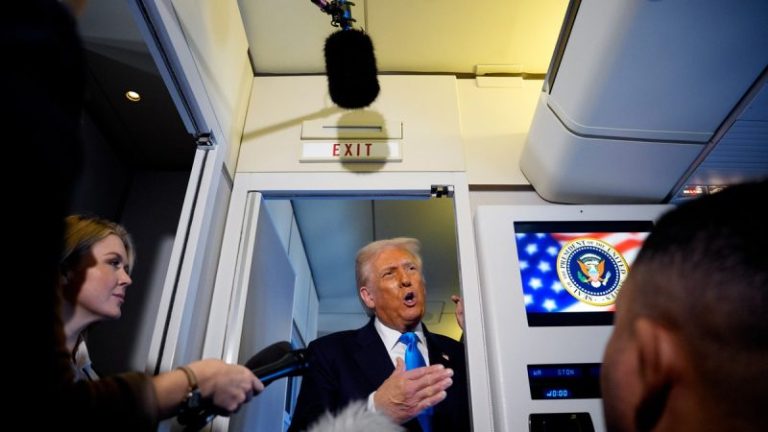
President Donald Trump spoke to the press while en route to South Korea on Tuesday aboard Air Force One and made remarks about his authority to deploy U.S. military forces domestically — something that will likely draw legal and political concerns.

Trump was traveling to the Asia-Pacific Economic Cooperation (APEC), where he is scheduled to meet with Chinese President Xi Jinping.

During the media availability, Trump claimed he could deploy U.S. military forces into American cities if necessary, claiming that ‘the courts wouldn’t get involved.’

When speaking with reporters, he said he would consider using the military beyond the National Guard if the need arises.

‘I would do that if it was necessary,’ he said. ‘It hasn’t been necessary. We’re doing a great job without that.’

Trump also argued that, as president, he has the power to take such an action.

‘If I want to enact a certain act, I’m allowed to do it routinely,’ he said. ‘I’d be allowed to do whatever I want… You understand that the courts wouldn’t get involved. Nobody would get involved.’

He added, ‘I could send the Army, Navy, Air Force, Marines. I can send anybody I wanted, but I haven’t done that because we’re doing so well.’

Trump made it a point to use San Francisco as an example, describing how federal officials were ‘all set to go last Saturday’ to intervene in the city but held off after local leaders asked for a chance to handle it themselves.

‘We would have solved that problem in less than a month,’ he said, adding that federal intervention ‘would go a lot quicker and it’s much more effective.’

He also emphasized what he described as progress in other parts of the U.S.

‘Memphis is making tremendous progress,’ Trump said. ‘It’s down, I think, almost 70%, 60–70%. And within two or three weeks it would be down to almost no crime.’

The president is scheduled to meet with Xi on Wednesday to discuss fentanyl trafficking, trade policy and border security.

This post appeared first on FOX NEWS