Author

admin

Browsing

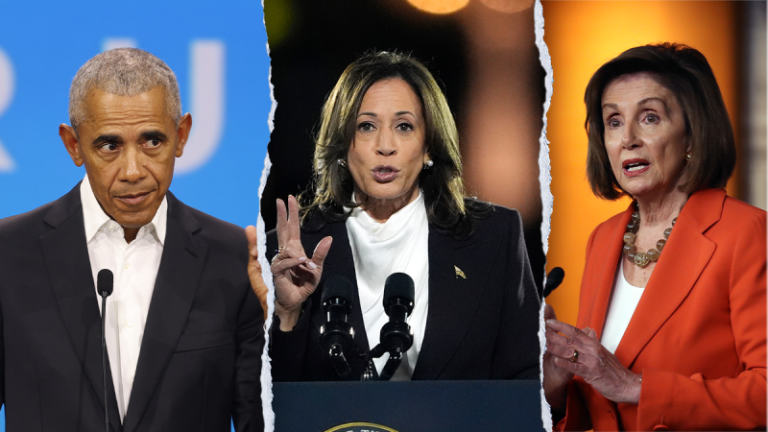
President Barack Obama was angry with former House Speaker Nancy Pelosi for her quick endorsement of former Vice President Kamala Harris after President Joe Biden withdrew from the 2024 election, according to a new book.

An excerpt from ABC News’ Jonathan Karl’s upcoming book, ‘Retribution,’ asserts that Pelosi and Obama had come to an understanding that Harris ‘should not simply be handed the nomination unchallenged.’ Nevertheless, Pelosi handed her an endorsement within 24 hours of Biden’s withdrawal.

‘The Obamas were not happy,’ a source close to Pelosi told Karl, according to an excerpt obtained by the Daily Mail.

‘This person summed up Obama’s message to Pelosi as, essentially, ‘What the f–k did you just do?’’ Karl wrote.

The book asserts that Obama had deep concerns about Harris’ ability to beat President Donald Trump and wanted Democrats to hold an open convention.

‘Obama and Pelosi — arguably the two most influential figures in the Democratic Party — had privately agreed to abstain from making any endorsements,’ Karl wrote.

‘The former president wanted to know what had happened. Why had Pelosi issued a statement endorsing Harris so soon? Hadn’t he and Pelosi agreed days earlier that party leaders anointing the vice president as Biden’s replacement would be a mistake?’ Karl added.

Obama gave Pelosi an angry phone call, during which Pelosi argued ‘that train has left the station,’ when Biden endorsed Harris during his withdrawal message.

The source close to Pelosi claimed Obama sounded ‘genuinely irritated’ on the call.

Obama himself ultimately waited five days after Biden’s withdrawal before offering his endorsement to Harris in a joint phone call with his wife, Michelle.

‘We called to say Michelle and I couldn’t be prouder to endorse you and do everything we can to get you through this election and into the Oval Office,’ Obama said.

Michelle chimed in, ‘I am proud of you. This is going to be historic.’

This post appeared first on FOX NEWS

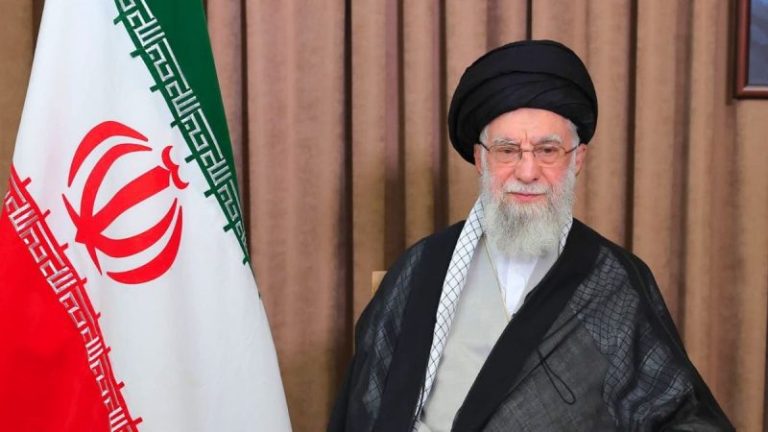
Iran’s supreme leader has publicly acknowledged for the first time that thousands of people were killed during recent anti-government protests, according to reporting from the BBC, as President Donald Trump escalated his rhetoric and called for new leadership in Iran.

Ayatollah Ali Khamenei made the remarks during a public address Saturday, blaming the U.S. for the unrest and violence and saying some protesters died ‘in an inhuman, savage manner,’ the BBC reported.

The protests, which began in late December over economic conditions, later expanded into calls for an end to Iran’s ruling system. 

U.S.-based Iranian Human Rights Activists News Agency estimates that more than 3,000 people were killed over roughly three weeks of unrest, though Iranian authorities have not released an official death toll.

According to the BBC, nationwide internet shutdowns have made independent verification difficult, with connectivity dropping to roughly 2% of normal levels, citing data from cyber monitoring group NetBlocks.

Videos authenticated by BBC Persian and BBC Verify show Iranian security forces firing on demonstrators during the unrest.

Trump told Politico on Saturday that ‘it’s time to look for new leadership in Iran,’ after being read a series of hostile posts from Khamenei’s X account accusing the president of responsibility for the violence.

‘What he is guilty of, as the leader of a country, is the complete destruction of the country and the use of violence at levels never seen before,’ Trump said, according to Politico. ‘Leadership is about respect, not fear and death.’

Trump went further in personal terms, telling Politico, ‘The man is a sick man who should run his country properly and stop killing people.’

‘His country is the worst place to live anywhere in the world because of poor leadership,’ Trump added.

Trump has previously urged Iranians to continue protesting and ‘take over institutions,’ saying that ‘help is on its way,’ according to Politico. The president later said he had been informed that the killings had stopped.

‘The best decision he ever made was not hanging more than 800 people two days ago,’ Trump told Politico, when asked about the scope of potential U.S. military action.

In a series of posts on X posts, Khamenei accused Trump of responsibility for the violence, writing, ‘We find the US President guilty due to the casualties, damages and slander he inflicted upon the Iranian nation.’

In another post, Khamenei claimed that ‘America’s goal is to devour Iran.’

Trump has said in recent days he was looking at ‘very strong options’ including possible military involvement.

The State Department did not immediately respond to Fox News Digital’s request for comment.

This post appeared first on FOX NEWS

President Donald Trump will deliver his first official State of the Union address of his second term Tuesday night before a joint session of Congress at the Capitol, as viewers watch for viral moments and headline-grabbing exchanges like those that have defined past speeches.

Here are the top five moments from past State of the Union addresses.

1. Reagan surprises the crowd with first-ever acknowledgment of a guest in the audience

It’s become commonplace in recent years for presidents to acknowledge guests in the audience during SotU addresses, but President Ronald Reagan’s 1982 address was the first time the practice was rolled out. 

Reagan’s speech came just weeks after Air Florida Flight 90 crashed into Washington’s 14th Street Bridge over the Potomac River shortly after taking off in an accident that killed 78 people. 

Three people survived the crash thanks to civilians on the ground who rushed to their aid, including Congressional Budget Office assistant Lenny Skutnik, who stripped off his shoes and clothes and dove into the frigid waters.

Reagan honored Skutnik in his speech, which made honoring people in the crowd a common theme in the years to come. 

‘Just two weeks ago, in the midst of a terrible tragedy on the Potomac, we saw again the spirit of American heroism at its finest — the heroism of dedicated rescue workers saving crash victims from icy waters,’ Reagan said. ‘And we saw the heroism of one of our young government employees, Lenny Skutnik, who, when he saw a woman lose her grip on the helicopter line, dived into the water and dragged her to safety.’

2. Speaker Pelosi tears up Trump’s 2020 speech

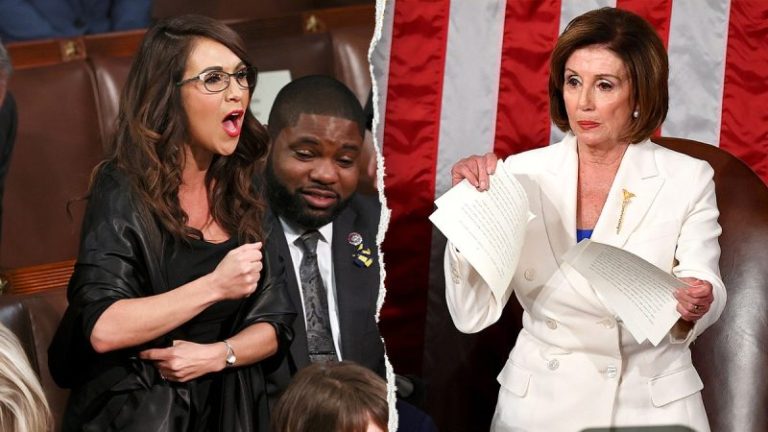
Democratic House Speaker Nancy Pelosi sparked a social media firestorm and cemented herself in State of the Union infamy in February 2020 when she stood up and tore Trump’s speech into pieces after he had finished.

When Fox News asked Pelosi afterward why she did it, she responded, ‘Because it was the courteous thing to do considering the alternatives.’ She added, ‘I tore it up. I was trying to find one page with truth on it. I couldn’t.’

Pelosi’s outburst came on the heels of Trump’s first impeachment trial, which ended in a Senate acquittal the day after the speech.

‘Speaker Pelosi just ripped up: One of our last surviving Tuskegee Airmen. The survival of a child born at 21 weeks. The mourning families of Rocky Jones and Kayla Mueller. A service member’s reunion with his family. That’s her legacy,’ the White House tweeted after Pelosi tore up the speech, referencing individuals who Trump mentioned during his address.

3. Rep. Joe Wilson ‘You lie!’ outburst at President Obama

One of the most remembered moments from a State of the Union address came in 2009 when South Carolina Republican Rep. Joe Wilson interrupted President Barack Obama’s address, which at the time was far less common than it later became. 

‘There are also those who claim that our reform effort will insure illegal immigrants,’ Obama said, talking about his controversial Obamacare plan. ‘This, too, is false. The reforms I’m proposing would not apply to those who are here illegally.’

‘You lie!’ Wilson shouted from his seat on the Republican side of the chamber, causing widespread yelling from other members in the audience.

Wilson later apologized to Obama’s chief of staff, Rahm Emanuel. 

‘This evening, I let my emotions get the best of me when listening to the president’s remarks regarding the coverage of illegal immigrants in the health care bill,’ Wilson said in a written statement. ‘While I disagree with the president’s statement, my comments were inappropriate and regrettable. I extend sincere apologies to the president for this lack of civility.’

4. Rep. Boebert heckles Biden over Afghanistan withdrawal during 2022 address

‘You put them in, 13 of them,’ GOP Rep. Lauren Boebert shouted at Biden as he talked about Afghanistan veterans who ended up in caskets due to exposure to toxic burn pits. Boebert was referencing the 13 U.S. service members killed during Biden’s chaotic withdrawal from Afghanistan in 2021. 

Boebert was wearing an outfit that said ‘Drill Baby Drill’ in opposition to Biden’s energy policies and her outburst drew some boos from the audience.

At another point, Boebert and Greene started chanting ‘build the wall’ when Biden was talking about immigration. 

5. President Biden blasts GOP lawmakers in 2023 address, prompting jeers from Republicans in the crowd

‘Some of my Republican friends want to take the economy hostage — I get it — unless I agree to their economic plans,’ Biden said to Congress, prompting a shake of the head from then-GOP House Speaker Kevin McCarthy in the background and shouts from the crowd and shots of other Republicans shaking their heads. 

‘Instead of making the wealthy pay their fair share, some Republicans, some Republicans, want Medicare and Social Security to sunset,’ Biden continued, which caused an even more pronounced shake of the head from McCarthy, who mouthed ‘no’ as Republicans continued to jeer. 

‘I’m not saying it’s the majority,’ Biden continued, which resulted in even more boos from the raucous crowd. 

‘Let me give you — anybody who doubts it, contact my office. I’ll give you a copy — I’ll give you a copy of the proposal,’ Biden continued to say over increasingly louder shouting from the crowd. 

‘That means Congress doesn’t vote — I’m glad to see — no, I tell you, I enjoy conversion,’ Biden said, apparently meaning to say ‘conversation.’

Biden’s speech continued to devolve from there as Republican outrage interrupted him on multiple occasions. 

This post appeared first on FOX NEWS

History is being rewritten on the White House grounds, where a new formal ballroom is rising in place of the East Wing. The project has become a political lightning rod, as images of its construction reignite debate over President Donald Trump’s imprint on the nation’s most iconic address.

While the White House has hosted countless ceremonial events, it has never had a dedicated ballroom. The new structure will fill that void, replacing the historic East Wing with a space designed instead to host large-scale gatherings.

The ballroom is estimated to cost $250 million and will be financed jointly by Trump and private donors.

While the White House has pledged to release details on the individuals and corporations funding the ballroom’s construction, a comprehensive breakdown of contributions has not yet been made public.

During a July 31 briefing, White House press secretary Karoline Leavitt detailed the administration’s plans to construct a 90,000-square-foot ballroom on the White House grounds.

Leavitt said the new ballroom will accommodate approximately 650 seated guests and will stay true to the classical design of the White House.

‘The White House is currently unable to host major functions honoring world leaders in other countries without having to install a large and unsightly tent approximately 100 yards away from the main building’s entrance,’ Leavitt said on July 31.

She added that the new ballroom will be ‘a much-needed and exquisite addition.’

This post appeared first on FOX NEWS

President Donald Trump shot down speculation that he would run as a vice presidential candidate in 2028, telling reporters aboard Air Force One that Republicans already have ‘great’ prospective candidates.

Trump made the statement during a gaggle with reporters on Sunday, brushing off questions about whether he would fully pursue such an option. Trump pointed to Vice President JD Vance and Secretary of State Marco Rubio as two potential successors, while denigrating potential Democratic candidates as ‘low IQ.’

‘We have great people. I don’t have to get into that, but we have one of them standing right here. We have JD, obviously. The Vice President is great. Marco is great, I think. I’m not sure if anybody would run against those. I think if they ever formed a group, it would be unstoppable,’ Trump said.

‘They have Jasmine Crockett, a low IQ person. They have AOC’s low IQ. If you give her an IQ test, have her pass, like, the exams that I decided to take when I was at Walter Reed. I took those very hard, they’re really aptitude tests, I guess, in a certain way, but they’re cognitive tests. Let AOC go against Trump. Let Jasmine go against him,’ he continued.

‘The first couple of questions are easy. A tiger, an elephant, a giraffe, you know. When you get up to about five or six, and then when you get up to 10 and 20 and 25, they couldn’t come close to answering any of those questions,’ he asserted.

Asked about whether he would run as vice president in 2028, Trump noted that he would be ‘allowed to do that,’ but he called the plan ‘too cute.’

‘Is it the White House, or the White House counsel’s, or your legal position, I guess, that you could do that?’ a reporter pressed.

‘You’d be allowed to do that, but I wouldn’t do that. I think it’s too cute,’ Trump responded.

Trump’s comments come as he flies across Asia meeting with world leaders in a five-day tour this week. The president landed in Japan early Tuesday morning, and he is expected to meet with newly-elected Prime Minister Sanae Takaichi in Tokyo. Takaichi is Japan’s first female prime minister.

Trump also confirmed on Sunday that he would be open to meeting with North Korean dictator Kim Jong Un during his visit to South Korea.

This post appeared first on FOX NEWS
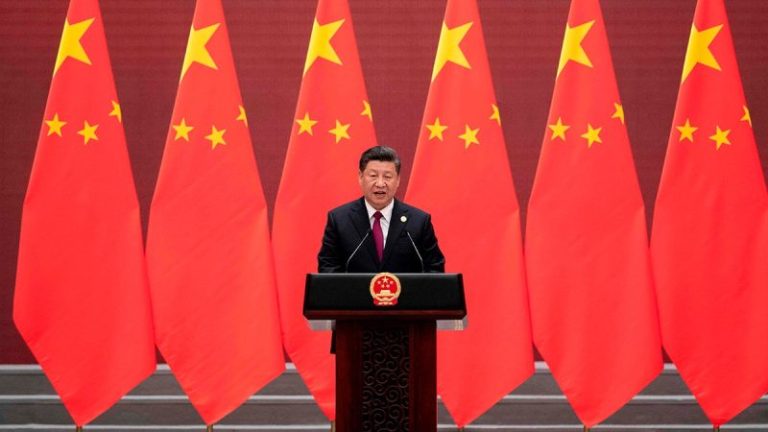
In a political environment where little is agreed upon, there stands one exception: China. That country is cited by nearly every national security expert as the No. 1 geopolitical threat to the U.S. The question is how to coexist without being codependent, how to compete without conflict, and how to protect American producers and consumers while China plays by its arbitrary rules.

No sooner had a meeting between President Donald Trump and Chinese President Xi Jinping been announced before China threatened U.S. access to rare earth minerals. The U.S. countered by threatening an additional 100% tariff on Chinese imports.

Most Americans could not conjure why China would make such a provocative move after both presidents agreed to meet. Surely, the Chinese government must know Trump would react. Xi has been the leader of China for well over a decade with no sign of relenting.

Conversely, Trump is nearly a year into his final term in office. China has always played the long game, assuming Americans lack the will to wait out a prolonged contest. China thinks patience will win — that Americans can’t sustain pressure. It may wind up being surprised that patience is an overrated virtue and how quickly this administration can act.

The Trump administration has already resolved conflicts around the globe, as evidenced by its history-defying peace agreement in the Middle East. The administration has used tariffs and the threat thereof to increase revenue for the U.S., balance the trade playing field and reposition the U.S. for increased domestic manufacturing.

It has been clear about the threats posed by Venezuela, repositioned our relationship with Colombia, opened dialogue between Israel and moderate Arab states, bombed Iranian nuclear ambitions and closed a porous border. All of that in less than a year.

The conflict left to be resolved is in Eastern Europe, and the ‘white whale’ among outstanding trade agreements is China. The two are interconnected. While the U.S. was trying to isolate Russia for its aggression against Ukraine, China was providing both military and economic assistance to Russia.

Next on the administration’s agenda is ending the Russian invasion of Ukraine and negotiating a trade agreement with China that can withstand the reality that the problematic forces within today’s Chinese Communist Party aren’t going anywhere.

Even if Xi steps down or his power wanes, there is no Chinese equivalent to America’s 22nd Amendment — no constitutional limit to the number of terms or years a leader can serve. That means Beijing’s leadership can remain in power indefinitely, which is a central pillar of the Communist Party’s strategy. The United States must live with that reality and yet negotiate from a position of strength to achieve our interests.

While recent reports suggest Xi’s grip may be weakening amid internal purges and speculation about dissent within the Chinese Communist Party, history teaches such reports are often exaggerated. And even if Xi were to fall, his successor would continue the long-term authoritarian policies that define modern China.

China perceives time and our democratic system as allies in its strategy. The key is to make Beijing recognize Trump’s impatience with that country’s malingering and duplicity is not a weakness but rather a threat to their own interests.

The administration’s China pressure strategy isn’t confined to tariffs. It extends to the technological front, where the next great battles for global power will be fought.

The Trump administration has already resolved conflicts around the globe, as evidenced by its history-defying peace agreement in the Middle East. 

Recognizing that China’s dominance in communications and artificial intelligence poses an existential threat to U.S. security, the Trump administration has moved to aggressively end Beijing’s control of critical infrastructure.

For example, the Department of Justice has taken decisive steps to counter the dominance of Huawei, a company controlled by the Chinese Communist Party, over global telecommunications. Huawei still controls the global telecom market (and, by extension, the AI and 5G future) and has repeatedly been found by the Department of Defense and our security agencies to include backdoors and security vulnerabilities.

To level this playing field, the Trump administration — working together with U.S. intelligence officials — approved the HPE-Juniper merger, giving America a credible competitor and a real chance to out-innovate China while securing critical communications infrastructure.

There were opponents to this merger — both the usual suspects and a few new ones. Democrat attorneys general, led by Colorado Attorney General Phil Weiser — are crying foul but doing so without access to any of the information necessary to make an informed decision. Too often, visceral disdain for the president has supplanted a reasoned consideration of national security realities.

When the president perceived national security threats in the computer chip realm, he took the unprecedented step of teaming with Intel. Unconventional? Yes. But these are not traditional times, and the next conflicts will not be waged in conventional terms.

While progress has been made both practically and in principle with China, more remains to be done, which is why the president and his economic, trade and national security teams are willing to meet with China. Next may come tightening export controls on other sensitive technologies and strengthening military partnerships in the Indo-Pacific to deter Chinese ambitions.

Beijing has watched Trump re-invigorate NATO, end several wars, impose tariffs and meet intended pain with imposed pain. Beijing has seen patience when warranted, power when called for, and an overarching preference for peace.

While recent reports suggest Xi’s grip may be weakening amid internal purges and speculation about dissent within the Chinese Communist Party, history teaches such reports are often exaggerated. 

Do not mistake diplomacy for weakness or discussion for a lack of resolve. Trump can make peace, level the playing field, stop intellectual property theft, punish currency manipulation and allow for healthy, fair competition, even among perceived opponents.

The fact that someone seeks peace does not mean he isn’t preparing for a world without it. China would be wise to know that while democracy limits a person’s time in office, it does nothing to deter the speed with which actions can be taken to preserve that democracy.

This post appeared first on FOX NEWS
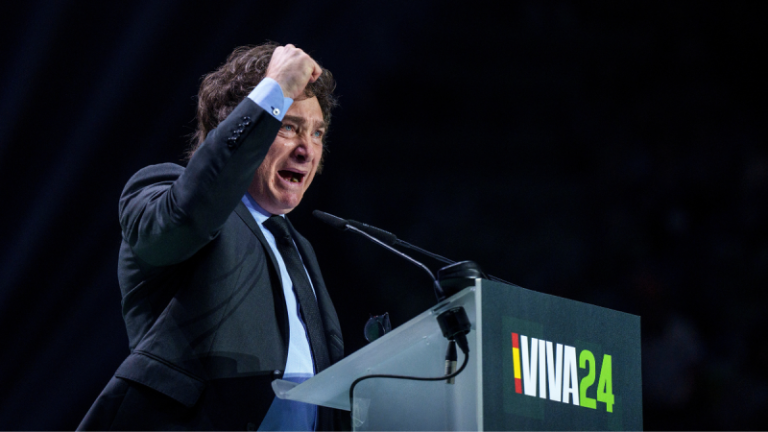
Argentine President Javier Milei secured a decisive victory Sunday in midterm elections, expanding his control of Congress and giving his government fresh momentum to push forward with deep spending cuts and sweeping free-market reforms.

The result gives Milei’s libertarian movement a boost and marks another sharp turn for one of Latin America’s largest and most volatile economies.

Milei’s party, La Libertad Avanza, won about 41.5% of the vote in Buenos Aires province, a historic upset in a region long dominated by the Peronist opposition. The rival coalition took 40.8%, according to figures cited by Reuters and The Associated Press.

Nationwide, La Libertad Avanza increased its seats in the lower house from 37 to 64, positioning Milei to more easily defend his vetoes and executive decrees that have defined his economic agenda.

‘The result is better than even the most optimistic Milei supporters were hoping for,’ Marcelo Garcia, Americas director at the risk-analysis firm Horizon Engage, said in comments reported by Reuters. ‘With this result, Milei will be able to easily defend his decrees and vetoes in Congress.’

Political consultant Gustavo Cordoba told Reuters the outcome reflected a cautious optimism among voters who appear willing to give Milei’s economic policies more time.

‘Many people were willing to give the government another chance,’ Cordoba said. ‘The triumph is unobjectionable, unquestionable.’

Reuters reported that inflation has fallen from 12.8% before Milei’s inauguration to 2.1% last month. His government has also posted a fiscal surplus and pushed through broad deregulation measures — a dramatic reversal after years of economic turbulence.

According to The Associated Press, the U.S. government under President Donald Trump offered Argentina a $40 billion aid package, including a $20 billion currency swap and a proposed $20 billion debt-investment facility, after tying future U.S. support to Milei’s performance in the midterms.

Investors reacted positively to the results. Reuters reported that Argentine bonds and stocks are expected to rally as Milei’s stronger hand in Congress gives him the political capital to accelerate his reforms

Milei called the election ‘a turning point for Argentina,’ according to AFP via the Times of Israel.

This post appeared first on FOX NEWS
President Donald Trump is in ‘excellent overall health,’ the president’s doctor said in a memorandum after a follow-up evaluation at Walter Reed National Military Medical Center on Friday. 

Earlier this week, the White House announced that Trump, 79, would undergo a ‘routine’ semiannual physical on Friday. 

The president also met with troops while at the hospital in Bethesda, Maryland. 

‘President Donald J. Trump successfully completed a scheduled follow-up evaluation at Walter Reed National Military Medical Center,’ Navy Capt. Sean P. Barbabella, the physician to the president, wrote in a memorandum to White House press secretary Karoline Leavitt. 

Barbabella said that the visit was part of an ongoing health maintenance plan that included ‘advanced imaging, laboratory testing and preventative health assessments conducted by multidisciplinary team of specialists.’ 

He added, ‘Comprehensive laboratory studies performed in conjunction with the visit were exceptional, including stable metabolic, hematologic and cardiac parameters.’

In his summary, Barbabella said Trump, ‘remains in exceptional health, exhibiting strong cardiovascular, pulmonary, neurological, and physical performance.’ 

Barbabella also said Trump also received updated COVID-19 and flu shots in preparation for international travel. 

‘President Trump continues to demonstrate excellent overall health,’ he wrote, adding that his cardiac age was found to be ‘approximately 14 years younger than his chronological age. He continues to maintain a demanding daily schedule without restriction.’ 

The medical checkup will be Trump’s second this year. He had a similar exam in April, during which his physician stated that he ‘remains in excellent health.’

In July, the president was diagnosed with a vein condition known as chronic venous insufficiency. At the time, Leavitt said Trump had noticed ‘mild swelling’ in his lower legs and was evaluated by the White House medical unit.

Chronic venous insufficiency occurs when veins in the legs struggle to allow blood to flow back up to the heart.

Leavitt attributed the bruising on the president’s hand to ‘frequent handshaking and the use of aspirin.’

This post appeared first on FOX NEWS

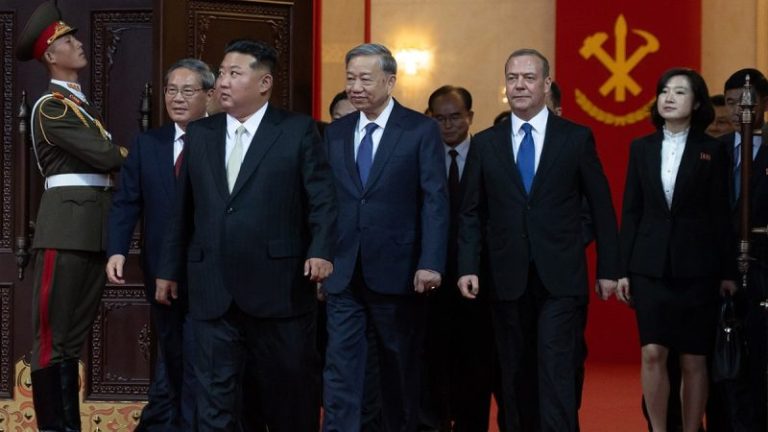
North Korean leader Kim Jong Un displayed a new long-range intercontinental ballistic missile at a military parade in Pyongyang that included foreign leaders on Friday. 

The yet-to-be-tested Hwasong-20 was described by the state-owned Korean Central News Agency as having the ‘most powerful nuclear strategic weapons system.’

The government also displayed shorter-range ballistic, cruise and supersonic missiles at the military parade, which marked 80 years since the founding of the Worker’s Party.

Kim said at the parade that the military ‘must continue to evolve into an invincible force that eliminates all threats.’

The foreign dignitaries at the parade included Chinese Premier Li Qiang, former Russian President Dmitry Medvedev, and Vietnam’s Communist Party chief To Lam. 

Kim also met with Medvedev on Friday, who praised the sacrifice of North Korean soldiers fighting with Russia in Ukraine. 

Kim said he hoped to strengthen ties with Russia and work together toward common goals. 

Last summer, Kim’s sister Kim Yo Jong warned the U.S. to not attempt to restart talks centered around denuclearization, adding that Pyongyang would view any attempt to pressure North Korea to denuclearize as ‘nothing but a mockery.’ 

‘If the U.S. fails to accept the changed reality and persists in the failed past, the DPRK- U.S. meeting will remain as a ‘hope’ of the U.S. side,’ Kim Yo Jong said, referring to the nation by its official name, the Democratic People’s Republic of Korea.

The Associated Press and Reuters contributed to this report. 

This post appeared first on FOX NEWS

Secretary of War Pete Hegseth on Friday announced that the Department of War (DOW) is establishing a new counter-narcotics Joint Task Force in the Caribbean Sea. 

Hegseth said the task force’s aim would be to ‘crush the cartels, stop the poison, and keep America safe. The message is clear: if you traffic drugs toward our shores, we will stop you cold.’

The task force is launching at the direction of President Donald Trump, he said, in the SOUTHCOM area, which covers the Caribbean and Latin America. 

The U.S. Southern Command said in a release that the task force was being launched under the II Marine Expeditionary Force on Friday ‘to synchronize and augment counter-narcotics efforts across the Western Hemisphere.’

‘Transnational criminal organizations threaten the security, prosperity, and health of our hemisphere,’ Admiral Alvin Holsey, the commander of SOUTHCOM, said in a statement. ‘By forming a JTF around II MEF headquarters, we enhance our ability to detect, disrupt, and dismantle illicit trafficking networks faster and at greater depth – together with our U.S. and partner-nation counterparts.’

This comes as the administration has begun strikes against boats in the Caribbean it says are linked to drug trafficking networks.

The administration has conducted a series of fatal strikes against four small boats believed to be carrying drugs over the last few months.

It said 21 people were killed in the strikes.  

The attacks have alarmed Democratic lawmakers as the administration hasn’t detailed what evidence it had against the targeted boats or their passengers. 

This post appeared first on FOX NEWS