
Author

admin

Browsing

European stock index futures pulled back further on Thursday as investors reacted to the soaring crude oil prices and the bizarre military options CENTCOM will offer President Donald Trump. The FTSE 100 futures dropped to £10,190, while those linked to the DAX, Stoxx 50, and CAC 40 fell by nearly 1%.

Crude oil price soars on new military options on the Iran war

Futures tied to top indices like the German DAX, Stoxx 50, and CAC 40 retreated as crude oil prices rallied. Brent, the global benchmark, soared to $126, its highest level since Russia invaded Ukraine. The West Texas Intermediate (WTI) and other oil benchmarks also continued soaring.

According to Axios, CENTCOM will present Trump with a few military options that it hopes will push Iranians to the negotiating table. All these options sound bizarre as they don’t explain how Iran will react.

First, Brad Cooper plans to have a “short and powerful” wave of strikes targeting infrastructure targets in hopes of breaking the negotiating deadlock. 

The reality, however, is that Iran will also retaliate with similar strikes against Israel and Middle East neighbors. Its retaliations may include oil and gas infrastructure in order to push oil prices higher.

Second, CENTCOM is also planning to take over part of the Strait of Hormuz to allow commercial shipping, an option that would include ground forces. This option would leave US troops vulnerable to Iranian attacks.

Third, the US may decide to have special forces to secure Iran’s enriched uranium. This would also be a difficult option, as the uranium is buried deep under mountains and would expose troops.

The implication of all this is that crude oil prices will remain at an elevated level for a while. Such a move will hurt European economies that are contending with slow economic growth and a high inflation rate. Europe depends mostly on oil from the Middle East, with some airlines already canceling flights.

DAX, FTSE 100, Stoxx 50, and CAC 40 in focus ahead of interest rate decisions

European stock indices will react to the upcoming ECB and Bank of England (BoE) interest rate decisions. These meetings will come a day after the Federal Reserve left rates unchanged between 3.50% and 3.75%.

Economists expect the ECB to leave rates unchanged as it contends with the new reality of tempered economic growth and high inflation. This is a big change as the ECB had succeeded to bring inflation to its 2% before the war started.

The Bank of England is in a more difficult place as the UK inflation was still above 3% before the war started and the country remains in a stagflation period. Stagflation is characterized by high inflation and slow economic growth.

At the same time, several large European companies will publish their financial results in the next two days. In the UK, the focus will be on Rolls-Royce, NatWest, Standard Chartered, and Endeavor Mining.

The DAX Index will react to earnings reports by top companies like BASF, Deutsche Post, Volkswagen, and Linde. In France, companies like Schneider Electric, BNP Paribas, Société Générale, Credit Agricole, and Capgemini will release their numbers.

The post FTSE 100, DAX, CAC 40 futures fall as risk rises ahead of ECB, BoE appeared first on Invezz


China’s real residential property price index just hit a record low with 17 consecutive quarters of decline.

In real, inflation-adjusted terms, home values are now below where they were in 2010, wiping out fifteen years of appreciation for the country’s urban middle class.

Meanwhile, official GDP grew at 5% in Q1 2026, beating forecasts. So perhaps one headline is more significant than the other.

What the headline number is hiding

The 5% growth figure is not fabricated. But it is being manufactured in a very specific way.

State-owned enterprises are leading a surge in infrastructure and advanced manufacturing investment.

Fiscal spending was front-loaded into Q1 2026. Exports of EVs, batteries, and semiconductors are genuinely booming.

Strip all of that out, and what remains, the organic private-sector-driven activity that reflects how actual Chinese households and businesses are doing, is tracking closer to 3% by several independent estimates.

The property sector, which as recently as 2021 accounted for roughly 24% of GDP, has seen its contribution cut in half.

Property investment collapsed 17.2% in 2025 alone. New home prices in March 2026 marked their 23rd consecutive month of year-on-year decline, including falls of 8% to 12% from peak in cities like Shanghai and Beijing, once considered untouchable.

The BIS real residential property price index closed Q4 2025 at 86.79 on a 2010 base of 100. Prices are not just falling. They have erased the entire decade-and-a-half of real gains.

Property was never just a sector

To understand why this matters so profoundly, you have to understand what property actually was in China. It was the savings account, the pension plan, and the primary store of national wealth, all in one.

Residential real estate represents 70% of urban household assets. Land sales funded roughly 20% of local government fiscal revenue, which in turn paid for hospitals, schools, roads, and public services across hundreds of cities and provinces.

At its peak, the property complex was consuming 60% of global cement output and 50% of global steel. It absorbed 25% of all bank loans in China.

This was not a sector running alongside the economy. It was the economy’s skeleton.

Local government land revenues have fallen 44% from their 2021 peak.

Banks are carrying non-performing exposure that official figures almost certainly understate.

An estimated $18 trillion in household wealth has been destroyed since the peak, a number larger than the entire US GDP.

The doom loop nobody in Beijing wants to name

There is a specific economic concept that fits China’s situation precisely, which is a balance sheet recession. The term was developed by economist Richard Koo to describe Japan after 1991.

When the primary asset of a nation’s households collapses in value, those households rationally respond by saving more and spending less, even when interest rates are near zero.

The correct individual response becomes collectively catastrophic.

Chinese household bank deposits have nearly doubled over the past five years.

Consumer confidence remains depressed. Retail sales growth repeatedly misses forecasts.

The People’s Bank of China can cut rates, and it has, but it cannot manufacture the confidence needed to make people spend.

Monetary policy, in this environment, is a lever disconnected from the machine it is supposed to operate.

The second-order effect is the one poisoning the global trading system. Factories that lose domestic demand do not close. They cut prices and export.

China’s industrial overcapacity is now flooding global markets with cheap steel, chemicals, solar panels, and EVs at prices that competitors in Europe, the US, and Southeast Asia simply cannot match.

This looks like Chinese industrial strength. It is, in significant part, Chinese domestic weakness finding an exit valve, and it is the primary driver of the trade tensions escalating around it.

What investors are actually buying when they buy China

The green industrial complex is real. Output in AI-adjacent sectors, including integrated circuits, grew nearly 50% year-on-year in Q1 2026.

EV exports surged 77.5%.

Lithium battery production rose over 40%.

China is winning the green technology race decisively, and these are not manufactured numbers. For investors with long horizons and tolerance for policy risk, there is genuine value in the sectors Beijing has chosen to champion.

The problem is that these industries do not employ enough people, at sufficient wages, to replace the economic mass of what property used to generate.

A semiconductor fab is not a jobs engine. An EV export line does not rebuild the confidence of a household sitting on a mortgage worth more than the apartment securing it.

Goldman Sachs estimates the property downturn dragged approximately 2 percentage points off annual GDP growth in both 2024 and 2025.

The generation that bought the dream

The sharpest way to understand what is happening in China is not through GDP tables or BIS indices. It is through the young professionals who stretched their savings and their parents’ savings to buy an apartment in 2019 or 2020.

That person is now servicing a mortgage on an asset worth 23% less in real terms than when they bought it, in a job market where youth unemployment runs at approximately 20% officially and significantly higher by independent estimates.

They are not consuming. They are not investing. They are doing what every rational actor does in this situation: waiting, saving, and hoping the floor arrives before the ceiling closes in.

Multiply that across tens of millions of households, and you have the actual state of the Chinese economy in 2026.

The GDP number tells you what the state is building.

The property price chart tells you what people are living.

Beijing can paper over the second story with the first one for a while longer, but the BIS data doesn’t take instructions from anyone.

The post Is China's economic resilience masking a real estate collapse? appeared first on Invezz

The Justice Department’s endeavor to break up Live Nation, Ticketmaster’s parent company, has officially made its way to the courtroom.

The antitrust case, which began with jury selection Monday, is unfolding in federal court in New York. Opening statements are scheduled to start Tuesday, with the trial expected to last six weeks.

The lawsuit, filed in 2024 by the Justice Department and dozens of state attorneys general, as well as Washington, D.C., alleges that Live Nation has illegally dominated the live concert industry by monopolizing ticketing, concert booking, venues and promotions.

The complaint, which was filed in the Southern District of New York, accuses the company of engaging in ‘anticompetitive conduct’ that leads fans to pay more in fees, artists to get fewer opportunities to play concerts and venues to have limited choices for ticketing services.

Ticketmaster has for years been the target of scrutiny by music fans who reported frustrations with buying tickets through the platform.

Live Nation directly manages more than 400 musical artists and owns or controls more than 265 concert venues in North America. And through Ticketmaster, the lawsuit says, it controls around 80% of major concert venues’ ticketing — as well as a growing share of the resale market.

“Through interconnected agreements associated with Live Nation’s various roles as ticketer, promoter, artist manager, and venue owner,” the complaint says, “Live Nation has created a feedback loop that pushes ticketing and ancillary fees higher while allowing Live Nation to be on all sides of numerous transactions and thereby double-dip from the pockets of fans, artists, and venues.”

Here’s what else to know.

Attempts to advocate for ticketing reform have spanned decades. The rock band Pearl Jam tried to push the issue forward 30 years ago when its members testified before Congress, saying Ticketmaster had refused to agree to low concert ticket prices and fees. The case was dismissed a year later, and Ticketmaster’s dominance has persisted over the decades that followed.

But frustration over Ticketmaster began to boil over when it incurred the wrath of one of the country’s largest fan bases: Swifties, aka followers of Taylor Swift.

In late 2022, overloaded presale queues for the domestic leg of Swift’s 2023 Eras Tour caused the site to crash and led Ticketmaster to cancel the sale. The fiasco even drew the attention of Swift herself, who called it “excruciating” to watch.

Soon afterward, in January 2023, the Senate Judiciary Committee held a hearing examining Ticketmaster’s dominance in the industry. During the bipartisan hearing, which probed whether Ticketmaster’s outsize control has unfairly hurt customers, even senators couldn’t refrain from making references to Swift.

The Swifties also brought their own lawsuits against Ticketmaster in December 2022. One class-action suit was dropped by the end of 2023, while another suit, filed together by 355 individual ticket buyers, still awaits trial.

Live Nation Entertainment has denied that it’s a monopoly.

The company has told NBC News that the Justice Department’s lawsuit “won’t solve the issues fans care about relating to ticket prices, service fees, and access to in-demand shows.”

“Calling Ticketmaster a monopoly may be a PR win for the DOJ in the short term, but it will lose in court because it ignores the basic economics of live entertainment, such as the fact that the bulk of service fees go to venues, and that competition has steadily eroded Ticketmaster’s market share and profit margin,” the company said.

Last week, Live Nation asked U.S. District Judge Arun Subramanian to pause the case so it could appeal his decision denying the case’s dismissal.

Subramanian, who was appointed by President Joe Biden, declined to delay the trial and ruled to allow the Justice Department’s claims to proceed.

Potential witnesses for the trial include: musician Kid Rock (whose real name is Robert Ritchie), Minnesota Timberwolves CEO Matthew Caldwell, Roc Nation CEO Desiree Perez, Live Nation Entertainment CEO Michael Rapino and Mumford & Sons keyboardist Ben Lovett.

Kid Rock is expected to testify about ‘competitive conditions for concert promotions and primary ticketing, including the impact of Defendants’ actions on artists and fans,’ according to the potential witness list provided by the plaintiffs’ attorneys. In January, he told the Senate Commerce Committee at a hearing that the ticketing industry is ‘full of greedy snakes and scoundrels.’ (It appears Kid Rock is still partnering with Live Nation for his “Freedom 250” tour, with tickets currently being sold exclusively through the platform.)

Lovett’s testimony, meanwhile, would be likely to address ‘artist preferences and competitive dynamics associated with the promotions and amphitheaters markets,’ according to the plaintiffs’ potential witness list document. He’s also listed on the defendants’ potential witness list document.

Live Nation CEO Michael Rapino and former Ticketmaster CEO Irving Azoff are also expected to take the stand. They were instrumental figures in the 2010 merger.

Azoff, who represents major artists such as Harry Styles, is ‘likely to testify about industry trends, dynamics, and competition, the selection of live event promotion companies, and tour and show routing and venue selection, as well as ticketing provider preferences,’ according to the potential witness list provided by the defendants’ attorneys.

Rapino’s expected testimony would focus on ‘the company’s business, its corporate structure, strategy, and finances, including the different lines of business and how they interact, as well as industry trends, dynamics, and competition.’ The defendants’ attorneys also said he would be likely to ‘rebut the plaintiff’s allegations of misconduct and anticompetitive effects.’

Last year, the Federal Trade Commission separately sued Live Nation and Ticketmaster over allegations of illegal and deceptive business practices that it says caused consumers to pay ‘significantly more’ than the face value of a ticket.

Seven states — Colorado, Florida, Illinois, Nebraska, Tennessee, Utah and Virginia — joined the FTC’s suit, which was filed in U.S. District Court for the Central District of California.

This post appeared first on NBC NEWS

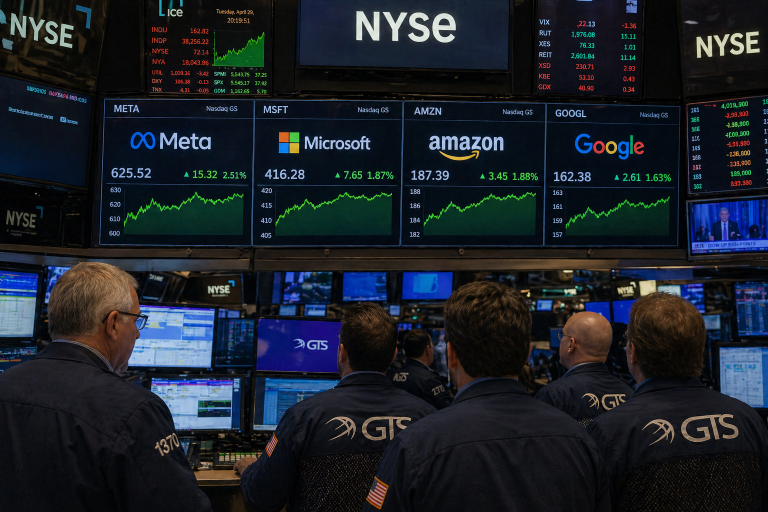
A pivotal moment for global markets is set to unfold as Alphabet, Amazon, Meta and Microsoft prepare to report earnings on the same day, offering a rare, concentrated look into the health of the artificial intelligence economy.

The simultaneous results from the four technology giants, which together account for a significant share of the S&P 500, are expected to provide critical insight into whether the massive investments being poured into AI infrastructure are translating into sustainable growth.

“Biggest earnings day ever. To the best of my knowledge, these four largest companies have never put it on the same day, so we’re gonna learn a lot in a very short period of time,” Gil Luria, DA Davidson head of technology research, told Yahoo Finance.

AI spending and data centre expansion under scrutiny

At the centre of investor focus is an unprecedented $650 billion combined capital expenditure plan for 2026, largely directed toward building data centres and expanding AI capabilities.

Analysts say the key question is not just how much these companies are spending, but whether they can execute those plans in an environment constrained by energy shortages, regulatory hurdles and supply bottlenecks.

“There’s been plenty of reporting for the last three months about delays in data centres, a lot of regulation, a lot of constraints on the ability to access electricity,” Luria said, adding that the companies’ commentary will determine whether they can meet timelines for expanding infrastructure.

If these four companies can't build data centres at the rate they want, then everyone else won't be able to live up to their expectations.

Gil Luria
Head of technology research at DA Davidson

The implications extend far beyond Big Tech, affecting chipmakers, equipment suppliers and a growing ecosystem of smaller cloud providers dependent on hyperscaler demand.

Supply constraints threaten AI momentum

Despite surging demand for computing power following the rise of generative AI tools, infrastructure limitations remain a major hurdle.

“The entirety of the AI complex right now is going to be supply-constrained,” Citizens analyst Andrew Boone said.

He noted that insufficient energy and computing infrastructure could limit how quickly companies scale their AI operations.

Part of the question will be who is executing well enough to get capex into the ground.

Andrew Boone
Citizens analyst.

Recent developments highlight the intensity of demand.

Companies such as Anthropic have signed multiple infrastructure deals, while Amazon has announced agreements to supply custom chips to Meta.

Meanwhile, Alphabet said its systems now process more than 16 billion tokens, underscoring rapid growth in AI usage.

What analysts are watching across Big Tech

Each of the four companies faces a distinct set of expectations when reporting results.

At Alphabet, analysts expect Google Cloud to drive growth, supported by enterprise adoption of AI tools such as Gemini.

However, margins will be closely watched as rising capital expenditure feeds into depreciation costs.

Amazon’s results will be judged largely on the performance of Amazon Web Services, particularly its ability to expand capacity and manage backlog amid strong AI demand.

Investors are also looking for clarity on its $200 billion capex plans.

At Meta, attention will centre on how AI investments are improving its core advertising business, including targeting and content recommendations.

Analysts say the company needs to clearly demonstrate how AI is translating into revenue growth.

Microsoft, meanwhile, faces questions around capacity constraints in its Azure business and the pace of AI monetisation through products like Copilot.

Margins, monetisation and market expectations

Beyond infrastructure, investors are increasingly focused on whether AI investments are beginning to generate returns.

“The setup going into earnings is pretty straightforward,” Bernstein analyst Mark Shmulik wrote in a note last week.

Companies will need to deliver AI-driven revenue growth, maintain capital expenditure commitments and demonstrate cost discipline through efficiency measures such as layoffs or pricing power.

At the same time, there is a growing debate about whether spending could overshoot expectations.

Some analysts warn that rising capex forecasts may reignite concerns about overspending in the AI race.

A defining moment for the AI trade

The convergence of earnings from the four largest technology companies marks what some analysts describe as one of the most important reporting days in recent years.

Wednesday will be “one of the most significant earnings days in recent memory,” Matt Stucky, chief portfolio manager at Northwestern Mutual, told MarketWatch.

With demand for AI computing power accelerating but infrastructure struggling to keep pace, the results and guidance from these companies are likely to shape investor sentiment not just for Big Tech, but for the broader global economy tied to artificial intelligence.

The post META, MSFT, AMZN, GOOG head for 'biggest earnings day': why it matters appeared first on Invezz

The Nikkei 225 Index slipped a bit after the Bank of Japan (BoJ) delivered its interest rate decision amid the ongoing US-Iran war. It dropped to ¥59,920 on Thursday, down slightly from the year-to-date high of ¥60,592.

Bank of Japan interest rate decision 

Japanese stocks retreated as market participants reflected on the latest BoJ interest rate decision, in which officials decided to leave interest rates unchanged, as most analysts were expecting. They left rates at the 30-year high of 0.75%.

The main reason why the Nikkei 225 Index dropped, and the Japanese yen jumped is that more officials voted to increase interest rates in this meeting. Three members voted to hike by 0.25%, up from the previous two.

As a result, there are concerns that the bank will ultimately decide to hike interest rates later this year as inflation continues rising.

The biggest risk for the Japanese economy is that energy prices have surged in the past few months, with Brent and the West Texas Intermediate (WTI) rising to $109 and $97, respectively. 

This rally continued this week as the contentious ceasefire between the two sides continued. At press time, Trump had not responded to Iran’s offer to reopen the Strait of Hormuz.

The BoJ has been relatively hawkish in the past few years as it exited negative interest rates and hiked rates to the highest level in three decades. It also ended the yield curve control, which explains why bond yields have soared recently.

Looking ahead, the Federal Reserve will deliver its interest rate decision on Wednesday, with most analysts expecting that it will leave rates unchanged between 3.50% and 3.75%.

Top companies to publish earnings 

The other important catalyst for the Nikkei 225 Index is the upcoming earnings by some of the top companies in Japan. Hitachi, Advantest, and Astellas Pharma have already released their numbers this week..

The ones to watch today will be Mitsubishi Electric, Shin-etsu Chemical, Fujitsu, Dentso, and Komatsu. 

After this, the biggest Japanese trading houses like Mitsubishi, Mitsui, Marubeni, Sumitomo, and Itochu will release their range. These earnings are watched closely because of the large investments that Warren Buffett has made in them.

The Japanese stock market will react to the upcoming earnings by some of the biggest American companies, including popular names like Apple, Microsoft, Google, and Amazon. These numbers are important because of their size and the fact that they use Japanese supply chains in their AI businesses.

Nikkei 225 Index technical analysis 

Nikkei Index chart | Source: TradingView 

The daily chart shows that the Nikkei 225 Index has wavered in the past few days and is hovering slightly above the important support level at ¥59,297. This support is important as it is the upper side of the cup-and-handle pattern.

The index remains much higher than the 50-day and 100-day Exponential Moving Averages (EMA), while the Average Directional Index (ADX) continues its uptrend. Therefore, the most likely Nikkei Index forecast is bullish as investors target the next key resistance at ¥61,000.

The post Here’s why the Nikkei 225 Index may surge despite hawkish BoJ tilt appeared first on Invezz

Los Angeles County filed a civil lawsuit against Roblox, alleging that the platform markets itself as a gaming experience for children but has created a ‘largely unsupervised online world’ that allows adults to mingle with minors with very little oversight.

The lawsuit says that Roblox’s architecture makes it easy for adults to masquerade as children in order to target them.

‘Beneath the bright animation and cheerful branding lies an environment in which child predators can readily locate, contact, and interact with minors through Roblox-enabled features and defaults, and where age-inappropriate sexual content and sexually themed interactions and experiences can be assessed and disseminated through Roblox’s functionality and tools, leaving minors to navigate dangers they do not and cannot understand,’ the lawsuit says.

The suit was filed on Thursday and asks that Roblox be ordered to pay a civil penalty of up to $2,500 for each violation of the Unfair Competition and False Advertising laws. It also asks that Roblox cover the county’s legal fees.

Roblox said in a statement that it disputes the county’s claims ‘and will defend against it vigorously.’

‘Roblox is built with safety at its core, and we continue to evolve and strengthen our protections every day,’ a company spokesperson said. ‘We have advanced safeguards that monitor our platform for harmful content and communications, and users cannot send or receive images via chat, avoiding one of the most prevalent opportunities for misuse seen elsewhere online.’

The company said safety remains a top priority and takes ‘swift action against anyone found to violate our safety rules.’

The lawsuit, however, accuses Roblox of failing to implement safety measures, including age verification, default communications restrictions and effective reporting mechanisms.

‘These fixes are obvious, easy, and long overdue,’ it says.

The county said in its suit that it has had to ‘expend, divert and increase resources to address rising rates of child sexual exploitation, trafficking, abuse and mental health trauma.’

‘By taking actions that increase the costs of law enforcement, child protective services, victim services, mental health counseling, and other public services, Roblox has diverted taxpayer dollars away from other critical public programs and services,’ the suit alleges.

Roblox said in its statement that as of January, it requires all users to undergo a facial age check to use the chat feature, and that chat users are placed into age groups.

Parents are given control over whether their child can access the chat feature, can block specific users and games, and can set screen time limits. The company also said it does not allow users to send images or videos via chat.

‘There is no finish line when it comes to protecting kids, and while no system can be perfect, our commitment to safety never ends,’ Roblox said.

Since its launch in 2006, Roblox has grown to become a massive global success. It has 144.5 million daily active users with over 35 billion engagement hours, its website states.

According to its most recent shareholder letter for Quarter 4, revenue grew 36% year-over-year to $4.9 billion and generated $1.8. billion in operating cash flow in fiscal 2025.

This was due to the addition of about 60 million daily active users from Quarter 4 of 2024 to Quarter 4 of 2025, the letter says.

Over the years, the gaming platform has been at the center of several lawsuits, including one filed last year where a California woman alleged that her teenage son was groomed and coerced to send explicit images on Roblox and Discord. The suit was filed after the boy took his own life in April 2024.

Attorneys for the mother said the boy was targeted by “an adult sex predator” who posed as a child on Roblox. The lawsuit alleged that the conversation between the boy and the man escalated to include “sexual topics and explicit exchanges.” The man eventually encouraged the boy to move the conversation to Discord, demanded that the boy share explicit videos and images, and then threatened to post them, the lawsuit alleged.

Both companies said at the time that it does not comment on legal matters. The case is still pending.

Louisiana Attorney General Liz Murrill also sued the platform last year, alleging that it was “the perfect place for pedophiles” due to its failure to implement strong safety protocols. Roblox denied her claims and said it was committed to working with the prosecutor’s office to keep children safe.

This post appeared first on NBC NEWS

Warner Bros. Discovery said Tuesday that it was reopening talks with Paramount Skydance, giving the studio a week to rival Netflix in its bid to take over the streaming and cable giant.

In a statement, Warner Bros. Discovery said it had rejected the latest $30-a-share offer from Paramount but would give the company until Monday ‘to make its best and final offer.’

It also said a ‘senior representative’ of Paramount had indicated that the CBS owner would be willing to meet an even higher price, $31 a share, seemingly enticing the board back to the table.

At the same time, Warner Bros. is still recommending its shareholders vote at a special meeting March 20 to approve the $82.7 billion deal it reached in December to sell its streaming service, studio and HBO cable channel to Netflix.

Paramount is seeking to buy the entirety of Warner Bros. Discovery.

‘Every step of the way, we have provided [Paramount Skydance] with clear direction on the deficiencies in their offers and opportunities to address them,’ David Zaslav, CEO of Warner Bros. Discovery, said in the statement.

In a letter to the Paramount board — chaired by David Ellison, also the company’s CEO and controlling shareholder — Warner Bros. said that while Paramount had indicated it would address ‘unfavorable terms and conditions,’ these had not yet been removed from the proposed merger agreement.

Warner Bros. has repeatedly rejected previous bids from Paramount, citing the ‘insufficient value’ offered.

In a separate statement, Netflix hit out at what it called Paramount’s ‘antics.’

‘Throughout the robust and highly competitive strategic review process, Netflix has consistently taken a constructive, responsive approach with WBD, in stark contrast to Paramount Skydance,’ it said.

Netflix said that it was ‘confident that our transaction provides superior value and certainty’ but also recognized ‘the ongoing distraction for WBD stockholders and the broader entertainment industry caused by’ Paramount. The company said it granted Warner Bros. the one-week window to reopen talks with Paramount to ‘fully and finally resolve this matter.’

Netflix also took aim at the regulatory process required for either company to complete a takeover.

It said that Paramount has ‘repeatedly mischaracterized the regulatory review process by suggesting its proposal will sail through.’

‘WBD stockholders should not be misled into thinking that PSKY has an easier or faster path to regulatory approval — it does not,’ Netflix said.

In a statement, Paramount Skydance reiterated its existing offer to Warner Bros. Discovery of $30 per share. The company did not indicate if it would submit a higher bid.

Paramount called the one-week negotiating window ‘unusual’ but said it ‘is nonetheless prepared to engage in good faith and constructive discussions.’

The Ellison-backed media giant also said it would continue advocating against the Netflix deal and submit a slate of directors for Warner Bros.’ board at the upcoming shareholder meeting, as it previously planned to.

President Donald Trump, whose administration approved Ellison’s takeover of Paramount last year, said early in the bidding process he would be involved in approving a deal with Warner Bros.

But earlier this month, Trump changed his tune. ‘I’ve been called by both sides, it’s the two sides, but I’ve decided I shouldn’t be involved,’ he told ‘NBC Nightly News’ anchor Tom Llamas.

Trump still hinted that one company looked problematic to him. ‘I mean, there’s a theory that one of the companies is too big and it shouldn’t be allowed to do it,’ he said.

‘They’re beating the hell out of each other and there’ll be a winner,’ Trump said.

Warner Bros. has an archive of storied movies, as well as a diverse portfolio of brands including CNN and HBO.

The bidding war for the media empire comes at a pivotal time for the entertainment industry, with traditional broadcasters and studios facing serious challenges from digital newcomers Netflix, Apple and Amazon.

Since Netflix announced its deal to buy parts of Warner Bros. Discovery, its shares have tumbled nearly 25%.

This post appeared first on NBC NEWS

The Commodity Futures Trading Commission (CFTC) is stepping in to stop what it calls an “onslaught” of state-level regulation of prediction markets.

CFTC Chairman Michael Selig said Tuesday in a video posted on X that the agency has filed a “friend of the court brief” in support of Crypto.com in its escalating legal battle with regulators in Nevada.

The move is significant because it marks the first time under Selig that the CFTC has taken sides in what is shaping up to be an epic fight between regulators and prediction markets, platforms that allow users to trade contracts tied to a wide range of events, from local elections to the Super Bowl.

By intervening, Selig’s CFTC is effectively arguing that prediction markets are federally regulated and not subject to state-level gambling laws.

“Over the past year, American prediction markets have been hit with an onslaught of state-led litigation,” Selig said in the video.

“The CFTC will no longer sit idly by while overzealous state governments undermine the agency’s exclusive jurisdiction over these markets by seeking to establish statewide prohibitions on these exciting products,’ said Selig.

The debate over how the platforms should be regulated comes as they explode in popularity. Kalshi said Super Bowl 60 generated more than $1 billion in total trading volume — a 2,700% increase from last year.

It’s a fight with broad implications and high stakes. Over the past year, several states including Massachusetts and Nevada have moved to restrict prediction markets, filing lawsuits, issuing cease-and-desist letters and arguing that the platforms amount to unlicensed gambling.

Utah’s Republican governor, Spencer Cox, said in a post on X Tuesday that he will use “every resource” within his disposal to “beat” Selig in court.

“These prediction markets you are breathlessly defending are gambling—pure and simple,” he said. “They are destroying the lives of families and countless Americans, especially young men. They have no place in Utah.”

Meanwhile, Cox’s fellow Republican, Sen. Bernie Moreno of Ohio, issued his support of Selig’s announcement on X. “Clear lines of delineation and clarity on regulations is essential for American led innovation,’ he said.

Selig’s move comes days after a group of Democratic senators led by Nevada’s Catherine Cortez Masto sent the chairman a letter urging the CFTC to ‘abstain from intervening in pending litigation involving contracts tied to sports, war, or other prohibited events.’

As states attempt to rein in these fast-growing platforms, the question is no longer simply whether these products amount to gambling. It’s who gets to decide that question.

Industry advocates argue that the platforms aren’t gaming, which is traditionally regulated by states. Instead, they claim the prediction markets are financial exchanges that fall under the CFTC’s purview, where users trade contracts with one another. and don’t bet against a “house.” The exchanges don’t set odds or take the opposite side of trades. Instead, they collect transaction fees, similar to a brokerage.

In the video, Selig said prediction markets allow Americans to “hedge commercial risks like increases in temperature and energy price spikes,” and they act as “an important check on our news media and our information screens.”

He ended the video with a warning directed at the state attorneys general who are on the front lines of the legal fights to regulate prediction markets: “To those who seek to challenge our authority in this space, let me be clear: We will see you in court.”

This post appeared first on NBC NEWS

Global markets started the week with a mixed bag as equities in the region are being lifted by Wall Street’s momentum, while oil remains sensitive to every fresh twist in the US-Iran standoff.

China’s latest profit data suggests some industrial improvement, but the broader recovery still looks uneven.

In India, Sun Pharma is making a giant outbound bet on Organon.

Together, the day’s headlines point to a market obsessed with growth, energy security, and cross-border deal-making.

Asia mixed, led by Japan

Asian markets opened the week mixed, with Japan’s Nikkei 225 standing out after setting a fresh record high at 60,564.18, up 1.4%.

South Korea’s Kospi and Taiwan’s Taiex also advanced, while Hong Kong’s Hang Seng, Shanghai, and Australia’s ASX 200 were softer.

The tone was broadly risk-on, helped by Wall Street’s strong finish and continued appetite for technology shares.

The pattern suggests regional traders are still willing to buy dips, but they are not ignoring the oil shock and Iran-related uncertainty that continue to hang over sentiment.

Oil stays on edge

Oil prices remained elevated as stalled US-Iran peace talks and tighter traffic through the Strait of Hormuz kept supply fears in focus.

Brent crude climbed to $107.49 a barrel, while US WTI rose to $96.17, with both benchmarks extending a run of sharp weekly gains.

The tanker activity has stayed thin, with Tehran restricting the strait and Washington maintaining a blockade on Iranian ports.

Goldman Sachs also raised its year-end price forecasts, warning that the economic risks from the disruption may be greater than the market’s base case suggests.

Sun Pharma’s giant bet

Sun Pharmaceutical Industries has agreed to buy Organon & Co. in an all-cash transaction valued at $11.8 billion in enterprise value, with Organon shareholders set to receive $14 per share.

Organon said the deal gives Sun Pharma access to a portfolio of more than 70 products sold across roughly 140 countries, strengthening its women’s health and general medicine businesses.

The move is seen as one of India’s biggest outbound acquisitions, and the scale alone makes it a major signal for Indian pharma’s global ambitions.

The deal also reflects strategic timing: Sun Pharma is buying into scale, geography, and product breadth at a moment when overseas expansion matters more than ever.

China profits improve

China’s industrial firms reported faster profit growth in March, with profits up 15.8% year on year, after a 15.2% rise in January-February.

For the first quarter, industrial profits rose 15.5%, helped by a broader economic rebound that kept growth near 5%.

But the recovery is uneven: AI-linked manufacturers have been strong, while consumer names remain under pressure from weak domestic demand.

Rising energy costs from the Iran war could further squeeze margins, especially if companies cannot pass on higher input prices.

The data is encouraging, but it does not yet erase the risks from softer exports, cooler industrial output, and a still-fragile demand backdrop.

The post Morning brief: Asia mixed, oil jitters surge, Sun Pharma’s big bet appeared first on Invezz

Taylor Wimpey share price continued its relentless freefall, reaching its lowest level July 2023, down by over 46% from its since July 2023. It has plunged by over 45% from its highest point in October 2024, erasing billions of dollars in value. This crash may continue in the foreseeable future after releasing mixed results.

Taylor Wimpey’s business is facing major headwinds 

UK housebuilders are among the worst-performers in the London Stock Exchange (LSE) this year as they face a double-whammy of slow demand and high costs.

A report released its trading statement, which showed that its business is struggling as mortgage rates remain at an elevated level.

The statement said that its total order book stood at over £2.22 billion, much lower than £2.3 billion in the same period last year. At the same time, house prices dropped by 1%, with the New South Wales region being the most affected.

The company is also seeing higher costs as energy costs jump. It is experiencing build cost inflation of low to mid single digits. The management added:

“We continue to be highly focused on the operational levers under our control, including driving sales performance, tightly controlling land and WIP spend and mitigating cost where possible.”

Taylor Wimpey’s business will likely remain under pressure in the foreseeable future as the Iran war is not ending any time soon. One major cost is the rising fuel prices, which will affect its transport costs. Other building materials will also continue rising as the war continues.

At the same time, this increase will lead to higher inflation. Indeed, a recent report showed that the headline Consumer Price Index (CPI) jumped to 3.3%, moving further away from the Bank of England (BoE) target of 2.0%. 

As a result, there is a risk that the BoE will maintain a more hawkish tone in the coming meetings. Higher interest rates mean that mortgage rates will remain between 4% and 5% in the foreseeable future, hurting its demand.

On the positive side, Taylor Wimpey continues to pay dividends despite the ongoing challenges. It is also repurchasing its stock, completing the initial purchase of shares worth £34.9 million. This buyback is part of the £52 million authorization.

Taylor Wimpey share price technical analysis 

TW stock chart | Source: TradingView 

The weekly timeframe chart shows that the TW stock has crashed and is now hovering at its lowest level in years. It has crashed below the key support at 85.35p, its lowest level in September last year and the neckline of the double-top pattern.

The stock has moved below the 61.8% Fibonacci Retracement level and is nearing the 78.6%. It has also dropped below all moving averages, a sign that bears remain in control.

The Average Directional Index (ADX) has jumped to nearly 30, a sign that the bearish momentum is continuing. Therefore, the most likely scenario is where the stock continues falling as it continues to lack a clear catalyst. If this happens, the next key target to watch will be at 70p.

The post Taylor Wimpey share price is in a freefall: will it recover? appeared first on Invezz