Author

admin

Browsing

American Uranium Limited (ASX:AMU, OTC:AMUIF) (American Uranium, AMU or the Company) is pleased to advise that hydrogeological testing at its Lo Herma ISR uranium project in Wyoming’s Powder River Basin has commenced. Testing is being undertaken by Petrotek Corporation, a leading injection well and subsurface resources consultancy with more than 28 years of experience in hydrogeological testing and ISR resource development.

Highlights

  • Hydrogeological testing at Lo Herma has commenced, marking a key milestone in advancing towards ISR project development
  • Testing is expected to take approx. 2 weeks with results anticipated by the end of 2026
  • Phase 1 of the resource development drilling campaign at Lo Herma is underway and progressing well with over half of the planned program completed. Initial results are expected before the end of 2026
  • These programs are designed to underpin a Mineral Resource Estimate and Scoping Study update in 2026.

This testing is running concurrently with Phase 1 of the resource development drilling campaign which is progressing well and is now past the halfway point of the resource expansion program. Drilling results are expected by the end of 2026. The hydrogeological testing fieldwork program is expected to be complete during the week commencing November 24th, with results anticipated before the end of 2026.

AMU CEO and Executive Director Bruce Lane commented:

“We are very pleased to now have both the hydrogeological testing and resource development drilling programs underway at Lo Herma. These programs represent major steps toward advancing one of America’s most promising ISR uranium projects. Lo Herma is one of the few near-term, low-cost ISR projects in the U.S. The hydrogeological testing aims to validate our initial aquifer observations and confirm aquifer transmissivity.

“The first phase of drilling is now well underway and past the halfway point with an objective to grow the current 8.57Mlb resource base and ultimately feed into an updated Mineral Resource Estimate and Scoping Study in 2026, positioning us to capitalise on significant support programs in place to support the US domestic nuclear fuel supply chain.”


Click here for the full ASX Release

This post appeared first on investingnews.com

A video shared on X shows Erika Kirk at the Turning Point USA office surrounded by staff members, proudly showing them the Presidential Medal of Freedom awarded to her late husband, Charlie Kirk.

In the clip posted by Mikey McCoy, Charlie Kirk’s former chief of staff, Erika speaks movingly to the assembled team.

In the clip, she can be heard saying, ‘I wanted you guys all to see the Medal of Freedom and be able to look at it and the back of it.’

‘You guys are all part of the legacy. Thank you,’ she says warmly.

The Presidential Medal of Freedom is the highest civilian award in the U.S. It was awarded posthumously to Charlie Kirk by President Donald Trump on Oct. 14, 2025, a date that would have been Kirk’s 32nd birthday. 

Erika accepted the award on her husband’s behalf at a ceremony in the Rose Garden at the White House. She also delivered remarks highlighting her husband’s beliefs and sacrifice.

Charlie Kirk was assassinated on September 10, 2025, while speaking at a Turning Point USA event at Utah Valley State University in Orem, Utah.

Following her husband’s death, Erika was unanimously appointed CEO and chair of Turning Point USA’s board.

This post appeared first on FOX NEWS

American Rare Earths (ASX: ARR | OTCQX: ARRNF | ADR: AMRRY) (“ARR” or the “Company”), is pleased to announce an updated Mineral Resource Estimate for the Cowboy State Mine area within its flagship Hallack Creek Rare Earths Project. The update incorporates the results from 18 additional channel samples and coincides with the acquisition of two new exploration drilling permits.

Highlights

  • Updated Mineral Resource Estimate in the Cowboy State Mine (“CSM”) Area RECLASSIFIES INDICATED RESOURCE BY 68.4 MILLION TONNES.
    • 102 Channel Samples collected in 2025 provided data points for an updated geological resource model, resource conversion and mineral resource ESTIMATE
    • Summer exploration and mapping collected 18 additional channel samples across the CSM area
      • 18 Channel samples returned average values of 5,471 ppm Total Rare Earth Oxides (TREO)
      • Standout sample (CS25-RM111) contained a new record high assay grade for the entire Halleck Creek Resource with a Total Rare Earth Oxide (“TREO”) grade of 13,816 PPM, which is 4X higher than the resource average
  • New exploration drilling permits obtained at Halleck Creek:
    • 27 hole locations were permitted at the CSM area for the Development drilling needed for future technical studies beyond the Pre-Feasibility Study (“PFS”)
    • 29 hole locations were permitted at the Bluegrass area, a potential exploration target which would add to total Halleck Creek Mineral Resource Estimates

Odessa Resource Ltd. (“Odessa”), of Perth Australia, were commissioned to update the geological resource model for the CSM Area using 102 channel samples collected during 2025. The locations and assays for the 102 channel samples added to the geological resource model reside in Appendix B. The updated mineral resource estimate for the Cowboy State Mine area is approximately 547.5 million tonnes using a TREO cut-off grade of 1,00ppm, see Table 1 and Figure 4. The channel sample results enabled Odessa to reclassify approximately 63.9 million tonnes to the indicated category from the inferred category from the Mineral Resource Estimate presented in the February 2025 updated CSM Scoping Study1, see Table 2. Additional mapping associated with the channel sampling expanded the resource area to increase the CSM mineral resource estimate by approximately 4.5 million tonnes. It should be noted that the overall tonnage increase and change in grade do not reflect a material change to the total resource estimates for the Cowboy State Mine area.

Click here for the full ASX Release

This post appeared first on investingnews.com

East Star Resources (LSE:EST) and Endeavour Exploration announced they have entered into a binding earn-in and joint venture (JV) agreement to advance gold exploration in Kazakhstan.

Endeavour Exploration, a subsidiary of top gold producer Endeavour Mining (LSE:EDV,TSX:EDV,OTCQX:EDVMF), will have the right to earn up to an 80 percent interest in a new JV company via staged investments.

Stage 1 includes a US$5 million payment within two years, equivalent to a 51 percent interest. If an additional US$20 million is given over three years, its interest will increase to 70 percent.

The last 10 percent will be given to Endeavour if it funds and completes a prefeasibility study.

During the initial phase, East Star will act as manager of the JV.

The area of interest for the partnership includes two proven, underexplored mineral belts.

‘This agreement with Endeavour is a transformational milestone for East Star that validates the quality of our exploration programme and provides a clear pathway to unlock the full potential of our gold exploration strategy,” said East Star Resources CEO Alex Walker in a November 13 press release.

While the JV will focus on gold, East Star is also pursuing copper in Kazakhstan.

Its assets include a volcanogenic massive sulfide deposit with a JORC-compliant resource estimate of 20.3 million metric tons at 1.16 percent copper, 1.54 percent zinc and 0.27 percent lead.

An investor webcast is scheduled for Tuesday (November 18) to discuss the terms of the JV.

Both parties will fund the JV company in proportion to their ownership share after the earn-in period.

Securities Disclosure: I, Gabrielle de la Cruz, hold no direct investment interest in any company mentioned in this article.

This post appeared first on investingnews.com

A teenage street musician has been jailed and charged with leading a public gathering in which she led a crowd in singing an anti-Putin rock song in St. Petersburg, a rare act of defiance, according to local reports.

Diana Loginova faces a single administrative charge for organizing an unauthorized public gathering and has been jailed for 13 days, The Moscow Times reported.

After serving her sentence, Loginova will face an additional administrative offense of ‘discrediting’ the Russian military, Reuters reported.

Loginova, who performs under the name Naoko with the band Stoptime, was arrested Tuesday after being filmed earlier leading a crowd in singing the lyrics to exiled rapper Noize MC’s hit song ‘Swan Lake Cooperative.’

Noize MC, the musician who wrote ‘Swan Lake Cooperative,’ is openly critical of the Kremlin and left Russia for Lithuania after the start of the war in Ukraine.

For its part, Moscow has added him to its list of ‘foreign agents,’ which includes hundreds of individuals and entities accused of conducting subversive activities with support from abroad, Reuters reported.

The song doesn’t reference Russian President Vladimir Putin or mention the war in Ukraine. It is a reference to Tchaikovsky’s Swan Lake, which was played on television after the deaths of Soviet leaders and during the 1991 coup attempt against President Mikhail Gorbachev.

In May, a St. Petersburg court banned the song on grounds it ‘may contain signs of justification and excuse for hostile, hateful attitudes towards people, as well as statements promoting violent changes to the foundations of the constitutional order.’

This post appeared first on FOX NEWS

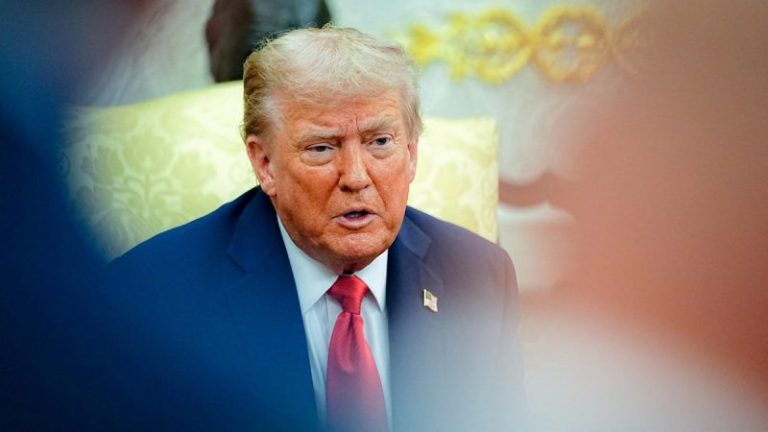
President Donald Trump on Wednesday announced federal law enforcement will next set its eyes on San Francisco, commending the FBI’s more than 23,000 violent criminal arrests, which he said is more than double the number arrested in the final year of the Biden administration.

During an Oval Office news conference at the White House, Trump said the FBI has ‘destroyed or severely disrupted’ more than 170 organized criminal enterprises and gangs, 1,600 of the most violent gangs, and confiscated more than 6,000 illegal firearms since he was sworn in.

He added he wants to make every city safe, and his focus has turned to San Francisco.

‘These are great cities that could be fixed,’ the president said. ‘I’m going to be strongly recommending … [we] start looking at San Francisco. I think we can make San Francisco one of our great cities. … It’s a mess, and we have great support in San Francisco. … Every American deserves to live in a community where they’re not afraid of being mugged, murdered, robbed, raped, assaulted, or shot.’

During the news conference, FBI Director Kash Patel announced ‘Operation Summer Heat,’ which the FBI created to target violent criminals, yielded 8,700 arrests of violent offenders in three months.

More than 2,200 guns and 421 kilograms of fentanyl seized during the operation—enough fentanyl to kill 55 million Americans, according to Patel.

To date, he said the FBI has seized 1900 kilograms of fentanyl—enough lethal doses to kill 127 million Americans alone to date.

‘If you look at the past four years of the Biden administration, [there were] 16,000, 17,000, 15,000, 15,000 … arrests year over year of violent felons in this country,’ Patel said. ‘You have 28,600 arrests of violent felons in just seven months alone because of your leadership and the dedication of the men and women at the FBI who want to go out there and do the job they were prevented from doing. … This number is historic by every metric.’

Patel also highlighted the FBI’s efforts to find missing children, claiming 5,400 were located since January.

‘That is a 30% increase year to date over the last administration,’ he said. ‘Violent crimes against children arrests alone are up 10% [and] gang arrests are up 210% in the last seven months alone. … Mr. President, you said we have to go after the worst of the worst. … This is just the beginning.’

This post appeared first on FOX NEWS
Researchers have documented the first known recovery of naturally formed nanoscale monazite from a living plant, potentially opening up new paths to recover in-demand rare earth materials.

The study, published this month in Environmental Science & Technology, identifies nanoscale monazite crystals inside Blechnum orientale, an evergreen fern known to accumulate rare earths at unusually high concentrations.

The work was carried out by researchers at the Guangzhou Institute of Geochemistry under the Chinese Academy of Sciences, in collaboration with a geoscientist at Virginia Tech in the US.

In the paper, the authors write that the discovery “opens new possibilities for the direct recovery of functional rare earth element (REE) materials,” adding, “To our knowledge, this is the earliest reported occurrence of rare earth elements crystallising into a mineral phase within a hyperaccumulator.”

The method, known as phytomining, relies on certain plants that naturally pull unusual amounts of metals from the ground. In this case, the fern absorbed rare earths so efficiently that tiny mineral crystals formed inside its tissues.

The mineral identified — monazite — is normally created deep underground under intense heat and pressure.

The team’s analysis shows that the fern somehow produced nanoscale versions of it under normal surface conditions, with the highest concentrations found in its leaflets and roots. In this state, the plant appears to lock the metals outside its cells as a way of protecting itself, with the process enabling the mineral to crystallize.

Monazite is prized for uses ranging from lasers to electronics to materials that withstand high heat and radiation, so finding it naturally produced inside a plant could open up a new, lower-impact source of rare earths.

REEs take priority in global supply race

REEs, a group of metals used in permanent magnets, lasers, consumer electronics and advanced defense systems, are receiving renewed international scrutiny as governments race to reduce dependence on concentrated supply chains.

Earlier this month, the US Department of the Interior published its final 2025 list of critical minerals, naming 60 minerals deemed vital to the American economy and exposed to supply risk.

The list emphasizes the importance of rare earths, which the US imports heavily, and highlights neodymium, scandium and dysprosium as metals where supply disruptions would impose the “highest cost” on the US economy.

Washington has moved in parallel to strengthen access to rare earths through domestic production, expanded mapping of US deposits and agreements with partners in Australia, Japan, Malaysia and Thailand.

In addition to these efforts, US officials continue to signal confidence that Beijing will adhere to commitments under a rare earths framework outlined last month.

Secretary of the Treasury Scott Bessent said in a recent interview that a deal with China will “hopefully” be done by Thanksgiving, while also rejecting a report suggesting that Beijing is planning new restrictions on US companies.

Are plants a viable source of rare earths?

The use of ferns for mineral extraction remains at an early stage, and the researchers emphasize that phytomining is not a replacement for conventional production.

But finding mineralized rare earths in a living organism offers a proof of concept that could broaden how countries approach resource development at a time when REEs remain strategically critical for major economies.

As the US, China and other nations look for secure supply routes, the possibility that plants themselves may contribute to the pipeline adds a new dimension to a field dominated by mining companies.

Securities Disclosure: I, Giann Liguid, hold no direct investment interest in any company mentioned in this article.

This post appeared first on investingnews.com

It has been a turbulent yet inspiring year for Koreans. A declaration of martial law last winter plunged the nation into uncertainty, but what followed was not chaos – it was the reaffirmation of a people’s unshakable faith in democracy. 

The ‘Revolution of Light,’ culminating in the peaceful election of a new government, reminded the world that the Republic of Korea’s constitutional order rests not on the will of any ruler, but on the collective conscience of its citizens. 

Some observers abroad have mistaken the intensity of Korea’s political transition for fragility or deviation from democratic norms. In truth, such intensity is the very pulse of democracy itself. Our debates are often fierce, our elections passionately contested, yet our institutions endure. That resilience – born of experience, sacrifice, and civic discipline – is Korea’s greatest democratic asset.

Since taking office, President Lee Jae Myung has acted swiftly to reinforce the foundations of democracy at home and to renew the Republic of Korea’s partnership with the United States. In word and deed, President Lee has recognized the vital importance of the ROK-U.S. alliance and strengthened pragmatic cooperation with President Donald Trump, and put our interlocking security and economic objectives, and shared values at the heart of his agenda. 

This approach reflects Korea’s confidence as a mature democracy and responsible global partner. President Lee views the alliance not merely as a legacy of the past, but as a living partnership, adapting to new challenges – from regional security and economic cooperation to advanced future technology.

This vision was clear at their August summit, where the two leaders spoke with candor and mutual respect, underscoring their shared determination to build what they called a ‘Future-Oriented Comprehensive Strategic Alliance.’ President Trump’s remark, ‘We’ve gotten along very well,’ captured the new tone of trust shaping this alliance. 

President Lee and the whole of the Korean government have meticulously ensured that even as we focus on restoring our democratic system, we not flail for one second in our responsibilities as friend and ally.  This makes certain commentaries – portraying Korea’s new leadership as undemocratic, illegitimate or even hostile to religion – so bewildering and saddening. Such claims, often repeated in online forums and even on opinion pages, bear little resemblance to facts and hinder our joint efforts for real solutions. 

Let’s set the record straight: The government of the Republic of Korea was democratically elected. President Lee prevailed in a fair and transparent vote recognized around the world for meeting the highest election standards. Neither Korea’s independent judiciary nor its opposition parties objected to the result. 

Since then, the principles of the rule of law have been scrupulously observed. Ongoing legal proceedings concerning the previous administration’s declaration of martial law and other alleged abuses of power are being conducted by independent prosecutors appointed by the National Assembly – not by the Presidential Office. These legal proceedings demonstrate the rule of law, not the erosion of it.

Equally unfounded are recent claims that the new government is ‘anti-Christian.’ Such narratives appear to arise from ongoing investigations into bribery allegations involving church funds, but for people familiar with Korea, the notion of prejudice is demonstrably absurd.

Christianity, along with Buddhism and other faiths, has played an integral role in Korea’s social and cultural life. Christian missionaries helped establish many of the nation’s leading educational and medical institutions, countless Christians sacrificed their lives for Korea’s independence from Japanese colonial rule. 

Today, a large share of Korean population identifies as Christian, with millions of both Protestants and Catholics contributing to the fabric of Korean society. These individuals, like people of all faiths, continue to play a vital role in civic life, community service and the pursuit of national unity.

President Lee himself is a man of Christian faith. He and his administration have the deepest respect for freedom of religion and expression, which our Constitution enshrines. They, like all Koreans, are unambiguously proud of the legacy of Christianity and believe freedom of religion in the Republic of Korea rivals that of any place in the world.

To portray legitimate, lawful efforts to restore democratic order as a campaign against Christianity is not only misleading, but it undermines Christian legacy and respect for religious freedoms that are central to Korea’s democratic values.

As Koreans committed to democracy, vigorous debate and even disagreement are more than welcomed. It is what the new Korean government strove so vigorously to safeguard these past four months. But mischaracterizing all that has occurred does nothing to advance mutual understanding or produce real solutions for the Koreans and Americans alike.

The Republic of Korea and the United States have sustained our alliance through eight decades of bravery and sacrifice. Today’s challenges require nothing less. Under President Lee’s government, Americans can be assured that they have a friend and partner who shares core values and is committed to the success of both of our nations. 

Look no further than their summit on Aug. 25 where the two leaders ushered in the era of a ‘Future-oriented Comprehensive Strategic Alliance’ – one that looks confidently toward a more secure, democratic and prosperous future for both nations. Korea’s story is not one of uncertainty but of conviction: that a free people, tested by history, can renew both their democracy and their alliance with courage and grace. 

This post appeared first on FOX NEWS

Rio Tinto (ASX:RIO,NYSE:RIO,LSE:RIO) said on Monday (November 17) that it has signed a joint development agreement with environmental technology company Calix (NYSE:CALX,ASX:CXL) to develop Calix’s Zero Emissions Steel Technology (Zesty) green iron demonstration plant in Western Australia.

If approved, the plant will be built at a site in Kwinana, south of Perth, that was previously earmarked for Rio Tinto’s BioIron research and development facility and associated pilot plant.

Under the deal with Calix, Rio Tinto will invest more than AU$35 million, pending project milestones. Funding from the mining giant will include both in-kind and financial contributions.

The plant received AU$44.9 million in Australian Renewable Energy Agency support in July.

Rio Tinto’s work will include helping Calix reach a final investment decision through technical support, engineering services and advocacy. Subject to a final investment decision and successful project construction, Rio Tinto will provide up to 10,000 tonnes of various Pilbara iron ores for plant commissioning and the initial testing phase.

The miner will also provide introductions to potential customers for downstream use of the Zesty product.

“The world needs low-emissions steel if it is going to decarbonise, and we continue to look at a range of ways Pilbara iron ores can help to do this as new technologies emerge,” said Rio Tinto Iron Ore Chief Executive Matthew Holcz.

He added that Rio Tinto will keep progressing BioIron with its partners, the University of Nottingham and Metso. However, the company has decided that the current furnace design requires additional development.

“Both projects are part of our work to reduce emissions and support the future of iron ore in Australia and the communities that depend on it,’ Holcz added, referring to Zesty and BioIron.

Securities Disclosure: I, Gabrielle de la Cruz, hold no direct investment interest in any company mentioned in this article.

This post appeared first on investingnews.com

President Trump continues to be hailed as a global peacemaker for freeing the Hamas hostages and brokering a ceasefire between Israel and the terrorist group.

By assembling a coalition of countries to stop the two-year-old war, the president melded threats and diplomacy to end – at least for now – the bloody conflict that began with the heinous Hamas massacre of Oct. 7. 

Despite warning signs that Hamas may be unwilling to surrender its weapons, the guns have gone silent and the moving videos of freed hostages embracing their loved ones keep coming. 

Trump has drawn praise from leading Democrats (the Clintons), virtually all the media (which he thanked), and the likes of Jimmy Kimmel, James Carville and Bill Maher.

Then he came home.

Government employees aren’t being paid under the two-week-old shutdown that Trump engineered, in the sense that he refused to seriously negotiate with Democrats worried about the prospect of soaring Obamacare premiums.

The president, as he threatened to do, has cut or frozen almost $28 billion for projects largely based in Democratic-led cities and states, according to a New York Times analysis. That includes giant transportation projects in New York and Chicago.

Trump imposed a new round of layoffs on the Department of Education, targeting the Office of Civil Rights and the Special Education unit – which, following earlier firings, will be down to about six staffers, a 95% reduction since he took office.

He refused to take questions from ‘ABC fake news,’ but called on one of its female reporters, turned to a chuckling JD Vance and said, ‘I just like to watch her talk.’ He then said, ‘Good job. Thank you, darling,’ ignoring what she had asked.

What a stark contrast.

Why is the man capable of such steely leadership abroad insisting on being such a divisive figure at home?

He fervently believes that keeping an iron grip on his MAGA base is how he got elected and crucial to his political health. When Democrats attack his actions, it thrills most of his Republican supporters.

There were also those two horrifying assassination attempts last year.

Trump often complains that he is a victim – of relentlessly unfair media coverage, left-wingers calling him a Nazi and a dictator and lawfare investigations that produced four indictments against him.

As he sees it, he is counterpunching – simple as that. And he definitely has a major point.

Of course, no president has ever ordered the Justice Department to prosecute his political opponents, as with the indictments of James Comey and Letitia James. That shatters any remaining notion of DOJ independence.

Trump even took issue with a glowing Time cover story on the ceasefire – ‘His Triumph’ – because he didn’t like the picture, in which the lighting washed out part of his hair. 

And then there’s the handling of scandals.

One case of blatant partisanship, on both sides, is the Politico disclosure of group chats by Young Republican groups that drip with racist, anti-Semitic and violent content.

In 2,900 pages of leaked documents, the participants – all fervent Trump supporters – described Black people as monkeys and ‘the watermelon people.’ They talked about sending their opponents to the gas chambers that would reflect ‘the Hitler aesthetic,’ where they would be killed. A woman who is New York’s national committee member said: ‘I’m ready to watch people burn now.’

These are mainly not college kids, but party operatives, government staffers and one state senator, who under the rules, must be under the age of 40. Three participants have been ousted from their political jobs.

The national federation, which has 15,000 members, said: ‘we are appalled by the vile and inexcusable language … Such behavior is disgraceful, unbecoming of any Republican.’

I bring this up because of the reaction at 1600 Pennsylvania Avenue.

A White House spokesperson told Politico that ‘Only an activist, left-wing reporter would desperately try to tie President Trump into a story about a random groupchat he has no affiliation with.’ To be sure, this cannot be blamed on the president in any way.

But, it does reflect how fringe views have infiltrated at least a small minority of younger party members.

What’s striking is the way in which the vice president dismissed the ugliness. 

Vance focused instead on Jay Jones, the Democratic candidate for Virginia attorney general, who was revealed to have texted a colleague in the legislature about his fantasies of killing the then-speaker, Todd Gilbert. ‘Two bullets to the head,’ Jones wrote. Chilling.

‘This is far worse than anything said in a college group chat,’ Vance said, ‘and the guy who said it could become the AG of Virginia.’

Trump also weighed in, saying that Jones wanted to see a ‘Republican legislator in Virginia shot in the head and to see his children murdered… pretty amazing.’

Now let me say it is beyond disgustingly pathetic that top Virginia Democrats haven’t pulled their support for Jones, and that he hasn’t been driven out of the race. It’s indefensible.

But it’s also a classic case of whataboutism, with each party’s leaders – there are some exceptions – focusing on the other side’s misconduct. 

Vance went a bit further yesterday, saying, ‘the reality is that kids do stupid things. Especially young boys, they tell edgy, offensive jokes.’ Again, they’re not just boys.

In the Middle East, Trump was trying to bring combatants together. In America, he is the chief combatant, doing whatever it takes to wield and expand his power.

Many politicians strive for unity, if only to win more converts to their side. That has never been Trump’s style, dating back to his days as a real estate developer and then as a candidate. His default setting is to fight.

Right now, Bibi Netanyahu loves Donald Trump. So do those who voted for him in a sweeping election victory. But the president has shown little interest in winning over his detractors.

This post appeared first on FOX NEWS