Author

admin

Browsing

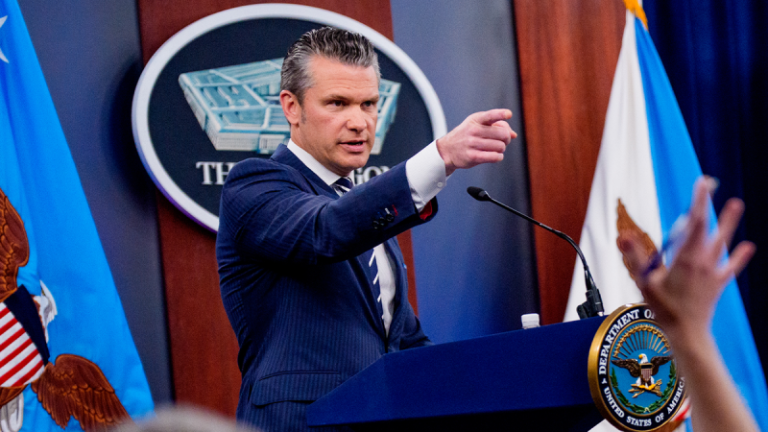
War Secretary Pete Hegseth said Wednesday that Iran’s decision to strike neighboring countries has backfired strategically, driving Gulf states that had hoped to stay out of the conflict ‘into the American orbit’ as the U.S. prepares to dramatically increase firepower over Tehran.

‘What Iran is doing by targeting allied countries that would otherwise want to stay out of this, they’ve actually pulled them into the American orbit,’ Hegseth said during a briefing at U.S. Central Command headquarters in Tampa, Florida.

He cited the United Arab Emirates, Qatar, Bahrain, Saudi Arabia and Kuwait as countries now offering expanded cooperation, arguing that Tehran’s retaliatory campaign has strengthened regional alignment with Washington rather than weakened it.

U.S. military officials say Iran has launched strikes against a growing number of countries in the region since the conflict began, with CENTCOM Commander Adm. Brad Cooper noting Tehran has targeted at least a dozen nations.

Rather than isolating the United States, Hegseth suggested Iran’s actions are consolidating support for the campaign.

‘The amount of firepower over Iran and over Tehran is about to surge dramatically,’ he said, pointing to additional base access and increased bomber operations.

Hegseth also addressed allied base access, including the United Kingdom’s initial hesitation to grant U.S. forces early access to strategic facilities. He said the issue has since been resolved and that British-controlled bases are now part of the expanding U.S. air campaign.

‘It was unfortunate that … the Brits didn’t, from day one say, ‘Hey, go ahead and have access,’’ he said. ‘But we got there, we got there. And that’s now part of the way that we’re operationalizing bomber runs. … The amount of firepower over Iran and over Tehran is about to surge dramatically, and part of it is that we’re going to have even more basing.’

Gulf and Arab governments have publicly condemned Iranian missile and drone strikes on their territories as violations of sovereignty and threats to regional security, while stopping short of criticizing U.S. military action.

Saudi Arabia, Qatar, Bahrain, Kuwait, the United Arab Emirates and Jordan issued a joint statement strongly condemning Iran’s ‘indiscriminate and reckless’ missile and drone attacks against sovereign territory in the region, reaffirming their right to self-defense.

Regional leaders have framed Iran’s actions as dangerous escalations rather than legitimate retaliation, underscoring a rare moment of unified public opposition among Gulf Cooperation Council members.

Beyond the Gulf, Azerbaijan has also protested what it says were Iranian drone strikes on its Nakhchivan exclave, which injured civilians and damaged the international airport. Baku summoned Tehran’s ambassador and said it reserved the right to take retaliatory measures in defense of its territory, even as Tehran denied responsibility for the incident.

Some regional analysts say Iran appears to have miscalculated by striking at U.S. assets in third-party nations.

‘It was absolutely inevitable that the Iranians would seek to lash out, to widen the conflict … but all they’ve really done is made everybody quite mad, and that was a really bad calculation on their part,’ said Danielle Pletka, a senior fellow at the American Enterprise Institute.

Peter Doran, a senior fellow at the Foundation for Defense of Democracies, noted the shift in regional alignment.

‘It would have been unbelievable just one year ago to see Saudi Arabia and the Gulf states lining up with the United States and Israel against the Islamic Republic,’ he said.

Hegseth dismissed suggestions that the war is spiraling outward, arguing that Iran’s actions are instead clarifying the battlefield and strengthening U.S. partnerships.

‘This idea that it’s expanding or going — no,’ he said. ‘It’s actually simplifying in a number of ways exactly what we need to achieve and how we’ll achieve it.’

Pentagon officials say U.S. bombers have struck nearly 200 targets in the past 72 hours, destroyed more than 30 Iranian naval vessels and significantly reduced missile and drone attacks since the opening days of the operation.

Officials maintain that the campaign’s objectives remain limited to degrading Iran’s ability to threaten Americans and its neighbors, even as the president has suggested he needs to have a say in who becomes Iran’s next leader.

‘I think the president’s having a heck of a say in who runs Iran, given the ongoing operation we have,’ Hegseth said.

Related Article

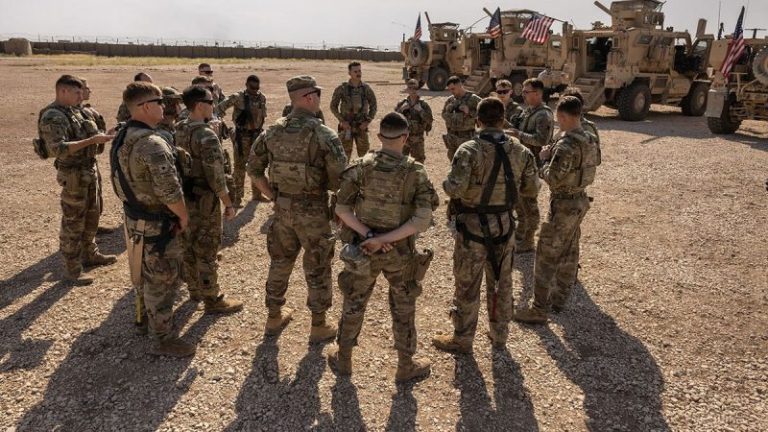
The future of war? US-Israel blitz on Iran unveils next-gen allied combat
This post appeared first on FOX NEWS

U.S. and partner forces killed or captured nearly 25 Islamic State operatives in Syria in the days following a large-scale U.S.-led strike on Dec. 19, according to a new statement from U.S. Central Command, underscoring Washington’s assessment that ISIS remains an active and persistent threat inside the country.

CENTCOM said those forces conducted 11 follow-on missions between Dec. 20 and Dec. 29, killing at least seven ISIS members, capturing the remainder and eliminating four ISIS weapons caches. The operations followed Operation Hawkeye Strike, when U.S. and Jordanian forces hit more than 70 ISIS targets across central Syria using over 100 precision munitions, destroying infrastructure and weapons sites linked to the group. 

‘We will not relent,’ CENTCOM Commander Adm. Brad Cooper said, adding that U.S. forces remain ‘steadfast’ in working with regional partners to dismantle ISIS networks that pose a threat to U.S. and regional security.

The scope of the follow-on raids highlights a reality U.S. commanders and analysts have been warning about for months: ISIS no longer controls large swaths of territory, but it retains the ability to organize, strike and regenerate inside Syria’s fragmented security landscape.

Syria remains divided among competing forces, militias and foreign-backed armed groups, with no single authority exercising full control over large parts of the country. Analysts say that vacuum continues to provide space for ISIS cells to operate quietly, recruit and exploit overstretched local forces.

Analysts note that Syria’s security environment remains shaped by former jihadist networks that were never fully demobilized after the war. The country’s transitional leadership, including President Ahmed al-Sharaa, emerged from armed Islamist factions that relied heavily on foreign fighters and militias, according to regional security assessments. While those groups are not synonymous with ISIS, experts say the incomplete dismantling of extremist networks has left gaps that ISIS cells continue to exploit.

‘ISIS today doesn’t need a caliphate to be dangerous,’ Bill Roggio told Fox News Digital. ‘We’ve always been quick to declare terrorist organizations defeated and insignificant, and that couldn’t be further from the truth.’

Roggio said the group has adapted rather than disappeared, shifting away from holding territory toward smaller, more covert cells capable of carrying out lethal attacks. He pointed to ongoing ISIS activity not only in Syria and Iraq, but also in Afghanistan and other regions, citing United Nations reporting that estimates roughly 2,000 ISIS fighters remain active in Afghanistan alone.

‘That’s not what a defeated group looks like,’ Roggio said, noting that ISIS continues to recruit, indoctrinate and inspire attacks even without the visibility it once had.

One of the most sensitive vulnerabilities remains the network of detention facilities in northeastern Syria holding thousands of ISIS terrorists and supporters. Those prisons are guarded primarily by Kurdish-led forces backed by a small U.S. military presence, estimated at roughly 1,000 troops, according to Reuters.

U.S. and coalition officials have repeatedly warned that any major disruption to prison security could allow hardened ISIS operatives to escape and reconstitute networks across Syria and beyond. Kurdish officials have also raised concerns about funding shortages, manpower strain and pressure from rival militias operating nearby.

While U.S. officials have not publicly linked the recent strikes to prison-related threats, analysts say the broader environment of fragmented control increases the risk of coordinated attacks, insider assistance or prison unrest.

The danger is not theoretical. ISIS has previously staged mass prison break operations in Syria and Iraq, including a 2022 assault on the al-Sinaa prison in Hasakah that required days of fighting to contain.

The U.S. strikes also come amid continued instability inside Syria, where multiple armed actors operate with overlapping authority. Analysts note that clashes among militias, sectarian violence and unresolved command structures have weakened overall security and diverted attention from counterterrorism efforts.

Bombings in neighborhoods of Damascus, including Mezzeh, and unrest in minority areas have further illustrated the gaps ISIS and other extremist groups can exploit, according to regional security assessments and open-source reporting.

‘Syria’s chaos is the accelerant,’ Roggio said. ‘ISIS thrives where no one is fully in charge.’

U.S. officials and analysts stress that ISIS activity in Syria is part of a wider pattern rather than an isolated flare-up.

Sources in the Israeli Mossad told Fox News Digital of continued ISIS-linked activity across multiple theaters, including recruitment networks and small-scale attacks designed to test security responses and maintain operational relevance.

In Turkey, security forces recently clashed with Islamic State militants during counterterrorism operations, wounding several officers, according to Reuters on Monday. Turkish authorities said the raids targeted ISIS cells suspected of planning attacks inside the country.

‘These are signals, not spikes,’ Roggio said. ‘ISIS operates across regions, adapting to pressure and exploiting weak governance wherever it finds it.’

The renewed U.S. military action raises difficult questions for policymakers about how long the current containment strategy can hold.

While U.S. officials say the Dec. 19 strikes delivered a significant blow to ISIS infrastructure, they have also acknowledged that counterterrorism operations alone cannot eliminate the underlying conditions that allow the group to persist.

‘Just because we want to declare the war against terror over doesn’t mean it’s over,’ Roggio said. ‘The enemy gets a vote.’

This post appeared first on FOX NEWS

Escalating claims by Russia that Ukraine tried to hit a residence used by President Vladimir Putin with drones have been dismissed by a top military drone expert, who called the alleged attack ‘hard to fathom’ and tactically implausible.

Cameron Chell’s comments came as Moscow doubled down on accusations Kyiv has flatly denied, with the drone industry leader arguing the alleged strike announced Monday runs counter to Ukraine’s drone tactics.

Chell, the CEO and co-founder of Draganfly, a drone manufacturer that supplies to the U.S. Department of Defense and allied militaries, including Ukraine, said Russia’s claims lack credibility.

‘What really makes things usually very signature about Ukraine is that they’re always incredibly clever about how they use drones,’ Chell told Fox News Digital.

‘They are clever from a cost perspective — let’s call it an efficiency perspective — but also very clever in their tactics,’ he added.

‘I find it hard to fathom that this drone attack even happened on Putin’s residence or that it was something that Ukraine orchestrated for a number of reasons,’ Chell said.

‘To get over the top of Putin’s residence, for one, the drones would not have been launched from a very long distance away,’ he added.

Chell’s comments came as Russia doubled down Tuesday on accusations that Ukraine attempted to strike a presidential palace in the Novgorod region using drones, allegedly to disrupt peace efforts.

Kyiv dismissed the allegation, with the timing also raising questions given the upbeat tone of a recent meeting between President Trump and Ukrainian President Volodymyr Zelenskyy in Florida.

Russian Foreign Minister Sergey Lavrov claimed late Monday that 91 drones were intercepted en route to Putin’s residence on the shores of Lake Valdai.

His statement appeared to contradict earlier Defense Ministry tallies, which said 89 drones were shot down over eight regions, including 18 over Novgorod, later adding another 23.

Only after Lavrov spoke did the ministry allege that 49 drones intercepted over Bryansk, nearly 300 miles away, were also targeting Valdai.

Asked about wreckage, Kremlin spokesman Dmitry Peskov said it was ‘a matter for our military,’ while calling Zelenskyy’s denial and Western skepticism ‘completely insane.’

Peskov said Russia’s diplomatic stance would be toughened, and Duma Speaker Vyacheslav Volodin vowed there could be ‘no forgiveness’ for Zelenskyy.

Chell said the story simply does not add up. ‘To attack Putin’s residence, you need long-range, very fast-moving drones,’ he said.

He added that for drones that small to reach such a site, they would have had to be launched from a much closer location, likely inside Russia itself.

‘They would have to be within about 10 kilometers [6.2 miles] — or maybe, at most, 30 kilometers — of Putin’s residence,’ Chell said.

‘That facility where Putin lives would also be incredibly secure, and so to have a number of lower-cost, slower-moving drones coming in on that facility would be very un-Ukrainian,’ Chell said.

‘Ukraine also doesn’t announce when they’re going to show up,’ he added.

Chell also noted that night operations would rule out GPS- or AI-based navigation due to jamming and visibility limits, making the launch of dozens of drones even less plausible.

‘Apparently the thing was at night, so that’s very difficult for machine vision or AI mapping software,’ he said. ‘So, you know, it definitely wasn’t using GPS, because it would have been jammed. There are just a bunch of things that don’t add up.’

Politically, Chell argued, Ukraine has nothing to gain. ‘They’re bold, but right in the middle of peace talks — when they need Trump on side — it makes no sense,’ he said. ‘Ukraine is just politically too smart to have done that.’

Zelenskyy on Monday also called the claim a complete fabrication, accusing Moscow of laying the groundwork for further attacks. 

Lavrov warned of retaliation but said Russia would continue talks with Washington.

Trump also said he learned of the alleged attack directly from Putin and was ‘very angry about it.’ Asked whether there was evidence, Trump replied, ‘We’ll find out.’

Fox News Digital has reached out to the Kremlin for comment.

This post appeared first on FOX NEWS

Two West African nations have issued a simultaneous ban on American citizens in a diplomatic tit-for-tat move, amidst heightened tensions with both the United States and Europe, and as Russia seeks to increase its economic and geopolitical influence in the region.

Mali and Burkina Faso made the move in response to the Trump administration’s Dec. 16 expansion of travel restrictions to more than 20 countries. The policy particularly affected the African continent, with Chad, Equatorial Guinea, Eritrea, Libya, Niger, Republic of the Congo, Sierra Leone, Somalia, South Sudan and Sudan also being subject to travel restrictions.

The Trump administration cited the persistence of armed attacks in both nations as part of the rationale for its decision:

‘According to the Department of State, terrorist organizations continue to plan and conduct terrorist activities throughout Burkina Faso. According to the Fiscal Year 2024, Department of Homeland Security (DHS) Entry/Exit Overstay Report (‘Overstay Report’), Burkina Faso had a B-1/B-2 visa overstay rate of 9.16 percent and a student (F), vocational (M), and exchange visitor (J) visa overstay rate of 22.95 percent. Additionally, Burkina Faso has historically refused to accept back its removable nationals.’

Regarding its decision to include Mali on the list, it stated:

‘According to the Department of State, armed conflict between the Malian government and armed groups is common throughout the country.  Terrorist organizations operate freely in certain areas of Mali.’

Burkina Faso and Mali are both currently ruled by military juntas that came to power amidst rising violence and instability, as both nations came under attack from Islamist terrorist groups.

Both nations have also seen a rise in anti-French sentiment, in conjunction with deepening relationships with Russia, which has pledged to offer assistance in fighting back the Islamist rebels battling the central governments for territorial control.

‘In accordance with the principle of reciprocity, the Ministry of Foreign Affairs and International Cooperation informs the national and international community that, with immediate effect, the Government of the Republic of Mali will apply the same conditions and requirements to US nationals as those imposed on Malian citizens,’ the Malian Ministry of Foreign Affairs stated.

Burkina Faso’s government cited a similar rationale for issuing its ban on American travelers.

Both nations, as well as neighboring Niger and Nigeria, have seen skyrocketing violence in recent years, as chronically underfunded governments struggle to retain control of rural, sparsely-populated desert regions.

The Associated Press contributed to this report.

This post appeared first on FOX NEWS

This year brought us Trump the Sequel and that meant the left had extra motivation to be annoying. Their hatred of President Donald Trump, conservatives and even the late Charlie Kirk defined 2025.

Still, there were some who outdid everyone else in their quest to be, drumroll, please, the Most Annoying Person of 2025. I ignored people who made news saying just one idiotic comment or who are just obscure media personalities. (Like Matthew Dowd who lost his bogus MSNBC job for his comments bashing Turning Point USA founder Charlie Kirk for ‘hate speech’ after Kirk had been murdered.)

1. He was funny 20 years ago

No one deserves the top spot on this list more than ‘Jimmy Kimmel Live!’ host Jimmy Kimmel. Most late-night programs have faded from view as their hosts have turned them into orgies of Trump-bashing. But Kimmel excels at hating conservatives so much that he almost qualifies to be a male cast member of ‘The View.’ (Yep, they’re here, too.)

Kimmel gained more attention for saying vile things and fighting Trump than for anything funny.

Former ‘Late Show’ host David Letterman termed Kimmel, ‘the leader of the resistance,’ and Kimmel later cried millionaire tears because he had a ‘hard year.’ He earned a temporary suspension with one of the worst comments about the Kirk assassination, saying, ‘We hit some new lows over the weekend, with the MAGA gang desperately trying to characterize this kid who murdered Charlie Kirk as anything other than one of them and everything they can to score political points from it.’ He was wrong, of course, but we are used to that. Trump later said, ‘Jimmy Kimmel was horrible,’ and who am I to disagree with my president?

2. You knew they’d make the list

If the annoying people of Earth have a home base, it’s not some secluded island fortress, it’s ABC’s ‘The View.’ The gaggle of hosts — from leftist moderator Whoopi Goldberg to crackpot Joy Behar to pretend conservative Alyssa Farah Griffin — is a reminder that quantity is not quality. 

This year, they pretended radical Islamic Iran wasn’t worse than the U.S. (Goldberg); claimed using the National Guard to stop crime was ‘a pretext to stop the next election!’ (Behar); and compared the election of Trump to … Hitler. (Behar: ‘The Germans voted also. Just saying.’)

The show has become such an embarrassment that the TV show ‘Landman’ mocked it for being a, ‘bunch of pissed off millionaires bitching about how much they hate millionaires, Trump, and men, and you, and me, and everybody else they got a bee up their ass about.’ ‘The View’ has gone from mindless propaganda to a punchline.

3. The first of the pod people

If you’re lucky, you’ve never heard of podcaster Jennifer Welch. Just imagine a ghoul-like figure from your deepest nightmares, then give her blonde hair and a microphone.

She’s one of the two co-hosts for the ‘I’ve Had It’ podcast, and it’s well-named. She and her co-host first appeared in the Bravo series ‘Sweet Home Oklahoma,’ which no one ever heard of. But now, the press loves her because she says hateful things about conservatives. 

CNN’s profile of Welch quotes her calling Trump a, ‘fat, fascist f— who’s ruining everything for everybody.’ The New York Times notes, ‘‘Patriots, gaytriots, theytriots, Blacktriots and browntriots,’ is how Ms. Welch greets the listeners of their primary podcast.’ She left out morontriots who must make up the bulk of her audience.

Welch made news calling Kirk’s widow Erika a ‘grifter’ and TPUSA said that comment was, ‘beneath contempt.’ 

I’m sure Welch will say worse in 2026 because the media reward her bile with support. CNN said she and her co-host are, ‘two women who love their country and aren’t afraid to name and shame people.’ 

See what I mean?

4. More pod-ish people 

Podcaster antisemite Nick Fuentes and Twitch antisemite Hasan Piker showed the world that the worst users of social media have one thing in common — hatred. Both of them have dominated the social world and been everywhere in the media as civilized society reacts in horror. 

Fuentes calls himself an admirer of communist Soviet dictator Joseph Stalin and says Nazi dictator Adolph Hitler was ‘really f—ing cool.’ Pretty much on brand.

Piker, when he’s not being accused of giving his dog electric shocks, spends his time saying offensive things, like, ‘America deserved 9/11.’ He later walked it back because of the backlash, but he still has millions of followers on multiple platforms. 

Fox News did an analysis of what he says, and it’s so vile, I don’t want to repeat it. He’s all across major media. The Times called him, ‘A Progressive Mind in a Body Made for the ‘Manosphere.’’ 

The press is desperate to recreate their own Joe Rogan and this is the best they’ve got.

5. Spacey

Singer Katy Perry had not one, but two spacey experiences in 2025. First, she sort-of went into space on a Jeff Bezos rocket. The owner of Amazon and the Washington Post sent his then-fiancée Lauren Sanchez, and five other famous women, into near-space. 

Perry is in the cool kids’ club, so she got to go. The singer actually vowed to ‘put the ‘a–’ in astronaut’ and made a fool of herself when she landed, kneeling and kissing the ground because of an 11-minute rocket trip. She was quoted declaring, ‘I feel super connected to love.’ 

That must have been true. She is now dating her own space cadet, former lefty Canadian Prime Minister Justin Trudeau.

6. Friday the 13th

Cynthia Erivo is 2025’s it gal. She’s everywhere and impossible not to see. As NBC put it, she’s ‘Proudly Bald and Has No Eyebrows.’ Throw in nails like Freddy Krueger and the bisexual star is everything the media want in a celebrity — weird and alternative. 

She’s the star of the two ‘Wicked’ movies and even played Jesus in the Hollywood Bowl (naturally) version of the musical ‘Jesus Christ Superstar.’ 

Erivo revels in her unusual look, even shaving her own eyebrows, ‘Whenever I’m talking to my makeup artist, I tell her that I just want to look like a pretty thumb.’ 

Yeah, I can’t top that.

7. It ain’t over till it’s over

The 2024 Democratic election debate wasn’t enough for Vice President Kamala Harris. Harris recently declared, ‘I am not done. I have lived my entire career a life of service, and it’s in my bones.’ Harris released her book, ‘107 Days’ and managed to annoy Democrats and Republicans about equally with her alleged recollection of events. 

At least former President Richard Nixon was nice enough to tell us, ‘You won’t have Nixon to kick around anymore.’ 

Harris will make us endure more garbled responses before she goes gently into that good night of her career.

This post appeared first on FOX NEWS

Lawmakers fought over Obamacare subsidies tooth and nail for the latter part of the year, and ultimately, neither side won.

Senate Democrats thrust the government into the longest shutdown in history in an effort to refocus the narrative in Congress on healthcare, and Republicans agreed to talk about it in the open. And both Republicans and Democrats got a shot to advance their own, partisan plans. Both failed.

Now, the subsidies are set to expire on Wednesday, sending price hikes across the desks of tens of millions of Americans that relied on the credits. 

When lawmakers return on the first week of January, healthcare will be front of mind for many in the Senate. But any push to either revive, or completely replace, the subsidies may, for a time, take a backseat to the government funding fight brewing ahead of the Jan. 30 deadline.

When asked if he was disappointed that lawmakers were unable to, at least in the short term, solve the subsidies issue, Sen. Josh Hawley, R-Mo., was more concerned about people that would experience higher costs. 

‘I think who it’s most disappointing for are the people whose premiums are going to go up by two, three times,’ Hawley said. ‘So, it’s not good.’

Price hikes on premium costs will be variable for the roughly 20 million Americans that rely on them, depending on age, income and other factors. Broadly, a person’s out-of-pocket cost is expected to double with the credit’s lapse, according to the Kaiser Family Foundation.

The nonpartisan healthcare think tank painted a broader picture of the disparate impact on premium cost increases in a report released late last month that, based on myriad factors, including where a person lives, their age range and where they sit above the poverty line, some could see price hikes as high as 361%.

While Senate Republicans’ and Democrats’ separate plans failed to advance — despite four Republicans crossing the aisle to support Senate Minority Leader Chuck Schumer’s, D-N.Y., plan — lawmakers are working together for a solution.

There are two plans with traction in the House. The GOP’s plan advanced on the floor earlier this month but doesn’t address the issue of the expiring tax credits. Then there is a bipartisan plan that calls for a three-year extension of the subsidies, similar to Senate Democrats’ plan, that is teed up for a vote.

The latter option, and its bipartisan momentum, has some Democrats hopeful that a three-year extension could get a shot in the upper chamber.

‘I’ll also say that the glimmer of hope is if we’re searching for a bipartisan deal that can pass the Congress, we don’t need to search any further than the three-year extension of the subsidies that’s going to pass the House of Representatives,’ Sen. Brian Schatz, D-Hawaii, told Fox News Digital. ‘We don’t need a negotiation any further. That bill can pass, if it can provide relief to the taxpayers, and it can pass, then that’s our vehicle.’

Senate Majority Leader John Thune, R-S.D., however, has maintained a deeply-rooted position against just a simple extension of the credits.

He argued that a straight-up extension for three years would be ‘a waste of $83 billion,’ and lacks any of the reforms that Republicans desire, like reinstalling an income cap, adding anti-fraud measures, and reaffirming language that would prevent taxpayer dollars from funding abortions.

‘I mean, I think if nothing else, depending on if the House sends something over here, there would be a new vehicle available,’ Thune said. ‘And if there is some bipartisan agreement on a plan, then you know, it’s possible that we could — obviously it’d have to be something that we think the House could pass, and the president would sign.’

‘But I’m not ruling anything out, I guess is what I’m saying,’ he continued. ‘But you know, a three-year extension of a failed program that’s rife with fraud, waste and abuse is not happening.’

Senate Democrats are open to negotiating on a bipartisan plan, something that is already ongoing after Sens. Susan Collins, R-Maine, and Bernie Moreno, R-Ohio, held a meeting with lawmakers before leaving Washington, D.C., earlier this month.

But Democrats are also making clear that they don’t want to budge on some of the Republicans’ demands.

‘Let’s put it this way, Republicans are asking to meet with me, and I’m telling them, I’ll listen, you know, I made it clear what I think is the only practical approach, and I’m certainly not going to go along with selling junk insurance,’ Sen. Ron Wyden, D-Ore., said.

This post appeared first on FOX NEWS

The House Oversight Committee is hearing from a billionaire on Wednesday who was named one of Jeffrey Epstein’s co-conspirators by a 2019 FBI document.

Les Wexner is the latest person to be deposed in the House’s investigation into the federal government’s handling of Epstein’s case. 

Unlike most previous depositions, however, committee staff and potentially some lawmakers are traveling to Ohio on Wednesday morning to depose Wexner in his home state.

A spokesperson for Wexner declined to comment on the deposition and on whether he would invoke his Fifth Amendment right to avoid answering questions.

But if he cooperates with the committee’s questioning, Wexner’s insight is likely to be key to unlocking information on just how Epstein obtained his vast wealth before dying by suicide in a Manhattan jail in 2019.

The 88-year-old businessman is the founder of L Brands, formerly called The Limited, through which he acquired well-known companies Victoria’s Secret, Bath & Body Works, Express, and Abercrombie & Fitch, among others.

He was also one of Epstein’s first major clients as a financial advisor, with Epstein being granted power of attorney over Wexner’s vast wealth.

Wexner also sold his Manhattan townhouse to Epstein, which was later discovered to be one of the locations where federal authorities accused Epstein of abusing young women and girls under 18.

But Wexner has never been criminally accused nor charged in relation to the late pedophile’s crimes.

A letter from Wexner to his Wexner Foundation charity dated Aug. 7, 2019, said he ended his relationship with Epstein sometime after the first federal investigation into his crimes emerged nearly 20 years ago.

Wexner also accused Epstein of misusing his vast wealth.

‘As the allegations against Mr. Epstein in Florida were emerging, he vehemently denied them. But by early fall 2007, it was agreed that he should step back from the management of our personal finances. In that process, we discovered that he had misappropriated vast sums of money from me and my family,’ read the letter, obtained by Fox News Digital on Tuesday.

‘This was, frankly, a tremendous shock, even though it clearly pales in comparison to the unthinkable allegations against him now. With his credibility and our trust in him destroyed, we immediately severed ties with him. We were able to recover some of the funds.’

Wexner is the fourth person appearing before the House Oversight Committee in its Epstein probe.

House Oversight Committee Chairman James Comer, R-Ky., previously oversaw the panel through the depositions of former Trump administration Attorney General Bill Barr, ex-Trump Labor Secretary Alex Acosta, who was the U.S. attorney in Florida who signed off on Epstein’s infamous 2008 non-prosecution agreement, and convicted Epstein accomplice Ghislaine Maxwell.

Maxwell’s deposition lasted less than an hour after she invoked the Fifth Amendment, refusing to answer questions unless she was granted clemency by President Donald Trump.

This post appeared first on FOX NEWS

When Benny Sabti was a child growing up in Iran, he remembers receiving an unusual prize at school. ‘For being an excellent student, I received a Persian translation of Mein Kampf by Adolf Hitler,’ Sabti told Fox News Digital. ‘They translated Hitler’s book into Persian and distributed it to students.’

The experience stayed with him. Looking back, Sabti, now an Iran expert at the Institute for National Security Studies (INSS) in Israel, says it reflected a broader effort by Iran’s ruling clerical establishment to shape how young Iranians viewed politics, religion and the world around them.

Schools, mosques, workplaces and media all became part of an ideological ecosystem designed to reinforce loyalty to the regime. But critics of Iran’s leadership say religion itself was often not the ultimate goal.

‘Faith for them is their tool,’ Banafsheh Zand, an Iranian-American journalist and editor of the Iran So Far Away Substack, told Fox News Digital. ‘It’s not the end all to be all. It’s a tool that they can hide behind so that they can carry out all their criminalities.’

Religion and power

The Islamic Republic was founded on the doctrine of velayat-e faqih, or ‘guardianship of the Islamic jurist,’ which places ultimate political and religious authority in the hands of the country’s supreme leader.

But Zand argues that in practice the system functions less as a purely religious project and more as a mechanism of political control. ‘It’s more like a mafia,’ she said. ‘They use faith in order to keep people down.’

According to Zand, ideology is reinforced through a mix of financial incentives and intimidation. ‘They tried by incentive and money and buying people,’ she said.

Programs tied to the Basij, a militia affiliated with the Islamic Revolutionary Guard Corps (IRGC), have often provided benefits such as jobs, housing and education to families aligned with the regime.

‘If you are poor and you join the Basij, they give you benefits,’ Zand said. ‘But you have to go along with whatever it is that they offer you.’

Ideology embedded in daily life

Sabti says the Islamic Republic built a vast network designed to reinforce ideology in everyday life. ‘In banks, offices, public spaces and even in the bazaars, regime representatives walk between shops telling people it is time to pray and checking who is not attending,’ Sabti said.

Mosques themselves are closely integrated into the political system. Friday prayer leaders often deliver sermons aligned with government messaging.

‘There are 16 propaganda bodies in Iran,’ Sabti said, describing a network of state institutions responsible for spreading the regime’s interpretation of Islam and the ideals of the Islamic Revolution.

Some institutions also focus on exporting that ideology abroad. ‘There is a university dedicated to converting Sunnis to Shiism,’ he said. ‘They bring people from Africa and South America to Iran, convert them to Shiism and send them back to export the Shiite Islamic revolution.’

Indoctrination in schools

Schools play a central role in the regime’s ideological system.

‘Schools are heavily indoctrinated,’ Sabti said. ‘In civil studies books, Islam was promoted as superior to all other ideologies.’

Religious messaging appears across the curriculum. ‘You cannot separate any school subject from Islam,’ Sabti said. ‘Not history, not geography. Everything is mixed with ideology. The only thing missing was adding it to mathematics.’

For Sabti, the Mein Kampf episode symbolized the ideological environment students were exposed to. The message, he said, reinforced hostility toward perceived enemies and embedded a political worldview from an early age.

Ideology and hypocrisy

Sabti says the credibility of the system is also undermined by the behavior of Iran’s own elites. ‘You can see it in the second generation,’ he said. ‘Their children live abroad while the elites live in palaces in Iran and in other countries. It is hypocrisy.’

Zand says ideology has always been reinforced by intimidation. ‘They make examples out of people in the most vicious possible way,’ she said. ‘It’s fear and manipulation.’

According to Zand, that atmosphere of fear shapes daily life for many Iranians. ‘Everybody is afraid of the police,’ she said. ‘Everybody is afraid of their neighbors.’

An ideology losing its grip

Despite the regime’s extensive ideological machinery, Sabti believes many Iranians never fully accepted the worldview the government tried to impose.

‘Over the years, the indoctrination has stopped working,’ he said. ‘Most of the public does not truly believe it.’

Still, the Islamic Republic remains in power. ‘The regime maintains control through money, weapons and propaganda,’ Sabti said.

Zand agrees the system never fully reshaped Iranian society. Many people, she said, complied outwardly simply to avoid punishment.

‘They won’t have a problem to transfer as long as they realize that the new Iran has no room for the violence and the horrifying characteristics of the Islamist regime,’ Zand told Fox News Digital.

She said that beneath the surface, Iran’s cultural identity remained intact even after decades of pressure from the state.

Related Article

Trump says Iran’s succession bench wiped out as Israeli strike hits leadership deliberations
This post appeared first on FOX NEWS

The dispute over occupied territories in Ukraine continues to be a sticking point amid negotiations between Kyiv and Moscow as President Donald Trump seeks to help bring an end to the war between the neighboring countries. 

Ukrainian President Volodymyr Zelenskyy told Fox News’ Bret Baier that a peace deal with Moscow could be close following his Sunday meeting with Trump at Mar-a-Lago.

‘Even with one question today, we’ve been very close,’ Zelenskyy told Baier on ‘Special Report.’ ‘I think we have a problem with one question: It’s about territories.’

Key issues about territory remain unresolved in talks that have taken place over months. Russian Foreign Minister Sergei Lavrov recently said that the West must acknowledge the fact that Russia holds the advantage on the battlefield.

Zelenskyy has been reluctant to cede territory held by Russian forces since the war began in 2022 over to Moscow. 

Zelenskyy has suggested that Ukraine might be open to withdrawing from the Ukrainian provinces of Donetsk, Luhansk, Kherson and Zaporizhzhia, which Russia wants to annex, only if Ukrainian voters give their approval in a referendum. 

‘I think the compromise, if we do a free economic zone that we have, and we have to move some kilometers back. It means that Russia has to make minor steps some kilometers back,’ Zelenskyy said. ‘This free economic zone will have specific rules. Something like this referendum is the way how to accept it or not accept it.’

Putin doesn’t want peace, Zelenskyy said, despite the mounting death toll for Russian forces. 

‘I don’t trust Putin. He doesn’t want success for Ukraine,’ Zelenskyy said. ‘I believe he can say such words to President Trump… but it’s not true really.’

Following his meeting with Trump, Zelenskyy said they were 90% agreed on a draft 20-point plan, despite Moscow showing no signs of budging on its territorial demands. 

The meeting came after Trump spoke with Putin over the phone where they both agreed that a deal must be reached to end Europe’s longest war in 80 years. 

It also came a day after Russia attacked the Ukrainian capital of Kyiv a day earlier. Moscow also claimed that Putin’s home in the Novgorod region was the target of a Ukrainian drone attack overnight, which Ukraine denies. 

This post appeared first on FOX NEWS

Outgoing Republican Rep. Marjorie Taylor Greene indicated to the New York Times Magazine that President Donald Trump, lacks ‘faith’ and does not reciprocate loyalty. 

She also said that she disapproves of ‘MAGA Mar-a-Lago sexualization,’ and indicated that she expects the U.S. to engage in ‘more war’ as the president seeks to maintain his grip on power.

Greene, a once ardent Trump supporter who had a dramatic falling out with the GOP juggernaut this year, is dishing out scathing criticism of the president she once lauded.

Here are some takeaways from her comments reported by the New York Times Magazine:

Greene says Trump ‘does not have any faith’

Earlier this year, during remarks at the memorial service for slain conservative activist Charlie Kirk, Trump said of Kirk, ‘He did not hate his opponents. He wanted the best for them. That’s where I disagreed with Charlie. I hate my opponent. And I don’t want the best for them.’

By contrast, Kirk’s widow, Erika Kirk announced that she forgave the suspected killer.

 ‘It just shows where his heart is. And that’s the difference, with her having a sincere Christian faith, and proves that he does not have any faith,’ Greene opined, according to the Times.

Greene on ‘MAGA Mar-a-Lago sexualization’

Greene objected to what she referred to as ‘sexualization’ among MAGA women.

‘I never liked the MAGA Mar-a-Lago sexualization. I believe how women in leadership present themselves sends a message to younger women,’ she noted, according to the Times. 

‘I have two daughters, and I’ve always been uncomfortable with how those women puff up their lips and enlarge their breasts. I’ve never spoken about it publicly, but I’ve been planning to,’ she noted.

Greene says Trump lacks loyalty

The New York Times Magazine reported that Greene said regarding loyalty and Trump, that it is ‘a one-way street — and it ends like that whenever it suits him.’

Last month, after President Donald Trump issued posts lambasting Greene on Truth Social, the congresswoman announced that she would resign from office, noting that her last day would be January 5.

Greene suggests ‘more war’ on the horizon

Greene suggested that the U.S. is headed for ‘more war.’

‘In my opinion,’ Greene opined, according to the outlet, ‘we’re going to see more war. Because what do you do when you really lose power, when you become a lame duck? How do you cling to power? You go to war.’

Greene indicates House Speaker Mike Johnson is following orders from the White House

Greene suggested that House Speaker Mike Johnson is just taking orders from the White House.

‘I want you to know that Johnson is not our speaker,’ Greene asserted, according to the Times. ‘He is not our leader. And in the legislative branch — a totally separate body of government — he is literally 100 percent under direct orders from the White House. And many, many Republicans are so furious about that, but they’re cowards.’

White House responds

The White House pushed back against Greene’s comments about Johnson, asserting to Fox News Digital, ‘We have a very collaborative relationship with Speaker Johnson just like we do with Leader Thune, which is why we’ve had so much success this year.’

White House spokesperson Davis Ingle accused Greene of ‘petty bitterness.’

‘President Trump remains the undisputed leader of the greatest and fastest growing political movement in American history — the MAGA movement. On the other hand, Congresswoman Greene is quitting on her constituents in the middle of her term and abandoning the consequential fight we’re in — we don’t have time for her petty bitterness,’ Ingle noted in a statement. 

This post appeared first on FOX NEWS